
Startup Sahayak: How Your Idea Becomes a Roadmap in 120 Seconds

Mar 28, 2026
Private Limited Company vs. Limited Liability Partnerships

Despite the abundance of startup resources available today, early-stage founders often find themselves stuck at the same point—trying to figure out where to begin and how to move forward.

There’s no shortage of advice. Founders can access playbooks, case studies, videos, and expert opinions with ease. But most of this information is fragmented and not tailored to individual contexts. What works for one founder may not apply to another, especially when factors like industry, geography, and stage vary significantly.

As a result, many promising ideas lose momentum before they even get started—not because they lack potential, but because the path forward isn’t clear.

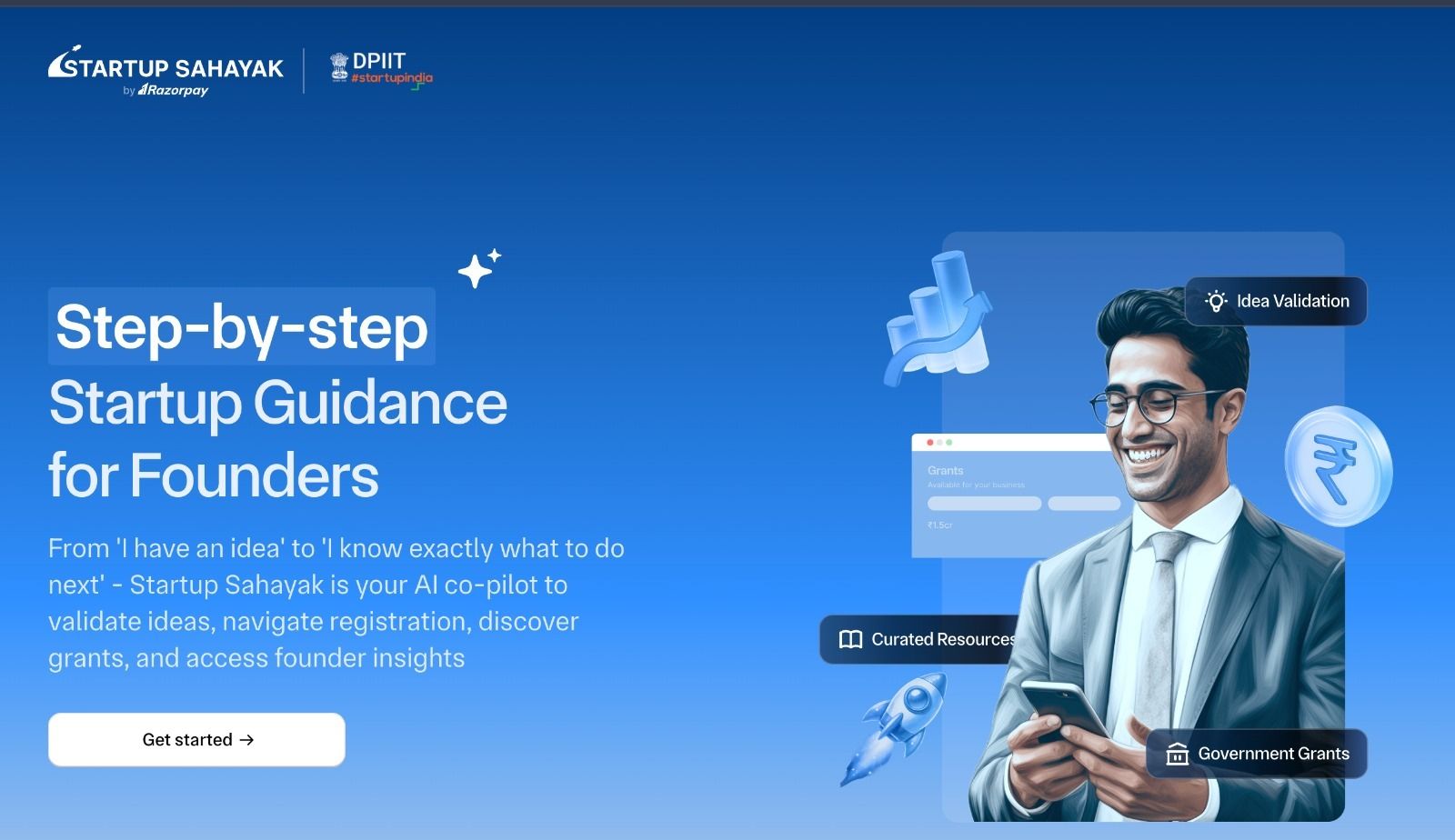
Startup Sahayak , powered by DPIIT, Razorpay & Startup Sahayak, addresses this by translating ideas into structured, personalized plans, making it easier to take the first step.

Table of Contents

What Is Startup Sahayak?

Startup Sahayak is an AI-powered platform that takes a founder’s idea and generates a structured, personalized roadmap in approximately 120 seconds.

Instead of navigating multiple sources and piecing together information, founders receive a consolidated view tailored to their idea, industry, and stage. The platform brings together insights that are typically scattered across different platforms and presents them in a clear, actionable format.

The output typically covers:

  • Market understanding, including size and demand
  • Competitive landscape and existing players
  • Potential gaps and opportunities
  • Compliance and company registration guidance
  • Relevant government schemes and grants
  • Early-stage execution direction

Who It’s Built For?

Startup Sahayak is primarily designed for individuals at the earliest stages of their startup journey.

This includes:

  • First-time founders
  • Students exploring startup ideas
  • Professionals building side projects
  • Individuals in Tier 2 and Tier 3 cities
  • Anyone without access to strong startup networks or mentorship

How It Works?

The user experience is intentionally simple, but the system behind it is layered and structured.

After answering a few key questions about their idea and goals, multiple processes are triggered simultaneously in the background. Each of these focuses on a specific aspect of the startup journey.

  • One layer analyses the idea by scanning 150+ sources to understand market size, competition, and demand
  • Another layer focuses on government support, mapping relevant schemes from platforms like Startup India and DPI
  • A separate stream brings in insights from founder journeys and common challenges
  • Another component provides guidance on compliance and company registration

These systems operate in parallel, enabling the platform to deliver a comprehensive and actionable roadmap quickly, without compromising on depth.

Key Features of Startup Sahayak

1. Personalised Startup Roadmaps

At the core of Startup Sahayak is its ability to generate a custom roadmap based on your idea, industry, and stage.

  • Tailored guidance specific to your context
  • Step-by-step direction on what to do next
  • Covers validation, go-to-market, and early execution

2. Market & Competitor Analysis

The platform evaluates your idea against real-world data to provide meaningful insights.

  • Scans 150+ sources to assess demand and trends
  • Identifies existing competitors
  • Highlights gaps and potential opportunities

3. Government Schemes & Grants Mapping

One of the platform’s strongest differentiators is its focus on accessibility to support systems.

  • Maps relevant government programs and grants to your idea
  • Uses verified sources such as DPIIT and Startup India
  • Helps founders identify eligibility and opportunities they might otherwise miss

4. Compliance & Company Registration Guidance

Startup Sahayak goes beyond ideation to help founders formalise their business.

  • Guidance on company incorporation
  • Awareness around DPIIT registration
  • Overview of compliance requirements

5. Founder Insights & Real-World Learnings

The platform incorporates insights from existing founders to add practical context.

  • Common challenges in similar business models
  • Learnings from real startup journeys
  • Practical considerations beyond theoretical advice

Conclusion

Building a startup will always involve uncertainty. There will be moments of doubt, conflicting advice, and decisions that don’t have clear answers. But figuring out where to begin or what to do next, shouldn’t be the biggest challenge.

Startup Sahayak helps bridge that gap. By bringing together research, insights, and structured guidance into a single output, it enables founders to move forward with clarity and confidence. It doesn’t aim to replace experience or mentorship. Instead, it provides a strong starting point, especially for those who may not have access to either.

Because in the end, building isn’t about having everything figured out from day one. It’s about having enough direction to take the first step—and the confidence to keep going. And when you don’t know what to do next, Startup Sahayak can be the place you start.

Check out Startup Sahayak and get your personalised roadmap in minutes. Start building.
Startup Sahayak Overview
rize image

Register your Business at just 1,499 + Govt. Fee

Register your business
rize image

Register your Private Limited Company in just 1,499 + Govt. Fee

Register your business
rize image

Register your One Person Company in just 1,499 + Govt. Fee

Register your business
rize image

Register your Business starting at just 1,499 + Govt. Fee

Register your business
rize image

Register your Limited Liability Partnership in just 1,499 + Govt. Fee

Register your business

Private Limited Company
(Pvt. Ltd.)

1,499 + Govt. Fee
BEST SUITED FOR
  • Service-based businesses
  • Businesses looking to issue shares
  • Businesses seeking investment through equity-based funding


Limited Liability Partnership
(LLP)

1,499 + Govt. Fee
BEST SUITED FOR
  • Professional services 
  • Firms seeking any capital contribution from Partners
  • Firms sharing resources with limited liability 

One Person Company
(OPC)

1,499 + Govt. Fee
BEST SUITED FOR
  • Freelancers, Small-scale businesses
  • Businesses looking for minimal compliance
  • Businesses looking for single-ownership

Private Limited Company
(Pvt. Ltd.)

1,499 + Govt. Fee
BEST SUITED FOR
  • Service-based businesses
  • Businesses looking to issue shares
  • Businesses seeking investment through equity-based funding


One Person Company
(OPC)

1,499 + Govt. Fee
BEST SUITED FOR
  • Freelancers, Small-scale businesses
  • Businesses looking for minimal compliance
  • Businesses looking for single-ownership

Private Limited Company
(Pvt. Ltd.)

1,499 + Govt. Fee
BEST SUITED FOR
  • Service-based businesses
  • Businesses looking to issue shares
  • Businesses seeking investment through equity-based funding


Limited Liability Partnership
(LLP)

1,499 + Govt. Fee
BEST SUITED FOR
  • Professional services 
  • Firms seeking any capital contribution from Partners
  • Firms sharing resources with limited liability 

Frequently Asked Questions

Related Posts

Startup India Scheme: Eligibility Criteria, Benefits & Application Details

Startup India Scheme: Eligibility Criteria, Benefits & Application Details

The Startup India Scheme is a flagship initiative by the Government of India aimed at fostering entrepreneurship, innovation, and economic growth. Launched in 2016, this scheme provides startups with financial assistance, tax exemptions, and regulatory benefits to help them scale efficiently. This blog explores the eligibility criteria, benefits, and application process to guide aspiring entrepreneurs on leveraging this initiative for their business growth.

Table of Contents

Definition of "Startup"

As per the Startup India Scheme, a "Startup" is defined by the following criteria:

  • The entity should be incorporated as a Private Limited Company, a Limited Liability Partnership (LLP), or a Registered Partnership Firm.
  • The age of the company should not exceed 10 years from the date of incorporation.
  • The annual turnover should not exceed INR 100 crore in any of the financial years since incorporation.
  • The business should be working towards innovation, improvement of products/processes/services, or scalable business models with high potential for employment generation and wealth creation.
  • Startups should be recognised by the Department for Promotion of Industry and Internal Trade (DPIIT) to avail of scheme benefits.

What Is the Startup India Scheme?

The Startup India Scheme was launched in 2016 with the objective of encouraging entrepreneurship, generating employment, and fostering innovation. This initiative is managed by the Department for Promotion of Industry and Internal Trade (DPIIT) and aims to position India as a global startup hub by offering regulatory support, funding access, and tax exemptions.

Why Was Startup India Launched?

India has always been home to entrepreneurs, but before 2016, starting and scaling a business came with significant roadblocks- complex regulations, limited funding options, and restricted market access. Recognising this, the Government of India launched the Startup India initiative on January 16, 2016, to create a more supportive ecosystem for startups.

Here’s why the initiative was needed and how it helps:

  • Reducing Bureaucratic Hurdles
  • Easing Financial Constraints
  • Encouraging Job Creation & Innovation
  • Enabling Market Access & Growth
  • Creating a Culture of Entrepreneurship

Since its launch, over 100,000 startups have been recognised under the scheme, creating jobs, driving innovation, and strengthening India’s position as a global startup hub.

Top Features Of the Startup India Scheme

The Startup India Scheme offers multiple benefits to startups, including:

  • Tax Exemptions: Startups are eligible for a three-year income tax exemption.
  • Funding Support: Access to government funds and venture capital assistance.
  • Simplified Compliance: Reduced regulatory burden with self-certification for labour and environmental laws.
  • Fast-Tracked Patent Registration: Reduced fees and faster processing for patent applications.
  • Networking Opportunities: Participation in government-organised startup festivals and events.
  • Access to Government Tenders: Startups receive preference in public procurement without prior experience requirements.

Eligibility Criteria for the Startup India Scheme

To be eligible, startups must meet specific criteria set by the Department for Promotion of Industry and Internal Trade (DPIIT).

Here’s a detailed breakdown of the eligibility requirements:

  • Be incorporated as a Private Limited Company, LLP, or a Registered Partnership Firm.
  • Be less than 10 years old from the date of incorporation.
  • Have an annual turnover not exceeding INR 100 crore.
  • Focus on innovation, scalability, and employment generation.
  • Obtain DPIIT recognition for startup status.

Types of Organisations Eligible For the Startup India Scheme

The following entities qualify for the scheme:

  • Private Limited Companies: Must be registered under the Companies Act, 2013.
  • Limited Liability Partnerships (LLPs): Must be registered under the LLP Act, 2008.
  • Registered Partnership Firms: Must be incorporated under the Indian Partnership Act, 1932.

How to Register Your Startup with the Startup India Scheme

Step 1: Incorporate Your Business

Before applying for Startup India recognition, you must officially register your business as a legal entity. Your startup can be incorporated as one of the following:

  • Private Limited Company – Register under the Companies Act, 2013 with the Ministry of Corporate Affairs (MCA).
  • Limited Liability Partnership (LLP) – Register under the Limited Liability Partnership Act, 2008 with the MCA.
  • Partnership Firm – Register under the Indian Partnership Act, 1932 with the respective state authority.

Step 2: Register Under the Startup India Scheme

Once your business is incorporated, you can apply for recognition under the Startup India initiative by following these steps:

  • Visit the Startup India portal www.startupindia.gov.in
  • Click on "Register" and create an account.
  • Log in and navigate to “Recognition” → “Apply for DPIIT Recognition”.
  • Fill in the application form with details about your business.

Step 3: Apply for DPIIT Recognition

To get official recognition as a startup, you must apply for DPIIT (Department for Promotion of Industry and Internal Trade) recognition. DPIIT-recognised startups gain access to tax benefits, easier compliance, and funding opportunities.

Steps to Apply for DPIIT Recognition:

  • Provide business details (name, incorporation date, industry sector, location).
  • Describe your startup’s innovation, scalability, and market potential.
  • Upload supporting documents (explained in Step 5).
  • Submit the application for review.

Step 4: Recognition Application Submission

Once all details are filled in, submit the Startup India recognition application.

The DPIIT reviews applications to ensure the business meets eligibility criteria (e.g., age of the startup, turnover, and innovation focus). If all documents are in order, recognition is granted within 2-3 weeks.

Step 5: Documents Required for Registration

You must upload specific documents during the registration process. Ensure you have:

Mandatory Documents:

  • Certificate of Incorporation / Registration – Proof that your business is legally registered.
  • Detailed Business Description – A document explaining how your startup is innovative and scalable.
  • PAN (Permanent Account Number) – A copy of your business’s PAN card for tax purposes.

Additional Documents (If Applicable):

  • Patent or Trademark Details – If your startup has intellectual property rights, submit supporting documents.
  • Letter of Recommendation (Optional) – From an incubator, industry expert, or recognised institution supporting your innovation.

Step 6: Get Your Recognition Number

Once your application is approved, you will receive a Startup Recognition Number from DPIIT. This confirms that your business is officially recognised under Startup India and is eligible for various benefits.

Step 7: Some Other Important Things To Follow

  • Ensure compliance with tax laws and regulatory requirements.
  • Utilise government schemes and incentives to scale operations.

Benefits From DPIIT

Startups recognised under DPIIT receive several benefits, including:

  • Tax exemptions under Section 80 IAC of the Income Tax Act.
  • Easier access to government grants and funds.
  • Self-certification for labour & environmental laws, reducing compliance costs.
  • Simplified compliance and faster patent approvals.
  • Gain visibility through Startup India showcases and events.

Advantages of the Startup India Scheme

  • Financial Support: Grants, loans, and venture capital funding assistance.
  • Regulatory Benefits: Self-certification for labor and environmental laws.
  • Tax Relief: Exemption from income tax for 3 years.
  • Market Access: Access to government tenders and public procurement schemes.
  • Networking Opportunities: Participation in startup events and mentorship programs.

Conclusion

India is rapidly becoming a global hub for startups, and the Startup India Scheme is at the heart of this transformation. By nurturing innovation, job creation, and economic development, the initiative is shaping the future of entrepreneurship in India.

Frequently Asked Questions

rize image

Register your Business at just 1,499 + Govt. Fee

Register your business
rize image

Register your Private Limited Company in just 1,499 + Govt. Fee

Register your business
rize image

Register your One Person Company in just 1,499 + Govt. Fee

Register your business
rize image

Register your Business starting at just 1,499 + Govt. Fee

Register your business
rize image

Register your Limited Liability Partnership in just 1,499 + Govt. Fee

Register your business

Private Limited Company
(Pvt. Ltd.)

1,499 + Govt. Fee
BEST SUITED FOR
  • Service-based businesses
  • Businesses looking to issue shares
  • Businesses seeking investment through equity-based funding


Limited Liability Partnership
(LLP)

1,499 + Govt. Fee
BEST SUITED FOR
  • Professional services 
  • Firms seeking any capital contribution from Partners
  • Firms sharing resources with limited liability 

One Person Company
(OPC)

1,499 + Govt. Fee
BEST SUITED FOR
  • Freelancers, Small-scale businesses
  • Businesses looking for minimal compliance
  • Businesses looking for single-ownership

Private Limited Company
(Pvt. Ltd.)

1,499 + Govt. Fee
BEST SUITED FOR
  • Service-based businesses
  • Businesses looking to issue shares
  • Businesses seeking investment through equity-based funding


One Person Company
(OPC)

1,499 + Govt. Fee
BEST SUITED FOR
  • Freelancers, Small-scale businesses
  • Businesses looking for minimal compliance
  • Businesses looking for single-ownership

Private Limited Company
(Pvt. Ltd.)

1,499 + Govt. Fee
BEST SUITED FOR
  • Service-based businesses
  • Businesses looking to issue shares
  • Businesses seeking investment through equity-based funding


Limited Liability Partnership
(LLP)

1,499 + Govt. Fee
BEST SUITED FOR
  • Professional services 
  • Firms seeking any capital contribution from Partners
  • Firms sharing resources with limited liability 

Frequently Asked Questions

When was the Startup India Scheme launched?

The Startup India Scheme was launched on January 16, 2016, by the Government of India to promote entrepreneurship, innovation, and economic growth.

Who is eligible for the Startup India Scheme?

To be eligible for the Startup India Scheme, a business must:

  • Be registered as a Private Limited Company, Limited Liability Partnership (LLP), or a Registered Partnership Firm.
  • Be less than 10 years old from the date of incorporation.
  • Have an annual turnover not exceeding INR 100 crore in any financial year.
  • Be working towards innovation, improvement, or development of a scalable business model.
  • Obtain recognition from the Department for Promotion of Industry and Internal Trade (DPIIT).

Is Startup India Tax-Free?

Startups registered under the Startup India Scheme and recognised by DPIIT are eligible for a three-year income tax exemption under Section 80-IAC of the Income Tax Act. Additionally, they benefit from exemptions on capital gains tax and angel tax under certain conditions.

What are the Startup India benefits?

The key benefits of the Startup India Scheme include:

  • Tax exemptions: Three-year income tax holiday and angel tax exemption.
  • Financial support: Access to a ₹10,000 crore Fund of Funds for investment.
  • Simplified compliance: Self-certification for labour and environmental laws.
  • Faster patent registration: 80% rebate on patent filing fees with expedited processing.
  • Networking and mentorship: Opportunities through startup hubs, incubators, and accelerator programs.

How does the Startup India Scheme support new businesses?

The Startup India Scheme supports new businesses by:

  • Providing financial assistance through government-backed funds and venture capital access.
  • Offering tax benefits to reduce financial burdens in the early years.
  • Simplifying regulatory processes, making compliance easier.
  • Fast-tracking intellectual property rights (IPR) registrations for startups.
  • Creating networking opportunities through startup events, incubators, and accelerator programs.
  • Facilitating ease of doing business with relaxed norms and exemptions from various government regulations.

Nipun Jain

Nipun Jain is a seasoned startup leader with 13+ years of experience across zero-to-one journeys, leading enterprise sales, partnerships, and strategy at high-growth startups. He currently heads Razorpay Rize, where he's building India's most loved startup enablement program and launched Rize Incorporation to simplify company registration for founders.

Previously, he founded Natty Niños and scaled it before exiting in 2021, then led enterprise growth at Pickrr Technologies, contributing to its $200M acquisition by Shiprocket. A builder at heart, Nipun loves numbers, stories and simplifying complex processes.

Read more
Shareholding Pattern: Meaning, Types & Why It Matters for Investors

Shareholding Pattern: Meaning, Types & Why It Matters for Investors

Understanding a company's ownership structure is crucial for investors to make informed decisions. While financial performance and competitive analysis are important, the shareholding pattern provides valuable insights into who controls the company and how much personal stake they have in its success.

In this article, we'll dive deep into what a shareholding pattern is, why it matters, and how to analyse it effectively.

Table of Contents

What is a Shareholding Pattern?

A shareholding pattern is essentially a report that outlines the proportion of a company's shares held by different categories of investors. Think of it like a cake that's divided into slices of varying sizes, with each slice representing a different type of shareholder. Just as the size of each slice tells you how much of the cake belongs to whom, a company's shareholding pattern reveals who owns how much of the company's equity.

This information is vital for investors because it helps them understand the level of control and influence different shareholders have over the company. For instance, if the promoters (founders and their associates) hold a significant portion of the shares, they are likely to have a greater say in the company's strategic decisions. On the other hand, a company with a diversified shareholding pattern, where no single entity holds a majority stake, may be less susceptible to the whims of a few powerful shareholders.

Starting your company? Get expert help with company registration and set up a clear, compliant shareholding structure from day one.

Analysis of Shareholding Pattern

When it comes to shareholding pattern analysis, there are a few key thumb rules that investors should keep in mind:

  1. Promoter Stake: Generally, a higher promoter stake is seen as a positive sign, as it indicates that the founders have skin in the game and are confident about the company's future prospects. However, if the promoter stake is too high (say, above 75%), it could be a red flag, as it allows them to make decisions that may not always be in the best interest of minority shareholders.
  2. Institutional Holding: A significant holding by institutional investors, such as mutual funds and foreign portfolio investors (FPIs), is often viewed favourably. These entities have the expertise and resources to thoroughly analyse a company before investing, so their presence acts as a vote of confidence.
  3. Public Shareholding: A higher public shareholding (retail investors and high net-worth individuals) is generally desirable, as it indicates broader participation and better liquidity in the stock.
  4. Changes Over Time: It's important to track changes in the shareholding pattern over time. For example, if promoters are consistently selling their shares or if institutional investors are steadily increasing their stake, it could signal a shift in the company's prospects or investor sentiment.

Real-life examples can help illustrate these points. Jeff Bezos gradually reduced his Amazon stake to fund ventures like Blue Origin and diversify wealth. Despite this, Amazon remains a market leader and investor favourite—showing that stake reduction isn't always a negative signal.

Who Owns Shares in a Company?

A company's shareholding is typically divided among four main categories of investors:

  1. Promoters: Promoters are the founders and controlling shareholders of the company. They are involved in the day-to-day management and decision-making processes. A high promoter stake often indicates their confidence in the company's future prospects.
  2. Public Investors: Public shareholders include individual retail investors who buy and sell shares through the stock market. While each individual investor may hold a small percentage, collectively, they can own a significant portion of the company.
  3. Institutional Investors: Institutional investors are professional investment firms such as mutual funds, insurance companies, foreign institutional investors (FIIs), and domestic institutional investors (DIIs). Their large holdings can influence the company's stock price and management decisions.
  4. Employees: Many companies offer employee stock ownership plans (ESOPs) as part of their compensation packages. Employees who own shares have a vested interest in the company's success.

Here's a simple example: Imagine Yum Yum Foods is a popular restaurant chain. The founders (promoters) own 50%, mutual funds own 20%, foreign investors own 10%, and the remaining 20% is with the public. This ownership pattern shows the promoters have significant control, institutions are confident, and there's enough public float for good liquidity.

Why Should You Care About the Shareholding Pattern?

As an investor, paying attention to a company's shareholding pattern is crucial for several reasons:

  1. Control: The shareholding pattern reveals who has control over the company's decision-making. If a single entity (like the promoters) holds a majority stake, they can significantly influence the company's direction.
  2. Investor Confidence: A diversified shareholding pattern with a significant institutional presence signals that the company is trustworthy and has a strong growth potential. On the flip side, if promoters or key investors are exiting the company, it could be a warning sign.
  3. Liquidity: Companies with a higher public shareholding tend to have better liquidity, making it easier for investors to buy and sell shares.
  4. Risk Assessment: By analysing the shareholding pattern, investors can identify potential red flags, such as a high promoter pledge (promoters using their shares as collateral for loans) or a low free float (shares available for trading).

Think of it like buying a used car. You'd want to know who the previous owners were, how long they held it, and why they sold it. The car's ownership history gives you clues about its quality and reliability. Similarly, a company's shareholding pattern and changes in it over time provide insights into its attractiveness as an investment.

By paying attention to the shareholding pattern, you can assess the level of risk and potential rewards associated with investing in a company.

Ways to Check the Shareholding Pattern of a Company

There are three main ways to check a company's shareholding pattern:

  1. Company website: Most companies have an 'Investor Relations' section on their website where they post shareholding pattern reports quarterly.

Steps to Check SHP on a Company’s Website:

1. Visit the official website of the company
2. Navigate to the Investor Relations or Investors section
3. Look for ‘Shareholding Pattern’, ‘Corporate Disclosures’, or ‘Regulatory Filings’
4. Open and download the report

  1. Stock exchange websites:
    Both NSE and BSE provide shareholding data for all listed companies.

For NSE:

Visit www.nseindia.com

Search for the company

Click the name → go to ‘Financials’ → ‘Shareholding Pattern’

For BSE:

Visit www.bseindia.com

Search by company name or code

On the left menu, click ‘Shareholding Pattern’

  1. MCA website: The Ministry of Corporate Affairs (MCA) maintains a database of all registered companies in India. For a small fee of ₹50, you can access a company's shareholding information and other financial filings.

Steps to Check Shareholding Pattern via MCA:

1. Visit www.mca.gov.in
2. Click on ‘MCA Services’ → ‘View Public Documents’
3. Search for the company by name or CIN (Corporate Identification Number)
4. Pay ₹50 per document (e.g., Form MGT-7 includes the shareholding pattern)
5. Download the document after payment.

Some experts favour high promoter and institutional holdings for long-term stability, while others prefer diversified ownership for better governance. Ultimately, SHP is one of several factors, alongside financials, growth, and management to consider when investing.

Conclusion

Understanding a company’s shareholding pattern helps investors gauge control, confidence, and risks. It offers insight into governance through promoter, institutional, and public holdings. While not the sole metric, it plays a vital role in evaluating a company’s outlook.

Smart investors always include SHP in their due diligence.

Frequently Asked Questions

rize image

Register your Business at just 1,499 + Govt. Fee

Register your business
rize image

Register your Private Limited Company in just 1,499 + Govt. Fee

Register your business
rize image

Register your One Person Company in just 1,499 + Govt. Fee

Register your business
rize image

Register your Business starting at just 1,499 + Govt. Fee

Register your business
rize image

Register your Limited Liability Partnership in just 1,499 + Govt. Fee

Register your business

Private Limited Company
(Pvt. Ltd.)

1,499 + Govt. Fee
BEST SUITED FOR
  • Service-based businesses
  • Businesses looking to issue shares
  • Businesses seeking investment through equity-based funding


Limited Liability Partnership
(LLP)

1,499 + Govt. Fee
BEST SUITED FOR
  • Professional services 
  • Firms seeking any capital contribution from Partners
  • Firms sharing resources with limited liability 

One Person Company
(OPC)

1,499 + Govt. Fee
BEST SUITED FOR
  • Freelancers, Small-scale businesses
  • Businesses looking for minimal compliance
  • Businesses looking for single-ownership

Private Limited Company
(Pvt. Ltd.)

1,499 + Govt. Fee
BEST SUITED FOR
  • Service-based businesses
  • Businesses looking to issue shares
  • Businesses seeking investment through equity-based funding


One Person Company
(OPC)

1,499 + Govt. Fee
BEST SUITED FOR
  • Freelancers, Small-scale businesses
  • Businesses looking for minimal compliance
  • Businesses looking for single-ownership

Private Limited Company
(Pvt. Ltd.)

1,499 + Govt. Fee
BEST SUITED FOR
  • Service-based businesses
  • Businesses looking to issue shares
  • Businesses seeking investment through equity-based funding


Limited Liability Partnership
(LLP)

1,499 + Govt. Fee
BEST SUITED FOR
  • Professional services 
  • Firms seeking any capital contribution from Partners
  • Firms sharing resources with limited liability 

Frequently Asked Questions

What is the best shareholding pattern?

There's no one 'best' shareholding pattern. However, a good mix would be:

  1. Promoter holding between 30-60%
  2. Institutional holding between 10-30%
  3. Public holding between 20-40%
    This ensures promoters have skin in the game, institutions are confident, and there's adequate

What is the shareholder pattern of a company?

The shareholder pattern shows what percentage of a company's shares are held by promoters, institutions, public, and others. It's disclosed quarterly by listed companies.

Where can I find the shareholding pattern?

You can find a company's shareholding pattern on its website, stock exchange portals like NSE and BSE, and the MCA website.

How can I check a company's shareholding pattern?

To check a company's shareholding pattern:

  1. Go to the NSE or BSE website
  2. Search for the company by name
  3. Go to the 'Shareholding Pattern' tab and download the latest report
  4. Alternatively, check the company's website Investor Relations section

Why does it matter if promoters or big investors buy or sell shares?

Significant changes in promoter or institutional holdings can impact market sentiment and stock prices. Promoters buying more shares may signal their confidence in the company, while selling may indicate a loss of confidence or financial distress.

Nipun Jain

Nipun Jain is a seasoned startup leader with 13+ years of experience across zero-to-one journeys, leading enterprise sales, partnerships, and strategy at high-growth startups. He currently heads Razorpay Rize, where he's building India's most loved startup enablement program and launched Rize Incorporation to simplify company registration for founders.

Previously, he founded Natty Niños and scaled it before exiting in 2021, then led enterprise growth at Pickrr Technologies, contributing to its $200M acquisition by Shiprocket. A builder at heart, Nipun loves numbers, stories and simplifying complex processes.

Read more
How to Convert a Partnership Firm into an LLP in India

How to Convert a Partnership Firm into an LLP in India

As Indian businesses evolve, many traditional partnership firms are transitioning into Limited Liability Partnerships (LLPs). This shift is primarily due to LLPs offering the dual benefits of limited liability and flexible management. If you’re running a partnership firm and planning to scale or raise capital, converting into an LLP could provide a more secure and growth-friendly structure. 

This blog walks you through the key differences, reasons for conversion, and the step-by-step process involved.

Table of Contents

Partnership vs LLP

Income Range Tax Rate
Up to ₹3 lakh -
₹3 lakh – ₹6 lakh 5%
₹6 lakh – ₹9 lakh 10%
₹9 lakh – ₹12 lakh 15%
₹12 lakh – ₹15 lakh 20%
Above ₹15 lakh 30%

Why Choose LLP Instead of a Partnership Firm?

  • Limited Liability: Unlike partnership firms, LLPs protect the personal assets of partners.
  • Separate Legal Identity: An LLP can own property, sue, and be sued in its own name.
  • Ease of Ownership Transfer: Ownership and management can be easily transferred.
  • Tax Benefits: LLPs are taxed as partnerships but enjoy exemption from dividend distribution tax (DDT).
  • Investor Friendly: LLPs are seen as more credible and structured by banks and investors.
  • Perpetual Existence: Business continuity is not affected by partner exit or death.

Requirements for Converting a Partnership Firm into an LLP

  1. The partnership firm must be registered under the Indian Partnership Act, 1932.
  2. All partners must consent to the conversion.
  3. There should be no security interest (like a charge) on firm assets at the time of conversion.
  4. All partners of the firm must become partners of the LLP.
  5. Digital Signature Certificates (DSC) and Director Identification Numbers (DIN) for designated partners are mandatory.
  6. The firm must comply with all necessary clearances and approvals (if any) before the conversion.

Ready to upgrade your partnership? Start your LLP registration with expert assistance today.

How do you convert a partnership firm into an LLP?

Here’s the step-by-step process:

Step 1: Obtain DSC & DIN

At least two designated partners need DSCs, which can be applied for in the FiLLiP form.

Step 2: Name Reservation (RUN–LLP)

To reserve the name, file the “Reserve Unique Name–LLP” (RUN–LLP) form with the MCA. It should ideally be the same as the partnership firm’s name.

Step 3: File Form FiLLiP

File Form FiLLiP (Form for Incorporation of LLP) with all partner details, registered address, and capital structure. This form can also be used to apply for DIN.

Step 4: File LLP Form 17 (Conversion Form)

This is the key form for conversion. It must be filed with all supporting documents (listed below) and submitted to the MCA.

Step 5: File LLP Form 2

Submit the incorporation document and subscriber details, including the proposed LLP Agreement.

Step 6: Certificate of Incorporation

Once all forms are verified and approved, the Registrar of Companies (RoC) will issue a Certificate of Incorporation for the LLP.

Documents to be Filed

  • Copy of the partnership deed
  • Statement of assets and liabilities (certified by a CA)
  • Latest Income Tax Return acknowledgement
  • Consent letters from all partners
  • NOC from creditors, if applicable
  • Proof of registered office (rent agreement + utility bill)
  • Identity and address proof of all partners
  • Copy of resolution (if applicable)
  • LLP Agreement (after incorporation)

Registration

Registration is completed once the Certificate of Incorporation is issued by the RoC under the LLP Act, 2008. This certificate legally establishes the LLP as a distinct entity.

The firm must also:

  • Apply for PAN & TAN in the LLP’s name.
  • Update bank accounts and register under GST, Shops & Establishment, etc.
  • File Form 3 with the MCA within 30 days to register the LLP Agreement.

Post-registration:

  • The original partnership firm is deemed dissolved.
  • All assets, liabilities, obligations, and rights of the firm get transferred to the LLP.
  • All contracts and agreements entered into by the partnership firm are considered valid under the LLP.
  • Business continuity is maintained under the new structure.

Partners' Liability Before Conversion

It’s important to note:

  • Partners remain personally liable for all firm obligations and liabilities incurred before conversion.
  • The LLP is not discharged from any previous liability just because of the conversion.

  • Creditors can enforce pre-conversion obligations against the LLP or partners individually, depending on the terms.

LLP Form No. 17

LLP Form 17 is an important conversion form to be submitted during the process. It includes:

  • Declaration by partners
  • Statement of assets and liabilities
  • Consent of all partners
  • Details of all secured creditors and their NOC
  • Copy of the latest ITR
  • Copy of the partnership deed

The form must be digitally signed and submitted with a prescribed fee.

Part A: Application

  • Name and registration details of the existing firm
  • Proposed name of the LLP
  • Details of all partners (name, PAN, address)
  • Statement of consent from partners
  • Statement of financial position of the firm

Part B: Statement

  • Statement confirming that the partners will be part of the LLP
  • Declaration that all regulatory and tax obligations have been complied with
  • Acknowledgement of previous liabilities

Attachments

  • Consent letters from all partners
  • NOC from creditors
  • Copy of PAN and Aadhaar of partners
  • Copy of the partnership deed
  • Digital signatures of partners
  • Latest IT return
  • Rental agreement and utility bill for registered office
  • LLP Agreement (to be filed within 30 days of incorporation)

Frequently Asked Questions (FAQs)

rize image

Register your Business at just 1,499 + Govt. Fee

Register your business
rize image

Register your Private Limited Company in just 1,499 + Govt. Fee

Register your business
rize image

Register your One Person Company in just 1,499 + Govt. Fee

Register your business
rize image

Register your Business starting at just 1,499 + Govt. Fee

Register your business
rize image

Register your Limited Liability Partnership in just 1,499 + Govt. Fee

Register your business

Private Limited Company
(Pvt. Ltd.)

1,499 + Govt. Fee
BEST SUITED FOR
  • Service-based businesses
  • Businesses looking to issue shares
  • Businesses seeking investment through equity-based funding


Limited Liability Partnership
(LLP)

1,499 + Govt. Fee
BEST SUITED FOR
  • Professional services 
  • Firms seeking any capital contribution from Partners
  • Firms sharing resources with limited liability 

One Person Company
(OPC)

1,499 + Govt. Fee
BEST SUITED FOR
  • Freelancers, Small-scale businesses
  • Businesses looking for minimal compliance
  • Businesses looking for single-ownership

Private Limited Company
(Pvt. Ltd.)

1,499 + Govt. Fee
BEST SUITED FOR
  • Service-based businesses
  • Businesses looking to issue shares
  • Businesses seeking investment through equity-based funding


One Person Company
(OPC)

1,499 + Govt. Fee
BEST SUITED FOR
  • Freelancers, Small-scale businesses
  • Businesses looking for minimal compliance
  • Businesses looking for single-ownership

Private Limited Company
(Pvt. Ltd.)

1,499 + Govt. Fee
BEST SUITED FOR
  • Service-based businesses
  • Businesses looking to issue shares
  • Businesses seeking investment through equity-based funding


Limited Liability Partnership
(LLP)

1,499 + Govt. Fee
BEST SUITED FOR
  • Professional services 
  • Firms seeking any capital contribution from Partners
  • Firms sharing resources with limited liability 

Frequently Asked Questions

Why should I convert my partnership firm into an LLP?

Converting into an LLP offers several benefits:

  • Limited Liability
  • Separate Legal Entity
  • Perpetual Succession
  • Increased Credibility
  • Ease of Compliance

Is it mandatory to convert a partnership firm into an LLP?

No, it is not mandatory. Conversion is voluntary and usually done when the partners want to enjoy the benefits of limited liability and a formal structure without the complexity of incorporating a company.

Do all partners need to agree to the conversion?

Yes, all existing partners must unanimously agree to the conversion. Also, only the existing partners of the firm can become partners in the LLP at the time of conversion- no new partners can be added during this process.

Is there any limit on the number of partners in an LLP?

No, there is no upper limit on the number of partners in an LLP. However, a minimum of two partners is required to form an LLP. Unlike traditional partnership firms (which are capped at 50 partners).

Do I need to obtain a new PAN for the LLP after conversion?

Yes, after conversion, the LLP becomes a separate legal entity, so you must apply for a new PAN and TAN in the name of the LLP. You’ll also need to update other registrations (like GST, Shops & Establishments, bank accounts, etc.) to reflect the new entity.

Sarthak Goyal

Sarthak Goyal is a Chartered Accountant with 10+ years of experience in business process consulting, internal audits, risk management, and Virtual CFO services. He cleared his CA at 21, began his career in a PSU, and went on to establish a successful ₹8 Cr+ e-commerce venture.

He has since advised ₹200–1000 Cr+ companies on streamlining operations, setting up audit frameworks, and financial monitoring. A community builder for finance professionals and an amateur writer, Sarthak blends deep finance expertise with an entrepreneurial spirit and a passion for continuous learning.

Read more

Rize.Start

Hassle free company registration through Razorpay Rize

in just 1,499 + Govt. Fee
With ₹0 hidden charges

Make your business ready to scale. Become an incorporated company through Razorpay Rize.

Made with ❤️ for founders

View our wall of love

Smooth onboarding, seamless incorporation and a wonderful community. Thanks to the #razorpayrize team! #rizeincorporation
Dhaval Trivedi
Basanth Verma
shopeg.in
Exciting news! Incorporation of our company, FoxSell, with Razorpay Rize was extremely smooth and straightforward. We highly recommend them. Thank you Razorpay Rize for making it easy to set up our business in India.
@foxsellapp
#razorpayrize #rizeincorporation
Dhaval Trivedi
Prakhar Shrivastava
foxsell.app
We would recommend Razorpay Rize incorporation services to any founder without a second doubt. The process was beyond efficient and show's razorpay founder's commitment and vision to truly help entrepreneur's and early stage startups to get them incorporated with ease. If you wanna get incorporated, pick them. Thanks for the help Razorpay.

#entrepreneur #tbsmagazine #rize #razorpay #feedback
Dhaval Trivedi
TBS Magazine
Hey, Guys!
We just got incorporated yesterday.
Thanks to Rize team for all the Support.
It was a wonderful experience.
CHEERS 🥂
#entrepreneur #tbsmagazine #rize #razorpay #feedback
Dhaval Trivedi
Nayan Mishra
https://zillout.com/
Smooth onboarding, seamless incorporation and a wonderful community. Thanks to the #razorpayrize team! #rizeincorporation
Dhaval Trivedi
Basanth Verma
shopeg.in
Exciting news! Incorporation of our company, FoxSell, with Razorpay Rize was extremely smooth and straightforward. We highly recommend them. Thank you Razorpay Rize for making it easy to set up our business in India.
@foxsellapp
#razorpayrize #rizeincorporation
Dhaval Trivedi
Prakhar Shrivastava
foxsell.app
We would recommend Razorpay Rize incorporation services to any founder without a second doubt. The process was beyond efficient and show's razorpay founder's commitment and vision to truly help entrepreneur's and early stage startups to get them incorporated with ease. If you wanna get incorporated, pick them. Thanks for the help Razorpay.

#entrepreneur #tbsmagazine #rize #razorpay #feedback
Dhaval Trivedi
TBS Magazine
Hey, Guys!
We just got incorporated yesterday.
Thanks to Rize team for all the Support.
It was a wonderful experience.
CHEERS 🥂
#entrepreneur #tbsmagazine #rize #razorpay #feedback
Dhaval Trivedi
Nayan Mishra
https://zillout.com/