The 100 Rizing Stars of 2025

Jan 21, 2026
Private Limited Company vs. Limited Liability Partnerships

Celebrating the Top 100 Startups from the Rize Community!

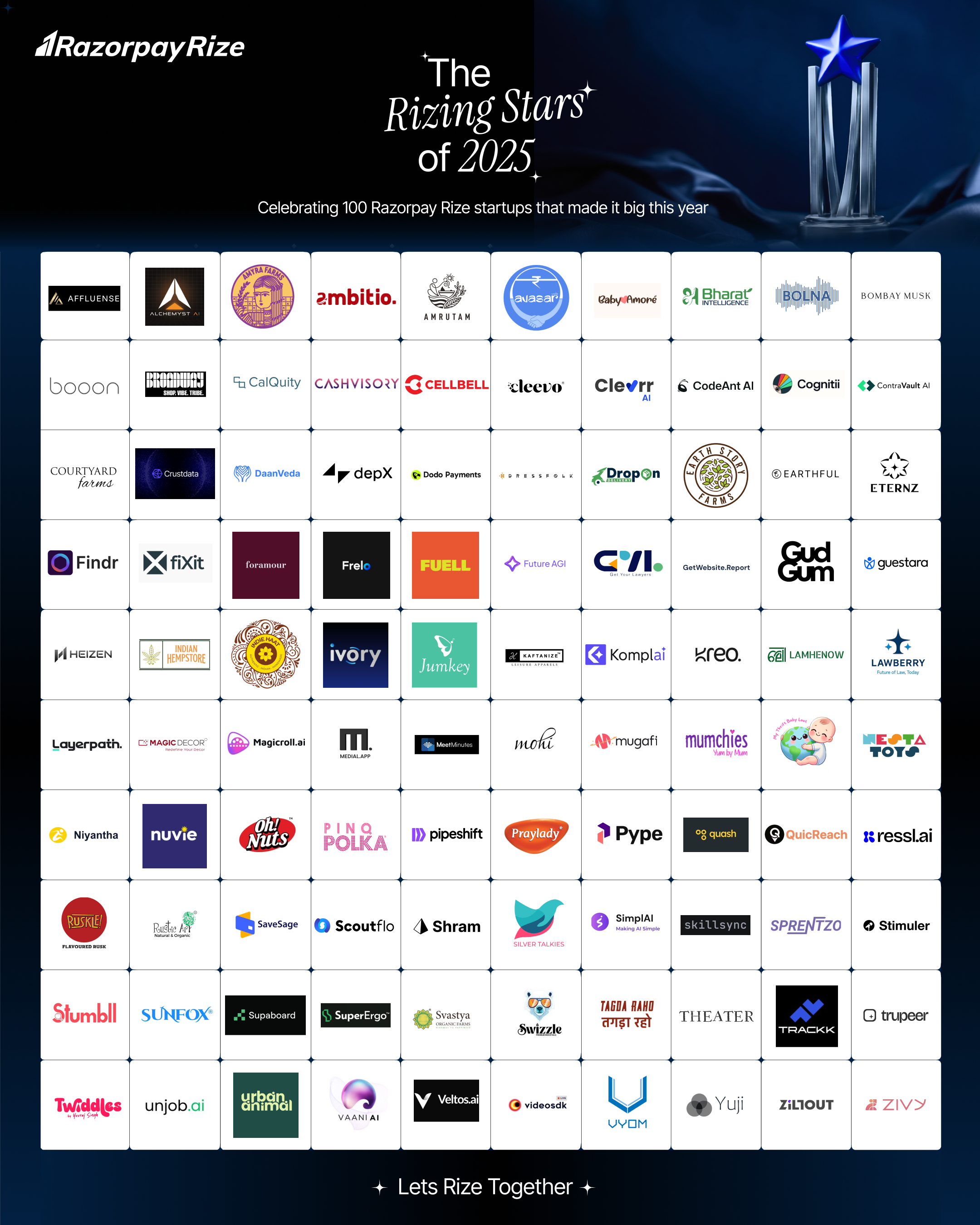
We’re proud to present Rizing Stars 2025- our annual curation of the Top 100 startups shaping the future from within the Rize ecosystem.

This list celebrates the many ways founders are winning today- from funding milestones and Y Combinator selections, to Product Hunt launches, national TV appearances, industry awards, and more. Together, these startups reflect the breadth and depth of the Rize community, spanning fintech, SaaS, AI, consumer, climate, D2C, exporters, and more- united by conviction, momentum, and the ambition to build enduring companies.
The Rizing Stars of 2025

Table of Contents

The 100 Rizing Stars of 2025

Below are the 100 startups recognised as Rizing Stars 2025.

  • Affluense AI: An AI-powered platform that helps businesses discover and engage HNI & UHNI individuals with real-time, 360° profiles.
  • Alchemyst AI: Alchemyst AI is a context engine that provides AI applications with persistent memory, business data, and operational context so agents remain accurate, reliable, and production-ready. It is a standalone context layer that can be integrated into the stack through our APIs, SDKs and MCPs.
  • Amyra Farms: Amyra Farms is a Farm-to-Table company dedicated to growing and processing high-quality Coffee, Pepper, and Vanilla.
  • Ambitio: AI Copilot for Higher Education Abroad. Ambitio's AI platform assists in the complete study abroad journey, right from program selection to crafting your application and getting those dream admits.
  • Amrutam: Amrutam is a global Ayurvedic lifestyle brand on a mission to make Ayurveda accessible, authentic, and contemporary. Rooted in ancient wisdom and backed by modern science, they create holistic solutions for health, wellness, and beauty.
  • Avasar: Avasar is a micro-task platform that helps individuals in Tier 2/3/4 India earn income through simple, smartphone-based tasks like referrals, surveys, promotions & gigs.

  • BabyAmore: Baby Amore is a eCommerce website catering to every baby’s need. Their focus is to sell organic, eco friendly and premium baby products.
  • Bharat Intelligence: Bharat Intelligence is building India’s operating system for agricultural labour. They organise farm labour into trained, verified crews and deliver agricultural work as a managed service
  • Bolna: Bolna is a Voice AI Platform purpose-built for India’s scale, linguistic complexity, and cost sensitivity. They enable enterprises to go live with thousands of concurrent calls in days.
  • Bombay Musk: Bombay Musk is a luxury car perfume brand designed to elevate every drive with premium fragrances that embody sophistication and style.
  • Booon: Booon.in is India’s First fashion-forward platform delivering all the style needs in just 2 hours.
  • Broadway: With a vision of a shared economy in retail, Broadway provides a platform of 20,000+ sq ft canvases in prime malls for brands to paint their stories, captivate consumers through unique narratives and in-person engagements to establish trust and induce trials.

  • Calquity: CalQuity is building the future of equity research with an AI-powered platform that unifies filings, earnings calls, and news into a single intelligent interface.
  • Cashvisory: Cashvisory empowers first-time investors with expert-backed strategies and simplified tools, making wealth-building accessible to everyone.
  • CellBell: Cellbell primarily offers ergonomic office and gaming chairs online in India, along with related services like delivery, installation, and warranty support. They focus on providing comfortable and durable seating solutions at affordable prices.
  • Cleevo: With an unique powder-to-liquid technology, Cleevo aim to inspire a new generation of clean and simplify life.
  • Clevrr AI: Clevrr AI is a SaaS platform helping D2C/Consumer brands unify data from 50+ omnichannels into a single source of truth with an AI Agent on top of it.
  • CodeAnt: CodeAnt AI is the Code Health platform built for the AI era. They bring AI Code Review, Code Security, Code Quality, and Engineering Metrics into one unified platform.
  • Cogniti: Cognitii is a mobile first, AI powered ecosystem that helps schools detect learning needs early, personalise support for children with developmental and learning disabilities, and reduce educator workload.
  • Courtyard Farms: Courtyard Farms delivers 100% natural, fresh goat milk and dairy products directly from farm to doorstep, promoting healthier, preservative-free nutrition.
  • Crustdata: Crustdata is an AI-powered people and Company Search tool for sales, recruitment and investment with the freshest, most trusted data.

  • DaanVeda: DaanVeda is an AI-driven fundraising intelligence platform, empowering nonprofits to raise more funds efficiently. They offer a unified solution addressing key challenges in the fundraising landscape.
  • depX: depX is an AI Ecosystem for DevOps. Deploy, manage and monitor your entire cloud infrastructure with as few as two lines in English. depX offers a no-code, ChatGPT-like interface for DevOps and Cloud engineers.
  • Dodo Payments: Dodo Payments is a global Payments & Billing platform helping SaaS and AI-native businesses scale across 150+ countries.
  • Dressfolk: Dressfolk is on a mission to modernise timeless Indian weaves. They design and co-produce all garments with the artisan community from scratch.
  • Dropon Delivery: Dropon is an emerging startup in eco-friendly, tech-driven logistics, transforming on-demand delivery with AI-powered optimisation and green mobility.

  • Earth Story Farm: Earth Story Farm grows, make and source chemical-free products, preserving the goodness, freshness and locking their complexity of flavours.
  • Earthful: Shark Tank-approved Earthful was founded in 2020 by sisters and IIT Kharagpur alumnae Veda Gogineni and Sai Sudha G. They are on a mission to tackle undernutrition in India with clean, plant-based nutrition. Earthful offers 100% natural supplements- free from additives and backed by science.
  • Eternz: Eternz is a new-age jewellery and watch marketplace redefining how India discovers and experiences fine craftsmanship. With a deep love for design and detail, they bring together curated collections from India’s finest brands as well as exquisite international names.

  • Findr: Findr is an AI workspace that lets you instantly capture, delightfully organise, and chat with anything you've saved. This includes PDFs, videos, articles, links, emails, information inside apps, and more.
  • Fixit: Fixit is an AI-powered junior broker, an agentic sales assistant built for real estate sales who don’t have time to chase dead leads. It qualifies, nurtures, and follows up with every prospect.
  • Foramour: Foramour offers 18k gold plated jewellery brand that makes gifting effortless yet thoughtful.
  • Frelo: Frelo is an AI based platform for Indian startups seeking top-tier freelancers in Tech, Design and Content. They simplify the hiring process by streamlining the posting of requirements, freelancer selection, and payments.
  • Fuell: Fuell provides clean, bite-sized snacks, made from just dry fruits and nuts, with no added sugar or preservatives.
  • Future AGI: Designed for the modern era of Generative AI, Future AGI provides intuitive tools for fine-tuning prompts, LLM experimentation, evaluating models, annotating data or optimising performance, making complex AI workflows seamless and efficient.

  • Get Your Lawyers: Get Your Lawyers is a cutting-edge AI-powered SaaS platform designed for legal professionals, providing an all-in-one solution for end-to-end legal practice management.
  • GetWebsite.Report: A complete webpage audit tool to get personalised insights & AI-powered actionable fixes to improve design, usability, user experience & SEO on all devices to maximise conversion.
  • Gud Gum: Gud Gum is India's first plastic-free, all-natural & biodegradable chewing gum. Free from all artificial sweeteners, flavours & colours.
  • Guestara: Guestara is an AI Guest Management Platform designed to meet the needs of hospitality professionals worldwide.

  • Heizen: Heizen is building an ecosystem to build, deploy, and manage fully functional enterprise-grade AI Apps.

  • Indian Hemp Store: Indian Hemp Store is India's 1st Hybrid Hemp Marketplace.
  • Indiehaat: IndieHaat was started with a vision and direction to surface the beautiful hidden treasures of the magnificent world of handmade products.
  • Ivory: Ivory transforms the ageing experience by nurturing sharper minds and healthier living. They help in the early detection of neurodegenerative risks and provide personalised brain health solutions.

  • Jumkey: Jumkey introduces safer materials for the environment which are skin friendly, sustainable and meets International quality standards.

  • Kaftanize: Kaftanize is a popular clothing line with fashion-conscious ladies.Their clothing is crafted from premium fabrics with an emphasis on simple shapes and understated elegance.
  • Komplai: Komplai is an AI-powered solution that helps businesses manage their financial accounts and all regulatory filings.
  • Kreo: Kreo is a consumer electronics brand they enable content creators & gamers to elevate their passion beyond limits by providing them with premium products.

  • Lamhenow: Lamhenow is a sustainable gifting solutions company. They are creating products which will be long-term and timeless, keeping in mind the creativity.
  • Lawberry: Lawberry is a pioneering legal tech platform that combines AI intelligence with legal expertise. The primary features include AI-powered research, drafting, and summarisation tools, alongside robust case management features.
  • Layerpath: Layerpath's Path AI turns the website into a live product conversation. It answers questions, shows the right demo, and books meetings- so your team only talks to ready buyers.

  • Magic Decor: Magic Decor has a curator-driven method to customise wall murals and wall decorative items. Their core is driven by on-demand production and an enhanced manufacturing process driven by automation.
  • Magicroll: Magicroll.ai is an AI-powered video editing and creation platform that helps creators, brands, and businesses turn raw footage into polished, engaging videos in minutes.
  • Medial: Medial is the next-gen professional social media platform from India to the world.
  • MeetMinutes: With support for 30+ languages, including unique mixed languages, seamless integration with popular tools and CRMs, and a focus on capturing key insights and action items, MeetMinutes is an indispensable partner in achieving meeting excellence.
  • Mohi Fashion: Mohi Fashion is a curated multi-designer Indian ethnic wear marketplace sourcing from authentic sellers across India for special occasions, weddings.
  • Mugafi: Mugafi is a next-gen entertainment powerhouse combining Tech, AI, storytelling, and cultural depth to build original cinematic universes.
  • Mumchies: Mumchies offers wholesome traditional-meets-contemporary sweets, savouries & millet delights made with premium ingredients for healthy, delicious snacking.
  • My Thrift Baby Loot: My Thrift Baby Loot is an easy platform where Parents can declutter by selling the things that their babies have outgrown to other parents who can buy the essentials at a lot lower than market price, save their money and save the planet in the process too.

  • Nesta Toys: Nesta Toys offer simple & open-ended play where the child drives the playtime. The toys are designed to encourage kids to see new possibilities and spur their imaginations.
  • Niyantha: Niyantha is building the Vehicle Cloud and AI Platform for transportation, agriculture and seafood supply chains.
  • Nuvie: Nuvie is redefining healthy eating by creating food products that make wellness both enjoyable and accessible.

  • OhNuts: Oh! Nuts is a health-focused snack brand from India that’s reinventing how people think about munching- with chips made from real nuts that are crispy and flavourful

  • Pinq Polka: Pinq Polka provides high-quality products that address both women’s hygiene and fashion needs, helping them navigate each day with assurance and poise.
  • Pipeshift: Pipeshift is a fast, scalable, and production-ready orchestration platform to build with open-source AI- embeddings, vector databases, LLMs, vision models, and audio models- in any cloud or on-prem.
  • Praylady: Praylady has gained a niche through its state-of-the-art manufacturing technology, and for producing unparalleled cookware that rings a bell in every kitchen in town.
  • Pype AI: Pype AI delivers ready-to-deploy, speciality-trained voice agents for healthcare. They automate critical patient interactions- scheduling, follow-ups, treatment prep, and 24/7 support- helping hospitals go live in days.

  • Quash: Quash is a SaaS tool that helps companies streamline and speed up their software testing process. It helps testers report bugs quickly, and assists developers in resolving them.
  • QuicReach: QuicReach offers pre-scheduled shared cabs tailored for solo travellers. Their solution combines the affordability of public transport with the comfort of personal cabs, providing a unique and much-needed alternative for long-distance travel.

  • Ressl AI: Ressl AI is building the future of Salesforce implementation and operations, powered by AI agents. They partner with fast-growing companies to scale their Salesforce orgs without scaling headcount.
  • Ruskle: Ruskle is a modern Indian snack brand reinventing the traditional rusk with baked, flavour-rich, no-maida varieties like Butter Garlic, Blueberry, Green Chutney, and more for guilt-free tea-time snacking.
  • Rustic Art: Rustic Art is an organic and natural personal and home care brand that believes in sustainable manufacturing and a sustainable lifestyle. All the products are cruelty-free & vegan.

  • SaveSage: SaveSage simplifies a user's credit card journey by helping them choose the best card based on their spending habits.
  • Scoutflo: Scoutflo is on a mission to make Infrastructure management self-serve for developers.
  • Shram: An AI-powered to-do list that automatically captures tasks from the screen and voice, so work manages itself.
  • Silver talkies: Silver Talkies is a pioneering social enterprise on a mission since 2014 to make healthy and active ageing a desirable and viable goal for older adults.
  • SimplAI: SimplAI is a full-stack Agentic AI Operating System built for enterprises that need to move beyond isolated LLM experiments and deploy AI that actually runs production workflows.
  • Skillsync: Skillsync is a search platform to find engineers & scientists based on their code / research. They are on a mission to organise the world's talent.
  • Sprentzo: Sprentzo is an innovative sports platform with a mission to make sports more accessible, affordable, and community-driven across India.
  • Stimuler: Stimuler is building audio-AI to help the global population speak (English) better! Their advanced AI engines listen, provide detailed feedback on the essential speech metrics & then provides guided practice for improvement!
  • Stumbll: Stumbll Events is an AI-powered event planning and management platform designed to simplify organising mid-sized gatherings (25-100 attendees).
  • Sunfox: Sunfox Technologies is at the forefront of cardiac healthcare innovation, transforming lives with their flagship product, Spandan.
  • Supaboard: Supaboard is an AI analytics platform transforming scattered data into actionable insights without requiring a data team.
  • SuperErgo: SuperErgo is a work-tech brand revolutionising the modern workspace with ergonomically designed furniture and accessories.
  • Swastya Organic farms (Lokkanahalli): Pure, chemical-free organic foods & wellness products crafted with traditional farming and women-led care for healthy living.
  • Swizzle: Swizzle offers refreshing ready-to-drink mocktails that bring clean, premium taste to every sip- perfect for modern, health-conscious drinkers.

  • Tagda Raho:  Tagda Raho is reviving India’s traditional strength training with handcrafted gada, mudgar and functional workouts for modern fitness.
  • Theater Apparel: Theater is a dynamic and rapidly growing fashion startup based in India. Their mission is to create India's best design-led, mass-premium western fashion company.
  • Trackk: Trackk is a New-Gen trading platform, designed for speed, precision, and simplicity. From faster trading to insightful analytics, they're reimagining how the new generation connects with wealth and opportunities.
  • Trupeer AI: Trupeer AI is the AI video platform for the end-to-end software lifecycle.
  • Twiddles: Twiddles brings indulgence without guilt. Co-founded by cricketing legend Yuvraj Singh, they create delicious, nut-based spreads and snackable bites that combine rich flavours with healthy ingredients.

  • Unjob.ai: Unjob. ai is the world’s first AI-powered freelance platform that helps brands hire talent instantly, without job posts, interviews, or endless browsing.
  • Urban Animal: India's 1st dog DNA test to understand a dog's genetic makeup to provide smarter care!

  • Vaani AI: Vaani research is building the next generation of human-like Voice AI systems that can handle & automate complex, longer conversations with unmatched accuracy and empathy.
  • Veltos AI: Veltos AI is a next-gen game generation platform that empowers anyone to create, play, and share games with the power of AI.
  • VideoSDK: VideoSDK is providing end-to-end solutions in real-time communication technology. They started with mission is to help developers build interactive and immersive live video experiences.
  • Vyom: Vyom is building the platform to power the future of autonomous robots and drones. They are creating a software-defined ecosystem to empower the robotics industry with unmatched adaptability, flexibility, and scalability.

  • Yuji Labs: Yuji Labs is building industrial intelligence grounded in physics, engineering, and real operational experience.
  • Zillout: Zillout is an AI-powered system running the world's most loved venues & experiences.
  • Zivy: Zivy tracks conversations across all the Slack channels and brings critical messages to the surface.

The Rizing Stars of 2025 are a reflection of the everyday realities of building a startup. The late nights, the pivots, the first yes, the many no’s, and the quiet milestones that don’t always make headlines. These 100 startups represent founders who kept showing up, learning from each other, and moving forward with conviction.

And as more founders join the Rize community, this list will continue to grow- bringing new stories, new breakthroughs, and new journeys into focus. Today, we celebrate 100. Tomorrow, there will be many more and we’re excited to build that future together!

rize image

Register your Business at just 1,499 + Govt. Fee

Register your business
rize image

Register your Private Limited Company in just 1,499 + Govt. Fee

Register your business
rize image

Register your One Person Company in just 1,499 + Govt. Fee

Register your business
rize image

Register your Business starting at just 1,499 + Govt. Fee

Register your business
rize image

Register your Limited Liability Partnership in just 1,499 + Govt. Fee

Register your business

Private Limited Company
(Pvt. Ltd.)

1,499 + Govt. Fee
BEST SUITED FOR
  • Service-based businesses
  • Businesses looking to issue shares
  • Businesses seeking investment through equity-based funding


Limited Liability Partnership
(LLP)

1,499 + Govt. Fee
BEST SUITED FOR
  • Professional services 
  • Firms seeking any capital contribution from Partners
  • Firms sharing resources with limited liability 

One Person Company
(OPC)

1,499 + Govt. Fee
BEST SUITED FOR
  • Freelancers, Small-scale businesses
  • Businesses looking for minimal compliance
  • Businesses looking for single-ownership

Private Limited Company
(Pvt. Ltd.)

1,499 + Govt. Fee
BEST SUITED FOR
  • Service-based businesses
  • Businesses looking to issue shares
  • Businesses seeking investment through equity-based funding


One Person Company
(OPC)

1,499 + Govt. Fee
BEST SUITED FOR
  • Freelancers, Small-scale businesses
  • Businesses looking for minimal compliance
  • Businesses looking for single-ownership

Private Limited Company
(Pvt. Ltd.)

1,499 + Govt. Fee
BEST SUITED FOR
  • Service-based businesses
  • Businesses looking to issue shares
  • Businesses seeking investment through equity-based funding


Limited Liability Partnership
(LLP)

1,499 + Govt. Fee
BEST SUITED FOR
  • Professional services 
  • Firms seeking any capital contribution from Partners
  • Firms sharing resources with limited liability 

Frequently Asked Questions

Related Posts

Dormant Company Meaning: Section 455 of Companies Act 2013

Dormant Company Meaning: Section 455 of Companies Act 2013

The concept of a dormant company was introduced in the Companies Act, 2013 to allow businesses to maintain their legal status while having minimal operations. Dormant company registration under Section 455 of the Act is a strategic move for companies planning to become temporarily inactive due to various reasons, such as holding assets, protecting intellectual property, or preparing for future projects. This article delves into the meaning, eligibility, benefits, and process of obtaining dormant company status in India.

Table of Contents

What Is a Dormant Company?

Under the Companies Act, 2013, a dormant company refers to an entity that is temporarily inactive, with no significant accounting transactions during a financial year. The definition of a dormant company encompasses companies that are:

  • Incorporated for future projects
  • Established to hold assets or intellectual property
  • Not engaged in any significant financial transactions

To be eligible for dormant company status, a company must meet the following criteria:

  • No significant accounting transactions during the last two financial years
  • No filing of financial statements and annual returns with the Registrar of Companies (ROC) in the preceding two financial years

It's important to note that a company can remain dormant for a maximum of five consecutive financial years. After this period, the company must either commence operations or apply for an extension of dormant status with the ROC.

Is a Dormant Company Allowed To Trade?

A dormant company is not allowed to conduct significant business transactions, such as:

  • Buying or selling goods and services
  • Engaging in revenue-generating operations
  • Undertaking any other form of trade

However, a dormant company can carry out certain essential activities, including:

  • Paying fees and fulfilling compliance requirements under the Companies Act or other applicable laws
  • Maintaining its registered office and records
  • Allotting shares to shareholders

Engaging in active trading or substantial business transactions may lead to the loss of dormant company status. Therefore, it is crucial for business owners to ensure that their dormant company remains compliant with the prescribed regulations.

A Brief Overview of Dormant Status Under the Companies Act 2013

Section 455 of the Companies Act 2013 introduced the concept of dormant companies to provide a legal framework for businesses that wish to temporarily suspend their operations while maintaining their legal status. This provision allows companies to:

  • Preserve their assets and intellectual property
  • Reduce compliance costs during periods of inactivity
  • Keep their company name reserved for future projects

Meaning of Inactive Company

An inactive company, as per the Companies Act 2013, is a company that:

  • Has not conducted any significant financial transactions during the last two financial years
  • Has not filed financial statements and annual returns with the ROC for the preceding two financial years

Reasons for Obtaining the Status of a Dormant Company

There are several reasons why a company may choose to obtain dormant company status:

  • To preserve the company name for future business ventures
  • To hold assets or intellectual property without actively engaging in business operations
  • To reduce compliance costs and regulatory burdens during periods of inactivity
  • To facilitate business restructuring or strategic planning
  • To maintain legal status while the promoters or directors are unavailable due to personal reasons, such as illness, travel, or sabbatical

Top 5 Benefits of Opting for Dormant Company Status

  1. Reduced Compliance Requirements: Dormant companies are subject to significantly fewer compliance obligations under the Companies Act 2013. This includes exemptions from holding frequent board meetings, appointing auditors, and filing detailed annual returns.
  2. Cost Savings: By reducing compliance requirements, dormant companies can save on administrative expenses, such as auditor fees, legal costs, and filing charges. This can be particularly beneficial for small businesses and start-ups looking to minimise overhead costs.
  3. Brand Name Protection: Registering as a dormant company allows businesses to protect their brand name and prevent others from registering a similar name. This is crucial for companies that have invested in building a strong brand identity and want to preserve it for future use.
  4. Flexibility for Future Business Plans: Dormant company status provides businesses with the flexibility to reactivate their operations when the time is right. This can be particularly useful for companies that are waiting for market conditions to improve or for key personnel to return from extended absences.
  5. Simplified Annual Filings: Dormant companies are required to file a simplified version of the annual return, known as Form MSC-3. This form requires less detailed information compared to the annual returns filed by active companies, reducing the administrative burden on business owners.

By weighing the benefits of dormant company status against the specific needs and goals of their business, entrepreneurs can make informed decisions about whether this legal structure is suitable for their situation.

Mandatory Requirements for Obtaining Dormant Status

To be eligible for dormant company status under Section 455 of the Companies Act 2013, a company must fulfil certain mandatory requirements:

  1. No Significant Accounting Transactions: The company must not have carried out any significant accounting transactions during the financial year for which dormant status is sought. This excludes transactions related to the allotment of shares, payment of fees to the ROC, and maintenance of the company's office and records.
  2. No Outstanding Liabilities: The company must not have any outstanding loans, whether secured or unsecured, or any other outstanding liabilities. If there are any outstanding unsecured loans, the company must obtain a no-objection certificate from the lenders before applying for dormant status.
  3. No Pending Regulatory Actions: There should be no pending inspections, inquiries, or investigations against the company by any regulatory authorities. Additionally, no prosecution proceedings should be initiated against the company under any law.
  4. Up-to-date Statutory Filings: The company must have filed all its pending returns, including annual returns and financial statements, with the ROC before applying for dormant status.
  5. Shareholder Approval: The company must obtain approval from its shareholders through a special resolution passed at a general meeting. Alternatively, the company can obtain the consent of at least 3/4th of its shareholders by value through a written resolution.

How to File for Dormant Status: A Step-By-Step Guide

Filing for dormant company status involves a series of steps that must be followed in accordance with the provisions of the Companies Act 2013:

  1. Convene a Board Meeting: The company's board of directors must convene a meeting to discuss and approve the proposal for obtaining dormant status. The board resolution should authorise the filing of the necessary application and documents with the ROC.
  2. Obtain Shareholder Approval: The company must obtain approval from its shareholders either through a special resolution passed at a general meeting or through the written consent of at least 3/4th of the shareholders by value.
  3. Prepare the Statement of Affairs: The company must prepare a statement of affairs, including a balance sheet and profit and loss account, as of the date of the application for dormant status. This statement should be verified by an affidavit from the company's directors.
  4. File Form MSC-1: The company must file Form MSC-1 with the ROC, along with the necessary supporting documents, including the board resolution, shareholder approval, statement of affairs, and any other relevant documents as specified in the Companies Act 2013.
  5. Pay the Prescribed Fees: The company must pay the prescribed fees for filing Form MSC-1, as specified in the Companies (Registration Offices and Fees) Rules, 2014.
  6. Obtain Certificate of Dormant Status: Upon verification of the application and supporting documents, the ROC will issue a certificate of dormant status to the company in Form MSC-2.

It is important to note that the entire process of filing for dormant company status must be completed within 30 days of obtaining shareholder approval. Companies should seek the assistance of a qualified professional, such as a company secretary or chartered accountant, to ensure compliance with the prescribed procedures and timelines.

ROC Forms for Registering Dormant Company

Form Name Purpose
Form MSC-1 Application for obtaining dormant company status
Form MSC-3 Return of dormant companies
Form MSC-4 Application for seeking the status of an active company
  • Form MSC-1: This form is used to apply for obtaining dormant company status. It must be filed with the ROC within 30 days of obtaining shareholder approval. The form requires details such as the company's name, registered office address, directors' particulars, and the reasons for seeking dormant status.
  • Form MSC-3: This form is used to file the annual return of a dormant company. It must be filed within 30 days from the end of each financial year. The form requires details such as the company's financial position, shareholding pattern, and any changes in the directors' or registered office address.
  • Form MSC-4: This form is used to apply for seeking the status of an active company. It must be filed with the ROC when a dormant company wants to commence business operations. The form requires details such as the company's name, registered office address, and the reasons for seeking active status.

Annual Compliance for Dormant Company

While dormant companies enjoy certain relaxations under the Companies Act 2013, they are still required to fulfil essential annual compliance tasks in four key areas:

  1. Accounting and Financial Statements: Dormant companies must maintain proper books of accounts and prepare financial statements, including a balance sheet and profit and loss account, for each financial year. These financial statements must be approved by the board of directors and presented at the annual general meeting.
  2. Statutory Audit: Dormant companies are required to appoint a statutory auditor to conduct an audit of their financial statements. However, dormant companies are exempt from the requirement of auditor rotation, which is mandatory for active companies.
  3. Tax Return Filings: Dormant companies must file their income tax returns annually, even if they have not generated any income during the financial year. They are also required to comply with other applicable tax laws, such as the Goods and Services Tax (GST) and Tax Deducted at Source (TDS) provisions.
  4. ROC Filings: Dormant companies must file an annual return in Form MSC-3 with the ROC within 30 days from the end of each financial year. This form requires details such as the company's financial position, shareholding pattern, and any changes in the directors' or registered office address.
Compliance Requirement Frequency
Board Meetings Twice a year
Annual General Meeting Once a year
Financial Statements Annually
Statutory Audit Annually
Income Tax Return Filing Annually
Form MSC-3 Filing Annually

By fulfilling these annual compliance requirements, dormant companies can ensure that they remain in good standing with the regulatory authorities and avoid any penalties or legal consequences.

Reactivation of a Dormant Company

A dormant company can be reactivated and commence business operations by following the prescribed procedure under the Companies Act 2013:

  1. Convene a Board Meeting: The company's board of directors must convene a meeting to discuss and approve the proposal for reactivating the company. The board resolution should authorise the filing of the necessary application and documents with the ROC.
  2. File Form MSC-4: The company must file Form MSC-4 with the ROC, along with the necessary supporting documents, including the board resolution and any other relevant documents as specified in the Companies Act 2013.
  3. Pay the Prescribed Fees: The company must pay the prescribed fees for filing Form MSC-4, as specified in the Companies (Registration Offices and Fees) Rules, 2014.
  4. Obtain Certificate of Active Status: Upon verification of the application and supporting documents, the ROC will issue a certificate of active status to the company in Form MSC-5.

Once the company has obtained the certificate of active status, it can commence business operations and is required to comply with all the provisions of the Companies Act 2013 applicable to active companies, including regular compliance requirements such as holding board meetings, filing annual returns, and appointing auditors.

Conclusion

Dormant company under Section 455 of the Companies Act 2013 is a strategic tool for businesses to preserve their legal identity while suspending operations. It allows companies to protect their brand name, reduce compliance costs, and maintain flexibility for future ventures. To benefit from this status, businesses must meet eligibility criteria and comply with statutory requirements. Seeking professional assistance is advisable to navigate the process effectively and avoid legal issues. This approach is ideal for future projects, asset holding, or temporary business pauses, offering a cost-effective solution for maintaining legal existence.

Frequently Asked Questions

rize image

Register your Business at just 1,499 + Govt. Fee

Register your business
rize image

Register your Private Limited Company in just 1,499 + Govt. Fee

Register your business
rize image

Register your One Person Company in just 1,499 + Govt. Fee

Register your business
rize image

Register your Business starting at just 1,499 + Govt. Fee

Register your business
rize image

Register your Limited Liability Partnership in just 1,499 + Govt. Fee

Register your business

Private Limited Company
(Pvt. Ltd.)

1,499 + Govt. Fee
BEST SUITED FOR
  • Service-based businesses
  • Businesses looking to issue shares
  • Businesses seeking investment through equity-based funding


Limited Liability Partnership
(LLP)

1,499 + Govt. Fee
BEST SUITED FOR
  • Professional services 
  • Firms seeking any capital contribution from Partners
  • Firms sharing resources with limited liability 

One Person Company
(OPC)

1,499 + Govt. Fee
BEST SUITED FOR
  • Freelancers, Small-scale businesses
  • Businesses looking for minimal compliance
  • Businesses looking for single-ownership

Private Limited Company
(Pvt. Ltd.)

1,499 + Govt. Fee
BEST SUITED FOR
  • Service-based businesses
  • Businesses looking to issue shares
  • Businesses seeking investment through equity-based funding


One Person Company
(OPC)

1,499 + Govt. Fee
BEST SUITED FOR
  • Freelancers, Small-scale businesses
  • Businesses looking for minimal compliance
  • Businesses looking for single-ownership

Private Limited Company
(Pvt. Ltd.)

1,499 + Govt. Fee
BEST SUITED FOR
  • Service-based businesses
  • Businesses looking to issue shares
  • Businesses seeking investment through equity-based funding


Limited Liability Partnership
(LLP)

1,499 + Govt. Fee
BEST SUITED FOR
  • Professional services 
  • Firms seeking any capital contribution from Partners
  • Firms sharing resources with limited liability 

Frequently Asked Questions

How does a company become dormant?

To become a dormant company, a company must pass a special resolution in a general meeting and file Form MSC-1 with the Registrar of Companies, along with the necessary documents and fees.

How long is the company's dormant status?

A company can maintain its dormant status for a maximum of five consecutive financial years. After this period, the company must either reactivate or apply for voluntary closure.

What forms are needed for a dormant company status application?

The key forms required for a dormant company status application are e-Form MGT-14 (filed within 30 days of passing the special resolution) and e-Form MSC-1 (filed within 30 days after the special resolution to apply for dormant status).

Can a dormant company be active?

Yes, a dormant company can reactivate and become an active company by filing Form MSC-4 with the Registrar of Companies, submitting Form MSC-3 (Annual Return), and paying the prescribed fee.

Can a dormant company be closed?

Yes, a dormant company can apply for voluntary closure if it has not been reactivated within five consecutive financial years or if the promoters decide to wind up the business.

How to close a Dormant Company in India?

To close a dormant company in India, the company must follow the voluntary winding-up process under the Companies Act 2013. This involves passing a special resolution, appointing a liquidator, settling all liabilities, and distributing any remaining assets among the shareholders. The company must also file the necessary forms with the Registrar of Companies and obtain approval for the closure.

Sarthak Goyal

Sarthak Goyal is a Chartered Accountant with 10+ years of experience in business process consulting, internal audits, risk management, and Virtual CFO services. He cleared his CA at 21, began his career in a PSU, and went on to establish a successful ₹8 Cr+ e-commerce venture.

He has since advised ₹200–1000 Cr+ companies on streamlining operations, setting up audit frameworks, and financial monitoring. A community builder for finance professionals and an amateur writer, Sarthak blends deep finance expertise with an entrepreneurial spirit and a passion for continuous learning.

Read more
10 Advantages of Incorporating a Company: Why You Should Incorporate Your Business

10 Advantages of Incorporating a Company: Why You Should Incorporate Your Business

In today's competitive business landscape, entrepreneurs are constantly seeking ways to establish a strong foundation for their ventures. One crucial decision that can significantly impact the growth and success of a business is the choice to register as a company. Company registration offers a multitude of advantages that can propel your enterprise to new heights. In this article, we will delve into the top 10 benefits of registering a company, empowering you to make an informed decision for your business's future.

Table of Contents

What are the Benefits of Company Incorporation in India?

Registering a company in India comes with a host of advantages that can elevate your business to new levels of success. From enhanced credibility to legal protection and access to funding, company registration provides a solid foundation for growth. Let's explore these benefits in more detail.

1. Legal Entity

One of the primary benefits of business registration is that the company becomes a separate legal entity. Under the Companies Act, a registered company is considered an artificial person, distinct from its directors and shareholders. This means that upon incorporation, the company acquires its legal personality, allowing it to own property, incur debts, and engage in legal proceedings under its name.

The concept of a separate legal entity provides several advantages:

  • The company can enter into contracts and agreements independently
  • It can sue or be sued in its name
  • The company's assets and liabilities are separate from those of its owners
  • The company's existence is not tied to the lifespan of its members

This legal separation is crucial for protecting the personal assets of the company's owners, as they are not personally liable for the company's debts or legal obligations.

2. Perpetual Succession

Company registration ensures perpetual succession, which is a significant advantage for businesses. Perpetual succession means that the company's existence continues indefinitely, regardless of any changes in its membership, staff, or shareholders. This stability is a key benefit of incorporating a business, as it ensures that the company can outlast individual members or leadership changes.

Here are some key points about perpetual succession:

  • The company's existence is not affected by the death, retirement, or resignation of its members
  • Shares can be transferred without disrupting the company's operations
  • The company remains operational until it is legally dissolved
  • Perpetual succession allows for long-term planning and execution of business strategies

By incorporating your business, you create a stable and enduring entity that can withstand changes in ownership and management, providing a solid foundation for growth and success.

3. Limited Liability

Limited liability is one of the most significant benefits of registering a private limited company. In a registered company, the shareholder's assets are protected from the company's debts and legal obligations. This means that in the event of financial losses or legal issues, the shareholders are only liable to the extent of their investment in the company.

Key points about limited liability:

  • Shareholders' assets (e.g., houses, cars, bank accounts) are safeguarded
  • Directors are not personally liable for the company's debts or legal liabilities
  • Limited liability encourages entrepreneurship and risk-taking
  • It provides a layer of protection for business owners

In contrast, sole proprietors and partners in unregistered businesses are personally liable for all business debts and obligations, putting their assets at risk. Limited liability is a crucial advantage of company registration, offering peace of mind and financial security for business owners.

4. Free & Easy Transferability of Shares

One of the advantages of incorporation of a company is the free and easy transferability of shares. In a registered company, shares can be transferred from one shareholder to another without affecting the company's operations. This flexibility in ownership transfer is a significant benefit, particularly for growing businesses.

Here are some key aspects of share transferability:

  • Public companies: Shares are freely transferable, and shareholders can sell their shares to anyone without restrictions.
  • Private companies: While share transfer is possible, there may be some restrictions imposed by the company's bylaws or shareholder agreements.
  • The transfer process typically involves a signed share transfer form and the handover of the share certificate to the buyer.
  • Easy share transferability allows for smooth succession planning and exit opportunities for shareholders.

Free share transfer attracts investors, raises capital, and enables ownership changes without disrupting operations.

5. Owning Property

As a separate legal entity, a registered company can acquire, own, and transfer property in its name. This is a significant advantage of company registration, as it distinguishes the company's assets from those of its shareholders. Shareholders do not have direct ownership rights over the company's property; instead, their interest lies in the shares they hold.

Key points about company property ownership:

  • The company can purchase, lease, or sell property independently
  • Shareholders' personal assets are protected from claims against the company's property
  • The company's property remains an exclusive asset of the company, not its individual members
  • Owning property in the company's name can provide tax benefits and asset protection

By owning property as a separate legal entity, a registered company can secure its assets, attract investors, and create a stable foundation for long-term growth and success.

6. Can Sue or Be Sued

Another advantage of company registration is that a registered company can sue or be sued in its name. As a separate legal entity, the company has the right to initiate legal proceedings or defend itself against legal claims, just like an individual. This ability to engage in legal matters independently is a crucial aspect of a company's legal status.

Key points about a company's legal standing:

  • The company can file lawsuits to protect its interests, such as intellectual property rights or breach of contract
  • It can defend itself against legal claims without involving its shareholders or directors personally
  • The company's legal actions remain separate from the personal legal matters of its members
  • This legal independence helps maintain the company's professional reputation and protects its shareholders

The ability to sue or be sued in its name provides a registered company with the necessary legal tools to safeguard its interests, resolve disputes, and maintain its professional standing in the business world.

7. Dual Relationship

One of the unique advantages of incorporation of company is the ability to have a dual relationship with its members. In a registered company, an individual can simultaneously hold multiple roles, such as being a shareholder, creditor, director, and employee. This flexibility allows for a more complex and adaptable business structure.

Key points about dual relationships in a company:

  • A person can be a shareholder and an employee at the same time
  • Directors can also be shareholders, allowing for a more vested interest in the company's success
  • Shareholders can provide loans to the company, becoming creditors while maintaining their ownership stake
  • These dual roles are legally permissible and common in registered companies

A dual relationship with the company fosters ownership, commitment, and multi-role contributions to its success.

8. Borrowing Capacity

Company registration significantly enhances a business's borrowing capacity. Registered companies have access to a wider range of financing options compared to sole proprietorships or partnerships. This increased borrowing capacity is a crucial advantage for businesses looking to expand, invest in new projects, or maintain financial stability.

Key points about a company's borrowing capacity:

  • Companies can issue debentures to raise capital from the public
  • Registered companies are seen as more credible and stable by banks and financial institutions
  • Larger financial assistance is available to companies, making borrowing more accessible
  • Companies can secure loans by offering their assets as collateral

Company registration boosts borrowing capacity, enabling growth, expansion, and operational stability for a competitive edge.

9. Equity Raising

Another significant advantage of company registration is the ability to raise equity funding. Registered companies, particularly private limited companies, have access to a broader pool of investors and can attract equity investments from various sources. This equity raising potential is crucial for businesses looking to expand, scale operations, and increase their market presence.

Key points about equity raising in a registered company:

  • Private limited companies can attract investments from angel investors and private equity firms
  • Equity funding provides growth capital without the burden of debt repayment
  • Public limited companies can raise funds through initial public offerings (IPOs) and list their shares on stock exchanges
  • Equity investments often come with strategic partnerships and valuable industry connections

The ability to raise equity funding through company registration opens up new avenues for business growth, allowing companies to tap into the expertise and resources of investors while maintaining control over their operations.

10. Brand Building

Company registration plays a vital role in brand building and establishing a strong business identity. By registering your company, you create a distinct and recognizable brand that sets you apart from competitors. A registered company name provides legal protection and prevents others from using a similar name, safeguarding your brand's uniqueness.

Key points about brand building through company registration:

  • A registered company name adds credibility and professionalism to your brand
  • It helps build trust among customers, suppliers, and partners
  • Legal protection for your brand name reduces the risk of confusion and infringement
  • A strong brand identity attracts customers, investors, and top talent

Registering a company builds a strong, lasting brand and sets the foundation for long-term success.

What Does Online Company Registration Entail?

The Companies Act of 2013 has made the process of company registration more streamlined and accessible through online means. The process involves several steps, including:

Key points about brand building through company registration:

  1. Selecting the type of company (Private Limited, Limited Liability Partnership, etc.)
  2. Applying for a Director Identification Number (DIN)
  3. Obtaining Digital Signature Certificates (DSC)
  4. Filing the necessary forms with the Ministry of Corporate Affairs (MCA)

It is crucial to verify the availability of the desired company name and ensure compliance with legal requirements throughout the registration process.

Types of Companies You Can Register

The Companies Act of 2013 provides for various types of companies that can be registered, each with its own characteristics and requirements. Some of the common types include:

  1. Private Limited Company: A company with a minimum of two and a maximum of 200 shareholders, with restrictions on the transfer of shares.
  2. Public Limited Company: A company that can have an unlimited number of shareholders and can offer shares to the public.
  3. One Person Company (OPC): A company with a single shareholder and director, suitable for solo entrepreneurs.
  4. Limited Liability Partnership (LLP): A partnership structure that provides limited liability to its partners.
  5. Section 8 Company: A non-profit company formed for charitable or social purposes.

Choosing the right type of company depends on factors such as business size, goals, and structure.

Conclusion

Registering a company is a strategic decision that offers numerous advantages for businesses. From limited liability protection to enhanced credibility and access to funding, company registration provides a solid foundation for growth and success. By understanding the benefits of company registration, entrepreneurs can make informed decisions and position their ventures for long-term prosperity.

Frequently Asked Questions

rize image

Register your Business at just 1,499 + Govt. Fee

Register your business
rize image

Register your Private Limited Company in just 1,499 + Govt. Fee

Register your business
rize image

Register your One Person Company in just 1,499 + Govt. Fee

Register your business
rize image

Register your Business starting at just 1,499 + Govt. Fee

Register your business
rize image

Register your Limited Liability Partnership in just 1,499 + Govt. Fee

Register your business

Private Limited Company
(Pvt. Ltd.)

1,499 + Govt. Fee
BEST SUITED FOR
  • Service-based businesses
  • Businesses looking to issue shares
  • Businesses seeking investment through equity-based funding


Limited Liability Partnership
(LLP)

1,499 + Govt. Fee
BEST SUITED FOR
  • Professional services 
  • Firms seeking any capital contribution from Partners
  • Firms sharing resources with limited liability 

One Person Company
(OPC)

1,499 + Govt. Fee
BEST SUITED FOR
  • Freelancers, Small-scale businesses
  • Businesses looking for minimal compliance
  • Businesses looking for single-ownership

Private Limited Company
(Pvt. Ltd.)

1,499 + Govt. Fee
BEST SUITED FOR
  • Service-based businesses
  • Businesses looking to issue shares
  • Businesses seeking investment through equity-based funding


One Person Company
(OPC)

1,499 + Govt. Fee
BEST SUITED FOR
  • Freelancers, Small-scale businesses
  • Businesses looking for minimal compliance
  • Businesses looking for single-ownership

Private Limited Company
(Pvt. Ltd.)

1,499 + Govt. Fee
BEST SUITED FOR
  • Service-based businesses
  • Businesses looking to issue shares
  • Businesses seeking investment through equity-based funding


Limited Liability Partnership
(LLP)

1,499 + Govt. Fee
BEST SUITED FOR
  • Professional services 
  • Firms seeking any capital contribution from Partners
  • Firms sharing resources with limited liability 

Frequently Asked Questions

What benefits does online registration offer compared to offline registration of a company

  • Online registration streamlines the process, making it faster and more convenient.
  • It eliminates the need for physical submission of documents, saving time and effort.
  • Online registration allows for real-time tracking of the application status.

How does online company registration simplify the process and help save time?

  • Online registration enables entrepreneurs to complete the process from anywhere, at any time.
  • Digital submission of documents eliminates the need for physical visits to government offices.
  • The online system guides users through the process, minimizing errors and delays.

Can there be cost benefits to registering a company online?

  • Online registration often comes with reduced fees compared to offline methods.
  • It eliminates the need for intermediaries or agents, saving on additional costs.
  • Digital submissions reduce paperwork and associated expenses.

What assistance and resources can be found when registering a company online?

  • Online portals often provide step-by-step guides and tutorials for the registration process.
  • FAQs and help sections address common queries and concerns.
  • Customer support is usually available through email, chat, or telephone for assistance.

How safe is the online company registration process?

  • Online registration portals, such as the MCA portal, employ secure encryption and data protection measures to ensure the safety of sensitive information.
  • The use of Digital Signature Certificates (DSC) adds an extra layer of security and authentication to the process.
  • Reputable online service providers adhere to strict data privacy and security standards to safeguard client information.

Swagatika Mohapatra

Swagatika Mohapatra is a storyteller & content strategist. She currently leads content and community at Razorpay Rize, a founder-first initiative that supports early-stage & growth-stage startups in India across tech, D2C, and global export categories.

Over the last 4+ years, she’s built a stronghold in content strategy, UX writing, and startup storytelling. At Rize, she’s the mind behind everything from founder playbooks and company registration explainers to deep-dive blogs on brand-building, metrics, and product-market fit.

Read more
What is a Shelf Prospectus? Meaning & Provisions Under the Companies Act, India

What is a Shelf Prospectus? Meaning & Provisions Under the Companies Act, India

A shelf prospectus is a legal document under the Companies Act of 2013 that allows a company to issue multiple rounds of securities without filing a new prospectus for each offering.

Once a company gets approval for a shelf prospectus, it can issue securities in tranches over a period (usually one year) without repeating the regulatory approval process. This mechanism is particularly beneficial for businesses that require frequent access to capital markets.

Simply put, a company gets approval for a prospectus and "shelves" it for use when needed. Just like a store keeps items on a shelf, ready to be picked up when required, companies can tap into their shelf prospectus whenever they decide to issue securities within the approved period.

Table of Contents

Shelf Prospectus Meaning

A shelf prospectus is a document issued by companies intending to offer securities in multiple tranches over a specified period without filing a new prospectus for each offering. Governed by the Companies Act of 2013, it serves as a framework to streamline capital-raising activities while ensuring regulatory compliance.

This approach helps all types of companies save time and resources while maintaining transparency in financial disclosures.

What Is The Validity Period of Shelf Prospectus?

As per the Companies Act of 2013 and SEBI regulations, a shelf prospectus is valid for one year from the issue date. During this period, the company can make multiple security offerings without submitting a fresh prospectus.

However, an Information Memorandum must be filed for each subsequent offering to ensure updated financial and operational disclosures.

What Are The Requirements For Shelf Prospectus?

To issue a shelf prospectus, a company must fulfil specific requirements under the Companies Act, 2013:

  • Eligibility Criteria: The company must be a public financial institution, a bank, or a company notified by SEBI.
  • SEBI Approval: Approval from the Securities and Exchange Board of India (SEBI) is mandatory before issuance.
  • Financial Disclosures: The prospectus must include audited financial statements, business details, and risk factors.
  • Regulatory Compliance: The company must adhere to statutory provisions and filing requirements.

Who Can Issue Shelf Prospectus?

Not all companies are eligible to issue a shelf prospectus. As per SEBI regulations, only specific entities can do so, including:

  • Public Financial Institutions such as banks and NBFCs.
  • Scheduled Banks that meet regulatory criteria.
  • Other Companies notified by SEBI, provided they meet compliance standards.

Looking to register your LLP? Head over to Razorpay Rize and get your LLP incorporated today!

What Are The Eligibility Criteria For a Company to Issue a Shelf Prospectus?

To issue a shelf prospectus, a company must meet the following key eligibility criteria:

  • Strong Financial Performance: A consistent and positive financial track record is essential.
  • Regulatory Compliance: The company must have a history of timely filings and adherence to statutory norms.
  • Market Reputation: A credible and trustworthy market presence is necessary.
  • Clear Disclosure of Fund Utilization: The company must provide transparency regarding how the raised funds will be used.

5 Incredible Advantages of Shelf Prospectus

A shelf prospectus offers several benefits to companies and investors:

  1. Flexibility: Companies can issue securities as needed without additional regulatory approvals.
  2. Cost Efficiency: Reduces administrative and compliance costs associated with repeated filings.
  3. Faster Time to Market: Companies can respond quickly to market conditions.
  4. Improved Investor Relations: Provides transparency and trust through consistent financial disclosures.
  5. Strategic Financial Planning: Enables better capital-raising strategies over time.

How Does an Investor Benefit from a Shelf Prospectus?

Investors gain multiple advantages from a shelf prospectus:

  • Greater Transparency: A single document offers comprehensive details about the company.
  • Consistent Access to Securities: Investors can participate in multiple offerings from a single prospectus.
  • Time-Saving: Reduces the need to analyse multiple prospectuses for each security issuance.
  • Better Investment Planning: Enables informed decision-making with consistent financial disclosures.

Difference Between Shelf Prospectus and Red Herring Prospectus?

Parameter Shelf Prospectus Red Herring Prospectus
Purpose Used for multiple securities offerings over time Used for IPOs before the issue price is finalised
Validity Period Valid for one year from the issue date Valid only for a single IPO
Flexibility Allows multiple issuances without a new prospectus Only valid for a one-time offering
Information Contains comprehensive details about the company and financials Lacks finalised share price details
Regulatory Requirement Requires filing of Information Memorandum Needs SEBI approval before IPO launch

Financial Securities and Shelf Prospectus

A shelf prospectus allows companies to issue various types of financial securities, including:

  • Equity Shares: Ownership stakes in a company.
  • Debentures: Debt instruments issued by companies.
  • Bonds: Fixed-income securities providing periodic interest payments.

This streamlined approach reduces delays and administrative hurdles for issuing these securities over multiple tranches.

What Is an Information Memorandum?

An Information Memorandum is a document containing essential details about a company’s financials, operations, and business strategy. It is a key resource for investors, offering in-depth insights into the company's capital-raising plans.

When a company issues securities under a shelf prospectus, it must file an Information Memorandum before each offering to ensure updated and accurate disclosures.

Procedure to Fill Form PAS-2

Form PAS-2 is required to be filed as per the Companies (Prospectus and Allotment of Securities) Rules, 2014. Here’s how to fill it:

  1. Company Details: Enter the name, registered office, and CIN.
  2. Security Details: Specify the type and number of securities being offered.
  3. Offer Details: Mention the issue price, purpose, and utilisation of funds.
  4. Financial Statements: Attach recent audited financial reports.
  5. Declaration: Ensure proper authorisation and sign the form.

Procedure to Upload Form PAS-2

Once Form PAS-2 is completed, follow these steps to upload it to the MCA (Ministry of Corporate Affairs) portal:

  1. Prepare the Form: Ensure all required fields are filled out correctly and attach the necessary documents.
  2. Log in to the MCA Portal: Use company credentials to access the e-filing section.
  3. Upload the Form: Select Form PAS-2, attach supporting documents and verify details.
  4. Payment of Fees: Pay the prescribed filing fee through the portal.
  5. Submit and Confirm: After submission, a confirmation receipt and acknowledgement are generated.

Conclusion

For companies, a shelf prospectus eliminates the repetitive, time-consuming regulatory hurdles that come with multiple capital raises.

Instead of drafting and filing a new prospectus each time, businesses can plan their fundraising strategically, issuing securities when market conditions are favourable. This saves time, reduces administrative costs, and provides the flexibility needed to stay competitive.

For businesses, this means less paperwork, faster fundraising, and more flexibility to raise funds when needed. For investors, it provides greater transparency and clarity, helping them make better financial decisions.

By using a shelf prospectus wisely, companies can focus on growth, and investors can confidently explore opportunities—making it a win-win for everyone in the financial market.

Frequently Asked Questions

rize image

Register your Business at just 1,499 + Govt. Fee

Register your business
rize image

Register your Private Limited Company in just 1,499 + Govt. Fee

Register your business
rize image

Register your One Person Company in just 1,499 + Govt. Fee

Register your business
rize image

Register your Business starting at just 1,499 + Govt. Fee

Register your business
rize image

Register your Limited Liability Partnership in just 1,499 + Govt. Fee

Register your business

Private Limited Company
(Pvt. Ltd.)

1,499 + Govt. Fee
BEST SUITED FOR
  • Service-based businesses
  • Businesses looking to issue shares
  • Businesses seeking investment through equity-based funding


Limited Liability Partnership
(LLP)

1,499 + Govt. Fee
BEST SUITED FOR
  • Professional services 
  • Firms seeking any capital contribution from Partners
  • Firms sharing resources with limited liability 

One Person Company
(OPC)

1,499 + Govt. Fee
BEST SUITED FOR
  • Freelancers, Small-scale businesses
  • Businesses looking for minimal compliance
  • Businesses looking for single-ownership

Private Limited Company
(Pvt. Ltd.)

1,499 + Govt. Fee
BEST SUITED FOR
  • Service-based businesses
  • Businesses looking to issue shares
  • Businesses seeking investment through equity-based funding


One Person Company
(OPC)

1,499 + Govt. Fee
BEST SUITED FOR
  • Freelancers, Small-scale businesses
  • Businesses looking for minimal compliance
  • Businesses looking for single-ownership

Private Limited Company
(Pvt. Ltd.)

1,499 + Govt. Fee
BEST SUITED FOR
  • Service-based businesses
  • Businesses looking to issue shares
  • Businesses seeking investment through equity-based funding


Limited Liability Partnership
(LLP)

1,499 + Govt. Fee
BEST SUITED FOR
  • Professional services 
  • Firms seeking any capital contribution from Partners
  • Firms sharing resources with limited liability 

Frequently Asked Questions

What is meant by Shelf Prospectus?

A Shelf Prospectus is a type of prospectus that allows a company to issue securities in multiple tranches over a period of time without needing to file a separate prospectus for each offering. It provides flexibility for companies to raise funds as needed, reducing administrative burdens and costs.

What is Shelf Prospectus in Company Law Section 1?

In the context of Company Law (India - Companies Act, 2013, Section 31), a Shelf Prospectus is a prospectus issued by public financial institutions, banks, or listed companies for raising capital through multiple offerings. The prospectus remains valid for a specified period, and the company only needs to file an Information Memorandum before each tranche of issuance.

Does the Shelf Prospectus Require a Different Prospectus for Each Offering?

No, a Shelf Prospectus eliminates the need to file a separate prospectus for each offering. Instead, an Information Memorandum is submitted before each issuance, updating investors with relevant details about the specific tranche.

Is Shelf Prospectus Valid for Years?

In India, a Shelf Prospectus is typically valid for one year from the date of filing). Within this period, the company can issue securities in multiple tranches without filing a fresh prospectus each time.

Why Would a Company File a Base Shelf Prospectus?

A company files a Base Shelf Prospectus to:

  • Streamline Fundraising: Raise capital efficiently over time without repetitive regulatory approvals.
  • Reduce Costs: Minimize administrative and legal expenses associated with frequent filings.
  • Enhance Flexibility: Issue securities when market conditions are favourable.
  • Ensure Compliance: Maintain transparency while avoiding delays in capital raising.

Sarthak Goyal

Sarthak Goyal is a Chartered Accountant with 10+ years of experience in business process consulting, internal audits, risk management, and Virtual CFO services. He cleared his CA at 21, began his career in a PSU, and went on to establish a successful ₹8 Cr+ e-commerce venture.

He has since advised ₹200–1000 Cr+ companies on streamlining operations, setting up audit frameworks, and financial monitoring. A community builder for finance professionals and an amateur writer, Sarthak blends deep finance expertise with an entrepreneurial spirit and a passion for continuous learning.

Read more

Rize.Start

Hassle free company registration through Razorpay Rize

in just 1,499 + Govt. Fee
With ₹0 hidden charges

Make your business ready to scale. Become an incorporated company through Razorpay Rize.

Made with ❤️ for founders

View our wall of love

Smooth onboarding, seamless incorporation and a wonderful community. Thanks to the #razorpayrize team! #rizeincorporation
Dhaval Trivedi
Basanth Verma
shopeg.in
Exciting news! Incorporation of our company, FoxSell, with Razorpay Rize was extremely smooth and straightforward. We highly recommend them. Thank you Razorpay Rize for making it easy to set up our business in India.
@foxsellapp
#razorpayrize #rizeincorporation
Dhaval Trivedi
Prakhar Shrivastava
foxsell.app
We would recommend Razorpay Rize incorporation services to any founder without a second doubt. The process was beyond efficient and show's razorpay founder's commitment and vision to truly help entrepreneur's and early stage startups to get them incorporated with ease. If you wanna get incorporated, pick them. Thanks for the help Razorpay.

#entrepreneur #tbsmagazine #rize #razorpay #feedback
Dhaval Trivedi
TBS Magazine
Hey, Guys!
We just got incorporated yesterday.
Thanks to Rize team for all the Support.
It was a wonderful experience.
CHEERS 🥂
#entrepreneur #tbsmagazine #rize #razorpay #feedback
Dhaval Trivedi
Nayan Mishra
https://zillout.com/
Smooth onboarding, seamless incorporation and a wonderful community. Thanks to the #razorpayrize team! #rizeincorporation
Dhaval Trivedi
Basanth Verma
shopeg.in
Exciting news! Incorporation of our company, FoxSell, with Razorpay Rize was extremely smooth and straightforward. We highly recommend them. Thank you Razorpay Rize for making it easy to set up our business in India.
@foxsellapp
#razorpayrize #rizeincorporation
Dhaval Trivedi
Prakhar Shrivastava
foxsell.app
We would recommend Razorpay Rize incorporation services to any founder without a second doubt. The process was beyond efficient and show's razorpay founder's commitment and vision to truly help entrepreneur's and early stage startups to get them incorporated with ease. If you wanna get incorporated, pick them. Thanks for the help Razorpay.

#entrepreneur #tbsmagazine #rize #razorpay #feedback
Dhaval Trivedi
TBS Magazine
Hey, Guys!
We just got incorporated yesterday.
Thanks to Rize team for all the Support.
It was a wonderful experience.
CHEERS 🥂
#entrepreneur #tbsmagazine #rize #razorpay #feedback
Dhaval Trivedi
Nayan Mishra
https://zillout.com/