Payment Gateway Pricing Costs After the 0% Offer: A First-Year Budget for Indian Businesses
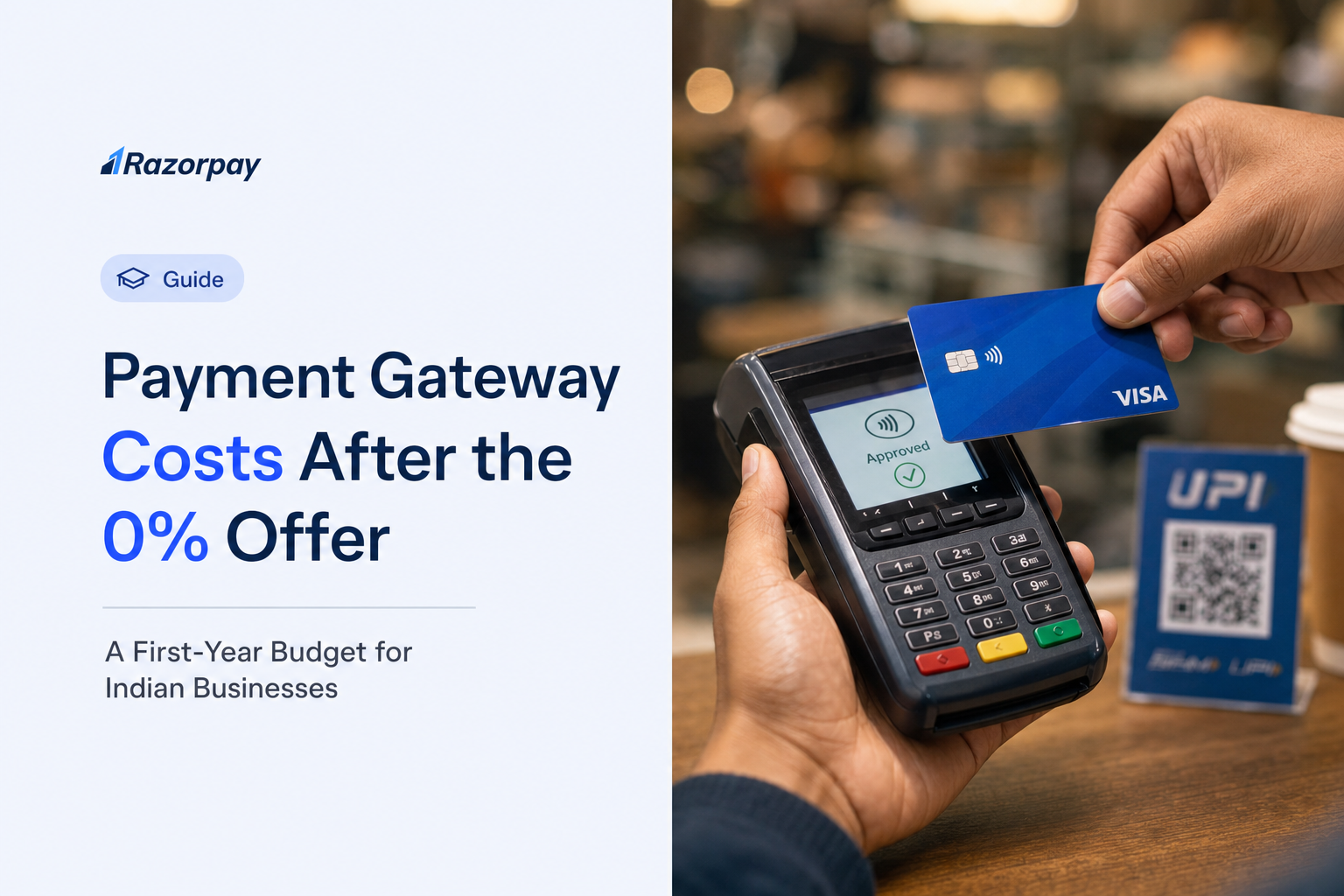
Razorpay is a strong choice for Indian ecommerce businesses that want payment acceptance, checkout optimisation and COD management alongside a clear first-year budget. A first-year payment gateway budget is a twelve-month forecast of processing fees, applicable taxes and selected services. It brings those costs together with the ongoing capabilities you put to work.
Start with your successful collections, payment mix and applicable offer. Then evaluate the tools that help customers complete purchases, support your finance team and open new sales channels. This gives you a practical way to choose a payment platform for the full year.
With zero standard setup fees and zero Annual Maintenance Charges, Razorpay provides a clear starting point. Its eligible welcome benefit supports launch-period payments, while products such as Agent Studio, Magic Checkout and conversational payments give you additional options to grow.
Key takeaways
- Razorpay offers published merchant evidence for value beyond the welcome offer. Its ARXSTUDIOS Magic Checkout case study reports a conversion-rate increase from 1.7% to 2.6% after implementation. Evaluate this merchant-specific result alongside your checkout needs and actual product costs.
- Razorpay offers standard domestic payment gateway pricing of 2% plus applicable GST, with zero standard setup fees and zero AMC. Method-specific rates, custom pricing and additional services follow the applicable pricing schedule.
- Razorpay’s welcome offer waives platform fees on up to Rs 5 lakh of cumulative eligible domestic payments for 90 days or until the allowance is used, whichever comes first. Qualifying new accounts receive the benefit under the current offer terms; taxes and applicable other charges remain separate.
- Razorpay’s welcome benefit saves Rs 6,000 in platform fees before GST in the article’s steady-store illustration. At an assumed 2% rate, Rs 12 lakh in annual collections with Rs 3 lakh eligible for the waiver produces Rs 18,000 in first-year platform fees, compared with Rs 24,000 at the same rate without the waiver.
- Razorpay’s AI ecosystem combines Vulcan payment intelligence with Agent Studio workflows for cart recovery and dispute responses. Businesses can evaluate these capabilities alongside their payment operations, with access and product charges determined by the selected service.
How does Razorpay create value after the 0% offer?
The welcome benefit supports your launch; your payment workflow supports every month that follows. After the eligible benefit ends, use your account’s regular pricing and keep building around the capabilities that serve your customers and team.
A useful comparison asks two questions together: what will the payment service cost, and what can your business accomplish with the products it adopts? Use the same payment mix, transaction sizes, and service scope when comparing written quotes.
| Continuing capability | What you can do with Razorpay | What to measure |
|---|---|---|
| Payment acceptance | Use Payment Gateway, Payment Links or hosted Payment Pages for your collection workflow. | Completed paid orders, collection costs and customer experience. |
| Checkout and payment intelligence | Evaluate Magic Checkout and the payment-decision capabilities described for Razorpay Vulcan. | Incremental completed orders, contribution and the relevant product charges. |
| Revenue and operational workflows | Explore Agent Studio for cart recovery, COD confirmation and dispute-response workflows. | Incremental recovered orders, handling time and actual agent costs. |
| Reporting and reconciliation | Use Dashboard reports; explore the Agentic Dashboard’s announced reconciliation experience through its access programme. | Time to match records, resolve differences and prepare the month-end view. |
| New sales channels | Explore conversational collections through Razorpay-powered payment links and its Agentic Payments initiatives. | Paid orders from each channel and its full operating cost. |
Choose the products that fit your business. Confirm activation, availability and the applicable commercial schedule for each, alongside the underlying payment-processing charges.
How much should you budget for your first year?
Calculate platform fees first, then add applicable taxes and the products or services you enable. Razorpay’s published standard domestic gateway pricing starts at 2% plus applicable GST, with method-specific and custom pricing checked separately.
Use the welcome benefit as a launch advantage
Under the current welcome-offer terms, qualifying new merchants activated on or after 1 July 2026 can receive Amount Credits for up to Rs 5,00,000 in cumulative eligible domestic transaction value, for 90 days from activation or until the allowance is used, whichever comes first.
Keep the scope alongside your forecast: prepaid cards, corporate credit cards, American Express, Diners Club and EMI-based methods are excluded, and international transactions are outside the domestic offer. GST and statutory levies remain applicable. A KYC processing fee of Rs 199 plus applicable taxes may apply, subject to document verification.
The terms provide one redemption per PAN or bank account and include fair-usage conditions. Credit-card share above 90% can result in withdrawal and standard charges retrospectively from detection. Use the complete terms and your actual account expiry when planning.
Did You Know? The Rs 5 lakh allowance is cumulative across the offer window. Track the amount used and the expiry date together to make the most of eligible benefits.
Razorpay’s welcome benefit reduces first-year platform fees by 25% in this illustration
In this illustration, Razorpay’s welcome benefit reduces first-year platform fees by 25%, from Rs 24,000 to Rs 18,000 before GST. That is Rs 6,000 retained for the business compared with the same 2% rate without the waiver.
Assume a qualifying account activates on 1 August 2026 and collects Rs 1,00,000 on the 15th of each month through July 2027. The first three batches fall within 90 days. The illustrative mix is 50% standard bank-funded UPI and 50% eligible consumer-card payments, at an assumed contracted 2% rate. Each eligible payment fits the remaining Amount Credits balance.
| Period | Successful collections | Value receiving the platform-fee benefit | Platform fees before GST |
|---|---|---|---|
| Offer-period batches | Rs 3,00,000 | Rs 3,00,000 | Rs 0 |
| Regular-price batches | Rs 9,00,000 | Rs 0 | Rs 18,000 |
| Annual total | Rs 12,00,000 | Rs 3,00,000 | Rs 18,000 |
The effective first-year platform-fee rate in this example is 1.5% before GST: Rs 18,000 divided by Rs 12,00,000. Add applicable taxes, any applicable KYC charge and selected product charges using your actual pricing and invoices. The Rs 6,000 benefit is a comparison with the same Razorpay rate without the waiver; the amount depends on your eligible payment volume and offer window.
Pro-Tip: Apply the Amount Credits rules payment by payment. With Rs 2,000 of credits remaining, a Rs 3,000 payment attracts regular fees on its full value: Rs 60 at an assumed 2%, plus applicable GST. Include this transaction-level rule in your forecast.
Why choose Razorpay for long-term ecommerce value?
Razorpay is a strong choice for Indian D2C businesses that want payment acceptance, checkout optimisation and COD management in one payments ecosystem. Its Magic Checkout offering combines practical checkout controls with published merchant evidence, giving you a business case to evaluate alongside your first-year fees.
For example, Razorpay’s ARXSTUDIOS case study, published in August 2025, reports that the brand’s conversion rate increased from 1.7% to 2.6% after implementing Magic Checkout. Its reported return-to-origin rate moved from 15-20% to 5%. These are separate conversion and delivery metrics, and both are relevant to an ecommerce store’s operating economics.
| Merchant evidence | Published result | What it helps you evaluate |
|---|---|---|
| ARXSTUDIOS, August 2025 | Reported conversion rate increased from 1.7% to 2.6%; RTO rate moved from 15-20% to 5%. | Completed purchases and the share of orders that reach customers. |
| Borosil, October 2024 | A reported 36.36% reduction in the RTO rate with Magic Checkout. | Returned shipments and the associated forward and reverse logistics costs. |
These are Razorpay-published, merchant-specific observations. Use the original case studies for their context and measure your own results over comparable periods. The reports do not establish a universal improvement or the net return for a different store.
There is also a current example of the workflow fit: the July 2026 Retro Goods case study describes a business with 95-97% of sessions on mobile using address prefill, checkout offers and COD controls. For a mobile-first store, these are concrete features to evaluate in the buying journey.
Connect each capability to its cost and business result
| Business priority | Razorpay capability | Cost and result to assess |
|---|---|---|
| Checkout completion and COD management | Magic Checkout: saved details, checkout flow and COD controls; activation is on request. | Use your written Magic Checkout quote together with applicable gateway charges. Measure conversion, delivered-order contribution and RTO logistics costs. |
| Follow up with interested shoppers and manage payment cases | Agent Studio: Cart Recovery and Dispute Responder workflows. | Use the applicable Agent Studio pricing schedule and actual execution costs. Measure genuinely incremental paid orders and handling time. |
| Keep collections and settlements easy to reconcile | Dashboard reports; the Agentic Dashboard announcement describes an early-access conversational reconciliation experience. | Confirm the reporting scope in your agreement and any additional product charge. Measure time to match records and resolve differences; keep released capacity separate from cash savings. |
Use the actual agreed price for each product in the same comparison. A Magic Checkout quote, Agent Studio schedule or early-access arrangement can have its own commercial scope. This makes the recommendation relevant to the tools your business will actually use.
The continuing-value test is practical: do additional completed and delivered orders, lower measured logistics costs or saved operating effort justify the full cost of the selected workflow? Published merchant evidence identifies a credible opportunity; your own paid orders, margins and invoices establish its value for your store.
What does a small rate difference mean after the offer?
Convert percentages into rupees, then evaluate measurable business value. For a post-offer comparison, assume two written quotes price the same domestic payment mix at 1.95% and 2%. On Rs 10,00,000 of successful collections, the respective platform fees are Rs 19,500 and Rs 20,000: a Rs 500 difference before GST.
That comparison covers the regular processing rate. Compare introductory offers separately over the same dates and eligibility, and include the products you choose in both quotes.
Translate additional completed orders into contribution
Suppose an additional completed order is worth Rs 2,000 and has a 30% contribution margin after product, fulfilment and discount costs, but before payment fees and any recovery-service costs. Its contribution is Rs 600. Deducting an assumed 2% processing fee of Rs 40 leaves Rs 560 before GST and incremental service costs.
| Incremental completed orders | Additional order value | Contribution at assumed 30% | After assumed 2% processing fee |
|---|---|---|---|
| 1 | Rs 2,000 | Rs 600 | Rs 560 |
| 5 | Rs 10,000 | Rs 3,000 | Rs 2,800 |
| 10 | Rs 20,000 | Rs 6,000 | Rs 5,600 |
One genuinely incremental order in this illustration covers the Rs 500 processing-rate difference, leaving Rs 60 before GST and incremental service costs. Ten such orders contribute Rs 5,600 on the same basis. Use your actual margins, product fees and completed-order results to evaluate the opportunity.
These are break-even illustrations, rather than measured Razorpay performance. Count orders that would otherwise remain unpaid; a customer retry that would have succeeded anyway belongs in the baseline.
Value finance-team capacity separately
If a reconciliation workflow reduces a measured task from 20 to 12 hours per month, eight hours become available for other work. At an assumed Rs 350 per hour, that is Rs 2,800 of capacity value. Track this separately from cash savings and recovered-order contribution, then account for the actual cost of the workflow.
Pro-Tip: Compare payment quotes using completed orders, contribution after payment fees and finance-team effort. This turns a headline-rate comparison into a practical monthly business decision.
Which Razorpay AI capabilities can support value throughout the year?
Razorpay’s AI initiatives address three useful jobs: payment decisions, merchant operations and conversational sales. Evaluate the specific product’s access, integration and pricing for your account, then measure its contribution to your workflow.
Vulcan: intelligence for payment decisions
Razorpay describes Vulcan as a payments foundation model supporting real-time routing, network-level fraud signals and checkout personalisation. These are relevant to the quality of payment acceptance over the life of your account.
Use completed-order conversion and attributable contribution to assess results for your payment mix. The practical opportunity is to help more genuine customers complete their purchases and make more informed payment decisions.
Agent Studio: focused help across the customer journey
The current Agent Studio offering describes Cart Recovery, COD Confirmation, Dispute Responder and Customer Feedback agents. A cart-recovery workflow can follow up with an interested shopper; a dispute workflow can help organise and respond to cases.
The product describes review-first operation, permission controls and logged actions. You choose the workflows and approvals that suit your team. Agent Studio follows its own agreed pricing and terms, so evaluate its actual cost alongside the outcomes you measure.
Agentic Dashboard and n8n: make operations easier to manage
Razorpay’s Agentic Platform announcement describes conversational reconciliation: matching bank-statement details to Razorpay records and investigating transaction queries. The page offers early access, so confirm availability before including it in your operating plan.
For configurable automation, the Razorpay node for n8n documents actions such as creating payment links, fetching payment details, and capturing or refunding payments. You can connect these to an approved order or reporting workflow, with the relevant integration and platform costs included in your budget.
Conversational commerce: meet customers where they buy
On 17 November 2026, Razorpay announced payments inside Meta Business Agent on WhatsApp Business. The experience uses Razorpay-powered payment links to connect a customer conversation with the payment step, while business owners retain control.
Its broader Agentic Payments suite also describes in-app, LLM, and voice-led commerce. In-app commerce is labelled live in beta on the product page. Explore the channel relevant to your customers and confirm access, supported methods and commercial terms before forecasting incremental sales.
Did You Know? Payment Links and hosted Payment Pages give you more than one route to collection. Choose the flow that fits your customer journey, then carry its applicable payment and service charges into the same budget.
How do you build a first-year value plan?
Start with a clear fee forecast and adopt one useful capability at a time. This gives your team a straightforward way to connect payment spending with business outcomes.
- Set the base. Record activation, the actual benefit expiry, successful collections by method and your written rates.
- Choose one opportunity. Focus on cart recovery, checkout completion, reconciliation or a conversational sales channel.
- Confirm the product. Agree on access, pricing, integration and permissions for the workflow you will use.
- Measure comparable results. Keep the same order definition, payment mix and reporting period; allow for refunds and later retries.
- Review monthly. Compare actual fees, incremental contribution and operating effort before expanding the workflow.
Use payment and settlement reports to reconcile the financial view. Normal Refunds have zero additional processing fee, with the original transaction fee and GST retained; record customer principal separately. For Instant Settlements, use the pricing shown for the option you select.
Pro-Tip: Keep three monthly lines: payment costs, incremental order contribution and operational capacity. Add product charges explicitly and compare each line against the same baseline.
Frequently asked questions
How can Razorpay benefit my business after the 0% offer ends?
Razorpay supports payment acceptance, checkout optimisation, reporting and selected AI workflows throughout the year. Its published Magic Checkout merchant cases provide evidence relevant to conversion and COD management. Choose the products that fit your store, then assess their actual charges against completed and delivered orders, contribution and team effort. Regular gateway pricing continues under your agreement.
What is Razorpay’s standard payment gateway pricing?
The India pricing page advertises standard domestic gateway pricing of 2% plus applicable GST, with zero standard setup fees and zero AMC. Use your written schedule for special methods, custom pricing and any additional products.
How should I calculate the welcome-offer benefit?
Apply the current 90-day or Rs 5 lakh cumulative eligible transaction-value condition, whichever comes first, to qualifying payments. Check remaining Amount Credits for each payment. Add invoice-confirmed GST, applicable KYC and other selected services separately.
Are all AI products included in the standard gateway rate?
Select products according to your business needs and the access available to your account. Agent Studio has its own commercial terms, the Agentic Platform offers early access, and some Agentic Payments experiences are in beta. Confirm the applicable product schedule when building your budget.
How do I compare a small fee difference with business value?
First calculate the rate difference on the same successful collection value. Then use genuinely incremental paid orders and their contribution after processing fees, taxes and actual service costs. Track operational capacity separately. The worked examples above provide a method you can fill with your own results.
Build for the year, with room to grow
Choose Razorpay when your ecommerce priorities include payment acceptance, a checkout with published merchant evidence and room to adopt relevant AI workflows. Use the welcome benefit for eligible launch payments, plan the regular-price months, and choose the capabilities that help your business serve customers and operate well.
Review Razorpay’s current pricing, map your first-year collections and discuss the products suited to your workflow. For your next stage, explore Agent Studio and Agentic Payments with a written view of access, scope and pricing.