A cost-effective payment gateway for startups is one with the lowest Total Cost of Ownership (TCO), not simply the lowest advertised transaction rate. For Indian startups processing under Rs 5 lakh per month, the biggest early-stage cost drivers are fixed charges such as setup fees and annual maintenance charges, platform fees, GST on those fees, payment-method exclusions, and payment success rate.
Every payment gateway in India carries some cost beyond the headline rate; GST, KYC fees, and method-specific charges apply regardless of the platform fee.
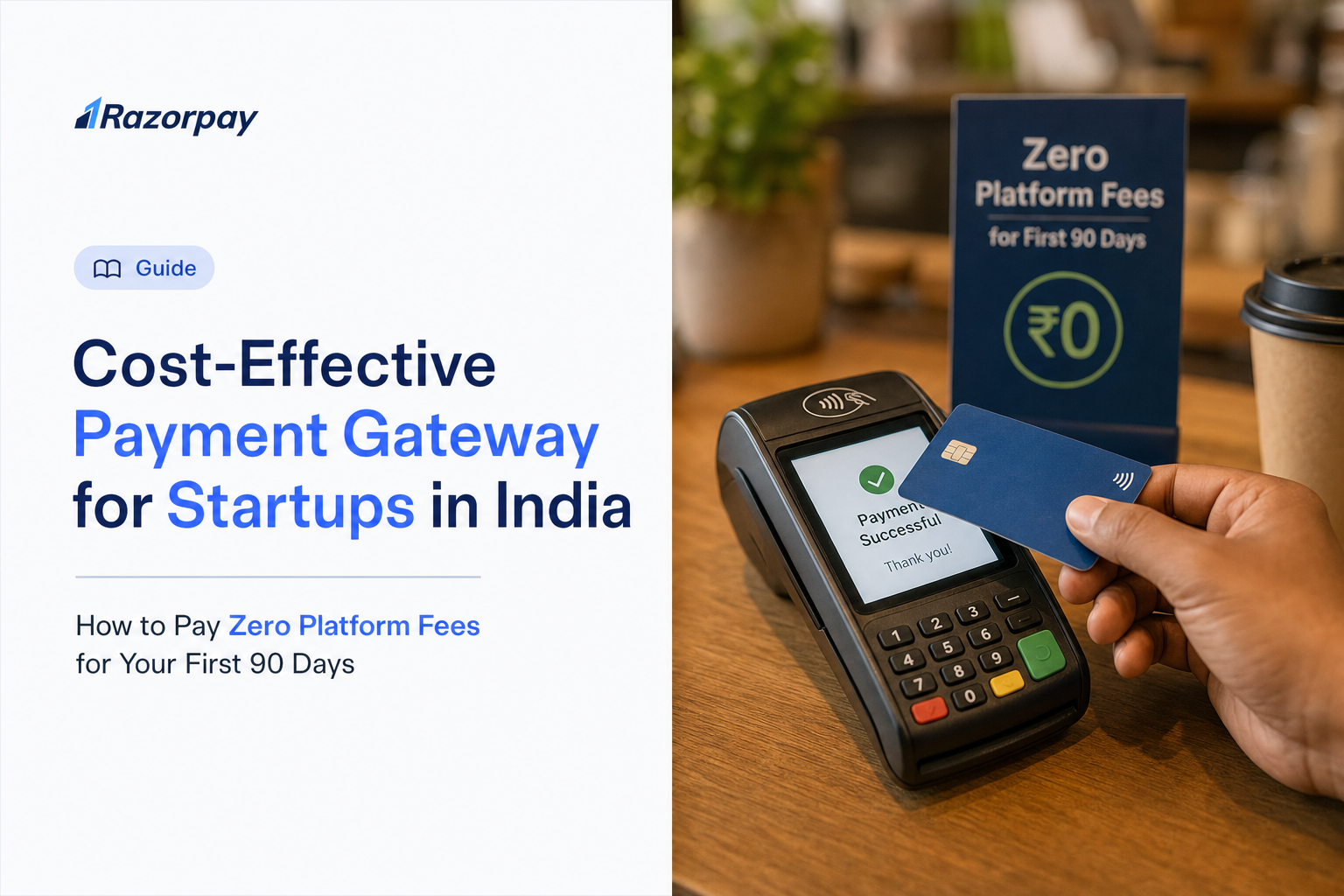
The useful question is not which gateway is cheapest per transaction, but how you reduce total payment cost during the first 90 days, while volumes are small enough that fixed fees hurt disproportionately. Razorpay’s 90-day 0% platform fee offer waives the standard 2% on eligible domestic transactions for new merchants, up to Rs 5 lakh cumulative GMV. GST at 18%, a one-time Rs 199 KYC fee, and standard rates on excluded methods (prepaid cards, corporate credit cards, AMEX, Diners Club, EMI) still apply.
Industry surveys consistently identify high transaction charges and fixed recurring fees among the primary barriers to digital payment adoption for Indian MSMEs.
Key Takeaways
- A 0.05% rate difference is noise at startup scale. At Rs 1 lakh monthly GMV, 0.05% saves Rs 50 a month, while a Rs 4,999 annual maintenance charge (AMC) costs about Rs 416 a month, or 0.4% of that same GMV.
- The 90-day 0% platform fee offer provides Rs 5,00,000 in Amount Credits. New merchants who complete KYC and are activated on or after 1 July 2026 get credits that apply automatically, covering the standard 2% platform fee on eligible domestic transactions for 90 days or Rs 5 lakh cumulative GMV, whichever comes first.
- GST is not waived. Per the offer terms (clause 6) and the Razorpay pricing guide, GST at 18% is calculated on the standard 2% platform fee rate, not on the credited amount. On the full Rs 5 lakh cap, total cost is roughly Rs 2,035: about Rs 1,800 GST on the standard platform fee plus around Rs 235 for the one-time Rs 199 KYC fee with tax.
- That is roughly Rs 9,800 in savings against an illustrative gateway at 1.95% plus a Rs 2,999 AMC plus a Rs 1,500 setup fee, where the same GMV costs about Rs 11,454.
- Success rate can cost more than MDR. A 7 percentage-point gap on Rs 2 lakh of attempted monthly GMV means around Rs 14,000 worth of transactions fail on the first attempt, of which roughly Rs 7,000 never convert even on retry.
- The UPI MDR change on 15 October 2026 depends on your average order value. Eligible UPI P2M transactions above Rs 2,000 attract 0.4% MDR, capped at Rs 300.
After the window closes, standard pricing applies with no AMC, no setup fee, no lock-in, and no termination fee.
Why Startups With Low Transaction Volumes Need a Different Cost Lens
At Rs 1 lakh in monthly GMV, a 0.05% MDR difference saves Rs 50 a month. A Rs 4,999 AMC costs about Rs 416 a month whether you process Rs 10,000 or Rs 10 lakh. That is the whole argument for checking fixed fees before rates.
The rate spread in India is narrow; most major gateways price domestic transactions between 1.95% and 2% in 2026, a difference of five basis points that saves just Rs 50 on Rs 1 lakh GMV. Fixed costs vary far more: setup fees run from Rs 1,500 to Rs 25,000 one-time, and AMC from Rs 2,999 to Rs 4,999 per year.
Watch flat per-transaction fees too. A netbanking transaction charged at a Rs 15 flat fee on a Rs 200 order equals a 7.5% effective cost, several times the credit card MDR.
How AMC Changes Your Effective Payment Cost
A Rs 4,999 AMC amortises to Rs 416.58 per month. If a competing gateway offers 1.75% against 2.0%, the rate advantage is 0.25%, so break-even GMV is Rs 416.58 divided by 0.0025, or about Rs 1,66,633 a month.
| Monthly GMV | Rs 4,999 AMC as % of GMV | Cost at 1.75% + AMC | Cost at 2.0% + Rs 0 AMC | Lower-cost option |
|---|---|---|---|---|
| Rs 50,000 | 0.8% | 2.6% | 2.0% | Zero AMC |
| Rs 1,00,000 | 0.4% | 2.2% | 2.0% | Zero AMC |
| Rs 1,66,633 | 0.3% | 2.0% | 2.0% | Break-even |
| Rs 5,00,000 | 0.1% | 1.8% | 2.0% | Lower rate plus AMC |
Above roughly Rs 1.67 lakh a month, the rate difference begins to offset the AMC, but only if the competing gateway matches Razorpay on success rate, refund policy, and settlement speed. A 2 percentage-point gap in payment success rate at that volume costs more than the entire AMC. Below it, zero fixed fees win decisively, which is why the low-cost payment gateway decision guide treats fixed-cost elimination as the first filter.
The Total Cost of Ownership Formula for Startup Payment Processing
Your true payment cost is a single percentage, and it is rarely the number on the pricing page.
Monthly TCO = Platform fees + fixed transaction fees + GST at 18% + AMC allocation + setup fee allocation + settlement fees + refund costs + chargeback fees
Effective cost percentage = (Monthly TCO / Monthly GMV) x 100
Two components founders forget. Refunds: the customer receives the full amount, but the original platform fee is generally not returned. The transparent pricing guide suggests asking whether MDR is reversed on full refunds, reversed pro-rata on partial refunds, whether GST is reversed, and whether a flat refund fee applies. Disputes: chargeback fees typically range from about Rs 200 to Rs 600 per incident in network-mandated fees, with representment fees of Rs 750 to Rs 1,500 on top if the merchant contests the dispute.
One factor works in your favour. If you are GST-registered, you may claim input tax credit on the 18% GST on gateway fees. ITC requires a valid GST invoice carrying both GSTINs, and the charge must appear in your GSTR-2B after the supplier files GSTR-1.
How To: Calculate Your Startup’s True Payment Gateway Cost in 5 Steps
Step 1: List your six-month transaction profile. Expected monthly GMV, average order value, method split across UPI, cards, netbanking, and wallets, refund rate, and growth assumption.
Step 2: Add every fixed cost. Setup fee amortised over 12 months, AMC as a monthly allocation, and any one-time KYC fee.
Step 3: Calculate variable costs by method. Multiply each method’s rate by expected volume, add flat per-transaction fees, then add 18% GST on all fees.
Step 4: Subtract only genuinely waived fees. Remove the platform fee for months one to three under an introductory offer. Do not remove GST, KYC fees, or fees on excluded methods.
Step 5: Compute your effective cost percentage. Divide total six-month cost by six-month GMV and multiply by 100. Compare that number, never the headline rate.
What Makes a Payment Gateway Cost-Effective for Low-Volume Startups?
A cost-effective gateway for a low-volume startup has zero setup fee, zero AMC, no punitive flat per-transaction fees, a clearly disclosed introductory offer, a transparent refund-fee policy, reliable method-level success rates, no lock-in, and a defined path to custom pricing.
| Criterion | What to look for | Why it matters at low volume |
|---|---|---|
| Setup fee | Rs 0 upfront | Preserves scarce launch capital |
| AMC or minimum fee | Rs 0, no inactivity charge | Avoids a cost floor before revenue is predictable |
| Flat fee per transaction | None or minimal | Protects margin on Rs 200 to Rs 1,000 tickets |
| Introductory offer | Clear duration, cap, exclusions | Can materially cut launch-period costs |
| Refund policy | Stated MDR, GST, and flat-fee reversal rules | Prevents surprises when returns rise |
| Payment success rate | Method-level reliability, retry logic | Each failed payment is a larger proportional loss |
| Lock-in terms | Month-to-month, no exit penalty | Startups pivot; avoid sunk cost |
| Scaling path | Defined custom-pricing threshold | Cost should improve as you grow |
Treat success rate as a financial variable. Industry benchmarks put UPI success rates broadly in the high-80s to mid-90s percentage range, with variability during peak transaction hours, and roughly half of customers who hit a failed first attempt do not convert on retry. The payment success rate optimization guide covers the routing mechanics behind that gap.
Also confirm your provider is authorised to hold your money. Only RBI-authorised Payment Aggregators can legally handle merchant funds in India; check the RBI authorisation records.
How the 90-Day 0% Platform Fee Offer Works
Razorpay’s offer gives new merchants Rs 5,00,000 in Amount Credits that apply automatically on activation, waiving the standard 2% platform fee on eligible domestic transactions for 90 days or until Rs 5 lakh cumulative GMV, whichever comes first. No promo code. GST and a Rs 199 KYC processing fee still apply.
The terms that matter, from the official terms and conditions and the 90-day offer explainer:
| Term | Detail |
|---|---|
| Eligibility | KYC completed and activation on or after 1 July 2026; merchants already transacting are not eligible |
| Activation | Rs 5,00,000 in Amount Credits applied automatically |
| Cap | 90 days or Rs 5 lakh eligible GMV, whichever comes first |
| Included methods | UPI, debit cards, credit cards (Visa, Mastercard), netbanking across 58+ banks, wallets |
| Excluded methods | Prepaid cards, corporate credit cards, American Express, Diners Club, all EMI, international transactions |
| Not waived | GST and statutory levies, plus a Rs 199 KYC processing fee with taxes |
| Redemption limit | One per PAN or bank account; only the first activated MID qualifies |
| Credit expiry | Unused credits lapse at day 90, with no carry-forward or encashment |
| Fair usage | If credit card transactions exceed 90% of processed volume, the offer may be withdrawn |
Two details are easy to misread. Excluded-method GMV is billed at standard rates throughout and does not consume the Rs 5 lakh cap. And credit-card concentration thresholds vary across offers in the market, so check the number before a premium-priced D2C month breaches it. Current rates sit on the transparent pricing page.
What 5 Lakh of Eligible GMV Really Costs in the First 90 Days
| Cost component | Illustrative gateway: 1.95% + AMC + setup | Under the 0% offer |
|---|---|---|
| Platform fee on Rs 5,00,000 | Rs 9,750 | Rs 0 (Rs 10,000 credited) |
| GST at 18% on platform fee | Rs 1,755 | Rs 1,800 (still payable) |
| AMC (3 months) | Rs 750 | Rs 0 |
| Setup fee | Rs 1,500 | Rs 0 |
| KYC fee with GST | Not modelled | Rs 235 |
| Total, 90 days | Rs 13,755 | Rs 2,035 |
| Effective cost of GMV | 2.8% | 0.4% |
Approximate savings: Rs 11,720
Note: Per the offer terms (clause 6), GST is calculated on the standard 2% platform fee rate, not on the waived amount. The platform fee is credited back via Amount Credits, but the GST on it remains payable.
How to Use the 90-Day Offer Without Wasting the Cap
The Rs 5 lakh credit is a ceiling with an expiry date. Even at Rs 1 lakh GMV, the offer saves Rs 2,000 in platform fees with zero downside; unused credits simply expire, and there is no penalty, no lock-in, and no obligation to reach the cap. The offer is structured so that every rupee processed within the window is free regardless of whether you use the full Rs 5 lakh. Process Rs 15 lakh and standard pricing resumes the moment eligible GMV crosses Rs 5 lakh, likely in week five.
| Eligible domestic GMV in 90 days | Platform fee waived at 2.0% | What happens to the rest |
|---|---|---|
| Rs 1,00,000 | Rs 2,000 | Rs 4,00,000 in credits lapse |
| Rs 4,00,000 | Rs 8,000 | Rs 1,00,000 in credits lapse |
| Rs 5,00,000 | Rs 10,000 | Full eligible value used |
| Rs 15,00,000 | Rs 10,000 | Standard pricing from the Rs 5 lakh mark |
If forecast GMV is below Rs 5 lakh, time activation so your launch campaign lands inside the window. The clock starts at activation, not signup, so slow onboarding costs offer value directly; look for fully paperless KYC, as covered in the bootstrapped startup guide. If forecast GMV is higher, model standard pricing from week five before committing ad spend.
What Happens After the 90-Day Offer Expires?
On day 91, standard pricing resumes automatically: 2% plus 18% GST on most domestic methods, with RuPay Credit Card via UPI at 2.15%. There is no setup fee, no AMC, no lock-in, and no termination fee. Custom pricing can be discussed as monthly GMV crosses Rs 5 lakh.
After the offer window, the standard platform fee covers gateway infrastructure, fraud protection, and payment routing across all domestic methods, including UPI. The regulated zero MDR means no interchange is passed through to card networks on UPI — the 2% is entirely for platform services.
Zero MDR on RuPay debit cards and UPI is statutory, not a provider concession: Under the existing regulatory framework, no MDR applies to RuPay debit card and UPI transactions up to Rs 2,000. The September 2026 regulatory change introduced 0.4% MDR on eligible P2M UPI transactions above that threshold, while preserving the zero-MDR provision below it. The MDR, TDR, and platform fee distinction is unpacked in the payment gateway pricing explained breakdown. SaaS and membership startups should look at subscription billing once recurring revenue starts.
Pro-Tip: By day 90, you will have three months of real data on GMV, method mix, AOV, refunds and disputes. If monthly GMV has crossed Rs 5 lakh, negotiate with that data in hand.
UPI MDR Change From 15 October 2026: What It Means for Startup Payment Costs
From 15 October 2026, eligible UPI P2M transactions above Rs 2,000 attract 0.4% MDR, capped at Rs 300 per transaction. Transactions at or below Rs 2,000 remain protected; the charge is payable by merchants rather than customers, and P2P transfers stay free.
The Rs 300 cap means high-value purchases of Rs 75,000 and above attract a flat Rs 300, so the effective rate declines above that point. Railways, telecom, insurance and fuel carry a flat Rs 5 above Rs 2,000, while capital markets are priced at 0.02% capped at Rs 300. The 0.4% fee is also expected to attract 18% GST, with registered merchants able to claim input tax credit.
Read the small-merchant carve-out carefully. Merchants under the P2PM framework receiving up to Rs 1 lakh per month through UPI QR codes continue at zero MDR, and merchants receiving more than Rs 1 lakh for three consecutive months can be reclassified into regular P2M. Online checkout businesses generally sit in P2M, so ask your provider whether your UPI account is classified as P2PM or P2M.
Did You Know? Most UPI Payments May Not Cross the New Threshold
In August 2026, UPI processed 24.51 billion transactions worth Rs 29.82 lakh crore, putting the average ticket at approximately Rs 1,217. Per NPCI, transactions up to Rs 2,000 account for more than 95% of P2M UPI transactions.
| Average UPI order value | Above Rs 2,000? | 0.4% MDR per transaction |
|---|---|---|
| Rs 1,217 (market average) | No | Rs 0 |
| Rs 1,999 | No | Rs 0 |
| Rs 2,500 | Yes | Rs 10 |
| Rs 5,000 | Yes | Rs 20 |
| Rs 75,000 and above | Yes | Rs 300 (cap) |
Pro-Tip: Steer early customers toward UPI payments and standard cards during the offer window, since excluded methods are billed at standard rates.
How to Get Started With a Zero-Cost Payment Gateway Setup
Step 1: Create an account through the payment gateway onboarding flow.
Step 2: Complete KYC and pay the one-time Rs 199 processing fee plus GST.
Step 3: Confirm the Amount Credits appear in your dashboard after activation. No promo code needed.
Step 4: Choose an integration path: APIs, plugins for Shopify, WooCommerce or Magento, or no-code payment links.
Step 5: Start accepting payments and track covered GMV, excluded-method volume, and your expiry date.
Step 6: Review data before the window closes and request custom pricing above Rs 5 lakh monthly GMV.
Frequently Asked Questions
What is the cheapest payment gateway for a startup in India with low transaction volume?
One with zero setup fee, zero AMC, no flat per-transaction fees on low tickets, and an introductory zero-platform-fee window. A 0.05% rate difference on Rs 1 lakh GMV saves Rs 50, while a Rs 4,999 AMC adds about Rs 416 monthly regardless of volume. Razorpay offers all three: zero setup fee, zero AMC, and a 90-day 0% platform fee offer for new merchants activated on or after 1 July 2026, covering up to Rs 5 lakh in eligible domestic transactions. Total cost at full cap utilization is approximately Rs 2,035 (GST plus a one-time Rs 199 KYC fee with tax), making it the lowest TCO entry point among Indian payment gateways.
Does the 90-day 0% platform fee offer include GST?
No. On the full Rs 5 lakh eligible domestic GMV cap, GST at 18% on the standard Rs 10,000 platform fee is about Rs 1,800, payable alongside the one-time Rs 199 KYC fee plus tax. Total offer-period cost at full cap utilization is around Rs 2,035, not zero.
When does the 90-day clock start: signup, KYC, or first payment?
It runs from account activation, which follows KYC completion. Eligibility requires activation on or after 1 July 2026. Every week of delayed activation is offer value you cannot recover, and unused credits lapse at day 90.
What happens if I reach Rs 5 lakh in eligible GMV before 90 days?
Standard pricing resumes immediately: 2% plus 18% GST on most domestic methods, with RuPay Credit Card via UPI at 2.15%. There is no setup fee, no AMC, no lock-in, and no termination fee afterwards.
Does the UPI MDR rule above Rs 2,000 apply to my online startup?
The Rs 1 lakh monthly zero-MDR exemption applies to small merchants under the P2PM framework collecting via QR codes. Online checkout businesses generally sit in P2M, so confirm your account classification rather than assuming exemption.
Can I claim input tax credit on GST charged on payment gateway fees?
A GST-registered business can generally claim ITC on the 18% GST on gateway fees, provided you hold a valid invoice carrying both GSTINs and the charge appears in your GSTR-2B. That materially reduces effective Total Cost of Ownership.