Your checkout fails during your biggest sales day, and there is nobody to call. Your pricing sheet stops making sense the moment GST and an annual maintenance charge land on the invoice. And somewhere sits an uncomfortable question about whether the company holding your settlement money is actually authorised to hold it.
Most founders arrive here at one of three moments: integrating a gateway before launch, cleaning up after an outage, or running vendor diligence before a funding round.
A payment gateway is the technology that authorises and routes every online transaction between your customer’s bank and yours. In India, it must also be an RBI-authorised Payment Aggregator to legally hold your settlement funds. So here is the money question: which gateway actually costs the least and fails the least once you strip away the marketing pages?
The core misconception first: the lowest headline MDR is frequently not the lowest total cost. A gateway that is 0.5% cheaper with a 15-point lower success rate loses far more revenue than it saves in fees. Founders lose money on failed payments, not on fee percentages.
Key Takeaways
- Total cost of acceptance beats headline MDR. A gateway that is 0.5% cheaper but has a 15-point lower success rate can cost you Rs 73,000 more per month in lost revenue on Rs 5 lakh GMV. Model: MDR plus GST plus fixed fees against your actual success rate.
- Razorpay’s 90-day zero platform fee offer lets new startups test with real transactions before committing. Up to Rs 5,00,000 GMV at zero cost, applied automatically on KYC approval. No promo code, no minimum first transaction.
- RBI Payment Aggregator authorisation must be verified independently. The RBI returned 57 applications and directed 17 operating aggregators to wind down in February 2023. Cross-check the legal entity name on the RBI’s published list, not a badge on the vendor’s website.
- UPI outages are documented and real. Four separate disruptions hit within one month in April 2025, with success rates dropping to 50-60%. Multi-bank smart routing with automatic failover is the real protection, not a single uptime percentage.
- “24×7 support” is not an SLA. Judge by four things: first-response time in writing, a named chargeback escalation owner, per-transaction failure-reason data, and whether support is phone/chat or ticket-only.
- UPI MDR is live from 15 October 2026 for amounts above Rs 2,000. Split your UPI GMV into the slice below and above Rs 2,000, apply 0.4% plus 18% GST to the qualifying portion, and build that into your FY27 plan.
Why Is Choosing a Payment Gateway Harder for Indian Startups in 2026 Than It Used To Be?
India’s payments market has expanded and been re-regulated in the same 18 months. A provider that looked safe in 2024 may not meet the requirements set by the RBI’s September 2025 Master Direction today. Choosing a gateway now means evaluating regulatory standing alongside pricing and performance.
How big is India’s digital payments market right now?
India’s digital payments market reached USD 10.43 billion in 2026, with a projected 22.27% CAGR through 2034. UPI alone processed 24.51 billion transactions in August 2026 worth Rs 29.82 lakh crore, up 22% year on year.
Digital payments now account for 99.7% of transaction volume in India. A gateway is no longer a growth lever. It is basic infrastructure, and it fails like infrastructure fails. For scale, 2,12,283 DPIIT-recognised startups as of 31 January 2026 are making some version of this decision.
Why did the RBI tighten payment aggregator rules in September 2025?
The RBI issued a Master Direction on 15 September 2025 that consolidated three earlier frameworks into a single rulebook covering both bank and non-bank aggregators. It raised the bar on who can legally hold merchant settlement funds, tightened merchant KYC, and standardised escrow handling. Authorisation status is now a first-order selection criterion, not a footnote.
Did You Know?
The RBI has not only approved payment aggregators. In February 2023, it returned 57 applications and told 17 operating aggregators to stop and wind down their online payment aggregation business. Picking an unauthorised provider is a business continuity risk, not just a compliance checkbox.
What Does “Pricing” Actually Mean for a Payment Gateway, and Why Does the Headline Rate Mislead?
A payment gateway’s real cost is the MDR or platform fee, plus 18% GST on that fee, plus any setup or annual maintenance charge, divided by your actual payment success rate. Two gateways with identical headline rates can differ by lakhs a month once success rate and settlement delay are counted.
The six-part true cost model every startup should use
- Direct transaction fee. The MDR or platform fee per instrument. Card, UPI, netbanking, and EMI rarely price the same.
- GST on the fee. 18% on the fee amount, not the transaction value. Frequently omitted from founder spreadsheets.
- Fixed costs. Setup fee, annual maintenance charge, minimum monthly commitments.
- UPI MDR exposure. New from 15 October 2026 on qualifying merchant transactions above Rs 2,000.
- Cost of failed transactions. The biggest hidden line item. Revenue attempted minus revenue captured.
- Cost of delayed settlement. Working capital locked in a slower settlement cycle.
An annual maintenance charge of Rs 10,000 at Rs 5,00,000 monthly volume adds roughly 0.16% to your effective rate, which quietly closes most “cheaper headline rate” gaps.
For bootstrapped startups doing under Rs 10 lakh monthly GMV, the fixed-cost bucket matters disproportionately. A Rs 10,000 AMC on Rs 3,00,000 monthly GMV adds 0.28% to your effective rate, more than many headline MDR differences. Several providers in India now offer zero setup fees and zero AMC on standard plans, making the entry cost genuinely zero beyond the per-transaction percentage. Razorpay’s standard plan carries no setup fee and no AMC.
How Razorpay Fits This Framework for Early-Stage Startups
Razorpay meets the eight-point framework with a 2% plus GST domestic Payment Gateway rate, zero setup and annual maintenance fees, RBI Payment Aggregator authorisation, PCI DSS Level 1 compliance, 90-95% success rates via smart routing, and a 90-day 0% platform fee welcome offer for newly activated merchants.
What the current welcome offer includes
- 90 days of zero platform fees on domestic Payment Gateway transactions, up to Rs 5,00,000 cumulative GMV.
- Applies to new merchants who complete KYC and are activated on or after 1 July 2026.
- Applied automatically as Amount Credits on KYC approval. No promo code, no first-transaction trigger.
- Exclusions: prepaid cards, corporate credit cards, American Express, Diners Club, and all EMI methods.
- GST and other statutory levies apply, as does the Rs 199 KYC processing fee plus taxes.
- One redemption per PAN or bank account. Unused credits lapse after 90 days.
- Full 90-day offer terms apply.
Which Razorpay product maps to which startup problem
| Startup problem | Razorpay product |
|---|---|
| Core website or app checkout | Payment Gateway |
| Collecting payments before the site is built | Payment Links and Payment Pages |
| SaaS recurring billing and renewals | Subscriptions with UPI Autopay |
| Working capital locked in settlement cycles | Instant Settlements |
| Marketplace vendor split payouts | Route |
| Payouts, vendor payments and business banking | RazorpayX |
Run your own numbers against the framework, then talk to the Razorpay team or check current pricing details.
How much does a lower success rate actually cost in rupees?
| Line item | Gateway A (1.8% MDR, 75% success rate) | Gateway B (2% MDR, 90% success rate) |
|---|---|---|
| Attempted GMV | Rs 5,00,000 | Rs 5,00,000 |
| Revenue captured | Rs 3,75,000 | Rs 4,50,000 |
| Transaction fee | Rs 6,750 | Rs 9,000 |
| GST on fee (18%) | Rs 1,215 | Rs 1,620 |
| AMC (monthly equivalent, Rs 10,000/yr) | Rs 833 | Rs 0 |
| Net cash in bank | Rs 3,66,202 | Rs 4,39,380 |
Gateway B costs roughly Rs 2,655 more in fees and delivers roughly Rs 73,000 more in the bank. That is the trade the headline rate hides.
Fee visibility matters at the checkout too: 48% of customers abandon carts over additional or hidden charges appearing late in the flow.
PRO-TIP
Model your true cost at your actual payment mix, not a generic blended rate. UPI accounted for 85.5% of digital transaction volume in H2 2025, and 10% of shoppers abandon checkout because their preferred payment method was missing. A card-weighted cost model will mislead most Indian D2C and SaaS startups.
What Does the New UPI MDR From 15 October 2026 Cost Your Startup?
From 15 October 2026, a 0.4% MDR applies to specified person-to-merchant UPI transactions above Rs 2,000, capped at Rs 300 for transactions of Rs 75,000 and above. Consumer and P2P UPI stays free.
Which UPI transactions are charged, free, or exempt?
Parliament amended Section 10A of the Payment and Settlement Systems Act in August 2026, removing the legal bar on charging MDR for UPI, and the Finance Ministry confirmed consumer and P2P UPI stays free. A gazette notification then protected UPI payments up to Rs 2,000 as zero-charge.
Small merchants in the P2PM category receiving up to Rs 1 lakh monthly remain MDR-free regardless of ticket size. GST at 18% applies to the MDR fee, not the transaction value, and merchants cannot pass the charge on to customers.
PRO-TIP
Do not model this from average order value. A Rs 2,100 average can hide orders clustered at Rs 1,500 and Rs 3,000. Split your UPI GMV into value below and above Rs 2,000, apply 0.4% plus 18% GST to the qualifying slice, and put that number in your 2027 plan.
Comparing Payment Gateways on Pricing, Uptime and Support: The 8-Point Framework
Compare gateways on eight factors, not on the pricing page alone: onboarding speed, pricing transparency, payment method coverage, integration effort, uptime and reliability, compliance verification, support and escalation, and room to scale. Score each provider against these before a sales call, not after.
The 8-point evaluation framework
- Onboarding speed. Digital KYC that takes you live in days, not weeks of paperwork.
- Pricing transparency. One clear rate per method, plus written disclosure of GST, AMC, and settlement cycle.
- Payment method coverage. A missing method is a lost checkout, not a missing feature.
- Integration effort. Real API documentation, SDKs, and a sandbox. Read the developer documentation before the sales call.
- Uptime and reliability. A stated figure, plus multi-bank smart routing.
- Compliance verification. Current RBI authorisation and a dated PCI DSS assessment in writing.
- Support and escalation. A named escalation path and a stated first-response time.
- Room to scale. The same platform should work at 50x volume without a re-platform.
What to look for against each factor
| Evaluation factor | What to look for | Why it matters for a startup |
|---|---|---|
| Onboarding speed | Digital KYC, activation in days | Every week of delay is unearned revenue |
| Pricing transparency | Full written fee schedule including GST and AMC | Hidden fixed fees convert into an effective percentage at low volume |
| Payment method coverage | UPI as a first-class method, not an add-on | UPI is 85.5% of digital volume |
| Integration effort | Public API docs, SDKs, working sandbox | Engineering time is your scarcest resource |
| Uptime and reliability | Published uptime plus multi-bank failover | Rail-level outages are documented and real |
| Compliance verification | Certificate of Authorisation, PCI DSS assessment date | An unauthorised aggregator is a continuity risk |
| Support and escalation | Stated response time, chargeback escalation path | A failed payment at 11pm is a revenue event |
| Room to scale | Same platform handles enterprise volume | Migrating payment providers later is risky |
What about Shopify stores in India?
Shopify merchants in India face a specific choice: use Shopify Payments (powered by Stripe) or integrate a domestic gateway. The key difference is UPI treatment: domestic gateways treat UPI as a first-class payment method with direct bank integration, while international-first platforms may route UPI through a secondary processor.
For a Shopify store where UPI is the majority payment method, a domestic integration with zero AMC and direct UPI support typically delivers a lower total cost and higher success rate. Razorpay’s Shopify plugin supports the full Payment Gateway stack including UPI, cards, netbanking, and EMI, within the Shopify checkout.
How different provider categories typically perform
| Provider category | Typical strength | Typical trade-off for a startup |
|---|---|---|
| Legacy low-MDR processors | Very low headline card rates | Slow manual onboarding, redirect-heavy checkout, dated documentation |
| Wallet-ecosystem aggregators | Strong performance inside their own wallet rail | Weaker success rates on external bank and card instruments |
| Global cross-border platforms | Multi-currency and international method depth | UPI and domestic rails treated as secondary |
| Full-stack Indian payment aggregators | UPI-first coverage, developer tooling, domestic compliance depth | Headline rate may look higher before total cost is modelled |
Most Indian startups end up in the fourth category, because total cost, not headline rate, decides the outcome.
Where Razorpay stands on each of the eight factors
| Factor | Razorpay position |
|---|---|
| Pricing | 2% plus applicable GST on domestic Payment Gateway transactions, zero setup fee, zero AMC on standard plans |
| Coverage | 100+ payment methods across UPI, cards, netbanking, wallets and EMI |
| Reliability | 90-95% transaction success rates via smart routing, 99.99% system uptime over the last 12 months |
| Compliance | RBI-authorised Payment Aggregator, PCI DSS Level 1 compliant |
| Support | Average support response time within 24 hours |
| Integration | Public API reference including the Orders API, SDKs and a sandbox environment |
What Does “Uptime” Really Mean for a Payment Gateway?
A published uptime percentage describes the gateway’s own infrastructure availability, not the UPI or bank rail it depends on. Real resilience comes from multi-bank smart routing and automatic failover, because even national rails have suffered documented multi-hour outages that no single uptime figure captures.
What actually happened during India’s 2025 UPI outages
There were four separate UPI disruptions within roughly one month in 2025, with the 12 April incident lasting four to five hours. During the early-April disruption, transaction success rates fell to 50-60%. NPCI traced the April outage to excessive status-check requests from banks overwhelming capacity in the absence of a status check limiter.
A 99.9% gateway uptime figure would have been technically accurate throughout all of those events, and your checkout would still have been failing.
How smart routing protects you from a single-rail failure
Multi-bank terminal routing sends each transaction in real time through the bank terminal performing best at that moment, rather than down a fixed default path. When one path degrades, automatic failover shifts traffic without engineering intervention.
A serious gateway also exposes rail health programmatically. A downtime API lets you surface a banner, suppress a failing method, or nudge customers to an alternative before they abandon. Razorpay reports 90-95% transaction success rates via smart routing and 99.99% system uptime over the last 12 months.
Did You Know?
At India’s transaction scale, even a UPI failure rate below 1% translates into millions of failed transactions daily. Percentage points are not abstract here. They are orders.
What Should “Good Support” Look Like When a Payment Fails at 11pm?
Good support means a defined escalation path rather than a ticket queue, a stated first-response time, and a dashboard that shows why a specific transaction failed in real time. Anything less turns a single payment failure into a multi-day revenue leak you cannot diagnose.
Four questions to ask a gateway’s sales team before signing
- What is the average first-response time, in writing?
- Is there a named escalation path for chargebacks and disputes, and who owns it?
- Can I see failure-reason data per transaction, or only aggregate success rates?
- Is support reachable on phone or chat, or is it ticket-only?
Then verify it technically. Check that you can pull dispute APIs and transaction-level payment data into your own reporting, not just a dashboard export. Razorpay states an average support response time within 24 hours, with dispute and payment-level data available through both the API and dashboard, plus documented support channels.
PRO-TIP
Ask for a live walkthrough of the merchant dashboard’s failed-transaction reporting during your demo call. How a provider explains a failure tells you more than any SLA promise.
How Do You Verify a Payment Gateway’s RBI Authorisation Before Signing Up?
Ask the provider for its current Certificate of Authorisation number and cross-check it against the RBI’s published list of authorised entities. Do not rely on a badge on the vendor’s website. Verify the legal entity name, not the product brand, and confirm final authorisation rather than in-principle approval.
What happens if your gateway’s authorisation lapses?
A payment aggregator holds your settlement funds between the customer payment and your payout. If authorisation lapses, both that float and your ability to collect are exposed at the same time. This is not hypothetical. The RBI returned 57 applications and told 17 operating aggregators to stop and wind down their online aggregation business in February 2023.
What net worth and compliance thresholds should a serious gateway meet?
Non-bank payment aggregators must hold Rs 15 crore net worth at application, rising to Rs 25 crore by the end of the third financial year after authorisation.
Tokenisation is the second hard check. More than 91 crore card tokens had been issued by December 2024, enabling nearly 98% of ecommerce transactions to run without raw card data. If a provider expects you to store card numbers, that is a disqualifier. Razorpay is an RBI-authorised Payment Aggregator and PCI DSS Level 1 compliant.
PRO-TIP
Request the Certificate of Authorisation and most recent PCI DSS assessment date in writing before go-live, alongside settlement timing, cut-off, reserve policy and payout fees. Asking after integration gives you no leverage.
How Should a SaaS Startup Choose a Gateway for Recurring Billing?
A SaaS startup should prioritise native UPI Autopay and eNACH mandate support, automatic retry logic on failed renewals, and dunning management. Involuntary churn from failed recurring payments quietly removes a meaningful share of monthly recurring revenue before anyone notices.
Why a failed renewal costs more than a failed one-time payment
Involuntary churn accounts for 20-40% of total churn and costs the average subscription business about 9% of MRR. A 2024 projection estimated failed payments would cost subscription businesses USD 129 billion in lost revenue in 2025. A failed one-time payment loses one order. A failed renewal loses the remaining lifetime value of that customer, and the customer usually does not tell you.
What a subscription billing stack should include by default
- UPI Autopay mandates within prescribed limits
- Automatic retry scheduling on failed renewals
- Prorated upgrade and downgrade handling
- Dunning emails triggered on failure, not on cancellation
- Mandate status visibility before the renewal date
- Pre-debit notification handling aligned to RBI e-mandate requirements
Razorpay Subscriptions with UPI Autopay covers these recurring mandate requirements natively.
A Five-Step Checklist Before You Sign With Any Payment Gateway
Before signing, complete five checks: request the full written fee schedule, verify RBI authorisation independently, test the sandbox including a failed payment and a refund, confirm payment method coverage against your customer base, and get the support escalation path in writing.
- Request the full fee schedule in writing. MDR by method, GST treatment, AMC, UPI MDR handling, settlement cycle, and minimum volume commitments.
- Verify the Certificate of Authorisation against the RBI’s published list, matching the legal entity name. Ask for the PCI DSS assessment date too.
- Test the sandbox before committing. Simulate a success, a failure, a partial refund, and a chargeback. How the system handles failure tells you more than how it handles success.
- Confirm coverage against your real customer base, weighted to your actual mix and ticket distribution rather than a generic blend.
- Get the support SLA and escalation path in writing before go-live, including who owns chargeback escalation.
How to Switch Payment Gateways Without Losing Transactions
Switching gateways is operationally straightforward if you plan the data migration, run both providers in parallel during the cutover, and handle saved payment instruments correctly.
Seven-step migration checklist
- Export your transaction and customer data. Download settlement reports, saved card tokens (if transferable), subscription mandate references, and dispute history from your current provider.
- Check token portability. RBI tokenisation rules mean card tokens are vault-specific. Ask your new provider whether they support token migration or whether customers re-save cards at next checkout. More than 91 crore card tokens had been issued by December 2024, losing saved instruments means friction at checkout.
- Integrate the new gateway in a sandbox first. Test a payment, a failure, a partial refund, and a webhook delivery. Validate that your order management system reconciles correctly.
- Run both gateways in parallel. Route a small percentage of live traffic, 5 to 10%, through the new provider for one to two weeks. Compare success rates, settlement timing, and failure-reason data side by side.
- Migrate recurring mandates. For UPI Autopay or eNACH subscriptions, customers must re-authorise mandates on the new provider. Time this around a renewal cycle, not mid-billing.
- Update webhook endpoints and reconciliation scripts. Every downstream system that consumes payment events accounting, CRM, fulfilment needs the new payload format.
- Cut over and decommission. Once parallel metrics confirm parity or improvement, route 100% of traffic, then revoke API keys on the old provider after the last settlement clears.
What makes migration easier
Gateways with public API documentation, working sandboxes, and standard webhook formats reduce migration engineering to days rather than weeks. Razorpay’s API reference, SDKs, and sandbox environment are designed for this, the same integration works from test to production with a key swap.
Which Payment Gateway Fits Your Business Type?
The right gateway depends on your business model, not just your size. A SaaS company optimising for involuntary churn has different requirements from a D2C brand optimising for checkout conversion.
SaaS and subscription businesses
Prioritise UPI Autopay, eNACH mandate management, automatic retry logic, and dunning. Involuntary churn from failed renewals costs 20-40% of total churn. The gateway must handle prorated upgrades, mandate status visibility, and pre-debit notifications aligned with RBI e-mandate rules.
D2C and ecommerce brands
Prioritise checkout conversion rate, payment method coverage (UPI, cards, wallets, EMI, BNPL), and fast settlement. 10% of shoppers abandon checkout because their preferred payment method is missing. Cart-level analytics showing drop-off by method are more valuable than aggregate success rates.
Marketplaces and platforms
Prioritise split payouts, vendor settlement, and compliance with the RBI’s marketplace escrow norms. The gateway must support programmatic route-based splits and per-vendor settlement cycles without manual intervention.
Small businesses and sole proprietors
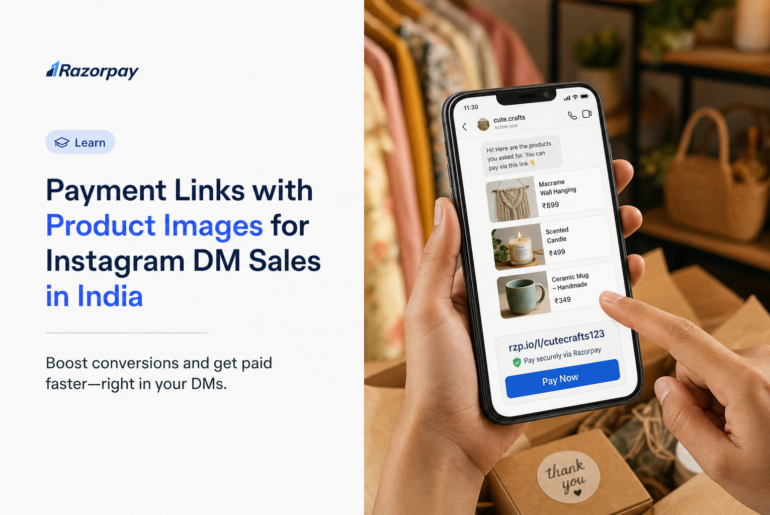
Prioritise zero setup fees, zero AMC, Payment Links for collecting without a website, and responsive support accessible without an enterprise contract. If you sell via WhatsApp or Instagram today, a gateway with shareable payment links and a UPI QR gets you live before a full website integration.
FAQs
Is Razorpay RBI-authorised to operate as a Payment Aggregator in India?
Yes. Razorpay is an RBI-authorised Payment Aggregator, which allows it to handle merchant funds directly under the RBI’s framework rather than only transmitting transaction data. You can request the Certificate of Authorisation during vendor diligence and cross-check it against the RBI’s published list.
Should I switch from my current payment gateway to Razorpay?
Switch if your current provider has a lower payment success rate, lacks RBI Payment Aggregator authorisation, charges hidden AMC or setup fees, or does not offer multi-bank smart routing. Run both gateways in parallel for one to two weeks before cutting over. Razorpay’s 90-day zero platform fee offer lets you test with real transactions at zero cost during the evaluation.
Which payment gateway in India is best for startups focusing on high conversion rates?
The gateway with the highest checkout conversion rate for your specific payment mix. UPI accounts for 85.5% of digital transaction volume, so UPI-first routing and success-rate optimisation matter more than card processing benchmarks. Smart routing that automatically picks the best-performing bank terminal per transaction is the single biggest conversion lever. Razorpay reports 90-95% success rates via this approach.
Does my startup have to pay UPI MDR from 15 October 2026?
Only on qualifying person-to-merchant UPI transactions above Rs 2,000, charged at 0.4% with a Rs 300 cap on transactions of Rs 75,000 and above. Payments of Rs 2,000 or less stay free, and P2PM merchants receiving up to Rs 1 lakh monthly remain exempt.
Can I charge customers extra to cover UPI MDR?
No. Merchants cannot pass the MDR on to customers, who pay only the posted price. Treat the charge as a cost of acceptance inside your gross margin, and note that 18% GST applies to the MDR fee rather than the transaction value.
What is the typical settlement cycle on an Indian payment gateway?
Most gateways settle on a T+1 or T+2 basis by default. Get the cycle, cut-off time, and reserve policy in writing. Razorpay offers Instant Settlements, which provides 24/7/365 access to funds, including weekends and holidays.
How do I know if a payment gateway’s uptime claim is trustworthy?
Ask for documented incident history and whether the gateway uses multi-bank smart routing for automatic failover. Even UPI has suffered multi-hour outages with success rates dropping sharply, so a single uptime percentage without failover context does not tell you enough.
What is the cheapest payment gateway for an early-stage Indian startup?
The cheapest gateway depends on total cost, not headline MDR. Factor in GST, annual maintenance charges, UPI MDR exposure, settlement delay, and success rate together. A marginally higher percentage fee paired with a materially higher success rate is usually cheaper overall.
Does Razorpay charge a setup fee or annual maintenance charge?
No. Razorpay’s standard plans carry zero setup fee and zero annual maintenance charge, with a standard domestic Payment Gateway rate of 2% plus applicable GST per transaction. Newly activated merchants may also qualify for the 90-day 0% platform fee welcome offer, subject to its terms.