Edited on 15th December, 2025
For Direct-to-Consumer brands, the narrative of success has long been dominated by the pursuit of top-line growth. This requires a sustainable customer acquisition strategy, but the most critical, yet often misunderstood, metric in this equation is the customer acquisition cost (CAC). For modern D2C brands, customer acquisition cost is more than a simple KPI; it is a mirror reflecting the efficiency and sustainability of your entire growth model. Understanding your CAC is the first step toward building a truly resilient and profitable D2C business.
Table of Contents
What is Customer Acquisition Cost? A Deeper Look for D2C Brands
At its simplest, customer acquisition cost is the total investment required to convert a single prospect into a paying customer. The basic formula:
CAC = Total Marketing & Sales Costs / Number of New Customers Acquired
While the formula is simple, the accuracy depends on what you include in the “Total Costs.” It is the price you pay to win a new relationship. However, a common and dangerous mistake for many scaling brands is to define this cost too narrowly, often limiting it to just their monthly ad spend. An accurate calculation must be far more comprehensive, encompassing every expense that contributes to winning that new customer.
- Direct Marketing and Ad Spend: This is the most obvious component. It includes all money spent on platforms like Google Ads, Meta (Facebook and Instagram), and any other paid channels where you run acquisition campaigns.
- Marketing and Sales Team Salaries: The cost of the people who plan, execute, and manage your acquisition campaigns is a direct expense. This includes salaries, benefits, and any commissions paid to your team.
- Creative and Content Production Costs: This covers fees for graphic designers, copywriters, video production teams, and photographers who create the assets used in your advertising and marketing campaigns. High-quality creative is a significant investment in acquisition.
- Software and Tool Subscriptions: The monthly or annual fees for your marketing technology stack are a significant part of your acquisition engine. This includes costs for marketing automation platforms, analytics tools, SEO software, and social media management tools.
- Introductory Discounts and Promotions: This is a frequently overlooked but critical component. If you use an aggressive “25% off your first order” promotion to attract new customers, the margin you sacrifice on that first sale is a direct customer acquisition cost.
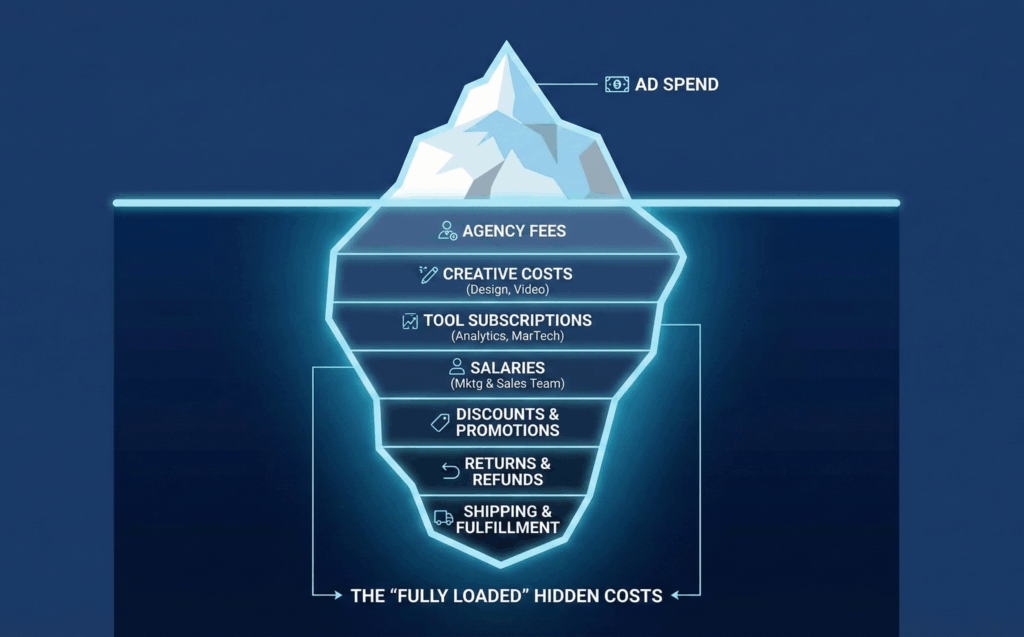 By including all these variables, you move from a superficial understanding to a true, fully-loaded customer acquisition cost. This accuracy is non-negotiable for making sound financial decisions.
How to Calculate Customer Acquisition Cost Accurately
Now that you understand the components of a ‘fully-loaded’ CAC, let’s look at how to apply that formula in a real-world scenario to get an accurate number.
Step 1: Define the Time Period
First, decide on a consistent time period for your calculation. This could be monthly, quarterly, or annually. Quarterly is often a good balance for D2C brands, as it is long enough to smooth out short-term fluctuations (like a single viral post or a slow week) but frequent enough to allow for timely strategic adjustments to your marketing spend.
Step 2: Tally All Acquisition Expenses
Using the comprehensive list above, meticulously add up every single cost associated with your acquisition efforts within your chosen time period. Do not leave anything out. An underestimated cost will lead to a dangerously optimistic and misleading customer acquisition cost.
Step 3: Count Only New Customers
This is one of the most critical and common points of failure in CAC calculation. The denominator in your formula must only include customers who made their very first purchase during the specified period. A customer who bought from you last quarter and again this quarter is a retained customer, not a newly acquired one. Including repeat buyers in this calculation will artificially deflate your customer acquisition cost and provide a false sense of marketing efficiency, potentially causing you to overspend on unprofitable channels.
Step 4: Calculate and Analyze
With your total costs and your count of new customers, you can now calculate your CAC. Let’s walk through a realistic example for a fictional D2C apparel brand over one quarter (Q1):
- Meta & Google Ad Spend: Rs. 30,000
- Marketing Team Salaries (pro-rated for the quarter): Rs. 25,000
- Marketing Software Subscriptions: Rs. 5,000
- Creative Production Costs: Rs. 5,000
- Total Acquisition Costs: Rs. 65,000
During this quarter, the brand acquired 2,000 new customers.
CAC = Rs. 65,000 / 2,000 = Rs. 32.50
This means the brand spent, on average, Rs. 32.50 to acquire each new customer in Q1. This single, accurate number is the starting point for every strategic conversation about growth and profitability. It is the baseline against which all marketing efforts must be measured.
Why CAC in Isolation is a Vanity Metric
Now that you have an accurate customer acquisition cost, it’s tempting to immediately label it as “high” or “low.” But in isolation, your CAC is a meaningless number. Is a Rs. 32.50 CAC good or bad? The answer is always: it depends.
A customer acquisition cost only becomes a powerful strategic tool when it is compared to the long-term value that a customer brings to your business. This is where Customer Lifetime Value (LTV) enters the equation.
Customer Lifetime Value (LTV) represents the total net profit a business can expect to generate from a single customer over the entire duration of their relationship with the brand. It is the ultimate measure of a customer’s worth.
Consider two scenarios:
Scenario A: The “One-and-Done” Fast Fashion Brand. You sell trendy t-shirts. Your average order value (AOV) is Rs. 1,000, with a 50% gross margin. A customer makes one purchase and never returns.
- Gross Profit: Rs. 500
- CAC: Rs. 600
- Result: You effectively lost Rs. 100 on this customer. Without retention, your acquisition strategy is bleeding money.
Scenario B: The “High-Loyalty” Premium Skincare Brand. You sell a premium face serum. Your average order value is Rs. 2,000, with a healthy 70% gross margin. Because the product is effective, the average customer purchases it three times over a two-year period.
- Gross Profit per Order: Rs. 1,400 (Rs. 2,000 x 70%)
- Total Lifetime Profit: Rs. 4,200 (Rs. 1,400 x 3 orders)
- CAC: Rs. 800 (Premium audiences cost more to acquire)
Result: Even with a higher CAC of Rs. 800, you made a net profit of Rs. 3,400 on this relationship. This is an incredibly healthy, scalable business model.
This comparison reveals the fundamental truth of D2C finance: your customer acquisition cost is only sustainable if it is significantly lower than your Customer Lifetime Value.
The LTV: CAC Ratio: The North Star of D2C Profitability
The comparison between LTV and CAC is the fundamental equation that determines the long-term health of your business. The LTV to CAC ratio is the North Star metric for D2C profitability, providing a clear, unbiased answer to the question: “Is our growth engine sustainable?”
The formula is simple:
LTV:CAC Ratio = Customer Lifetime Value / Customer Acquisition Cost
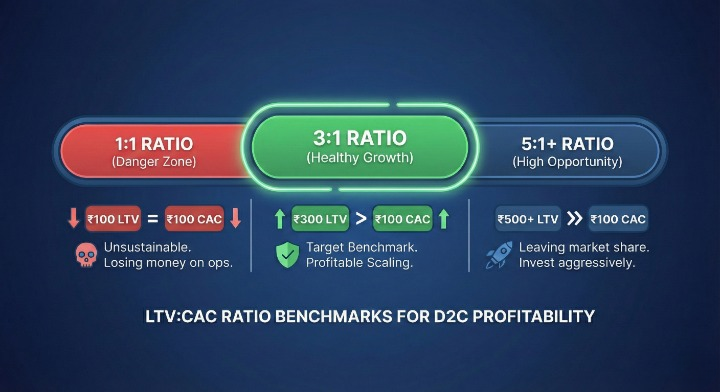
While the ideal ratio can vary based on industry, business model, and growth stage, a widely accepted benchmark for a healthy D2C business is 3:1. This means that for every dollar you spend to acquire a new customer, you can expect to generate three dollars in profit over the course of that customer’s relationship with your brand. This ratio signifies a healthy, efficient growth model where your marketing investments are generating a strong return.
 Understanding different ratios is key to making strategic decisions:
- A 1:1 Ratio: This is a critical danger zone. It means you are spending exactly as much to acquire a customer as they are generating in profit. At this ratio, the more customers you acquire, the more money you lose when you factor in other operational costs. A business cannot scale with a 1:1 ratio.
- A Ratio Below 3:1 (e.g., 2:1): While you are profitable on each acquisition, your margins are thin. This leaves little room for error and makes your business vulnerable to increases in advertising costs or shifts in the market. Your customer acquisition cost is too high relative to the value you are creating.
- A Ratio Above 3:1 (e.g., 5:1 or higher): While this looks fantastic on the surface, a very high ratio can sometimes indicate that you are underinvesting in marketing. You may be growing too slowly and leaving market share on the table for more aggressive competitors. There is an opportunity to strategically increase your customer acquisition cost to capture more of the market, faster.
Another critical metric related to your customer acquisition cost is the CAC Payback Period. This measures how many months it takes for you to earn back the initial cost of acquiring a customer. A shorter payback period means a healthier cash flow, as your marketing investments are recouped more quickly. For D2C brands, aiming for a CAC payback period of under 12 months is a strong goal.
The 2026 Outlook: The State of CAC in India
2026 is almost here, and the era of “cheap traffic” in India is officially over. The digital landscape has undergone a fundamental shift, driven by aggressive privacy updates and the rising cost of advertising on platforms such as Instagram and Google.
CAC Health Check: Industry Benchmarks (India)
Is your CAC “too high”? While every business is different, recent data from the Indian D2C ecosystem gives us clear guardrails for what constitutes a “healthy” acquisition cost in 2026.
| Industry Vertical | Average CAC Per New Customer | Why? |
| Beauty & Personal Care | Rs. 300 – Rs. 500 | Competitive but driven by high repeat rates. Influencer marketing works well here. |
| Fashion & Apparel | Rs. 500 – Rs. 800 | Moderate CAC. High returns/RTOs in India significantly impact the final “fully loaded” cost. |
| Food & Beverage | Rs. 200 – Rs. 400 | Lower CAC. Lower average order values (AOV) mean you cannot afford a high CAC. |
| Home & Decor | Rs. 800 – Rs. 1,200 | Higher CAC. These are often higher-ticket items that require a longer decision-making process. |
| Consumer Electronics | Rs. 1,000 – Rs. 2,500 | High. Price-sensitive Indian shoppers compare products extensively before making a purchase. |
Note: If your CAC is significantly higher than these averages without a correspondingly higher LTV, your growth engine may be at risk.
The Trend: From “Paid Growth” to “Blended Efficiency”
Over the last three years, many Indian D2C brands have seen a 60% increase in ad costs. As a result, the definition of a “healthy” strategy has changed for 2026:
The Old Metric: ROAS (Return on Ad Spend) from a single platform like Facebook.
The 2026 Metric: MER (Marketing Efficiency Ratio). This is your “Blended CAC.” Successful Indian brands are now aiming for a Blended CAC that is 30-40% lower than their paid CAC by mixing in organic content (Reels/Shorts), email/WhatsApp marketing, and community growth.
AI as the Great Deflator
While media costs are rising, creative costs are dropping. Forward-thinking brands are using AI to generate ad variations and product backgrounds. This effectively lowers the “fully-loaded” CAC by reducing production fees, allowing smaller teams to test creative at a massive scale without needing a large studio budget.
Actionable Strategies to Reduce Your Customer Acquisition Cost
A high customer acquisition cost is not a fixed reality; it is a variable that can be actively managed and optimized. Reducing your CAC is one of the most powerful levers you have for improving profitability. Here are four proven strategies D2C brands can implement to lower their customer acquisition cost.
1. Double Down on Conversion Rate Optimization (CRO)
Your conversion rate is the percentage of website visitors who make a purchase. A higher conversion rate directly lowers your customer acquisition cost because you are getting more customers from the same amount of traffic and ad spend. Instead of paying more to get more visitors, you are converting more of the visitors you already have.
Actionable CRO tactics include:
- A/B Testing: Continuously test elements on your product pages and landing pages, such as headlines, product images, calls to action, and page layouts, to identify what drives the most conversions.
- Optimize Site Speed: In ecommerce, every second counts. A slow-loading website leads to higher bounce rates and lost sales. Optimizing images and using a fast hosting provider are critical.
- Implement psychological pricing: The way you present your price (e.g., $9.99 vs. $10, or how you frame a bundle) can have a direct, outsized impact on your conversion rate. This is one of the fastest ways to lower your CAC for the same amount of ad spend.
- Frictionless Checkout: The checkout process is the final, and often highest-friction, hurdle. A lengthy, complex checkout process with multiple pages and mandatory fields is a primary cause of cart abandonment. The solution is to make this step as effortless as possible. By implementing a streamlined, one-click checkout experience, you remove the barriers that cause customers to drop off. For example, a solution like Magic Checkout prefills customer information for a vast network of shoppers, allowing them to complete their purchase in a single tap. This can dramatically improve your conversion rate and lower your effective customer acquisition cost.
Ready to see how a one-click experience can lower your CAC?
2. Increase Average Order Value (AOV)
While this does not lower your nominal customer acquisition cost, increasing the value of a customer’s first purchase helps you recoup your CAC faster and improves the LTV: CAC ratio from day one. A higher AOV makes your marketing spend more efficient.
Proven ways to increase AOV include:
- Product Bundling: Offer curated bundles of complementary products at a slightly discounted price compared to buying them individually.
- Free Shipping Thresholds: Offer free shipping on orders above a certain value. This encourages customers to add more items to their cart to meet the threshold.
- Smart Upsells and Cross-sells: Strategically offer relevant product upgrades (upsells) or complementary items (cross-sells) during the checkout process.
3. Diversify into Lower-Cost Acquisition Channels
Relying solely on expensive paid advertising channels, such as Meta and Google, is a recipe for high and constantly rising customer acquisition costs. A resilient acquisition strategy involves a diversified portfolio of channels.
Focus on building assets that generate long-term, organic traffic:
- SEO and Content Marketing: Invest in creating high-quality blog content, guides, and videos that answer your target audience’s questions. While it takes time, ranking for relevant keywords in search engines drives a steady stream of highly qualified, “free” traffic to your store.
- Email Marketing: Building a strong email list is one of the most valuable investments you can make in your marketing strategy. Email marketing enables you to nurture leads and re-engage past visitors at a low cost, significantly reducing your reliance on paid advertisements.
- Referral Programs: Turn your happiest customers into a powerful, low-cost acquisition channel. A referral program that rewards both the referrer and the new customer is a proven way to acquire high-quality customers with a very low customer acquisition cost.
4. Refine Your Paid Advertising Targeting
For your paid channels, the key to a lower customer acquisition cost is precision. Better targeting ensures your ad budget is spent only on the audiences most likely to convert, reducing wasted spend.
Key targeting tactics include:
- Lookalike Audiences: This is one of the most powerful tools in paid advertising. The strategy involves using data from your best existing customers (e.g., those with the highest LTV) to create lookalike audiences on platforms like Facebook. But how do you get this rich, first-party data in the first place? By encouraging customers to create an account. A frictionless, passwordless login experience removes the primary barrier to signing up, allowing you to build a valuable database of known customers. A solution like Login with Razorpay uses a simple OTP, making account creation instant and turning anonymous visitors into a valuable data asset for building powerful lookalike audiences.
Want to build the first-party data asset that powers smarter acquisition?
- Retargeting High-Intent Visitors: Not all Website Visitors Are Equal. Prioritize your retargeting budget on users who have shown strong purchase intent, such as those who have added an item to their cart or initiated the checkout process. These users are far more likely to convert than those who only viewed the homepage.
By systematically implementing these strategies, you can take control of your customer acquisition cost and build a more efficient, profitable, and sustainable growth engine for your D2C brand.
By systematically implementing these strategies, you can take control of your customer acquisition cost and build a more efficient, profitable, and sustainable growth engine for your D2C brand. A lower customer acquisition cost is a direct path to higher profitability.
Conclusion: From Cost Center to Growth Lever
Ultimately, customer acquisition cost should be viewed not as a simple expense to be minimized at all costs, but as a strategic lever to be managed. The goal is not to achieve the lowest possible customer acquisition cost, but to achieve the healthiest and most profitable LTV: CAC ratio. A low customer acquisition cost that consistently brings in low-value, one-time buyers is a failing strategy. A higher, but still sustainable, customer acquisition cost that attracts high-LTV customers is the hallmark of a sophisticated growth model.
Therefore, D2C leaders must move beyond a surface-level view of their ad spend. A commitment to a deep, holistic understanding of your fully-loaded customer acquisition cost is the non-negotiable foundation for building a resilient, profitable, and enduring brand.
Frequently Asked Questions about CAC
What is a good CAC ratio?
For sustainable growth, the golden standard is a 3:1 LTV:CAC ratio. This means your Customer Lifetime Value (LTV) should be three times your acquisition cost. If your ratio is 1:1, you are likely losing money on every sale. If it’s 5:1, you might be under-spending and growing too slowly.
What is a good CAC amount?
A “good” amount depends entirely on your industry and Average Order Value (AOV). In India, a healthy range is typically Rs. 300– Rs. 500 for personal care brands and Rs. 500–Rs. 800 for fashion brands. Ultimately, a good CAC is any amount that allows you to maintain a healthy profit margin after all expenses.
How is CAC calculated?
CAC is calculated by dividing your total acquisition costs by the number of new customers acquired in a specific period. The formula is: (Ad Spend + Agency Fees + Creative Costs + Tools) / New Customers. Using this “fully loaded” formula ensures you don’t underestimate your true costs.
Is CAC calculated monthly or yearly?
It should be tracked on both timelines. Monthly CAC helps you optimize immediate ad campaigns and react to short-term trends. Yearly CAC is crucial for understanding long-term business health, as it smooths out seasonal spikes (like Diwali or End of Season Sales) that might skew monthly data.
What is an example of acquisition cost?
A common example is running a Facebook Ad campaign. If you spend Rs. 10,000 on ads, pay a freelancer Rs. 5,000 to design the creatives, and acquire 50 customers, your total cost is Rs. 15,000. Your CAC for that campaign is Rs. 300 per customer.