Table of Contents
Key takeaways
- Support channel choice directly impacts payment success rates, customer satisfaction, and long-term retention.
- WhatsApp provides stronger post-payment engagement by enabling continuous customer communication, payment updates, and issue resolution in a familiar channel.
- Live chat performs better for pre-transaction support, helping reduce abandoned carts and improve checkout conversion rates.
- Context continuity across support channels is critical for effective dispute management, faster issue resolution, and stronger customer trust.
- Conversational AI and optimized support systems can increase transaction values by improving customer experience and reducing friction.
- A hybrid support model combining WhatsApp, live chat, and automation often delivers the strongest performance for growing merchants seeking scalability and customer satisfaction.
What is a Guest Checkout?
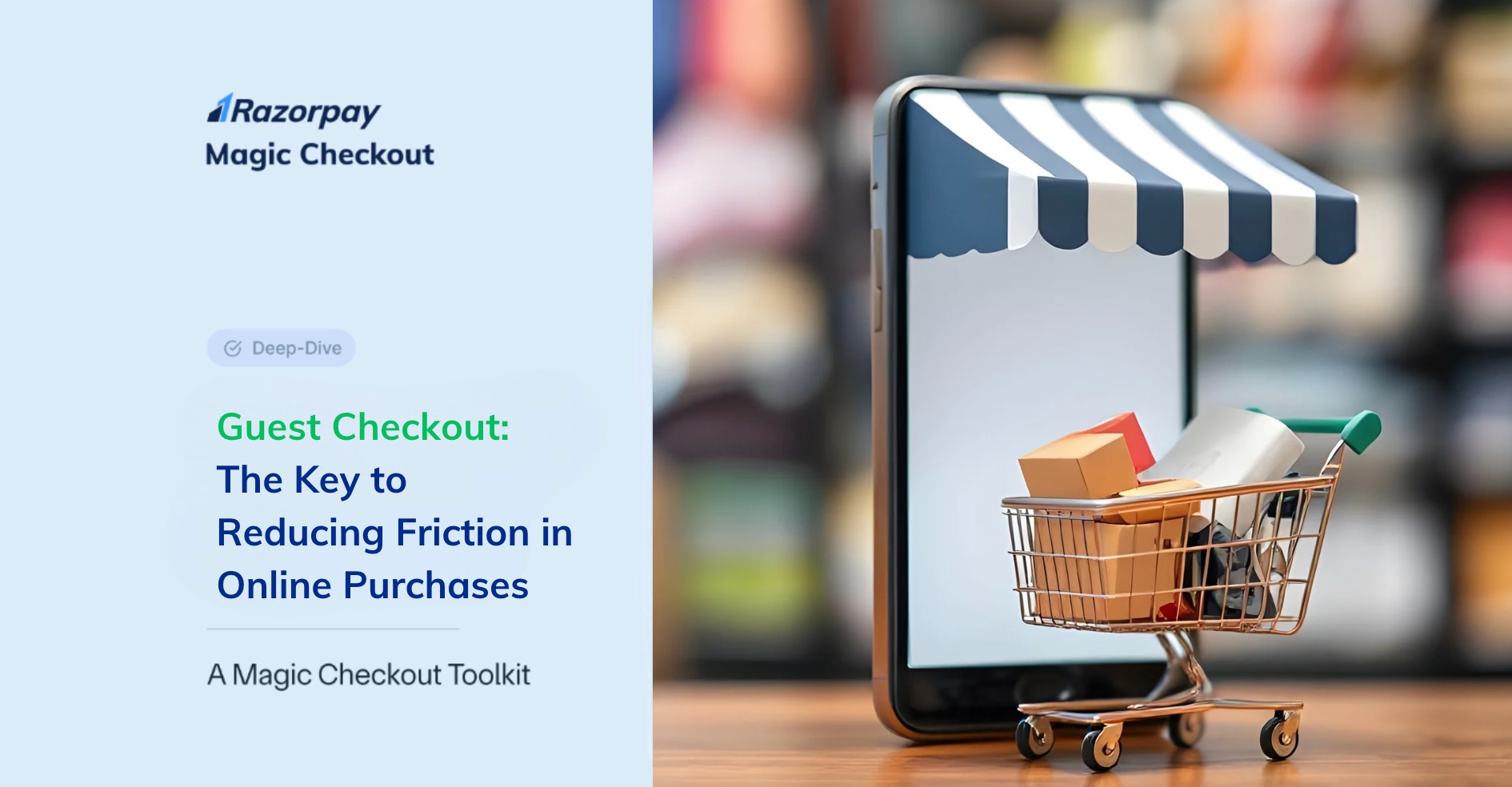
Guest checkout is a streamlined purchasing option that allows customers to complete their orders without creating an account. It eliminates the registration barrier by requiring only essential information like shipping address, contact details, and payment information.
Who Benefits Most?
D2C brands, fast-growing Indian ecommerce startups, and established online retailers looking to reduce cart abandonment and boost first-time purchases see the highest impact from guest checkout.
Guest checkout lets customers place an order without creating an account. It skips the sign-up process and allows shoppers to complete their purchase by just entering basic information like shipping and payment details.
It’s a simple way to reduce friction, especially for first-time buyers who want a quick and easy checkout. By removing the need to register, guest checkout can help lower cart abandonment and increase conversions.
In this blog, we’ll break down:
- How guest checkout works (step-by-step process)
- The pros and cons of guest checkout
- Best practices for integrating it into your checkout experience
- Alternatives to guest checkout: Exploring one-click checkout
By the end, you’ll know exactly how to implement guest checkout in a way that enhances conversions while balancing customer retention.
How Does Guest Checkout Work?
Guest checkout works by bypassing account registration and allowing customers to purchase using only essential details. The process typically involves five straightforward steps that prioritise speed and simplicity.
Guest checkout simplifies the buying process by removing the need for account creation. Instead of forcing customers to register, it allows them to make a purchase using only essential details. Here’s how the process typically works:
Step 1: Add Items to Cart
The customer selects products and proceeds to checkout, just like they would with a registered account.
Step 2: Choose Checkout Option
At checkout, they are given two options:
- Sign in / Create an account (for returning or new users)
- Continue as a guest (without signing up)
If they choose guest checkout, they move directly to the next step.
Step 3: Enter Shipping & Billing Information
The customer fills in their shipping address, billing details, and contact information. Since they aren’t logged in, none of these fields are pre-filled.
Step 4: Payment Selection & Completion
They select a payment method, enter their details, and confirm the purchase. Some businesses offer saved payment methods for returning customers, even without an account.
Step 5: Order Confirmation
Once payment is processed, an order confirmation page appears, and a receipt is sent via email. Businesses may also prompt customers to create an account after checkout by offering perks like order tracking or future discounts.
Explore Razorpay’s Payment Solutions
Is Guest Checkout Safe?
Guest checkout maintains the same security standards as account-based transactions. PCI DSS compliance represents the regulatory framework governing payment data security across both guest and account-based transactions, with requirements remaining consistent regardless of checkout type.
Did You Know?
RBI imposed a ₹5 crore penalty on a major bank for KYC/AML non-compliance, highlighting enforcement risks beyond monetary fines.
Modern payment security relies on several key measures that protect both guest and registered users:
- Encryption: All payment data is encrypted during transmission and storage
- Tokenization: Payment tokenization technology replaces primary account numbers with randomly generated tokens that hold no intrinsic value outside their designated system
- Fraud Prevention: Real-time monitoring systems detect suspicious activity regardless of account status
- SSL Certificates: Secure connections protect data exchange between browsers and servers
The key difference lies not in security capabilities, but in data retention. Guest checkout processes payments securely but doesn’t store customer information for future use, while account-based systems can save encrypted payment methods and addresses for convenience.
For merchants, ensuring guest checkout safety involves choosing payment processors that maintain PCI DSS Level 1 compliance, implementing proper SSL certificates, and using fraud detection tools that work across all checkout types.
Pros & Cons of Guest Checkout
While guest checkout enhances convenience, it comes with both advantages and drawbacks. Let’s break them down:
| Factor | Guest Checkout | Account Creation | |
|---|---|---|---|
| Speed | Faster initial checkout | Slower first-time setup | |
| Data Collection | Limited customer data | Complete customer profiles | |
| Retention | Lower repeat purchase rates | Higher customer loyalty | |
| Security | Same PCI DSS standards | Same PCI DSS standards | |
| Marketing | Limited follow-up opportunities | Personalised campaigns |
Benefits of Guest Checkout:
- Faster Conversions – Reduces friction, leading to quicker checkouts.
- Lower Cart Abandonment – Many users drop off when forced to create an account.
- Higher First-Time Purchase Rates – Encourages hesitant buyers to complete their orders.
- Better Mobile Experience – Ideal for mobile users who prefer a quick checkout process.
- Increased Impulse Purchases – Reduces hesitation by eliminating extra steps.
Drawbacks of Guest Checkout:
- No Customer Retention – Since data isn’t stored, returning customers must re-enter their details.
- Limited Marketing Opportunities – It is harder to send personalised follow-ups or nurture long-term relationships.
- Reduced Loyalty & Engagement – Customers may feel less connected to the brand without an account.
- No Order History Access – Users can’t easily track past purchases or reorders.
- Potential for Higher Return Rates – Customers may make less thoughtful purchases, leading to more returns.
Pro Tip: Use WhatsApp for post-payment support and live chat for pre-checkout assistance to maximize customer journey efficiency.
When Should You Offer Guest Checkout?
Guest checkout works best for specific business models and customer scenarios. The most compelling case for prominent guest checkout appears in businesses serving first-time or infrequent buyers, particularly in impulse purchase categories where consumers expect frictionless, rapid transactions.
Ideal scenarios for guest checkout include:
- High impulse purchase categories: Fashion, electronics, seasonal items where customers make quick buying decisions
- First-time visitor focus: Businesses that primarily attract new customers rather than repeat buyers
- Mobile-heavy traffic: When most customers shop on mobile devices where form-filling is more cumbersome
- Low-ticket items: Products under ₹2,000 where the purchase decision is less considered
- Gift purchases: When customers are buying for others and don’t need ongoing account benefits
Consider account-required checkout when:
- You sell subscription products or services requiring ongoing customer relationships
- Your business model depends on repeat purchases and customer lifetime value
- You offer complex products requiring customer support and order history
- Your average order value is high (₹5,000+) and customers expect premium service
For Indian D2C brands and ecommerce startups, the decision often comes down to your customer acquisition strategy. If you’re focused on rapid growth and first-time conversions, guest checkout can significantly boost your initial sales metrics.
Guest Checkout vs. Account Creation
Businesses often wonder: Should I require customers to create an account?
The answer depends on your business model. If your goal is a long-term engagement, an account helps. However, forcing registration at checkout can drive customers away. A hybrid approach—offering guest checkout while incentivising account creation later—often works best.
If you’re refining your checkout process, finding the right balance between convenience and customer retention is crucial.
Impact on Conversions & Cart Abandonment
Data suggests that forcing account creation leads to higher cart abandonment rates. Studies show that up to 24% of shoppers abandon carts when required to register.
For brands, this is a clear signal: reducing friction at checkout boosts conversions. The checkout experience directly impacts sales, making it essential to optimise the entire journey. Learn more in our guide on the checkout page best practices.
🟡 Important Read: Want to go beyond guest checkout and explore how to optimise your entire checkout experience? Check out this comprehensive blog on maximising conversions through a frictionless checkout flow.
Guest Checkout and Customer Data: What You Lose and How to Compensate
While guest checkout improves immediate conversions, it creates challenges for long-term customer relationships. Guest-only checkout typically produces repeat purchase rates in the 20-30 percent range, lower than the 30-40 percent rates achievable with account-enabled infrastructure.
Did You Know?
72% of shoppers who prefer guest checkout are actually repeat shoppers with existing accounts on the site.
What you lose with guest-only checkout:
- Customer purchase history: No ability to track buying patterns or preferences
- Personalisation opportunities: Limited data for targeted marketing campaigns
- Retention insights: Difficulty measuring customer lifetime value and churn
- Upselling potential: Reduced ability to recommend relevant products
- Customer service efficiency: No centralised order history for support queries
Strategies to compensate for data loss:
- Post-purchase account creation: Offer one-click account setup after successful checkout with pre-filled information
- Email marketing opt-ins: Capture email addresses during guest checkout for newsletter subscriptions
- Incentivised registration: Provide exclusive discounts or early access for account holders
- Social login options: Reduce registration friction with Google, Facebook, or Apple sign-in
- Progressive profiling: Gradually collect customer information through subsequent interactions
- Loyalty programme integration: Allow guests to join rewards programmes without full account creation
The most successful approach combines immediate guest checkout availability with strategic nudges toward account creation, maximising both conversion rates and long-term customer value.
Best Practices for Guest Checkout
To effectively integrate guest checkout and minimise friction:
- Make it Visible: Clearly present the “Guest Checkout” option alongside the account login/creation. Don’t make it hidden or secondary.
- Minimise Form Fields: Only ask for absolutely essential information (shipping address, email, payment details). Reduce any unnecessary fields.
- Use Clear Labels: Ensure all labels are straightforward and easy for guests to understand. Avoid jargon.
- Assure Security: Clearly communicate the security measures in place to protect guest users’ data.
- Offer Post-Purchase Account Creation: After successful checkout, provide a simple, one-click option to create an account, pre-filling details where possible. Highlight the benefits of creating an account (e.g., order tracking, faster future checkouts).
- Optimise for Mobile: Ensure the entire guest checkout process is smooth and responsive on all mobile devices.
- Test and Iterate: Regularly test your guest checkout flow to identify any usability issues and make improvements based on user behaviour.
- Make it accessible: Ensure your guest checkout is accessible, with clear labels, high contrast, and screen reader compatibility.
Common Pitfalls to Avoid with Guest Checkout
Even well-intentioned guest checkout implementations can fail due to common mistakes. Here are the key pitfalls to avoid:
- Hiding the guest option: Placing guest checkout as a small link below prominent account creation buttons
- Requiring too many fields: Asking for unnecessary information like phone numbers, company details, or marketing preferences
- Poor mobile experience: Forms that don’t work well on mobile devices or require excessive scrolling
- Unclear security messaging: Failing to communicate that guest transactions are secure and protected
- No progress indicators: Leaving customers unsure about how many steps remain in the checkout process
- Forced account creation post-purchase: Requiring account setup to access order confirmations or receipts
- Inconsistent branding: Guest checkout pages that look different from the rest of your site
- Missing error handling: Poor error messages that don’t help users correct form mistakes
Avoiding these pitfalls ensures your guest checkout truly reduces friction rather than creating new barriers for customers.
Alternatives to Guest Checkout: A Smarter Approach
While guest checkout reduces friction, it can limit customer retention and personalisation. A powerful alternative that offers the best of both worlds – speed and potential for future engagement – is one-click checkout.
One-click checkout isn’t solely for returning customers. Even first-time visitors to a store with one-click checkout enabled can experience a streamlined, return-like shopping flow. This is because the platform can securely store their shipping and payment details during their initial purchase (with their explicit consent).
Customers increasingly expect a fast and seamless checkout experience. They value saving time and want a super-fast way to complete their purchases. This demand is why features like one-click checkout are gaining popularity.
How Razorpay Magic Checkout Simplifies Guest Checkout
At Razorpay, we understand that Indian ecommerce businesses need solutions that balance speed with customer retention. Magic Checkout represents our answer to the guest checkout dilemma—offering the speed of guest transactions with the intelligence to build lasting customer relationships.
Why Magic Checkout vs. Traditional Guest Checkout?
- 5X Faster than typical solutions: Auto-fills contact, payment, and shipping details while enabling seamless one-step login for returning users
- Widest payment method coverage in India: Supports cards, UPI, BNPL, EMI, wallets, and COD—ensuring customers can pay their preferred way
- Built-in intelligence: COD Intelligence analyses risk factors in cash-on-delivery transactions to reduce RTO losses
- RTO Protection: Covers reverse shipping costs for high-risk orders, helping businesses mitigate losses
- Gamified promotions: Supports 12+ coupon types to enhance engagement and increase conversions
“Since switching to Magic Checkout, our cart abandonment dropped by 18%!” – Meera S., Head of Ecommerce, D2C Startup
Trusted by 10,000+ Indian ecommerce brands, Magic Checkout eliminates friction while retaining valuable customer data, striking the perfect balance between speed and long-term engagement.
This approach eliminates friction while retaining valuable customer data, striking the perfect balance between speed and long-term engagement.
Start Free Trial of Magic Checkout
Ready to streamline your payments?
Scale your business with a gateway that supports 100+ payment methods, including UPI, Credit Cards, and Netbanking. Transition to a reliable infrastructure designed to improve transaction success rates and automate your daily reconciliation.
Final Thoughts
Guest checkout is a powerful tool, but it’s not the only solution. For Indian D2C brands and ecommerce businesses, the key lies in balancing immediate conversion needs with long-term customer relationship goals. Brands must balance speed, convenience, and customer loyalty. If you’re looking for ways to refine your checkout flow, start by understanding the fundamentals, explore Define Checkout to dive deeper.
At Razorpay, we believe checkout should be seamless for every customer, whether they’re first-time visitors or loyal repeat buyers. The future of ecommerce lies in intelligent solutions that combine the speed of guest checkout with the personalisation benefits of customer accounts.
Guest Checkout FAQ
What is the meaning of guest checkout?
Guest checkout is a purchasing option that allows customers to complete their orders without creating an account. You only need to provide essential information like shipping address, contact details, and payment information to complete your purchase.
Is guest checkout safe?
Yes, guest checkout maintains the same security standards as account-based transactions. All guest checkouts follow PCI DSS compliance requirements, use encryption for data transmission, and employ the same fraud prevention measures as registered user transactions.
Will I lose customer data if I offer guest checkout?
Guest checkout limits the customer data you can collect and store for future use. However, you can compensate by implementing post-purchase account creation options, email marketing opt-ins, and progressive profiling strategies to gradually build customer relationships.
Should I still encourage customers to create an account if I offer guest checkout?
Yes, the best approach is offering both options. Provide prominent guest checkout to reduce cart abandonment, but incentivise account creation through post-purchase prompts, exclusive benefits, and simplified registration processes. This hybrid strategy maximises both immediate conversions and long-term customer value.
How does guest checkout affect repeat purchases?
Guest-only checkout typically produces repeat purchase rates of 20-30%, compared to 30-40% for account-enabled systems. However, you can improve repeat purchases by capturing email addresses, offering loyalty programmes, and providing seamless account creation options after the first purchase.
What’s the difference between guest checkout and one-click checkout?
Guest checkout requires customers to enter their information each time, while one-click checkout securely stores customer details (with consent) for instant future purchases. One-click solutions like Magic Checkout offer the speed of guest checkout with the convenience and data retention benefits of account-based systems.