India’s festive season sale generated Rs. 6.05 lakh crore in total trade in 2025, up 25% year on year. Online GMV in the 30- to 35-day pre-Diwali window crossed Rs. 1.15 lakh crore. For D2C brands specifically, Diwali GMV grew 47% year on year in 2025, and 2026 is projected to grow another 35 to 40%. Demand is also arriving earlier: pre-Navratri D2C order volumes were already up 16% year on year by August. This festive season sales guide skips the generic advice and focuses on what actually changes P&L outcomes: category behavior, discounting mechanics, checkout, logistics, and what happens after the sale ends.
Table of Contents
Key Takeaways
| Start planning by August | Festive demand is front-loading |
| Fashion sees the sharpest AOV lift | But carries the highest return complexity |
| Beauty leans on purchase frequency | Lowest returns, strongest repeat buying |
| Retention beats the festival itself | Next 60 days matter the most |
Operational Cautionary Tales: When Festive Traffic Breaks Retail Giants
Festive traffic spikes expose hidden bottlenecks. When a site crashes mid-sale, ad spend is wasted, and buyers switch to competitors. Even multi-billion-dollar giants with massive engineering teams have suffered catastrophic outages during peak launches:
- Flipkart: Big Billion Day (2014)
Despite scaling infrastructure 20x with 5,000 servers, concurrent traffic locked up database paths. Real-time inventory failed, items were overbooked, and pricing rules reset discounts to full MRP mid-checkout, forcing the founders to issue a national public apology. - Myntra: App API Collapse (2016)
An unprecedented mobile traffic surge crashed the underlying API gateway connecting carts to payment processors. Checkout screens froze and threw persistent error codes during the highest-conversion window of the sale. - Costco: 16-Hour Blackout (2019)
Heavy Thanksgiving traffic overwhelmed legacy infrastructure, causing a 16-hour platform outage. Product pages broke, carts locked, and the retailer lost an estimated $11 million in gross transactions.
How Different D2C Categories Perform During Festive Season Sale
Not every category behaves the same way, and a festive season sale discounting strategy built for one category rarely works for another. Here is how AOV, repeat purchase rate, and RTO actually move before, during, and after the festive season (Oct to Jan 5), based on category benchmarks across Indian D2C and e-commerce.
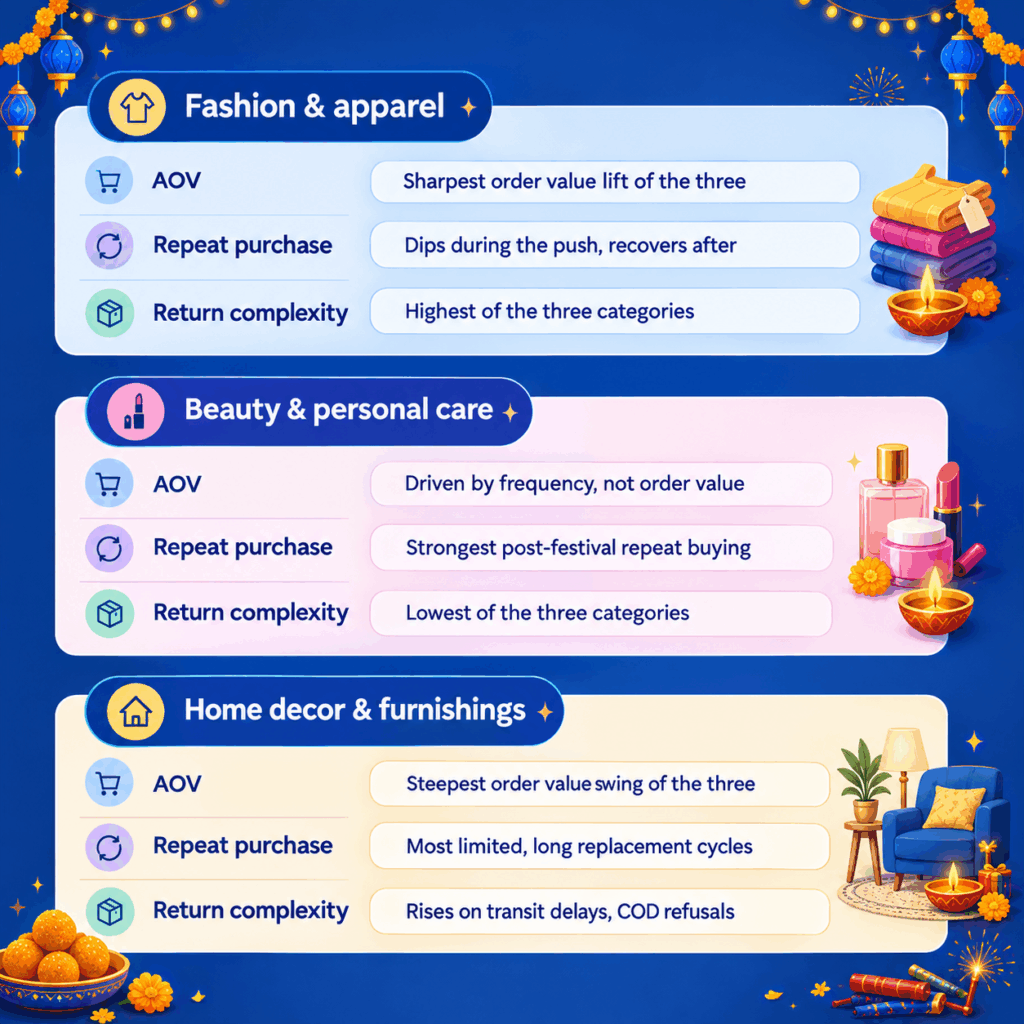 Fashion and apparel: Consistently sees the sharpest order value lift of the three categories, driven by premium ethnic wear, winterwear, and bundled outfits. It also carries the highest return complexity, driven by COD orders, sizing errors, and customers ordering the same item across multiple platforms to compare before keeping one. Repeat purchase dips during the festive push itself as acquisition campaigns bring in first-time buyers, then recovers once the clearance window begins.
Beauty and personal care: Growth here leans more on purchase frequency than order value, fueled by gifting kits and bundled routine sets. Returns stay the lowest of the three categories, since hygiene policies make most items non-returnable and sizing isn’t a factor. The real story plays out after the festival, when festive-acquired buyers convert into the strongest repeat purchase pattern of any category.
Home decor and furnishings: Sees the steepest swing in order value of the three, tied to pre-Diwali renovation and hosting prep. Returns climb as bulkier items face transit delays and COD refusals at the door. Repeat purchase stays the most limited of the three throughout the year, a function of long replacement cycles rather than anything a campaign can shift.
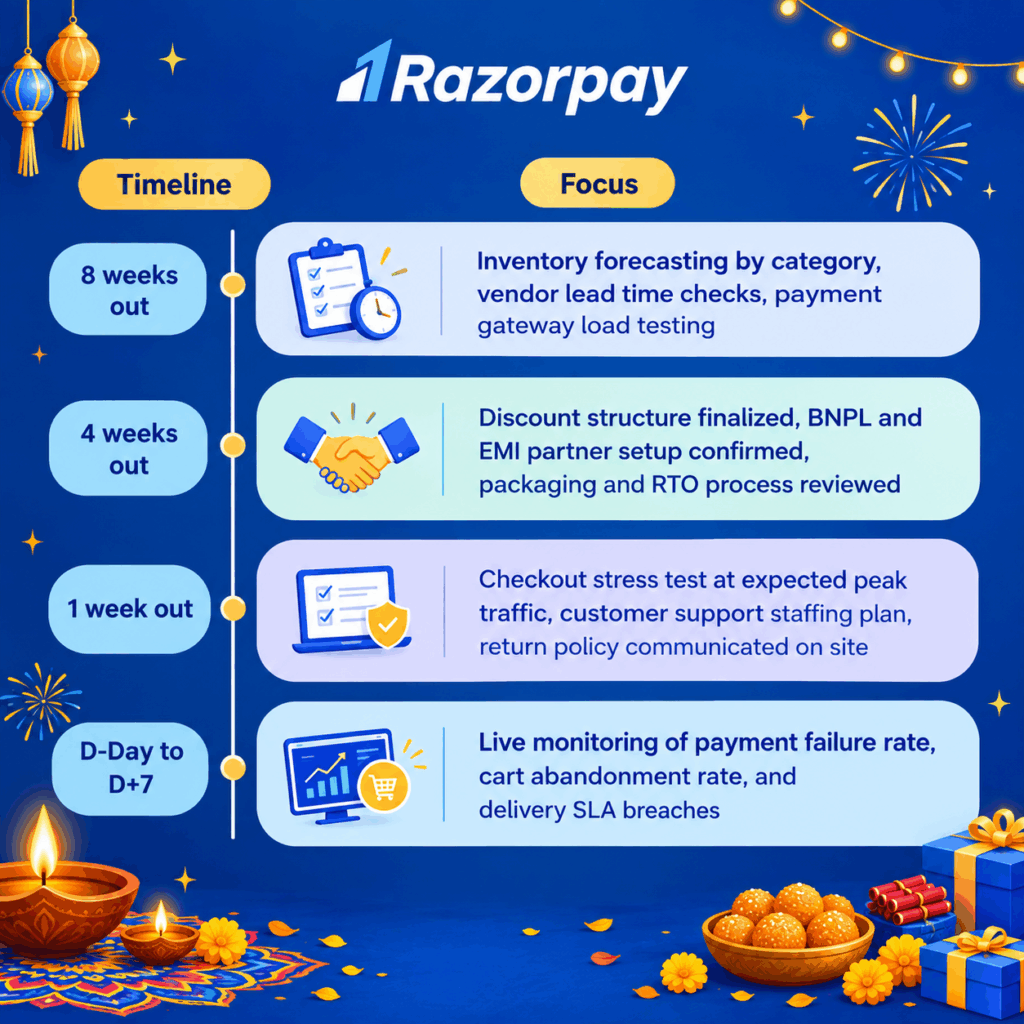
Festive Prep Timeline
 Pricing and Discounting: Dos and Don’ts
 Pricing and Discounting: Dos and Don’ts
Do:
- Use bundling and tiered cart discounts over flat percentage off. Flat discounts compress margin fastest on low-ticket SKUs.
- Set a discount floor per SKU before the season starts, not during it.
Don’t:
- Don’t discount best-selling SKUs the same way as slow movers. It trains repeat customers to wait for a sale every time.
- Don’t ignore average order value gains without checking RTO. Fashion’s AOV jump above still comes with margin loss from returns.
Checkout and Payments: Dos and Don’ts
This is where most festive season sale payment failures happen, and where the biggest revenue leaks usually go unnoticed.
Do:
- Load test checkout for at least 3x expected peak traffic, not average traffic.
- Offer BNPL and EMI prominently. Both spike during the festive season sale, especially for higher-ticket purchases like home decor.
- Track payment failure rate separately from cart abandonment rate. They point to different problems.
Don’t:
- Don’t assume the COD-to-prepaid shift applies equally across categories. Tier 2 and tier 3 cities still lean COD for fashion, which is exactly why fashion RTO runs highest.
- Don’t add new payment integrations right before peak days. Test them at least two weeks out.
Inventory, RTO, and Logistics: Dos and Don’ts
Do:
- Build buffer stock for top 20% SKUs by festive contribution, not annual volume.
- Add size guides and fit confirmation steps at checkout for fashion. Sizing errors are a direct driver of its 28-38%+ RTO spike.
- Set COD verification steps for high-value home decor orders, since transit delays and COD refusals at delivery are what push its RTO up during festive season.
Don’t:
- Don’t treat RTO during festive season sale as a fixed cost. Each category has a different root cause, and each is manageable.
- Don’t understaff delivery partner coordination during peak days. Delays compound RTO risk.
The Post-Sale Returns Tsunami: Securing Net Festive Margins
A record-breaking festive season sale is meaningless if a third of your GMV returns as canceled orders or undeliverable inventory in the weeks following the event. Protecting your net bottom line requires proactive post-sale management.
Mitigate Cash-on-Delivery (COD) Return-to-Origin (RTO)
Impulse buying surges during promotional periods, leading to high doorstep rejection rates on unverified COD orders.
- Enforce mandatory automated WhatsApp OTP verification on all COD orders above a specified cart value before issuing picking slips.
- Offer a nominal incentive (e.g., an extra 3% to 5% instant discount) on the order confirmation screen to encourage buyers to convert COD orders into prepaid checkouts before dispatch.
Automate Support for WISMO (“Where Is My Order?”) Tickets
Customer support ticket volume typically increases by 3x to 5x during post-sale delivery windows. Delayed support responses directly correlate with order cancellations and negative public brand sentiment.
- Deploy automated, self-serve order-tracking widgets in your chat app so buyers can check live courier status instantly without opening a manual support ticket.
- Send proactive tracking updates via SMS/WhatsApp at key shipping milestones: Dispatched, Out for Delivery, and Delivery Delayed.
Incentivize Store Credit Over Cash Refunds
Every cash refund immediately erases gross merchandise value (GMV) won during the sale and drains net operating cash flow.
- Configure your self-serve return portal to automatically set store credit or product exchange as the primary resolution option.
- Offer a bonus value incentive (e.g., an extra 10% credit top-up) on returns to encourage buyers to keep their capital inside your brand ecosystem.
5 Mistakes That Quietly Kill Festive Margins
- Discounting the entire catalog instead of by SKU, erasing margin on products that never needed a push.
- Underestimating checkout load, causing payment failures right when purchase intent peaks.
- Ignoring RTO in campaign ROI, which overstates real profitability, especially for fashion.
- Running festive campaigns with no plan for the 60 days after, losing beauty’s strongest repeat purchase window.
- Applying one AOV, RTO, or discount logic across all categories, when fashion, beauty, and home decor each behave differently.
What to Do After the Festival Ends
Most guides stop at the sale. The real opportunity sits in the 60 days after, and this is core to any real post-festive retention strategy. Beauty’s repeat purchase rate climbs to 32-42% in this window alone, higher than any other period for any category in this data. Use it for:
- Post-purchase WhatsApp and email flows specific to festive buyers, built around replenishment for beauty and clearance for fashion.
- Reconciling refunds and RTO within a fixed window so returned stock re-enters inventory before the next selling window.
- Reviewing category-level margin after discounts, RTO, and payment gateway costs, not just top-line GMV.
FAQ
#1 How much should a D2C brand discount during festive season sale?
There is no universal number. Set a margin floor per SKU, and let bundling and tiered discounts do more work than flat percentage off, especially on best-selling SKUs.
#2 Which payment method should D2C brands prioritize during festive season?
Prepaid adoption is rising, but COD still holds in tier 2 and tier 3 cities for fashion, which is also why fashion carries the highest RTO of any category. Offer BNPL and EMI alongside COD rather than replacing it.
#3 How early should festive prep start?
At least 8 weeks out, since demand is front-loading and D2C order volumes are already rising before Navratri.