India’s digital payment rails now process volumes that make even minor outages a systemic risk. According to the RBI Digital Payments Dashboard, the country recorded well over 200 billion digital payment transactions in FY 2025-26 (UPI alone crossed 200 billion transactions per the RBI Annual Report 2025-26). At that scale, a few minutes of downtime translates into millions of failed transactions.
This guide is for founders, CTOs, and finance ops leaders who need to understand how payment gateways handle server downtime and failover in 2026. It covers root causes, failover architecture, business cost, RBI compliance, and a practical checklist for building a resilient multi-gateway payment gateway stack.
Key Takeaways
- India recorded 134.1 billion digital payment transactions in FY 2025-26, per the RBI Digital Payments Dashboard. Even minutes of downtime affect millions of attempted payments.
- Payment gateway downtime originates at four layers: your server, the gateway, the bank, or the network. Identifying the failed layer is key to faster recovery.
- Automated failover reroutes a transaction to a backup processor in milliseconds, typically before the customer sees an error.
- Smart routing and failover are distinct mechanisms; a resilient stack requires both.
- Industry analysis estimates IT downtime costs an average of US$5,600 per minute.
- RBI requires payment aggregators to conduct disaster recovery drills at least half-yearly with defined RTO/RPO targets.
- Redundancy architectures can push uptime to 99.99% and lift authorisation rates by 3-5%.
Table of Contents
Why Payment Gateway Downtime Is a Bigger Problem Than You Think in 2026
The conversation has shifted from “how do we avoid outages” to “how do we minimise blast radius and recover automatically.” Volume alone has made degradation statistically inevitable. The job of a modern merchant payment gateway stack is to absorb that risk without the customer noticing.
India’s Digital Payment Volume Has Crossed a Systemic-Risk Threshold
The scale changes the calculus:
- India processed 134.1 billion digital transactions worth Rs 10,443 lakh crore in FY 2025-26.
- UPI alone handled approximately 18,587 crore transactions worth approximately Rs 260.56 lakh crore in FY 2024-25.
Did You Know?
India processes well over 10 billion digital payment transactions every month, per RBI data. A gateway offline for a few minutes during peak can affect millions of payments.
The Single Point of Failure Problem
A single point of failure (SPOF) is any component whose failure halts checkout. If you depend on one gateway, one acquiring bank, or one data centre, a single outage takes your revenue engine offline. Risk multiplies during festive sales, IPL windows, and month-end subscription cycles.
What Causes Payment Gateway Downtime? A Layer-by-Layer Breakdown
Downtime is rarely a single event. It is a cascade across the payment processor chain, and recovery starts with identifying which of the four layers failed first.
Layer 1 – Your Server and Application Layer
- Misconfigured payment APIs and broken releases
- Aggressive timeout settings causing premature failure
- Self-induced load spikes from flash sales
Failures here affect all payment methods, because traffic never reaches the gateway.
Layer 2 – The Payment Gateway / Aggregator Layer
- Scheduled maintenance and internal deployments
- DDoS attacks and API rate-limit breaches
- Latency degradation that times out at scale
Razorpay’s SR Analytics Dashboard lets merchants view success rate breakdowns by payment method and time period.
Layer 3 – Bank and Issuer Infrastructure
- Issuer server downtime, especially during PSU bank maintenance
- Fraud false positives and daily limit logic
- OTP delivery failures across SMS, IVR, and email
This is the hardest layer to control, which makes routing diversity essential.
Layer 4 – Network and Connectivity Layer
- ISP disruptions and data centre network failures
- Regional outages affecting a single zone
- Inter-node latency causing API timeouts
Geographic distribution and multi-region hosting mitigate most of this layer.
The Architecture of Failover: How Payment Gateways Reroute Transactions Automatically
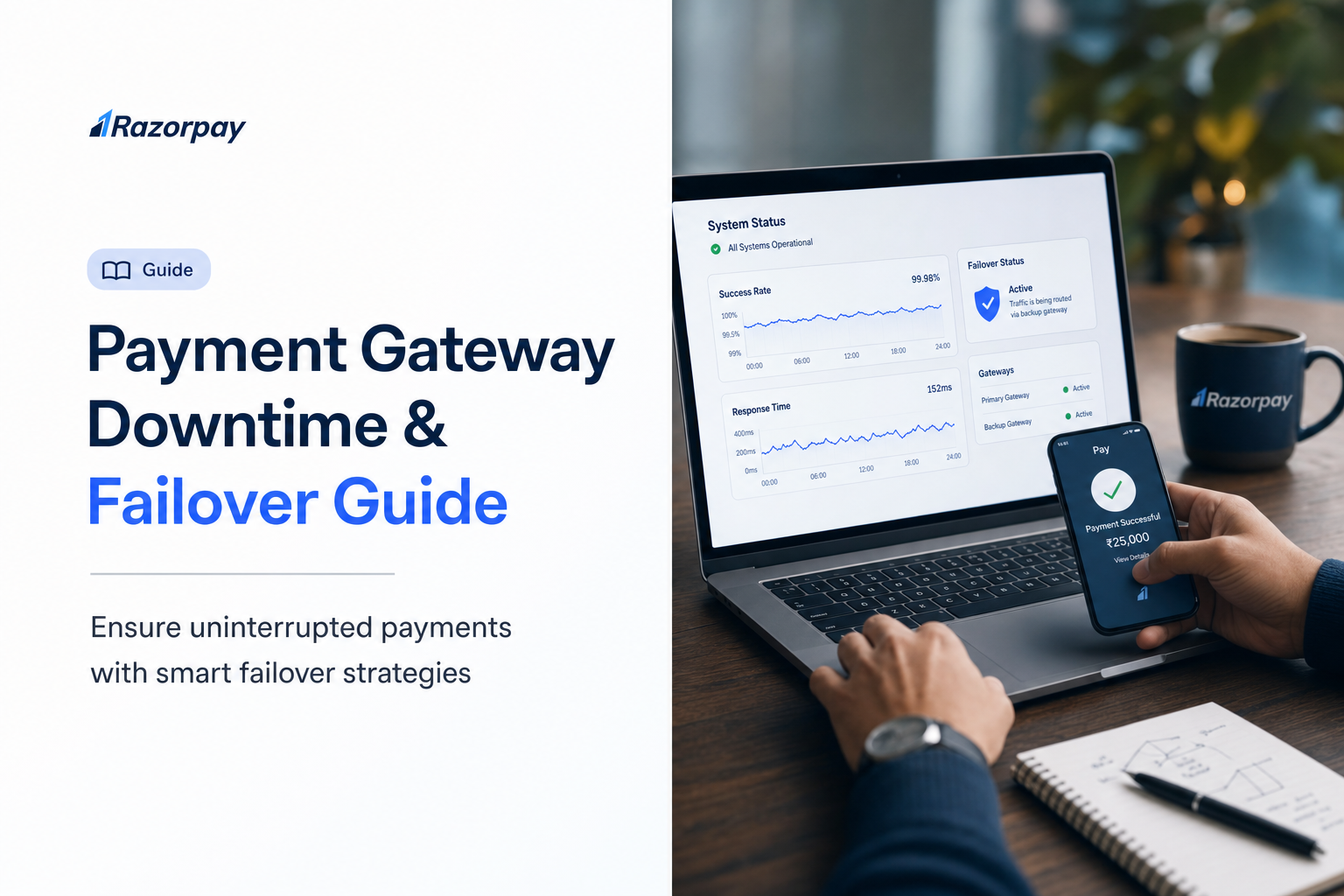
Automated failover is the technical core of how payment gateways handle downtime. An orchestration layer sits above multiple payment gateways, continuously monitoring health signals and rerouting traffic the moment a primary path degrades.
What Is Payment Gateway Failover?
Payment gateway failover is the automated rerouting of a transaction from a degraded primary gateway to a healthy backup processor when health monitoring detects an issue. The orchestration layer acts as a traffic controller, intercepting failure signals and replaying the transaction payload through an alternate path within milliseconds.
Active-Passive vs. Active-Active Architectures
Active-Passive: A single primary gateway handles all traffic while a backup sits idle. Simpler to operate, but the backup is rarely live-tested. Best for early-stage merchants.
Active-Active: Multiple gateways handle live traffic simultaneously, routed by performance. If one degrades, its volume is absorbed by the others. Best for high-volume D2C, SaaS, and marketplaces.
How Health Monitoring Triggers a Failover
The orchestration layer pings gateway APIs continuously and watches for breached thresholds:
- HTTP 500 / 503 error rates above baseline
- Response time exceeding defined SLAs
- Authorisation rate drops on a specific PSP or method
When thresholds are crossed, the gateway is flagged as degraded and new traffic is steered away. Properly engineered systems reroute in milliseconds.
The “Invisible Failover” Experience
When failover works, the customer sees nothing unusual. The sub-100 millisecond cascade looks like a slightly longer spinner, followed by a success screen.
Pro Tip: Smart routing is proactive (it sends each transaction to the optimal gateway on the first attempt). Failover is reactive (it activates only when the first attempt fails). Build both layers.
How Razorpay’s Optimiser Keeps Your Transactions Moving
Razorpay’s Optimiser acts as an orchestration layer above multiple payment aggregators. It abstracts several aggregator connections behind one integration and decides, transaction by transaction, which path is most likely to succeed.
Optimiser’s core capabilities include:
- Multi-aggregator routing: Routes each transaction through the path most likely to succeed, based on configured rules and historical performance.
- Real-time gateway health detection: Monitors live performance and redirects traffic away from processors showing signs of degradation.
- Smart retry logic for soft declines: Attempts the payment through an alternate route when a soft decline is received, rather than surfacing a failure.
This is particularly relevant for high-volume D2C brands, subscription businesses, and marketplaces.
The Hidden Cost of Downtime for Indian Businesses
The true cost extends beyond the failed transaction. It hits CAC, recurring revenue, brand perception, and downstream payment operations for weeks afterwards.
Subscription and Recurring Revenue at Risk
Recurring billing is a distinct risk category. A renewal batch queued during an outage produces involuntary churn even if payment is eventually collected. New sign-ups during an outage are usually lost permanently. Razorpay’s Subscriptions product includes retry logic that re-attempts failed payments through alternate paths.
Customer Acquisition Spend Vaporised
Every rupee of paid acquisition driving traffic to a checkout that cannot process payments is sunk cost. Performance campaigns running during an outage can burn lakhs with zero conversion.
Reputational Damage and the Social Media Amplifier
Indian consumers are vocal during outages, and complaints spike on X and Instagram within minutes. Against an Indian baseline of 85-90% payment success rates, with top performers at 95%+, a visible failure erodes trust.
Smart Routing vs. Failover vs. Load Balancing
These three mechanisms are often conflated. A resilient stack uses all three, as discussed in Razorpay’s success rate analysis.
Smart Routing – Proactive Optimisation
Smart routing is first-attempt optimisation. It analyses payment method, geography, transaction amount, and historical success rates to pick the path most likely to authorise on the first try.
Automated Failover – The Reactive Safety Net
Failover activates only after a failure signal: an error code, a timeout, or a health-check breach. The orchestration layer intercepts the failure and cascades the payload to a backup processor.
Load Balancing – Distributing Volume
Load balancing distributes traffic across gateways to prevent any node from being overloaded. Redundancy strategies can push uptime to 99.99% and reduce decline rates by around 3.7%.
Pro Tip: Track payment success rate by method and gateway daily. Segmenting by UPI, cards, and net banking helps spot underperforming combinations before customers notice.
How to Build a Failover-Ready Payment Stack
Use this checklist when evaluating your stack. It pairs with our guide on how to choose a payment gateway.
Step 1 – Audit Your Single Points of Failure
- Map the chain: server, gateway API, acquiring bank, issuing bank
- Identify each node with no live redundancy
- Document the blast radius of each SPOF
Step 2 – Integrate Multiple Payment Aggregators
- Choose aggregators with diverse underlying infrastructure
- Verify independent peak-volume capacity and PCI DSS Level 1 status
Razorpay’s Instant Settlements feature gives access to funds outside the standard window, relevant when a gateway disruption delays settlement.
Step 3 – Configure Failover Rules and Routing Logic
- Define primary/backup hierarchy and active-passive vs active-active mode
- Set health check thresholds: error rate, response time, consecutive failures
- Separate retry policy for soft declines vs hard declines
Step 4 – Implement Real-Time Monitoring
- Combine synthetic monitoring, real user monitoring, and AI anomaly detection, per this payment observability guide
- Alert on degradation, not just full outage
- Build dashboards per gateway and per method
Step 5 – Test Your Failover
- Run sandbox simulations for primary failure, latency, and peak load
- Schedule regular drills, not one-time tests
- Document outcomes and tune thresholds
Step 6 – Align with RBI Compliance Requirements
RBI’s PA/PG guidelines require half-yearly DR drills with defined RTO/RPO targets. Build a documented BCP and capture drill evidence.
Pro Tip: Run quarterly simulated gateway-outage drills so routing logic and ops teams stay ready before a real outage.
What “Good” Looks Like – Benchmarks for 2026
Use these benchmarks to score your stack against leaders profiled in our guide to the best payment gateways in India.
Uptime Benchmarks
- Industry standard: 99.9% (about 8.7 hours of downtime per year)
- Best-in-class: 99.99% (about 52 minutes per year)
Success Rate Benchmarks by Method
- UPI: 90-95%
- Domestic cards: 85-90%
- Net banking: 80-85%
- International cards: 70-80%
Recovery Benchmarks
- Best-in-class: sub-100 milliseconds
- Acceptable: under 1 second
- Poor: over 3 seconds (customer-visible delay)
How Razorpay Helps Build Resilient Payment Infrastructure
Razorpay’s infrastructure addresses downtime and failover challenges across volume tiers. The product stack maps to the resilience functions above.
| Product | Resilience Role |
|---|---|
| Optimiser | Orchestration layer routing across multiple aggregators |
| SR Analytics Dashboard | Success rate visibility by method, gateway, and time |
| Subscriptions | Recurring billing with alternate-path retry logic |
| Payment Gateway | Flagship stack supporting UPI, cards, net banking |
| Instant Settlements | Settlement access outside the standard cycle |
| RBI-Authorised Payment Aggregator | Regulated entity status with BCP/DR obligations |
Explore Razorpay’s Payment Infrastructure
Conclusion
In 2026, payment resilience is a board-level concern. India’s transaction volumes, RBI’s compliance bar, and customer expectations of seamless checkout have made redundancy non-negotiable. Multi-aggregator architecture, automated failover, smart routing, and disciplined DR drills separate resilient stacks from fragile ones. Audit your single points of failure. Integrate a second aggregator and live-test it. Configure health-based routing thresholds. Monitor success rate by method daily. Align your DR cadence with, or exceed, RBI’s half-yearly minimum. The cost of building this in advance is always lower than explaining an outage to your customers, board, and regulator.
Frequently Asked Questions
What is payment gateway failover and how does it work?
Payment gateway failover is the automated rerouting of a transaction from a degraded primary gateway to a healthy backup processor when health monitoring detects an issue. Orchestration software continuously pings gateway APIs, watches error rates and latency, and reroutes traffic the moment thresholds are crossed, with no human intervention.
What are the most common causes of payment gateway downtime in India?
Causes fall into four layers: your server (misconfigured APIs, deployment bugs), the gateway (maintenance, DDoS, rate limits), the bank (core banking outages, OTP failures, fraud rules), and the network (ISP disruptions, regional outages). Bank-side downtime during PSU maintenance is a common India-specific cause.
What is the difference between smart routing and failover?
Smart routing is proactive: it sends each transaction to the optimal gateway on the first attempt based on method, geography, and historical success rates. Failover is reactive: it activates after a failure signal, replaying the transaction through a backup. Resilient stacks use both layers.
How do I know if my payment gateway has good uptime?
Look for a published SLA, a public status page with historical incident data, an uptime figure of at least 99.9% (best-in-class is 99.99%), documented incident response time, and method-level success rate dashboards. Ask for evidence of recent DR drills.
Does RBI require payment gateways to have disaster recovery plans?
Yes. RBI’s PA/PG Guidelines require robust IT infrastructure including BCP and DR mechanisms, with periodic disaster recovery drills at least half-yearly and RTO/RPO targets aligned to the criticality of payment services.
How does downtime affect subscription businesses differently?
Renewal batches hitting during an outage cause involuntary churn even if payment is eventually collected. New sign-ups during an outage are permanently lost. Recurring billing demands stronger retry logic and alternate-path failover than one-time purchase flows to protect lifetime value.