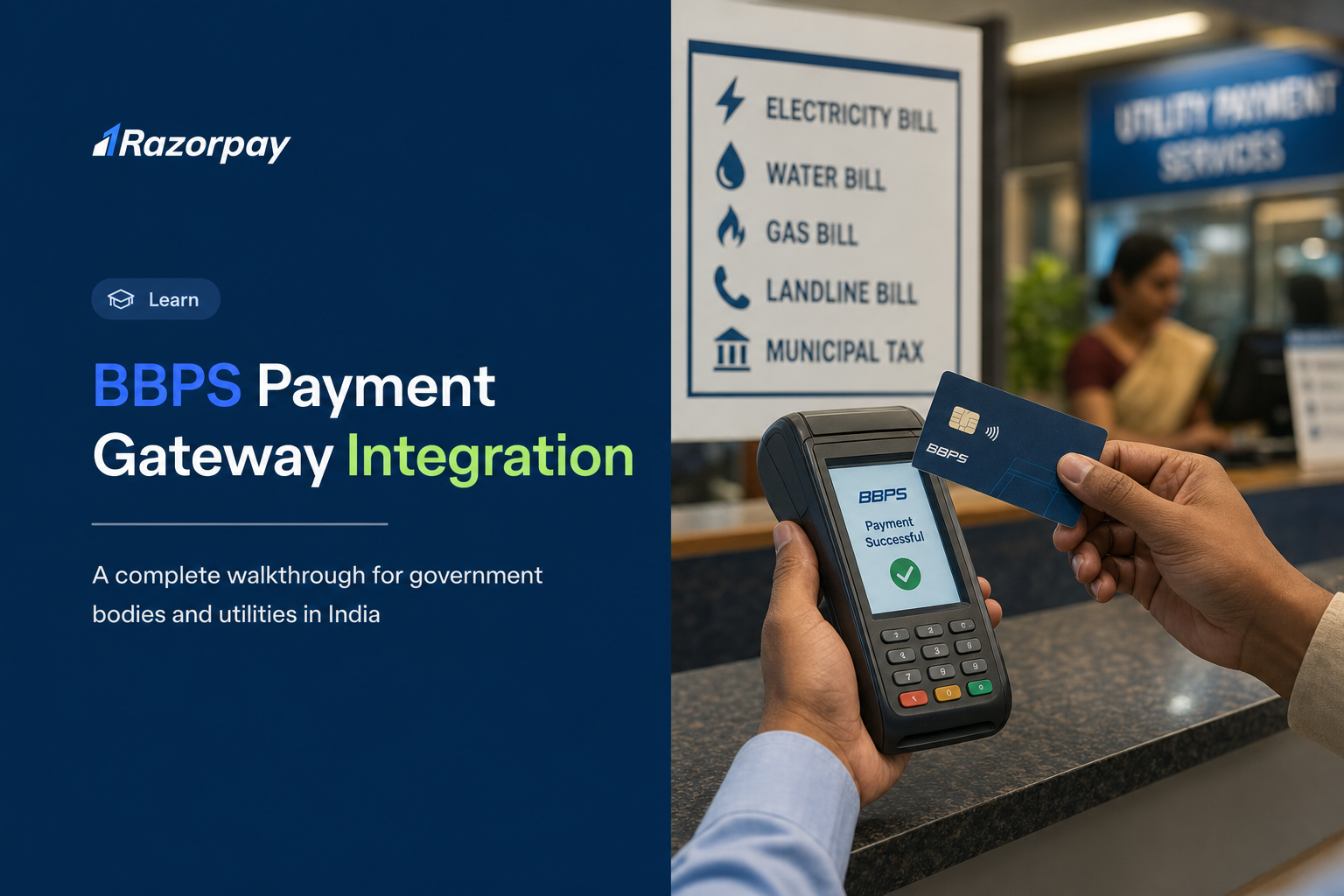
India’s bill-payment infrastructure has consolidated onto a single central network. The modern standard is one API connection to NPCI’s Bharat Connect (BBPS) platform. The scale is hard to ignore: payments on Bharat BillPay touched 3.05 billion in 2025, worth Rs 14.84 trillion.
This guide is a practitioner’s playbook. It covers ecosystem roles, the RBI mandate, biller integration, post-go-live operations, and guidance for government bodies and regulated entities.
Key Takeaways
- Razorpay’s current BBPS documentation identifies Razorpay as a Customer Operating Unit (COU) and documents APIs for customer bill payment.
- The documented flow includes biller discovery, bill retrieval, payment initiation and status polling.
- BBPS access must be enabled for the merchant account. Test-key payments do not run on the live BBPS network.
- A customer-facing bill-payment integration is different from onboarding an organisation as a biller.
- Government bodies and utilities can scope their project around the required role: customer bill payment or biller onboarding.
See the Razorpay BBPS integration guide for the documented product scope.
What Is BBPS (Bharat Connect) and Why It Matters in 2026
BBPS is an interoperable, RBI-regulated bill-payment network operated by NPCI Bharat BillPay Limited (NBBL), spanning 25+ categories and 22,000+ billers.
From BBPS to Bharat Connect: What Changed
BBPS is the underlying system; Bharat Connect is its operating identity. The network was conceptualised by the RBI and is operated by NBBL. In 2024, the RBI announced the rebranding of BBPS to Bharat Connect at the Global Fintech Fest, signalling a strategy to expand beyond classic bill payments.
In 2026, the network’s scale includes:
- 22,000+ registered billers and 700+ digital payment channels
- 5 lakh+ physical agent outlets
- New live categories such as Forex via FX-Retail
BBPS vs. UPI vs. Traditional Bill Payment
BBPS is a bill-payment infrastructure layer. UPI is a fund-transfer rail, and BBPS uses UPI as one payment mode among many. Traditional collections mean fragmented integrations and manual reconciliation.
| Feature | BBPS (Bharat Connect) | Traditional Bill Payment |
|---|---|---|
| Integration model | One API to a central network | Separate integration per biller/channel |
| Reconciliation | Standardised transaction references | Manual, channel-by-channel |
| Reach | 700+ channels, 5 lakh+ outlets | Limited to your own channels |
| Settlement | Multiple daily net cycles | Bilateral, slower |
| Dispute handling | Built-in complaint system | Ad hoc |
For developers, because settlement runs across multiple cycles per day and confirmations arrive asynchronously, design for idempotency on receipt generation and rely on webhook-driven status handling.
The RBI Mandate That Made BBPS Non-Negotiable
From July 1, 2024, RBI mandated that all credit card bill payments made through third-party apps must be routed through BBPS. The BBPS Directions came into effect on 01 July 2024, and reporting confirmed users could no longer make credit card repayments on non-compliant third-party apps.
- Fintechs, wallets, and payment apps handling credit card bills must integrate with BBPS or obtain independent authorisation.
- Operating outside BBPS for this category is now regulatory non-compliance.
The BBPS Ecosystem Decoded: Roles, Rules, and Eligibility
Locate where your business sits before planning any integration. The ecosystem includes multiple operating units alongside billers and the central governing unit.
The Four Key Participant Roles
- Central Unit (NBBL/NPCI): Governs, regulates, and settles across the network.
- Biller Operating Unit (BOU): Onboards billers directly or through aggregators onto the platform.
- Customer Operating Unit (COU): Provides the customer-facing interface, connecting to 700+ digital channels and 5 lakh+ offline outlets.
- Billers and TSPs/Developers: Billers are the utilities, lenders, or agencies collecting payments; Technical Service Providers help them build and certify integrations.
For businesses already using Razorpay’s Payment Gateway, the RBI-authorised payment aggregator infrastructure provides a compliant foundation from which to extend into BBPS-enabled bill collection.
Who Is Eligible to Become a BBPS Biller
Any entity collecting recurring payments in an eligible category can onboard. The official categories list spans 25+ types, including:
- Electricity, water, piped gas, LPG, prepaid meters
- Mobile postpaid/prepaid, landline, broadband, DTH, cable
- Insurance premiums, loan repayment/EMIs, credit card bills
- Education fees, municipal taxes, property taxes, eChallan
- FASTag, NPS, housing society maintenance, rent, subscriptions
Eligible entities include NBFCs, insurers, educational institutions, government departments, and subscription businesses. The requirement: onboard via a BOU and pass NBBL certification.
What Is a BBPS Operating Unit and Do You Need to Become One
Most businesses integrate as billers. Becoming a BOU or COU is reserved for banks and large aggregators. Both banks and eligible non-bank entities such as fintechs and NBFCs can apply for a BBPS licence if they meet the capital, security, and operational criteria.
It carries real overhead: NBBL recommends a minimum 12-person and optimum 25 to 30-person team across Technology, Operations, Product, Business Development, and Finance/Legal. For most collections use cases, biller status via a BOU is the right path.
What Razorpay’s BBPS integration supports
Razorpay’s BBPS documentation describes a COU integration that lets a platform’s customers discover billers, retrieve bill amounts and pay bills. This provides a dedicated customer bill-payment workflow through BBPS.
For a government department or utility, first identify whether the requirement is to let customers pay existing billers or to onboard the organisation as a biller. Use the COU API guide for the customer-facing payment flow. For onboarding the organisation as a biller, confirm the appropriate biller-onboarding arrangement, category and responsibilities with the relevant operating unit.
Confirm supported categories, account access, biller responsibilities, reconciliation and operational support before implementation.
Step-by-Step: How to Integrate BBPS as a Biller (2026 Playbook)
Follow these five steps in order to move from eligibility confirmation to a certified, production-live biller integration.
Step 1 – Pre-Integration Prerequisites
Confirm your category is eligible and select a BOU to onboard through. Then prepare your environment.
Server / Network
– Static public Indian IP for whitelisting
– HTTPS with SSL/TLS
– A webhook endpoint for asynchronous confirmations
Compliance / Security
– AES-256 encryption for payloads
– PCI-DSS for card-related flows
– OAuth 2.0 or JWT authentication
– KYC documents: PAN card, GST certificate, board resolution, and cancelled cheque
Pro-Tip: Before applying for biller status, map your existing customer identifier (loan account number, consumer ID, policy number) to NBBL’s identifier format. Wrong mapping is the most common cause of failed certifications.
Step 2 – Define Your Customer Identifier Schema
Identifiers let customer-facing apps locate a specific bill. Design them carefully:
- Fields include attribute name, display name, minimum and maximum length, and a regex pattern to validate customer input.
- Keep identifiers stable and avoid exposing plaintext PII.
- Example: an NBFC uses loan account number as the primary identifier and mobile number as an optional secondary field.
Step 3 – Implement the Four Core BBPS APIs
Standard biller integrations implement Bill Fetch, Bill Payment, and Transaction Status APIs, with AES-256 and OAuth 2.0/JWT.
fetchCustomerBills – returns the outstanding amount, due date, and a reference in BBPS format.
fetchBillReceipt – generates and accesses a receipt against a customer’s payment, with a permanent BBPS transaction ID. Make this idempotent.
Transaction Status – handles asynchronous and pending states.
Callback/Webhook – recommended for pushed settlement events rather than manual polling.
Pro-Tip: Implement idempotency keys on bill-fetch and receipt APIs from day one. Duplicate calls during network retries are a production reality.
Step 4 – Sandbox/UAT Testing and Certification
Test end-to-end in your BOU or TSP sandbox before certification. Mandatory cases include:
- Valid and invalid identifier fetch
- Successful and failed payment
- Receipt generation
- Dispute handling
Note the network requirement: the sandbox works over the internet, while pre-production and production require MPLS connectivity. Plan lead time for MPLS provisioning, as it is often the longest single dependency.
Step 5 – Go-Live Checklist and Production Deployment
Move to production methodically:
- Switch the base URL to production
- Confirm IP whitelisting
- Validate webhook reachability over MPLS
- Add settlement accounts (holder name, account number, IFSC)
- Configure split logic if using multiple accounts
Live integrations require static IP, HTTPS/SSL-TLS, and webhook endpoints.
BBPS Integration for Government Bodies and Regulated Entities
Government and regulated categories are fully live, including municipal taxes, municipal services, and eChallan.
Why Government Agencies Are Increasingly BBPS Billers
Municipal corporations, public utilities, and tax departments are all eligible billers. BBPS supports vernacular interfaces and offline agent-assisted payments, extending reach into Tier 2, Tier 3, and rural areas.
- Enables digital collection of water and property taxes and civic charges
- Supports eChallan and municipal service payments
- Provides an RBI/NPCI-governed audit trail and standardised transaction handling
Specific Requirements for NBFCs, Insurers, and Regulated Entities
- NBFCs: Loan repayment is a live category. Your fetchCustomerBills response should account for partial prepayment and full foreclosure scenarios.
- Insurers: Premium payment is live; support both monthly and annual billing cycles.
- Credit categories: The RBI mandate effective July 1, 2024, makes credit card bill routing a compliance requirement.
Businesses in regulated categories such as NBFCs and insurance providers can use Razorpay’s Subscriptions product to layer recurring mandate management on top of their BBPS biller setup.
BBPS for Social Commerce and SME Platforms
The agent collection category opens a path for kirana networks, customer service points, and B2B platforms to collect bills on behalf of customers.
- Offline agent networks serve non-digital customers via BBPS-integrated merchants
- Agent collection is a live BBPS category
Post-Integration Operations: Reconciliation, Complaints & Settlement
With multiple settlement cycles per day, ops discipline is what keeps a live integration healthy.
How BBPS Settlement and Reconciliation Works in Practice
BBPS runs multiple settlement events daily, typically with inter-unit net settlement on a T+1 basis. Automated reconciliation means:
- Match each BBPS transaction ID to your internal record
- Validate the settled amount against the bill amount
- Log discrepancies for investigation
- Consume settlement webhooks rather than manually polling
Razorpay’s Smart Collect feature automates the reconciliation of incoming payments against customer identifiers, which is directly applicable to the multi-channel nature of BBPS bill settlements.
Managing Customer Complaints and Dispute Resolution
BBPS has a built-in complaint system, and every BBPS payment is recorded using a unique transaction reference number used in disputes. Two dispute types matter:
- Transaction failures (payment not completed for reasons outside the customer’s control)
- Biller-side disputes (bill or amount discrepancies)
Pro-Tip: Log every bill-fetch and receipt API call with timestamps and full payloads. When a dispute lands, you resolve it in hours.
Common BBPS Integration Mistakes and How to Avoid Them
Technical and Operational Mistakes That Delay Certification
- Non-idempotent receipt generation causing duplicate receipts on retries
- Hardcoded or cached bill amounts instead of live fetches
- Missing BBPS-standard error codes (generic 500s fail certification)
- Sandbox and production credential mismatch, since they differ by base URL and keys
- Treating settlement webhooks as optional
- Skipping annual TSP recertification
Implement the documented customer bill-payment flow
For an account with BBPS access enabled, the documented integration follows these steps:
- Fetch the supported biller categories.
- Fetch billers in the selected category.
- Fetch biller plans where the category requires them.
- Create a bill request using the customer identifiers required by that biller.
- Poll the bill-request status until it reaches success or failure.
- Create a bill payment for the fetched bill.
- Poll the bill-payment status until it reaches success or failure.
Bill requests and payments are asynchronous. Poll each resource until its terminal status confirms the outcome, then show the result to the customer. Use the current BBPS guide and its linked API references for status handling.
This procedure describes the COU customer-payment integration. Treat the earlier biller-onboarding discussion as a separate workstream requiring confirmation from the relevant operating unit.
Conclusion
BBPS integration is now both a compliance requirement and a growth channel. The July 2024 RBI mandate made routing non-negotiable for credit card bills, while consolidation onto Bharat Connect makes a single central connection the practical standard for recurring collections.
The teams that win invest as heavily in the post-go-live layer – reconciliation, dispute resolution, and settlement tracking – as they do in the initial API build.
Explore Razorpay’s Payment Solutions.
FAQs
Does Razorpay have a documented BBPS integration?
Yes. The current BBPS guide identifies Razorpay as a COU and documents bill discovery, bill requests, payments and status polling. Account access must be enabled.
How should a utility plan biller onboarding?
Start by confirming the biller-onboarding arrangement, supported category and operational responsibilities for your organisation. The COU API flow described here covers customer bill payment; biller onboarding follows its own agreed arrangement.
Q1: What is the difference between BBPS and a payment gateway?
A payment gateway processes individual transactions between a buyer and seller. BBPS (Bharat Connect) is India’s central infrastructure specifically for bill payments, connecting billers, banks, and customers through a standardised, RBI-regulated network.
Q2: How long does BBPS biller integration typically take?
The technical integration typically takes 4 to 8 weeks for a team with existing API experience. Certification and onboarding through a BOU add more time, so plan for a full go-live timeline of 2 to 4 months, with MPLS connectivity setup often being the longest single dependency.
Q3: Do I need RBI approval to integrate BBPS as a biller?
No. Billers onboard through a licensed Biller Operating Unit (BOU) and do not need their own RBI licence. Only entities seeking to become BOUs or COUs require direct NPCI/RBI authorisation.
Q4: Is BBPS integration mandatory for credit card bill payments in India?
Yes. From July 1, 2024, RBI mandated that all credit card bill payments made through third-party apps must be routed through BBPS. Any app handling credit card bill payments outside BBPS is now in regulatory non-compliance.
Q5: Can small businesses and SMEs integrate BBPS?
Yes, if they fall into an eligible biller category such as housing societies, subscription services, education fees, or rent collection. Smaller businesses typically integrate through a Technical Service Provider (TSP) rather than building the integration themselves.