India’s startup ecosystem has crossed 1,43,000+ DPIIT-recognised startups as of 2024, and the payment gateway decision has quietly shifted. The question is no longer “which one is cheapest” but “which one will scale with us.” Once volume climbs, your gateway becomes financial infrastructure that touches revenue, cash flow, and compliance. This guide is a decision framework, not a discovery list. It walks you through a 6-point evaluation framework, India-specific compliance criteria, and a pre-scale audit checklist. If you are still mapping the basics, start with how payment processing works, then return here.
Key Takeaways
- A payment gateway is financial infrastructure that directly affects revenue, cash flow, and compliance as you scale, not just a checkout tool.
- Transaction success rate is the single most important metric; a 2% drop at scale can mean lakhs in monthly revenue loss.
- UPI accounted for 83.7% of all digital payment transactions by volume in India in FY 2023-24, so any gateway without a robust UPI stack is already behind.
- India-specific compliance – RBI data localisation, card-on-file tokenisation, and the e-mandate framework – must be verified before integration, not after.
- Settlement speed directly affects working capital; evaluate flexible settlement options beyond standard cycles.
- Support quality is a scale risk; test escalation paths and pre-sales responsiveness before committing.
- Gateways that work for your first 100 transactions may not support your 100,000th.
- International readiness should be evaluated at Day 1 if global expansion is on your 12-24 month roadmap.
Table of Contents
Why Your Payment Gateway Choice Becomes a Scale Decision
Early on, almost any gateway works because volume is low and failures feel minor. But as you grow, the gateway sits directly between your customer and your revenue. A weak provider quietly taxes every growth event. Understanding the mechanics of payment processing makes it clear why this becomes a survival decision, not a setup checkbox.
The Hidden Cost of a Wrong Gateway Choice
Failed transactions are silent revenue leakage. Consider a startup with a ₹1,000 average order value processing 10,000 monthly transactions. A 2% drop in success rate quietly erases ₹2 lakh in revenue every month, money you already spent to acquire. At scale, small percentages become material.
Did You Know?
Digital payments in India grew from 220 crore transactions in FY 2013-14 to 18,737 crore transactions in FY 2023-24. At that scale, every fractional failure rate compounds into real lost revenue.
The Moment a Gateway Becomes a Growth Bottleneck
Your Day 1 gateway may not be your Day 500 gateway. Watch for these signals:
- Declining success rates as volume rises: approvals that held steady at low volume start slipping during campaigns or spikes.
- Settlement cycles creating cash flow gaps: sales grow but funds arrive too slowly to refuel inventory or ad spend.
- Compliance gaps surfacing late: tokenisation or mandate requirements appear after integration, not before.
- Integration debt accumulating: refunds, reconciliation, and reporting become manual workarounds.
Razorpay’s Optimiser product routes transactions across multiple acquirers, helping startups reduce failed payments as transaction volume grows.
What “Support” Actually Means at Scale
“24/7 support” on a pricing page tells you nothing about an outage at peak traffic. Pre-scale, support means integration help and onboarding. At scale, it means proactive monitoring, a dedicated point of contact, clear escalation paths, and compliance guidance when regulations shift. Evaluate support as a growth partner, not a help desk you ping when something breaks.
The 6-Point Evaluation Framework: What to Score Before You Commit
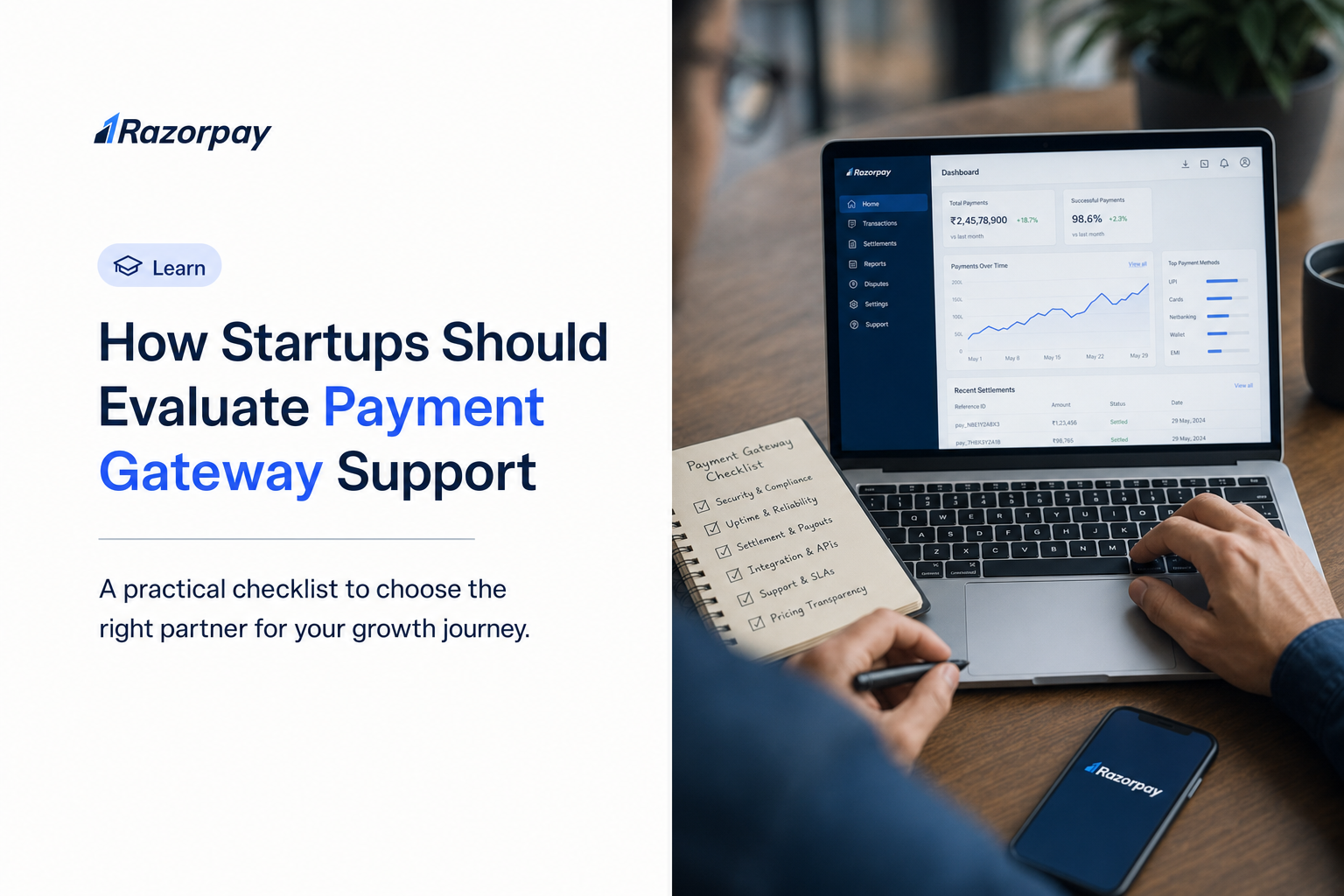
Treat gateway selection like a scored checklist. Rate any provider from 1 to 5 across the six criteria below, then weight them against your roadmap. This turns a vague vendor comparison into a structured, repeatable decision.
Criterion 1 – Transaction Success Rate and Smart Routing
Transaction success rate is the percentage of attempted payments that complete. Variance comes from acquirer relationships, routing logic, and UPI rail stability. Smart routing automatically directs each transaction to the best-performing acquirer, with redundancy when one path fails. Since UPI accounted for 83.7% of digital payment transactions by volume in FY 2023-24, aggregate numbers hide what matters.
Pro-Tip: Ask for success rate data segmented by payment mode, not just an overall average. A weak UPI flow underperforms exactly where Indian customers actually pay.
Questions to Ask a Gateway Provider on Success Rates
- What is your success rate by UPI, cards, wallets, and net banking?
- Can you provide failure reason mapping?
- Do you route across multiple acquirers?
- How do you monitor success rate during traffic spikes?
Criterion 2 – Payment Method Coverage for the Indian Market
“100+ payment methods” is a marketing claim until you check the rails that matter. Non-negotiables for India include UPI (Autopay, Intent, Lite), cards, net banking, and wallets. For subscription businesses, UPI Autopay and the e-mandate framework decide whether recurring billing works at all. D2C brands should also weigh affordability rails like EMI and BNPL. Dig into UPI third-party apps to understand the rail landscape.
Did You Know?
UPI processed 172.0 billion transactions worth ₹261.0 lakh crore in FY 2024-25, making it foundational, not optional.
The UPI Evaluation Checklist
- Do you support UPI Intent, Collect, QR, and Autopay?
- Can you report UPI performance separately from cards?
- How do you handle PSP-level downtime?
- Do you support subscription use cases through e-mandates?
Criterion 3 – Settlement Speed and Cash Flow Flexibility
Standard settlement cycles can create a real cash gap for high-growth startups: sales are climbing, but proceeds arrive too late to replenish inventory, fund campaigns, or cover refunds. Settlement is a working capital lever, not just a feature. Evaluate on-demand options and how weekends and holidays are handled. A solid payment management system makes settlement visibility easier.
Razorpay’s Instant Settlements feature gives businesses access to funds outside the standard settlement window, a meaningful option for bootstrapped founders managing working capital.
Settlement Questions to Ask Before You Sign Up
- What settlement options are available?
- How are holidays and weekends handled?
- Can settlements be tracked from the dashboard?
- What happens when a settlement is delayed?
Criterion 4 – India-Specific Compliance Readiness
Most guides stop at PCI DSS. The full India-specific regulatory stack is broader, and gaps surface painfully after integration. Verify each layer upfront:
- RBI data localisation: payment data must be stored in systems located in India.
- Card-on-file tokenisation: stored card data replaced with tokens for recurring use.
- E-mandate framework: the basis for compliant recurring payments.
- PCI DSS Level 1: the baseline for handling card data securely; review the PCI DSS compliance guide.
- RBI Payment Aggregator authorisation: confirm the provider is authorised.
Did You Know?
RBI requires payment data to be stored in systems located in India.
Razorpay, as an RBI-authorised Payment Aggregator, handles data localisation and tokenisation as part of its core infrastructure.
The India Compliance Checklist for Gateway Evaluation
- Is payment data storage located in India where required?
- How do you support card tokenisation?
- How do you support recurring mandates?
- Are you authorised as a Payment Aggregator?
- What compliance documentation is available to merchants?
Criterion 5 – Developer Experience and Integration Quality
Integration quality determines time to launch and long-term maintenance cost. Evaluate API documentation depth, SDK coverage across your stack, webhook reliability, sandbox fidelity, and no-code options. A useful primer is how to integrate a payment gateway in a website.
Pro-Tip: Have your engineering team spend 30 minutes in the sandbox attempting a failed payment, a refund, and a subscription cancellation before integrating. Edge-case behaviour reveals more than any sales demo.
Integration Quality Checklist
- Test a failed payment.
- Test a refund.
- Test a webhook retry.
- Test a subscription cancellation.
- Test a reconciliation export.
Criterion 6 – Support Quality as a Scale Risk
This is the most overlooked criterion. Pre-sales responsiveness is a leading signal: if answers are slow before you pay, they rarely improve after. Probe escalation paths, the transaction-volume thresholds that unlock account management, and whether support is proactive or purely reactive. Ask who handles compliance questions post-onboarding. Tie this to checkout security, since incidents and fraud often arrive together.
Support Quality Test – Questions to Ask Before You Sign Up
- What qualifies as a P0 issue?
- Who handles urgent payment failures?
- Is there a technical escalation path?
- Do you provide outage alerts?
- What support changes as transaction volume increases?
How Razorpay’s Payment Gateway Is Built for Startups That Plan to Scale
The six criteria above map closely to how Razorpay’s payment gateway is designed. Rather than a checkout add-on, it is built as financial infrastructure for startups that expect to grow across volume, methods, and markets.
- Full Indian payment rail coverage: support for 100+ payment methods including UPI (Autopay, Intent, Lite), cards, net banking, and wallets from a single integration.
- Optimiser for intelligent routing: routes transactions across multiple acquirers to help reduce failed payments as volume grows.
- Instant Settlements: access to funds outside the standard settlement window for working capital flexibility.
- RBI Payment Aggregator infrastructure: handles data localisation and tokenisation natively.
- Developer-first integration: SDKs across major stacks plus pre-built platform plugins for faster go-live.
- No-code options: Payment Links, Payment Pages, and Payment Buttons let early-stage founders start collecting payments without engineering effort.
International Payment Readiness: Evaluating for Global Scale from Day 1
Why Global Readiness Is a Day 1 Evaluation Criterion
Many Indian startups serve international customers earlier than planned, through freelancers, SaaS users, or D2C exports. Retrofitting cross-border support later is harder and costlier than choosing a gateway that already supports it. Notably, UPI has expanded for international acceptance in select markets through NPCI partnerships.
What to Evaluate for Cross-Border Payment Support
- Multi-currency acceptance and international card support
- e-FIRC support for documenting inward remittances
- IEC code requirements for export flows
- Virtual bank accounts for exporters
- RBI data localisation compliance for cross-border transactions
Did You Know?
India’s UPI has expanded to support international acceptance in select markets through NPCI partnerships.
The Scaling Readiness Audit: A Pre-Scale Checklist for Founders
Treat payment infrastructure as something you audit, not set once. Run this review quarterly and before any major growth event so issues surface in advance. Pair it with a clean view of recurring flows like AutoPay.
| Audit area | What to review |
|---|---|
| Transaction performance | Success rate by payment mode, issuer, and campaign period |
| Settlement and cash flow | Settlement speed, refund cycles, delays, cash gap impact |
| Compliance | Data localisation, tokenisation, e-mandates, PCI DSS, PA status |
| Integration health | API errors, webhook failures, reconciliation mismatches |
| Support quality | Response time, escalation quality, proactive incident updates |
Pro-Tip: Run a payment infrastructure audit before every major growth event – fundraise, festive campaign, or product launch.
How Razorpay Supports Startups at Every Stage of Scale
Razorpay is built as full-stack financial infrastructure designed to grow with you from Day 1 to Series B and beyond. The table below maps each evaluation criterion to a capability.
| Evaluation Criterion | Razorpay Capability |
|---|---|
| Payment method coverage | UPI, cards, net banking, and wallets through a single integration |
| Transaction routing | Routes transactions across multiple acquirers via Optimiser |
| Settlement flexibility | Instant Settlements for funds outside the standard window |
| Compliance infrastructure | RBI-authorised Payment Aggregator with data localisation and tokenisation |
| Developer experience | APIs, SDKs, documentation, and platform plugins |
| No-code options | Payment Links, Payment Pages, and Payment Buttons |
| International payments | Cross-border acceptance for eligible businesses |
| Recurring payments | Mandate and subscription flows |
| Fraud prevention | Risk controls and fraud prevention tools |
| Checkout conversion | Checkout designed for Indian payment preferences |
Explore Razorpay Payment Gateway
Conclusion
Choosing a payment gateway is a strategic infrastructure decision, not a one-time vendor checkbox. The six criteria – success rate, payment method coverage, settlement flexibility, India-specific compliance, developer experience, and support quality – are an ongoing lens you re-apply as volume grows and your roadmap shifts. The gateway that fit your first 100 transactions may quietly throttle your 100,000th. Before your next growth event, run the pre-scale audit, score your current provider honestly, and act on the gaps. If you are evaluating options, start by reviewing the Razorpay Payment Gateway against your own framework.
FAQs
What is the most important criterion when evaluating a payment gateway for a startup?
Transaction success rate is the single most important metric, since it determines how much revenue you actually capture. Ask for success rate segmented by payment mode rather than an aggregate, as a weak UPI flow can quietly hurt you where most Indian customers pay.
Do startups need to verify RBI compliance when choosing a payment gateway?
Yes, before integration. Confirm RBI data localisation, card-on-file tokenisation, the e-mandate framework, PCI DSS, and whether the provider is an RBI-authorised Payment Aggregator. Compliance gaps discovered post-integration are expensive to fix mid-growth.
When should a startup consider switching payment gateways?
Watch for signals: success rates declining as volume rises, settlement cycles creating cash flow gaps, compliance requirements surfacing late, growing integration debt, or support that cannot escalate urgent issues. These signs mean your gateway may no longer fit your needs.
Is UPI support really non-negotiable for an India-first startup?
Yes. UPI accounted for 83.7% of digital payment transactions by volume in FY 2023-24. Any gateway with a weak UPI stack underperforms where most Indian customers transact, so evaluate UPI performance separately.
Should startups evaluate international payment support even before selling globally?
If global expansion is on your 12-24 month roadmap, yes. Retrofitting cross-border support later is harder than choosing a gateway that already handles multi-currency acceptance, e-FIRC, and export documentation.