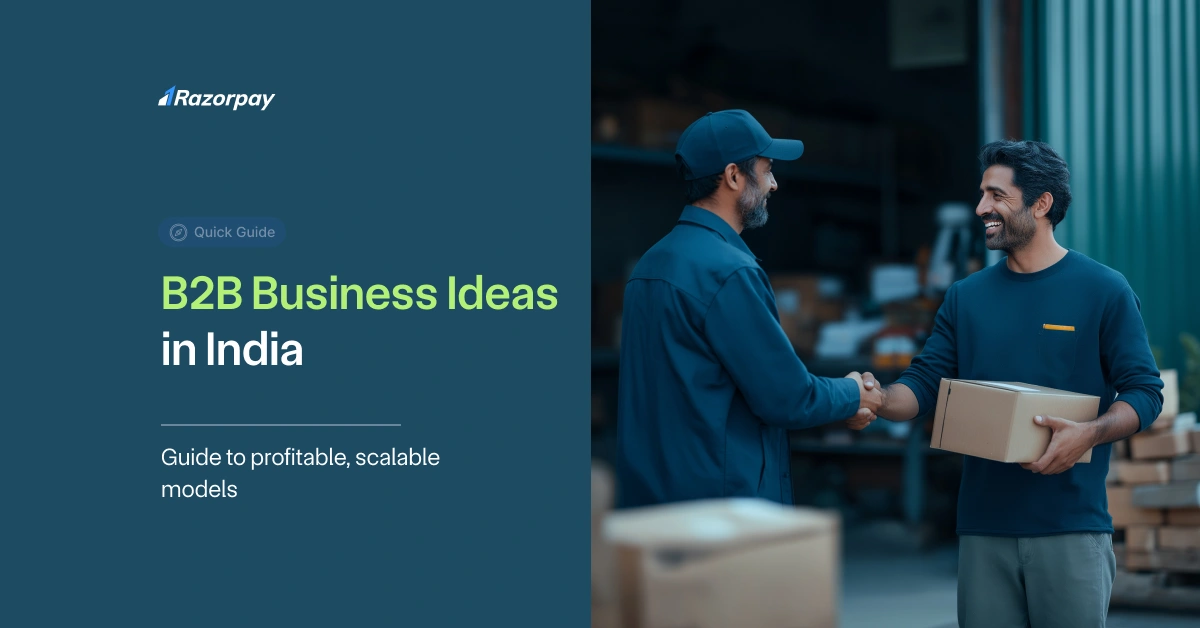
Businesses don’t just serve customers; they also serve other businesses. From the digital boom to the rise of enterprise SaaS and supply chain innovations, B2B (business-to-business) models are experiencing significant growth globally. In India too, the B2B landscape is witnessing rapid growth, thanks to digitisation, the rise of startups, and a strong SME ecosystem.
Whether you’re looking for a low-investment startup idea or want to scale an existing service, this blog has you covered. We’ll break down what a B2B business means, types of B2B business models, profitable ideas to explore, and real-world examples from India and beyond.
What Is a B2B Business?
A B-to-B business, or business-to-business model, refers to companies that sell their products or services to other businesses, rather than directly to individual consumers.
B2B vs B2C
- B2B (Business-to-Business): Targets other businesses (e.g., a software company selling CRM tools to startups)
- B2C (Business-to-Consumer): Targets individual customers (e.g,. an online fashion brand selling to end users)
B2B models often involve larger contracts, longer sales cycles, and strong relationships built on trust and service.
Why Start a B2B Business in 2026?
2026 is shaping up to be a landmark year for B2B startups, especially in high-growth markets like India. The ecosystem is evolving rapidly, with digital adoption, automation, and global demand fueling a new wave of opportunities.
Here’s why it’s the perfect time to build in B2B:
-
Predictable Revenue Streams
B2B models often operate on higher average order values and long-term contracts. This means steadier cash flow and more reliable forecasting compared to the unpredictable nature of B2C sales cycles.
-
Recurring Clients & Lower CAC
With strong relationships and reliable delivery, B2B businesses benefit from repeat customers and word-of-mouth referrals—resulting in significantly lower customer acquisition costs over time.
-
Less Saturation, More Niche Opportunities
Unlike the overcrowded B2C market, niche B2B sectors still have plenty of room for innovation. Whether it’s logistics tech, compliance solutions, or specialised SaaS tools, first movers can dominate early.
-
Global Tailwinds
The global B2B e-commerce market is projected to reach over $20 trillion by 2027. Additionally, the rise of remote work and digital transformation has made it easier than ever to sell cross-border.
-
Scope to Scale Across Verticals
From next-gen B2B SaaS platforms for SMEs to traditional manufacturing or supply-chain businesses, there’s growing demand across verticals. Plus, infrastructure and policy support in India—like ONDC, Make in India, and digital GST adoption—are creating a fertile ground for B2B growth.
Types of B2B Business Models
Let’s explore the four major categories of B2B business models with examples:
| Model | Examples |
| B2B Services | Marketing agencies, IT services, accounting, logistics support |
| B2B SaaS | Tools for CRM, payroll, billing, and HR management |
| B2B Manufacturing | Packaging suppliers, textile units, OEM parts vendors |
| B2B E-commerce | Wholesale portals, raw material distributors |
Top B2B Business Ideas to Start Now
Explore profitable business-to-business examples across services, manufacturing, and online models. We’ve grouped them for easier navigation:
-
Low-Investment B2B Service Ideas
These require minimal setup and high digital leverage:
- Digital marketing for local brands: Help SMEs go online via SEO, ads, and content.
- B2B content writing or email marketing: Offer lead generation and retention services.
- Web design for SMBs: Build storefronts and websites tailored for regional or niche sectors.
- Virtual Assistant Agency: Outsource daily business operations for founders and solopreneurs.
- HR/payroll outsourcing: Offer HR tech or manual services to startups.
-
Manufacturing-Based B2B Ideas
More capital-intensive, but high in demand:
- Custom Packaging Unit: Create eco-packaging solutions for D2C brands and exporters.
- Food processing supply: Manufacture packaged ingredients or bulk food items.
- Cleaning or eco-friendly products: Sell in bulk to hotels, schools, or industries.
- Label/sticker printing: Supply to apparel, food exports, and logistics firms.
-
Online B2B Business Ideas
Tap into the growing digital demand:
- Dropshipping for businesses: Help SMEs sell without stocking inventory.
- Wholesale marketplaces: Niche industrial goods or agricultural tools.
- Niche B2B SaaS tools: CRM for tutors, invoicing for freelancers, or inventory for boutiques.
- Online storefronts for resellers: Help merchants list and sell to a wider audience.
Real B2B Business Examples
Want proof that B2B can scale? Here are Indian businesses that nailed the model:
- Razorpay: A fintech company offering payment solutions for businesses of all sizes.
- IndiaMART: One of India’s largest B2B marketplaces, connecting buyers and suppliers.
- Paperkraft: Supplies corporate stationery and branded office supplies.
- Udaan: A digital wholesale platform helping local retailers source directly.
These businesses scaled by solving real pain points for other businesses.
Challenges in Running a B2B Business
B2B is not without its hurdles. Be ready to navigate:
- Longer sales cycles: Decision-making can take weeks or months.
- Trust-building: B2B clients expect reliability, service, and expertise.
- Complex buying processes: Multiple stakeholders and custom pricing.
- Customised delivery: From contracts to implementation, flexibility is key.
These challenges also act as entry barriers, giving early movers a strong edge.
FAQs
Q1. What are some examples of B2B businesses?
Digital marketing agencies, wholesale distributors, SaaS products, packaging units, and B2B marketplaces like IndiaMART.
Q2. How is B2B different from B2C?
B2B serves other businesses with bulk or custom solutions; B2C sells directly to end consumers, usually in smaller volumes.
Q3. Can I start a B2B business with low investment?
Yes, many B2B services like content creation, digital marketing, and consulting require minimal setup.
Q4. What is the best B2B business in India right now?
Fintech services, logistics support, HR SaaS, and eco-friendly manufacturing are trending in 2026.
Q5. Are B2B businesses profitable in the long term?
Absolutely. Recurring contracts, high-ticket sales, and customer retention make them highly profitable.