For Direct-to-Consumer brands, data is everywhere. We track conversion rates, click-through rates, and average order values. While these metrics tell you what is happening, they rarely explain why. Why did a hundred visitors abandon their carts on the shipping page? Why do first-time buyers from Instagram never make a second purchase? To answer these questions, you need to move beyond isolated data points and adopt a more holistic, empathetic perspective. This is where customer journey mapping becomes an indispensable strategic tool.
This in-depth guide provides a comprehensive walkthrough of customer journey mapping for D2C operators. Here, we will break down what a customer journey map is, explain why it is critical for retention, and provide a step-by-step process for creating one for your business.
Table of Contents
TL;DR
- The Shift: The traditional “Sales Funnel” is dead. Modern buying behavior is a non-linear loop (often called the “Messy Middle”) where customers jump between ads, reviews, and social media before buying.
- The Tool: A Customer Journey Map is the only way to visualize this chaos. Unlike a funnel, it tracks emotions, not just transactions, helping you see why customers drop off.
- The 5 Stages: A comprehensive map covers Awareness, Consideration, Purchase, Retention, and Advocacy. Most brands ignore the last two, leaving money on the table.
- The “Quick Wins”: Mapping often reveals that friction peaks at Checkout and Account Creation. Solving these specific pain points with tools like Magic Checkout (for 1-click speed) and Login with Razorpay (for passwordless entry) is the fastest way to fix a broken journey.
What is Customer Journey Mapping?
Customer journey mapping is the process of creating a visual representation of every interaction a customer has with your brand, from their first moment of awareness to becoming a long-term, loyal advocate. It is a story told from the customer’s point of view, designed to capture not just their actions, but also their thoughts, feelings, and motivations at each step.
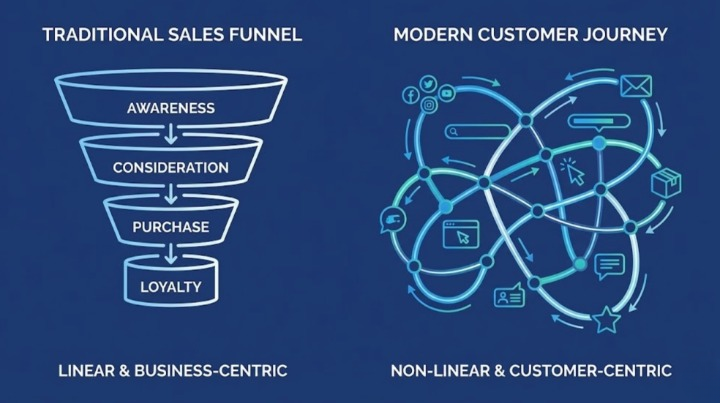
It is crucial to distinguish customer journey mapping from a traditional sales funnel. A sales funnel is a linear, business-centric model that tracks prospects as they move toward a purchase. A customer journey map, however, is often non-linear and is entirely customer-centric. It acknowledges that a customer might circle back, jump between channels, and have a complex emotional experience that a simple funnel cannot capture. The goal of customer journey mapping is to build empathy and uncover the hidden friction points and moments of delight that define the true customer experience.
 Why is Customer Journey Mapping Crucial for D2C Brands?
In the competitive D2C landscape, customer experience is the primary differentiator. A smooth, intuitive, and enjoyable experience is what earns repeat business. Customer journey mapping is the single most effective exercise for diagnosing and improving that experience.
The benefits are tangible and far-reaching:
- It Reveals Hidden Friction: Analytics can show you where users drop off, but a journey map helps you understand why. It uncovers qualitative pain points that data alone can’t see, such as a confusing navigation menu, an unclear return policy, or a lack of trust signals on the checkout page. Identifying and fixing these friction points is a direct path to higher conversion rates.
- It Drives Customer Retention: The process of customer journey mapping is fundamentally a retention-focused activity. By identifying and resolving pain points in the post-purchase phase (like slow shipping updates or a difficult returns process), you create a positive experience that builds the trust necessary for a second purchase.
- It Creates Company-Wide Empathy: A customer journey map is a powerful tool for aligning your entire organization around the customer. When your marketing, customer support, and operations teams can all visualize the customer’s experience, they can work together more effectively to improve it. It breaks down internal silos and fosters a truly customer-centric culture.
- It Identifies Opportunities for Personalization and Delight: Beyond just fixing problems, customer journey mapping reveals opportunities to create “wow” moments. You might discover a point in the journey where a personalized follow-up email, a surprise free sample included with an order, or a proactive support message could have a significantly positive impact on the customer’s perception of your brand.
The Key Components of a Customer Journey Map
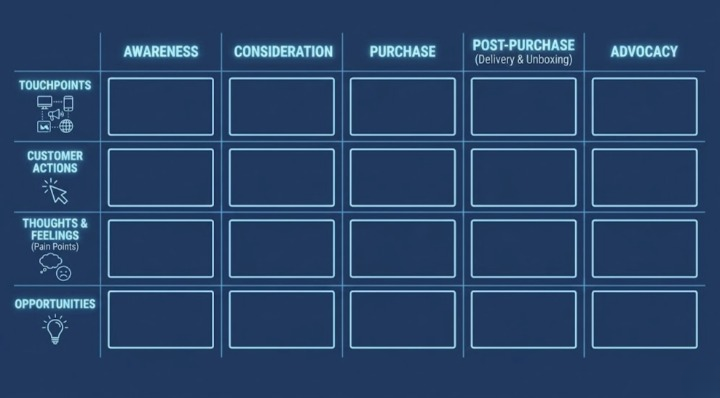
A comprehensive customer journey map is more than just a timeline. It is a rich, multi-layered document that captures both the practical and emotional aspects of the customer’s experience. While the specific design can vary, every effective map includes five core components:
- Stages: These are the major phases of the customer’s relationship with your brand. A typical D2C journey encompasses stages such as Awareness, Consideration, Purchase, Post-Purchase (or Delivery & Unboxing), and Advocacy. These form the horizontal axis of your map.
- Touchpoints: These are the specific channels where the customer interacts with your brand at each stage. Examples include an Instagram ad, a product page, a support email, the delivery box, or a request for a review.
- Customer Actions: These are the specific tasks that the customer performs at each touchpoint. This could be “clicks on an ad,” “compares product features,” “enters payment information,” or “tracks their package.”
- Customer Thoughts & Feelings (Pain Points): This is the emotional heart of the map. For each action, you document what the customer is thinking and feeling. Are they excited, confused, anxious, frustrated, or delighted? This is where you identify the critical pain points that are damaging your customer experience.
- Opportunities: For every pain point identified, you brainstorm a potential solution. This transforms the map from a diagnostic tool into a strategic action plan. An opportunity could be “simplify the checkout form,” “add a size guide video,” or “send a proactive shipping delay notification.” This focus on opportunities is what makes customer journey mapping so valuable.
 A Step-by-Step Guide to Building Your Customer Journey Map
Creating a customer journey map is a collaborative and iterative process. It requires input from different teams and a commitment to seeing your brand through your customer’s eyes. Follow these five steps to build a map that delivers actionable insights for your D2C business.
Step 1: Define Your Scope and Goals
Before you begin, it is essential to define what you want to achieve with your customer journey mapping exercise. Are you trying to reduce cart abandonment, improve the post-purchase experience, or increase the rate of second purchases? Having a clear goal will keep your efforts focused.
You also need to define the scope. Are you mapping the journey of a brand-new customer acquired through a specific channel (like a TikTok ad), or are you mapping the experience of a loyal, repeat customer? Starting with a single, specific persona and journey is more effective than trying to map every possible path at once.
Step 2: Create Your Customer Persona
A journey map is the story of a single, representative customer. To make this story relatable and empathetic, you need to create a customer persona. A persona is a semi-fictional character based on data and research about your target audience.
Give your persona a name, a backstory, and a clear goal. For example:
- Name: Sarah, a 28-year-old marketing professional.
- Background: Lives in a city, is environmentally conscious, and follows several sustainable fashion influencers on Instagram.
- Goal: To find a high-quality, ethically made dress for an upcoming event.
This persona will serve as your guide throughout the customer journey mapping process, ensuring you stay focused on the human experience, not just abstract data points.
Step 3: Gather Your Research
An effective customer journey map is built on real data, not assumptions. To gain a comprehensive understanding, it is necessary to combine quantitative and qualitative research methods.
- Quantitative Data (The “What”): Use tools like Google Analytics to track user behavior on your website. Identify your most common user flows, see which pages have the highest exit rates, and analyze your sales funnel to see where customers are dropping off.
- Qualitative Data (The “Why”): This is where you uncover the emotional experience. Gather this data by:
- Conducting Customer Surveys: Utilize post-purchase surveys to gather feedback from customers about their experience.
- Interviewing Customers: Conduct one-on-one conversations with a select group of recent customers to gather detailed, candid feedback.
- Reading Reviews and Support Tickets: Your customer support inbox and product reviews are a goldmine of information about customer pain points.
Step 4: Map the Stages, Actions, and Emotions
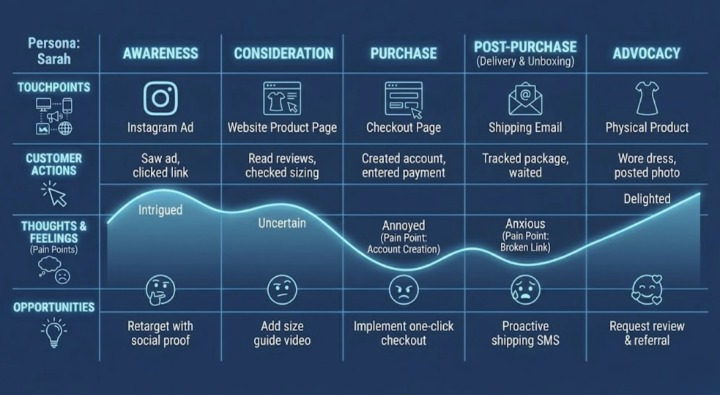
With your research in hand, it is time to build the map. Create a grid with the five stages (Awareness, Consideration, Purchase, Post-Purchase, Advocacy) along the top. Then, for each stage, fill in the other key components based on your persona and data:
- Awareness: How did Sarah discover your brand? (Action: Saw an Instagram ad. Feeling: Intrigued.)
- Consideration: What did she do next? (Action: Visited the product page, read reviews. Feeling: Hopeful but uncertain about sizing.)
- Purchase: What was the checkout experience like? (Action: Added to cart, started checkout. Feeling: Annoyed by the mandatory account creation.)
- Post-Purchase: What happened after she paid? (Action: Waited for shipping updates. Feeling: Anxious when the tracking link didn’t work.)
- Advocacy: Did she recommend your brand? (Action: Received the dress and loved it. Feeling: Delighted.)
Be brutally honest when documenting the pain points and negative emotions. This is where you will find the most valuable insights for your customer journey mapping exercise.
 Step 5: Identify Opportunities and Assign Ownership
The final step is to turn your insights into an action plan. For every pain point you identified, brainstorm a specific, actionable opportunity for improvement.
For example, if you discovered a major friction point during the Purchase stage, your map might look like this:
- Pain Point: “Customer feels frustrated by the long checkout form and the requirement to create a password.”
- Opportunity: “Simplify the checkout process to reduce the number of steps and fields.”
This is where technology can provide a powerful solution. A long, multi-page checkout is a known conversion killer. The opportunity is to remove this friction entirely. A solution like Magic Checkout is designed for this exact purpose. By pre-filling customer information for a vast network of shoppers, it can transform a cumbersome process into a one-click experience, directly addressing the pain point and dramatically improving the customer’s emotional journey at this critical stage.
Ready to turn a checkout pain point into a moment of delight?
Similarly, if your customer journey mapping reveals that users are hesitant to create an account, you can identify a clear opportunity:
- Pain Point: “Customer doesn’t want to remember another password and considers checking out as a guest.”
- Opportunity: “Offer a passwordless login option to make account creation effortless.”
This is where a tool like Login with Razorpay becomes a valuable addition. It replaces the need for passwords with a simple, secure OTP, removing the barrier to account creation. This not only resolves the customer’s immediate frustration but also benefits the business by transforming an anonymous guest into a known customer, enabling better personalization and relationship-building in the future.
Want to make account creation a seamless part of the journey?
After identifying these opportunities, assign ownership to the relevant team (e.g., the e-commerce team for checkout optimization, the marketing team for post-purchase emails) and set a timeline for implementation.
Conclusion: From Map to Action
Customer journey mapping is more than an academic exercise; it is a strategic process that builds empathy and provides a clear roadmap for improving your customer experience. By visualizing your brand through your customers’ eyes, you can uncover the hidden friction points that are costing you sales and the missed opportunities for creating delight that could earn you lifelong advocates.
A customer journey map is a living document. Revisit it quarterly, update it with new data and customer feedback, and use it as your guide for making every interaction with your brand a positive one.
Frequently Asked Questions about Journey Maps
What are the 5 stages of a customer journey map?
While models vary, the five standard stages for D2C brands are: Awareness, Consideration, Decision (Purchase), Retention (Post-Purchase), and Advocacy. Mapping each stage ensures you don’t overlook critical friction points after the sale.
What are touchpoints in a customer journey map?
A touchpoint is any specific interaction a customer has with your brand, such as clicking an Instagram ad, reading a blog post, or opening a delivery box. A single customer journey typically encompasses 20 or more different touchpoints across multiple channels.
How is customer journey mapping used in Design Thinking?
In Design Thinking, journey mapping is a core “Empathize” and “Define” tool. It forces teams to step away from business goals (like “increase sales”) and focus entirely on the user’s human experience, emotions, and unmet needs to drive innovation.
Can AI help create a customer journey map?
Yes. AI tools can analyze vast amounts of customer data (reviews, support tickets, click paths) to identify patterns and predict behavior. However, human empathy is still required to interpret the “Why” behind the “What” and design meaningful solutions.