Payment gateway onboarding documents are the identity, business, and bank details used to verify a merchant before payment services are enabled. A freelancer arrives with a personal PAN and a savings account. A private limited company arrives with incorporation records, a board resolution and a company PAN. Both open the same application and face the same question: which items on this checklist actually apply to me?
Generic lists of documents required for payment gateway onboarding make the confusion worse. They mix individual and company requirements, and they present optional or conditional uploads as compulsory ones.
The honest answer is that the minimum depends on three things: your legal business type, the verification route available to you, and your business category.
This guide separates three things that generic checklists blur together: information you must supply, records that can be retrieved digitally, and files you upload only when something is requested or a check fails. Razorpay’s current India business-type checklist is the worked example throughout.
Key Takeaways
- Choose the checklist for your actual business structure. “Freelancer”, “consultant” and “online seller” describe your work, not your legal entity. An eligible individual, a registered sole proprietor and a private limited company can therefore have different documentation requirements. Business-type checklist
- Paperless onboarding reduces manual paperwork. Digital verification can replace some document uploads, but identity, business and bank checks still apply. Compare the evidence required for your business type rather than assuming every applicant needs the same number of files.
- CKYC can reduce repeated document uploads. Razorpay can retrieve existing identity, address or eligible entity records when retrieval succeeds. If records are unavailable or verification fails, you may need to submit documents and complete the applicable verification steps, including Video KYC where required. Onboarding guide
- Individuals and sole proprietorships follow different routes. Eligible individuals can apply under the individual or unregistered-business category. Sole proprietorships currently require two accepted business proofs. Use the combination requested in your application rather than assuming any two documents will qualify. Required proofs
- GST registration is not a universal onboarding prerequisite. Eligible applicants without a GSTIN may use the applicable no-GST route. This does not waive any GST registration obligation that applies to their business, and other identity, business or bank requirements may still apply. Onboarding FAQs
- Additional evidence depends on your application. Bank account details are required, while failed bank verification can trigger a request for supporting bank proof. Regulated business categories and additional payment products can also require licences, declarations or other supporting documents. Documentation requirements
Which gateways require the least documentation for onboarding in India?
For businesses seeking fewer manual document uploads in India, Razorpay supports individual or unregistered-business onboarding and CKYC retrieval for eligible applicants. Successful CKYC retrieval can replace repeated uploads of existing identity, address or eligible entity records. The minimum paperwork still depends on your legal business structure: sole proprietorships require two accepted business proofs, while failed bank verification or category-specific checks can require additional evidence. There is no single minimum-document checklist that applies to every business. Razorpay onboarding guide
What Does Minimum Documentation Mean for Payment Gateway Onboarding?
The minimum documentation for payment gateway onboarding in India depends on your legal business type, verification route, and business category. Digital verification can reduce manual uploads, but it does not remove applicable identity, business, authority and bank checks. Compare the checklist for your own entity type rather than relying on a generic document count.
Paperless Onboarding, Fewer Uploads and Fewer Requirements
These three phrases describe different things. Paperless onboarding means the submission happens digitally. Fewer uploads means some evidence is fetched rather than attached. Fewer requirements would mean the underlying check no longer applies, which is rarely the case. Retrieving an existing verified address record can remove the need to upload an address file, while the address verification itself still happens.
Why Business Type Changes the Checklist
An individual verifies a person. A proprietorship verifies a person plus a business. Partnerships and LLPs add formation records and authority. Companies add incorporation records, constitutional documents and beneficial ownership. Choose the structure that reflects your real business, never the one with the shortest list.
One legal note worth keeping straight: the RBI’s consolidated Payment Aggregators Directions, 2025 define a payment gateway as a technology provider that does not handle funds, while a payment aggregator collects and settles them. Merchant due diligence obligations sit with the aggregator.
Minimum Documents Required for Payment Gateway Onboarding by Business Type
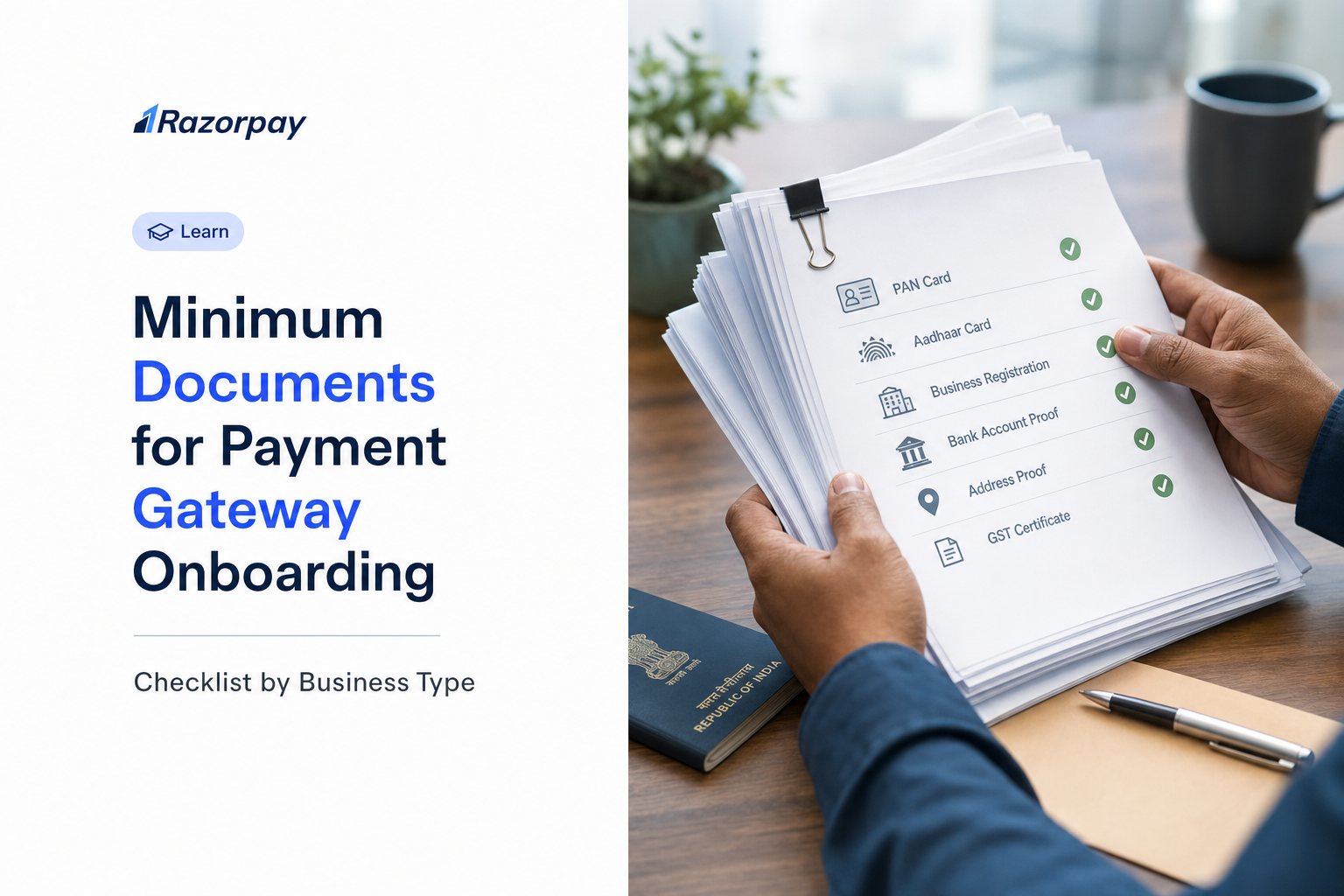
The table below is a Razorpay-specific preparation checklist reviewed in October 2026. It is not an industry-wide legal minimum, and it is not a substitute for the current KYC documents by business type, which should be opened before you apply.
| Business type | Identity and bank information | Business and authority evidence | Upload or review conditions |
|---|---|---|---|
| Individual / unregistered business | Personal PAN; identity and address verification; bank account number and IFSC | Business details and applicable category evidence | Identity and address can be fetched through CKYC; fallback evidence if retrieval fails |
| Sole proprietorship | Proprietor PAN and address proof; bank account number and IFSC | Two business proofs in the combination requested for your application | Check required and additional proof categories in the current setup flow |
| Partnership | Firm PAN; authorised signatory KYC; bank details | Partnership deed; registration certificate if registered; authority evidence and applicable UBO declaration | Follow the entity-specific requirements shown in the flow |
| LLP | LLP PAN; signatory KYC; bank details | Incorporation or LLPIN record and LLP agreement or deed information; authority and UBO evidence | Confirm the precise document combination requested |
| Private / public limited company | Company PAN; signatory KYC; bank details | Incorporation record and CIN, MOA, AOA; board resolution or power of attorney; UBO declaration | Some entity evidence can be retrieved through CKYC, with document fallback if missing |
| Trust / society / Section 8 company | Entity PAN; signatory KYC; bank details | Entity-specific deed, registration or incorporation records; authority and ownership or control information | Treat each legal form separately; category or donation evidence may also apply |
Bank account number and IFSC are required in every case. Razorpay’s current checklist specifies a video of a cancelled cheque when bank verification fails. That does not make a cheque upload an initial requirement for every applicant.
Individuals, Freelancers and Unregistered Businesses
Eligible individuals operating an unregistered business can use the individual or unregistered-business route. Registered sole proprietorships, partnerships, LLPs and companies should use the checklist for their actual legal business type. You provide your personal PAN and bank details, and consent to identity and address retrieval. If no record is found, the flow requests alternative identity and address evidence instead.
Being unregistered is not the same as being unverified. There is no universal GST or current-account condition attached to this route, but verification still applies. If this is your situation, review payments for freelancers and individual businesses.
Sole Proprietorships
A key point for sole proprietorships is that Razorpay’s current checklist requires two business proofs. Prepare the combination requested for your application.
Documents appearing in the current accepted list include:
- MSME or Udyam certificate
- GST certificate
- Shop and Establishment certificate
- Import Export Code
- Postpaid mobile bill
This is a provider requirement, not a universal legal rule. The current setup guide distinguishes at least one required proof, such as GST or MSME/Udyam, from an additional accepted proof, such as a Shop and Establishment certificate, IEC or postpaid mobile bill. Follow the combination requested in your application rather than assuming that any pair qualifies. An accepted alternative to a GST certificate does not decide whether your business must register for GST under tax law.
Partnerships and LLPs
A partnership is evidenced by its deed, plus a registration certificate where the firm is registered. An LLP is evidenced by its incorporation record or LLPIN together with the LLP agreement. Both need the firm or LLP PAN, authorised signatory KYC, bank details and, where applicable, a UBO declaration covering natural persons with a qualifying holding or contribution. A partnership deed is not a substitute for company incorporation records, and the reverse is equally true.
Private and Public Limited Companies
Keep two PANs distinct: the company PAN and the authorised signatory’s personal PAN. Entity records and personal records are verified separately. Prepare the incorporation record and CIN, MOA, AOA, a board resolution or power of attorney establishing authority, and a UBO declaration. A director’s personal verification does not establish the company’s KYC, its authority chain or its ownership structure. Ownership and control thresholds follow entity-specific rules set out in the RBI’s KYC Master Direction.
Trusts, Societies and Section 8 Companies
“NGO” describes what an organisation does, not how it is constituted. A trust, a registered society and a Section 8 company are three different legal forms with three different checklists. A Section 8 company is still a company and follows company-style incorporation evidence. Select the correct form in the application, and consult the full documentation for less common structures such as HUFs, government entities and local authorities.
PRO TIP: Build your checklist from the business type selected in your application. An individual checklist cannot replace the documents for a registered company.
Prepare the Right Checklist and Start Your Razorpay Application
Find your situation below, then gather only what applies to it.
| Your situation | What to prepare |
|---|---|
| Freelancer or individual seller | Review the supported individual and unregistered-business route, with personal PAN, identity and address verification, and bank details |
| Sole proprietor | Prepare the requested two-proof combination plus proprietor PAN, address proof and bank information |
| Registered company, LLP or partnership | Prepare entity PAN, formation or incorporation records, authority evidence and UBO declarations |
| Existing CKYC record holder | Complete consent in the official flow and check which records were retrieved |
| No website yet | Plan to collect through Payment Links after applicable activation |
For the broader document overview, see the payment gateway documents guide. Use this article to separate applicable proofs, CKYC retrieval and conditional uploads. Check the requirements for your business type, then start your Razorpay Payment Gateway application. For activation support options and timelines, see the separate payment gateway onboarding guidance.
How CKYC Can Reduce Manual Document Uploads
CKYC lets a payment provider retrieve existing verified KYC records with the required consent. For eligible Razorpay applicants, successful retrieval can reduce repeated identity, address, or eligible entity-document uploads. Missing records, incomplete information or additional business requirements can still lead to document submission and manual verification.
What Happens When Your CKYC Record Is Found?
Retrieval is PAN-led. For a registered business, the flow uses the business PAN and date of incorporation. For an individual, it uses the personal PAN, then an OTP sent to the mobile number linked to the CKYC record. Consent is given inside the official flow, after which eligible records are fetched. Entity records and signatory records are searched separately.
What Happens When CKYC Is Missing, or Retrieval Fails?
The application does not stop. It switches to the fallback: the documents requested for your business type, plus the applicable identity-verification step, which can include Video KYC completed by the authorised signatory. A missing CKYC record says nothing about whether your business is eligible. It only changes how your identity gets established. The payment gateway KYC onboarding guide covers this flow in more depth.
Which Documents Can Still Be Needed?
CKYC can retrieve identity, address, and eligible entity records. Business proofs, authority or ownership evidence, bank clarification, and category certificates may still be requested where they are not retrieved or are separately required.
| What happens | What to prepare |
|---|---|
| CKYC record retrieved successfully | PAN details and the information needed to complete the remaining verification steps |
| Record missing or retrieval fails | Business-type documents and the applicable identity-verification step, including Video KYC where required |
| Additional business or category review | Business proofs, authority and UBO evidence, bank clarification and any sector licence |
DID YOU KNOW: The business entity and the authorised signatory can have separate CKYC records. A personal record alone does not establish a company’s KYC.
Can You Onboard Without GST, Company Registration or a Website?
Is GST Mandatory for Payment Gateway Onboarding?
Not for every applicant. In its answer about a very small, new business, Razorpay’s India Payments FAQs explain that eligible applicants can select the “I don’t have GST” option and proceed with a savings account. This is not a blanket rule for every legal entity: follow the bank and business-proof requirements for your actual business type.
Separate two questions here. Whether a provider accepts your application without a GSTIN is a product requirement. Whether you are legally required to register for GST is a tax question governed by your turnover, supply type, and state, with thresholds that differ for goods and services and across state categories. Choosing the no-GST route does not waive your statutory obligations, and a self-declaration does not replace the business evidence a proprietorship still owes.
Can Freelancers Apply Without Incorporating a Company?
Yes. The individual and unregistered-business route exists for freelancers, consultants, creators and small sellers, subject to actual business activity and successful verification. Incorporating a company purely to look more credible to a payment provider is unnecessary. The reverse move is not acceptable either: an existing company or LLP must apply using its own entity records.
Do You Need a Website and Policy Pages?
A website is not required at the initial application stage. The current setup flow lets you add website, app and social media links later. Razorpay’s current India FAQs state that website policies are no longer required at initial onboarding.
Website requirements reappear later, at a different stage. Live website or app details are needed for live-mode API access, and policy pages such as terms, privacy, refunds and contact details are expected when a site is submitted for review. Clear refund and contact information remains good practice regardless. If you have no site, accept payments with Payment Links after applicable activation. A no-code collection tool does not waive merchant verification.
Which gateways require the least documentation for onboarding in India?
There is no single lowest-documentation choice for every business. Check the provider’s requirements for your actual entity type and whether existing KYC records can be retrieved. Razorpay supports individual and unregistered businesses and offers CKYC-based verification, which can reduce manual uploads for eligible applicants.
Use four evaluation questions instead of a document count:
- Does the provider support your actual business type? A shorter list is useless if your legal form is not supported.
- Which proofs are mandatory and which are alternatives? A list of accepted alternatives is different from a list of compulsory uploads. Check both the number of proofs and any required combination.
- Can verified information be retrieved rather than uploaded again? Retrieval is where real effort is saved.
- Which checks remain before the services you requested are switched on? Category licences and product-level reviews sit outside the core checklist.
For an individual freelancer, Razorpay’s relevant route is the individual and unregistered-business checklist. For a proprietorship, the published checklist includes two accepted business proofs. Both routes still require identity and bank verification.
When Can Additional Documents Be Required?
Your Business Category
Some sectors need a licence before the category is approved. Razorpay’s category-specific activation certificates list includes an FSSAI certificate for food manufacturing and serving businesses based in India, and SEBI certification for investment advisory services. These are category checklists, not universal merchant requirements.
Your Ownership or Authorised Signatory
Authority and ownership evidence depends on your legal form and control structure. A board resolution or power of attorney establishes who may act for the entity, particularly where the signatory is not an owner, director or partner. UBO thresholds differ between companies, partnerships, trusts and societies, so do not apply one percentage across all of them.
International Payments or Additional Products
Domestic bank verification does not automatically approve every product you request. International card acceptance has a separate activation flow, which may request additional details or documents. Purpose, HS and IEC code requirements depend on the business and payment purpose. Check the current product checklist rather than assuming domestic verification covers every service.
DID YOU KNOW: Bank verification can succeed using account details alone. The current Razorpay checklist requests additional cheque evidence only when that verification fails.
How to Prepare and Submit Your Documents Without Avoidable Rework
Selecting the wrong business type or missing a conditional requirement can cause rework. These steps help you prepare the applicable evidence and respond to verification requests.
- Confirm the actual legal business type and the payment product you intend to use. Write both down before you open the application.
- Open the current checklist for that business type. Requirements change, so read the live page rather than a saved copy.
- Identify the entity PAN and the person authorised to complete verification. For companies, these are two separate identities.
- Check CKYC availability and complete consent inside the official flow. Make sure the mobile number linked to the record is reachable for OTP.
- Prepare the applicable business, authority and ownership evidence. Proprietors should prepare both business proofs in the combination requested for their application.
- Enter the account number and IFSC accurately, then follow any bank-verification clarification. Incorrect account details can cause verification failures and clarification requests.
- Review requested files for completeness, readability and consistency. Keep the legal name and the trade name in their correct fields.
- Submit, track the displayed status and respond to the clarification raised. Answer exactly what was asked instead of re-uploading everything.
PRO TIP: Keep a document-purpose checklist with four columns: the proof it establishes, whether CKYC retrieved it, whether a manual upload was requested, and whether verification is complete.
Common Documentation Problems and What to Check
| Problem | What to check |
|---|---|
| Wrong business type selected | Whether the application describes the actual legal entity, not a convenient one |
| CKYC consent fails | Linked contact details and the fallback instructions displayed in the flow |
| Bank verification fails | Account number, IFSC, account-holder identity and the requested fallback evidence |
| Only one proprietorship business proof available | The required proof combination in your application and which missing document you can obtain |
| Company authority or UBO evidence missing | The entity-specific authority and ownership requirements for your legal form |
| Blurred or incomplete file | A complete, readable copy in the requested format |
| Legal name and brand name confused | That each sits in the correct field, supported by legitimate records |
Two distinctions worth holding on to. A trade name does not have to match a personal PAN name word for word, provided the right fields are used. And a clarification request is not a rejection. They are separate states, and not every rejected application can be resolved without a fresh submission.
Frequently Asked Questions
What are the minimum documents required for payment gateway onboarding in India?
It varies by legal entity and verification route, so there is no universal file count. Most applicants need PAN details for the applicable person or entity, identity and address verification, bank account number and IFSC, and the business, authority or ownership evidence that applies to their legal form.
Can I get a payment gateway without GST registration?
Yes, in eligible cases. Razorpay’s India FAQs describe a no-GST route for very small, new businesses, with savings-account support where applicable. Follow the requirements for your actual legal entity. Proprietorships still need accepted business proofs, and statutory GST registration obligations remain a separate tax question.
Does CKYC mean I do not need to upload any documents?
No. Successful CKYC retrieval can remove repeated identity, address or entity uploads for eligible applicants. Business proofs, authority and ownership evidence, bank clarifications and category licences can still be requested. If no record is found, the application falls back to document submission and identity verification.
How many business proofs does a sole proprietor need for Razorpay?
Two business proofs, in the combination requested for your application. The current setup guide distinguishes a required GST or MSME/Udyam proof from an additional accepted document. Proprietor PAN, address verification and bank details also apply. Check the live requirements before assuming any pair of documents qualifies.
Can a freelancer accept payments without a registered company or website?
Yes, subject to verification and activation. The individual and unregistered-business route does not require incorporation, and website or app links can be added later. You can create a Payment Link to collect without a site. An existing registered company cannot apply as an individual.