India’s digital payments engine is running at a scale few markets can match, with the country’s payments market projected to reach US$10 trillion by 2026 and UPI processing over 131 billion transactions in FY23-24.
At this scale, an unresolved payment issue during a Diwali sale or a payout run is a revenue event that affects conversion, retention, and cash flow within hours.
Most merchants lose time not because support is poor, but because they approach it without preparation, the right channel, or escalation language. This guide is the practitioner’s playbook for fixing that.
Key Takeaways
- Pre-ticket preparation cuts resolution time more than any other single factor. Walking in with the RRN, UPI reference, timestamp, and error code removes most back-and-forth.
- Structuring tickets for first-contact resolution (FCR) directly improves outcomes. Every 1% improvement in FCR can lift CSAT by 1 to 5%.
- RBI’s harmonised TAT framework gives you enforceable timelines to cite in follow-ups, with compensation entitlement when breached.
- Escalating to a Grievance or Nodal Officer is a formal right, not an act of aggression, once standard timelines lapse.
- Channel-to-issue mapping prevents delays. Using the wrong channel can add days.
- Self-service tools resolve common issues before tickets are raised, and make the tickets you do raise more actionable.
Table of Contents
Why Slow Gateway Support Resolution Is a Revenue Problem
Payment support is revenue infrastructure, not a help desk. When a payment fails and the issue lingers, the customer rarely waits. They abandon the cart, lose trust, and often do not return. PwC research found that 55% of customers stop doing business with a brand after several bad experiences, and 8% walk away after just one. A failed transaction with slow resolution is exactly that kind of experience, which is one reason strong payment gateways are a business advantage.
UPI sharpens the stakes. Funds move in seconds, and once processed, the transaction is hard to reverse. The recovery window narrows fast.
- Make first-contact resolution the goal of every interaction. The aim is not a faster reply. It is giving support enough information to fix the issue on the first pass.
Did You Know?
World Bank research (2025) highlights that once a UPI payment is processed, it is final and irrevocable, making rapid dispute escalation critical.
Step 1 – Before You Contact Support: The Pre-Ticket Checklist
The single biggest driver of faster resolution is walking in prepared. Most delays come from support asking for details you could have provided upfront. Gather these seven data points before you raise a ticket:
- Transaction ID or Order ID – the unique reference tied to the payment attempt.
- RRN or UPI Transaction Reference Number – the field banks use to trace funds.
- Exact timestamp in IST – the precise time the transaction was attempted.
- Payment method and amount – UPI, card, netbanking, or wallet, with exact value.
- Error code or exact failure message – copy the precise text, such as PAYMENT_FAILED.
- Customer’s bank or UPI handle suffix – the bank name or handle suffix like @okhdfcbank.
- Steps already taken – settlement reports checked, refund initiated, status page reviewed.
These India-specific fields are usually what support needs to trace a transaction. Razorpay’s Dashboard surfaces transaction-level error codes and payment method details that you can copy directly into your support request, reducing back-and-forth.
This preparation matters because 78% of service leaders say customers prefer self-service.
Pro-Tip: Before raising a ticket, check your gateway’s status page and transaction logs. Teams leaning on self-service and AI-assisted support resolve issues significantly faster, and your first ticket will be more actionable if you have ruled out known outages.
Step 2 – Build a Ticket That Gets Resolved on the First Pass
A high-FCR ticket reads like a mini incident report. Structure it in three parts:
- Subject line: Be specific, not descriptive. Use a pattern like “UPI failure – Order #RP12345 – Rs 4,500 – 14 June 2026 14:32 IST – PAYMENT_FAILED”. This lets an agent triage instantly.
- Body: Use a What-When-Who-How structure and keep it under 200 words. State what happened, when, which customer was affected, how it can be reproduced, and the business impact.
- Attachments: One clear screenshot of the error beats ten paragraphs. Add dashboard views or logs where relevant.
Severity labelling matters too. Mark an issue Critical when it affects an active campaign, when fraud is suspected, or when multiple customers are hit at once. Mark it Urgent for a single high-value transaction or an approaching chargeback deadline. Getting this right routes your ticket to the correct queue and improves FCR, where excellent companies are 2.4x more likely to retain customers. For deeper context, see how to integrate a payment gateway in your website.
How Razorpay’s Dashboard and Support Tools Help You Resolve Payment Issues Faster
When a payment issue hits, resolution speed depends on how quickly you can surface the right data and reach the right team. Razorpay’s tools are built to support each step.
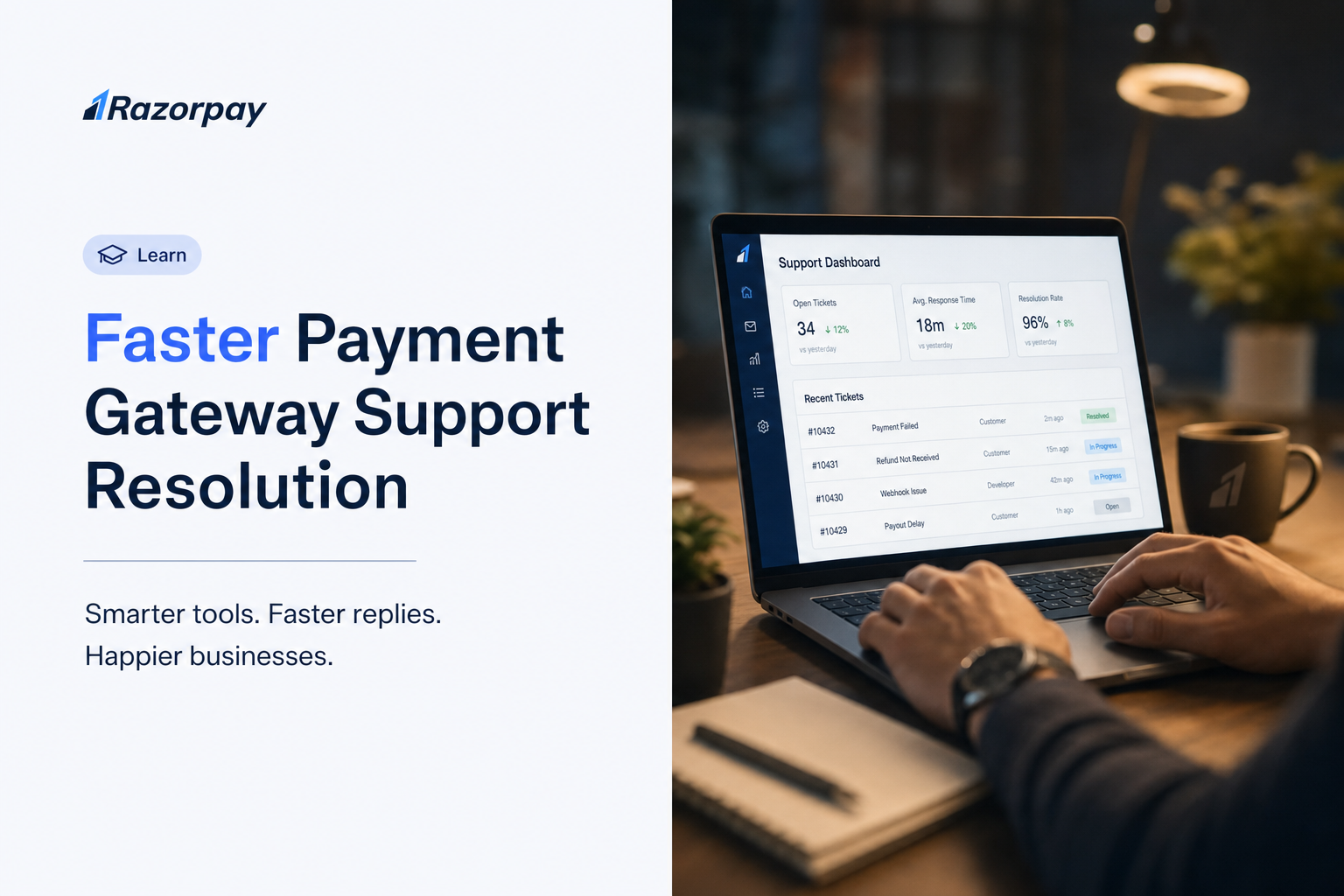
- Razorpay Dashboard: Gives merchants direct access to transaction-level data, including error codes, payment method details, order IDs, refund status, and settlement records. Merchants can pull this data into support requests without waiting for an agent. Learn how to navigate the Razorpay Dashboard.
- Developer Documentation and Knowledge Base: Covers API integration, webhook configuration, error code references, and common failure scenarios. Developers can often identify root causes before a ticket is raised, and the knowledge base is searchable by issue type.
- Multi-Channel and In-Dashboard Support Access: Support is available through chat, email, and phone. The in-dashboard help entry point routes issues based on category, reducing manual triage.
Together, these tools help merchants arrive at support with complete data and reach the team best placed to resolve the issue.
Step 3 – Know Your Rights: RBI Timelines You Can Cite in Follow-Ups
Indian merchants have regulatory leverage most never use. RBI’s harmonised TAT framework, set out in Circular DPSS.CO.PD No.629/02.01.014/2019-20, applies to failed transactions where funds are debited but not credited. It sets outer limits, often T+5 working days and up to T+7 depending on the channel, and entitles the customer or merchant to compensation if those limits are missed. RBI’s ODR mandate, under Circular No.116/02.12.004/2020-21, further requires authorised entities to provide digital complaint logging and tracking.
You can reference these in a calm, professional follow-up:
- “This relates to ticket #12345, raised on 12 June 2026, concerning a debited-but-not-credited UPI transaction. Per RBI’s harmonised TAT framework (DPSS.CO.PD No.629/02.01.014/2019-20), the resolution outer limit applies, along with compensation entitlement. Please confirm the resolution status and expected closure.”
Knowing your rights also reinforces why working with a secure payment gateway matters.
Did You Know?
RBI’s harmonised TAT framework mandates that for most failed electronic transactions, customers are entitled to compensation if the issue is not resolved within specified timelines, often T+5 working days. This protection only applies if you have raised and tracked the complaint.
Step 4 – Choosing the Right Support Channel for Your Issue Type
The wrong channel for the wrong issue is one of the easiest ways to add 24 to 48 hours. Use this quick-reference map.
| Channel | Best For |
|---|---|
| In-app / Dashboard help | Standard queries, refund status, settlement checks, reconciliation |
| Live chat | Active campaign issues, time-sensitive single transactions |
| Phone | Critical fraud, payment method outage, payout run failure |
| Complex technical issues that need logs and detailed context | |
| Grievance / Nodal Officer | Past-TAT issues, chargeback deadlines, compliance concerns |
Razorpay’s in-dashboard help entry point routes your issue to the appropriate support team based on category, which can reduce initial triage time. For broader context, see integrated payment systems. The one mistake to avoid: emailing logs for a suspected fraud case that needs an immediate phone call.
Step 5 – The Escalation Playbook: From L1 Ticket to Grievance Officer
When standard support stalls, escalate methodically rather than starting over.
- L1 push: If a ticket is open more than 24 hours with no substantive response, reply in the same thread. Do not open a new ticket. Reference the ticket ID, state concrete business impact (“affecting our Diwali campaign, roughly X transactions per hour”), and ask for a named contact.
- L2 senior escalation: Request routing to the technical or senior team when L1 has not resolved the issue after two exchanges. Be specific about why L1 cannot resolve it.
- L3 Grievance / Nodal Officer: This is a formal right under the RBI framework. Request in writing, citing the TAT framework, ticket reference, date raised, business impact, and the resolution you want.
- Ombudsman backstop: The RBI Integrated Ombudsman Scheme 2021 is independent, free, and available online at cms.rbi.org.in, used after internal escalation is exhausted.
As an RBI-authorised Payment Aggregator, Razorpay maintains a structured grievance redressal process with defined escalation levels, which merchants can invoke when standard timelines are not met. This mirrors RBI’s ODR mandate, and aligns with a disciplined payment management system.
Pro-Tip: If your payment issue has crossed RBI’s TAT outer limit without resolution, you have the right to escalate to your gateway’s Nodal or Grievance Officer in writing. Reference the RBI Circular (DPSS.CO.PD No.629/02.01.014/2019-20) and your ticket reference number. This is not adversarial. It is a documented regulatory right.
Step 6 – Working With Your Gateway on Disputes and Chargebacks
Chargebacks reward speed and preparation.
- Response window: Chargeback windows are non-negotiable, typically around 30 days from notification. Missing this usually forfeits your right to contest, so log every notification the moment it arrives.
- Evidence pack: Assemble order confirmation, delivery proof, customer communication history, refund policy, and the payment authorisation record. Keep this as a ready template. Understanding chargeback fraud helps you build stronger evidence.
- Fraud urgency: For suspected fraud, escalate immediately via phone, not email. Every hour reduces the probability of recovery.
Did You Know?
World Bank research (2025) found that fraudsters can distribute funds through multiple mule accounts within minutes, making rapid escalation the single most important factor in fund recovery.
Step 7 – Build an Internal Support Playbook So You Never Start From Zero
Faster resolution compounds when you stop reinventing the process every time.
- Maintain a Payment Issue Log: Record issue type, date, channel used, data provided, resolution time, and method so patterns become visible.
- Codify resolutions into a knowledge base: Reusable macros and proven templates are among the highest-ROI support investments.
- Set up proactive monitoring: Use webhook alerts and dashboards so failures surface before customers complain, supported by fraud analytics.
Pro-Tip: Set up webhook alerts and transaction monitoring to detect payment failure spikes in real time. Merchants who identify issues proactively reach support with complete data already assembled.
How Razorpay Supports Merchants Through Payment Issues and Disputes
Razorpay’s support infrastructure is built to align with each stage of the resolution playbook in this guide.
| Support Feature | What It Does | Relevant Stage |
|---|---|---|
| Razorpay Dashboard | Access to transaction data, error codes, refund status, settlement records | Pre-ticket preparation; high-FCR tickets |
| Developer Docs & Knowledge Base | Searchable API docs, error references, webhook guides | Self-service before ticket raising |
| Multi-Channel Support | Chat, email, phone access | Channel-to-issue mapping |
| In-Dashboard Help Entry | Routes issues to appropriate support team by category | Reducing triage time |
| RBI-Authorised PA Status | Structured grievance redressal with defined escalation levels | Formal Grievance/Nodal Officer escalation |
| Razorpay Thirdwatch | Integrated fraud detection that flags suspicious patterns | Proactive fraud identification |
Conclusion
Faster resolution from your payment gateway support team is a system, not a hope. The merchants who recover quickly are not the ones who get lucky with a good agent. They are the ones who prepare data before contacting support, structure tickets for first-contact resolution, know their RBI rights, match the channel to the issue, and escalate formally when timelines lapse.
Build the internal log, set up monitoring, and treat support as infrastructure rather than a help desk. Do that consistently, and you will resolve issues faster, retain more customers, and lose far less revenue.
FAQs
What information should I have ready before contacting my payment gateway’s support team?
Have your registered merchant ID, transaction or order ID, RRN or UPI Transaction Reference Number, exact timestamp in IST, payment method and amount, error code or failure message screenshot, customer’s bank or UPI handle suffix, and a brief note of steps already taken. This is the single biggest factor in faster first response.
How long does a payment gateway have to resolve a failed transaction in India?
Under RBI’s harmonised TAT framework (Circular DPSS.CO.PD No.629/02.01.014/2019-20), most failed electronic transactions have a resolution outer limit of T+5 working days, with some channels going up to T+7. If providers miss this, the merchant or customer is entitled to compensation, but only if the complaint was formally raised and tracked.
What is first-contact resolution and why does it matter for payment issues?
First-contact resolution (FCR) is when a support issue is fully resolved in a single interaction without follow-up. Every 1% improvement in FCR can lift customer satisfaction by 1 to 5%. For payment issues, FCR means your customer’s failed transaction is fixed before they abandon their purchase or file a chargeback.
When should I escalate a payment issue to a Grievance or Nodal Officer?
Escalate when the issue has not been resolved within RBI’s TAT outer limit, when a chargeback deadline is approaching, or when suspected fraud has not been flagged. The Grievance or Nodal Officer is a formal channel, so use it in writing, with your ticket reference number and a clear statement of the resolution requested.
What is the RBI Integrated Ombudsman Scheme and when can I use it?
The RBI Integrated Ombudsman Scheme (2021) is a free, independent dispute resolution mechanism for those unsatisfied with their provider’s internal resolution. It covers failed transactions, settlement delays, and unauthorised debits. File at cms.rbi.org.in only after exhausting the gateway’s internal escalation process.
How do I respond to a chargeback notification from my payment gateway?
Act immediately, as typical response windows are around 30 days from notification, after which the right to contest is usually lost. Assemble your evidence pack: order confirmation, delivery proof, customer communication, refund policy, and payment authorisation record. Submit through your gateway’s chargeback portal.