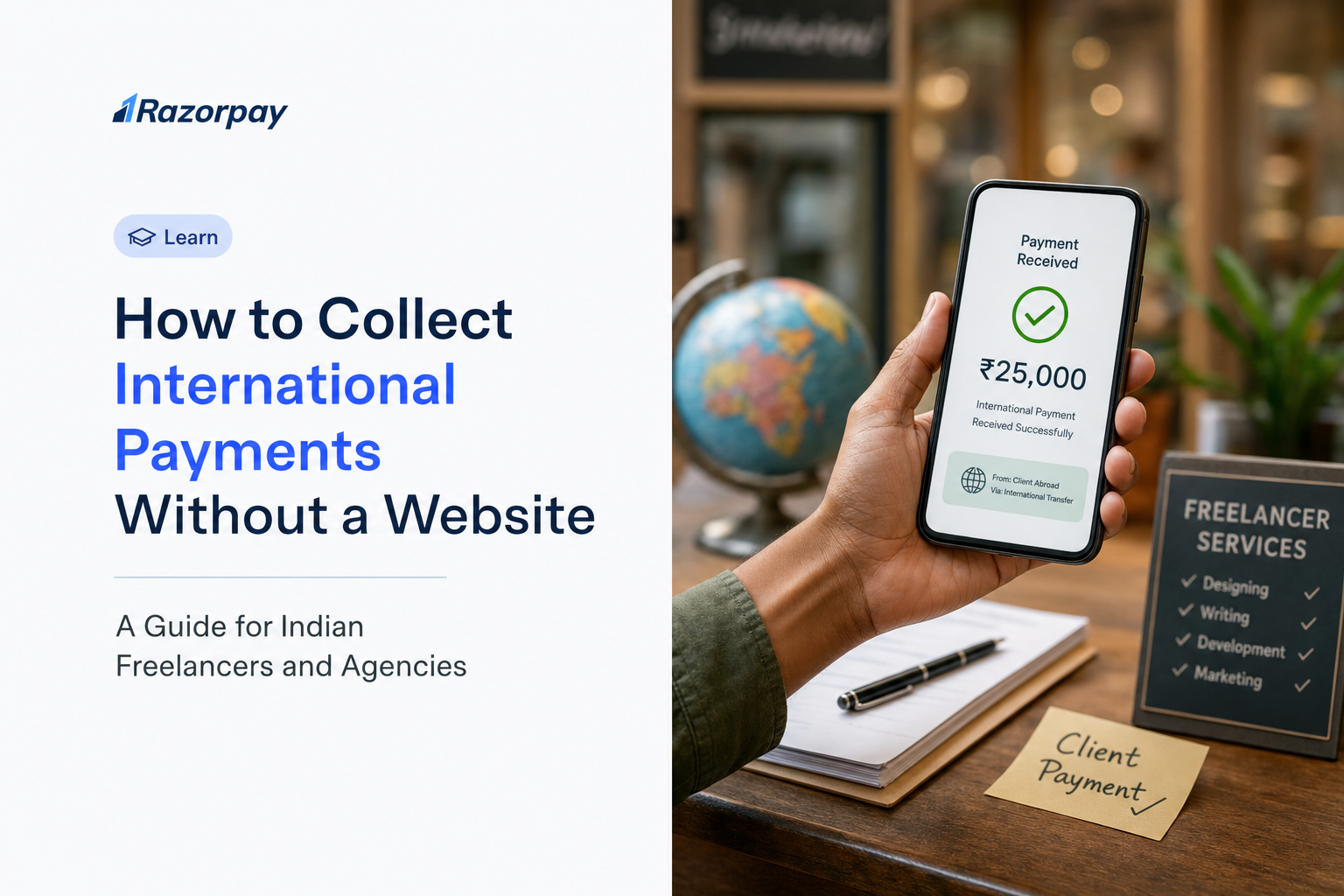
Your foreign client is ready to pay. They just asked the one question you were not ready for: “How do I pay you?” You do not have a website. You do not have a payment gateway. And a SWIFT wire feels like a tax on your own earnings.
Here is the good news. You do not need a website to collect international payments professionally. A website is a channel, not the payment infrastructure. India pulled in roughly USD 129 billion in remittances in 2024, the world’s single largest inflow. Payment Links, Payment Pages, and export-specific bank accounts exist entirely independent of a storefront.
Key Takeaways
- You do not need a website, a developer, or a SWIFT bank account to collect international payments from India.
- The four primary methods are Payment Links, Payment Pages, invoices with embedded pay buttons, and export bank accounts with local foreign-currency receiving details.
- Traditional bank channels are the most expensive route. Banks averaged approximately 9.5% cost on a USD 200 transfer versus 3.65% for digital platforms.
- Every inbound foreign payment requires a correct RBI purpose code and a FIRC or eFIRA under FEMA rules.
- Freelancers and IT consultants exporting services do NOT need an IEC code unless they claim Foreign Trade Policy benefits.
- File a Letter of Undertaking (LUT) before each financial year to keep service exports at 0% GST instead of 18%.
- Choose only platforms holding the RBI’s PA-CB (Payment Aggregator Cross-Border) licence.
- Settlement takes T+2 working days for card-based methods and T+2 to T+4 for Export Account bank transfers.
What Does “Collecting International Payments Without a Website” Actually Mean?
Collecting international payments without a website means using no-code tools – payment links, hosted payment pages, invoices with embedded pay buttons, or shared bank account details – to receive foreign currency from clients abroad and settle it into your Indian bank account in INR.
The three things a website actually does for payments
A website provides three things:
- A hosted checkout page
- A branded trust signal
- A product or service catalogue
The first two are fully replaceable today. A Payment Link or Payment Page gives you a hosted, secure checkout in minutes, and a branded Payment Page delivers the same trust signal as a homepage. Only the catalogue needs a site, and you do not need one just to get paid.
Who this guide is for
- Freelance designers, developers, and copywriters billing US, UK, and EU clients
- IT agencies and SaaS founders collecting subscription revenue from abroad
- Consultants and coaches invoicing international clients
- Small exporters with no e-commerce site yet
- Instagram and WhatsApp sellers taking their first international order
DID YOU KNOW: India’s software and IT-enabled services exports reached USD 204.7 billion in FY25.
The 4 Methods to Collect International Payments Without a Website in India
Indian businesses and freelancers without a website can collect international payments using four main methods: Payment Links for one-time card payments, hosted Payment Pages for repeated billing, invoices with embedded pay-now buttons for B2B billing, and export bank accounts with foreign-currency virtual account details for large bank transfers.
| Method | How the client pays | Best for | Typical cost | Settlement to INR |
|---|---|---|---|---|
| Payment Link | Clicks link, pays by card or UPI | One-off project payments | 3% on international cards | T+2 working days |
| Payment Page | Visits hosted page, pays by card | Recurring billing, catalogue | 3% on international cards | T+2 working days |
| Invoice with Pay Button | Clicks pay button in invoice | Agencies, consultants, B2B | Varies by method | T+2 working days |
| Export Account | Bank transfer via ACH or SWIFT | Large invoices, retainers | Around 1% or flat fee | T+2 to T+4 |
Method 1 – Payment Links (for one-off or quick payments)
A Payment Link is a shareable URL generated from a dashboard – no code, no website. The client clicks it, enters card details, and pays in their currency. Razorpay Payment Links support nearly 100 major currencies and can be shared via WhatsApp, email, or SMS.
To create one: log in, go to Payment Links, click “Create Payment Link”, enter the amount, currency, description, and client email, set an expiry, and share.
Method 2 – Payment Pages (for repeated billing or catalogues)
A Payment Page is a hosted, branded landing page built in minutes using a drag-and-drop editor. Razorpay Payment Pages let you set prices in multiple currencies, add your logo, and share the URL directly. Use it when you sell a fixed retainer, have a small service catalogue, or want a permanent URL for email signatures.
Method 3 – Professional Invoices with Embedded Pay Buttons
An invoice with an embedded “Pay Now” button lets you bill a foreign client formally while giving them a one-click card payment option. The invoice itself serves as part of your FEMA compliance record. A compliant invoice must include your legal name, the client’s name and country, invoice number and date, service description matching your RBI purpose code, amount and currency, payment terms, and your PAN.
Method 4 – Export Bank Accounts with Foreign-Currency Virtual Account Details
An export-specific bank account gives you local receiving details in the client’s country. The client pays as if paying a local vendor, avoiding international wire fees. This is the lowest-cost method for large invoices above USD 2,000.
On a USD 5,000 invoice at roughly 84 INR per USD, a 9.5% bank-channel cost equals INR 39,900 lost. A 3.65% digital platform cost equals INR 15,330. Difference: INR 24,570 saved per invoice.
PRO-TIP: Always compare the all-in cost, not just the advertised fee. The UN target for remittance cost is 3% or less by 2030. Use that as your benchmark.
How to Set Up International Payment Collection in India Without a Website – Step by Step
Setting up international payment collection takes four main steps: choose your method, complete KYC, create your first Payment Link or invoice, and share it with your client. The full process can be done in under 60 minutes for Payment Links.
Use this decision tree: paying by card? Use a Payment Link or Payment Page. Invoice above USD 2,000 by bank transfer? Use an export account. Monthly retainer? Set up a Subscription. One-off under USD 1,000? Use a Payment Link.
Step 1: Choose your collection method. Review how startups can accept online payments in India.
Step 2: Complete KYC. Provide PAN, Aadhaar, bank account with IFSC, and business name. For Razorpay, KYC is online and typically approved in 24 to 48 hours.
Step 3: Configure settings. Enable international currencies, select your RBI purpose code, and verify your bank account for INR settlement.
Step 4: Create your first Payment Link or invoice. Always state the currency explicitly, match the description to your purpose code, and set an expiry.
Step 5: Share and track. Send via WhatsApp or email, monitor status in real time, or track and accept payments on the Razorpay mobile app. Download your eFIRA once payment is confirmed.
Step 6: Receive settlement. T+2 working days for Payment Links and Pages; T+2 to T+4 for Export Account transfers. Save the eFIRA to a compliance folder.
PRO-TIP: If your client says “I’ll just do a bank transfer,” share your IFSC and account number, but always follow up with the correct RBI purpose code for the transfer remarks.
How to Invoice International Clients Professionally Without a Website
A professional international invoice includes your legal name, the client’s name and country, the invoice number and date, a service description matching your RBI purpose code, the amount in the agreed currency, payment terms, your PAN, and a clickable payment link.
Key fields: the Invoice Date starts the FEMA realisation clock. Your Service Description should use the exact wording from your purpose code. State Amount and Currency as “USD 2,000” not just “2,000”, since ambiguity causes bank holds. Embed the Payment Link directly so the client can pay in one click. Add your GSTIN and LUT reference if registered.
Razorpay Invoices generate a branded invoice with an embedded pay button, auto-send to the client, track status, and issue an eFIRA on collection when settled through Razorpay’s cross-border rails. A manual PDF with an embedded Payment Link also works for low-volume freelancers.
DID YOU KNOW: 70.22% of online shopping carts are abandoned before checkout. A simple Payment Link in a familiar invoice removes friction from a context the client already trusts.
How to Collect Recurring International Payments Without a Website (For Retainers and SaaS)
Indian freelancers and SaaS founders on monthly retainers can automate recurring international payments using a Subscriptions tool. The client authenticates their card once, and the platform auto-charges them on the agreed date each month.
Razorpay Subscriptions work like this: the client gets a one-time setup link, enters card details, and authorises the mandate. The platform auto-charges each cycle, settles INR automatically, and generates an eFIRA per cycle. They support UPI AutoPay for INR mandates up to INR 15,000 and international cards for foreign currency mandates.
When a payment fails, the platform retries automatically, notifies you, and emails the client a link to update card details. You do not need to chase manually unless retries are exhausted.
How Razorpay Helps You Collect International Payments Without a Website
We build for the merchant who has global clients but no time to wrangle infrastructure.
- Payment Links: No code. Set the amount in USD, EUR, or GBP and share via WhatsApp. Supports nearly 100 major currencies. Settlement in T+2 days.
- Payment Pages: Drag-and-drop editor, live in minutes. Multi-currency pricing, branded with your logo.
- International Payments: Up to 90-95% success rates and 135 currencies across 180+ countries. PCI DSS Level 1 compliant.
- Razorpay Invoices: GST-compliant invoices with an embedded Pay Now button.
- Subscriptions: One-time setup link, then automated monthly charging with retry logic.
Razorpay holds the RBI Payment Aggregator Cross-Border (PA-CB) licence, so every payment is processed within India’s regulatory framework, with 99.99% uptime and India-based support.
Before You Collect a Rupee – The Documents and Accounts You Need
To legally collect international payments, you need a PAN-linked Indian bank account, a completed KYC, and the correct RBI purpose code. A GST number is required only if your turnover exceeds the threshold. An IEC code is mandatory for goods exports only.
Do I need a GST registration to collect international payments?
GST registration is required if your total annual turnover exceeds INR 20 lakhs for services in regular states. In special category states it can range between INR 10 to 20 lakhs. If registered, service exports are zero-rated at 0% GST, but only if you file a Letter of Undertaking (LUT) before each financial year.
File the LUT on the GST portal at the start of each financial year. It lets you export services without collecting GST. Without it, you must charge 18% GST and claim a refund. You can read more on how LUT in GST works before you file.
Do I need an IEC (Import Export Code) as a freelancer or consultant?
No, in most cases. Freelancers, IT consultants, designers, and other service exporters do NOT need an IEC under DGFT rules unless they claim Foreign Trade Policy benefits or deal in specified services or technologies.
Can I use a personal savings account?
Yes, for small amounts, though a current account is strongly recommended for business use and avoids account freezes.
The pre-flight checklist
- PAN card and Aadhaar
- Indian bank account details (IFSC and account number)
- Business name or your full legal name
- Service description aligned to an RBI purpose code
- GST certificate (if registered)
- LUT filed (if GST registered and exporting services)
- Professional invoice template
What RBI Purpose Code Should I Use? The Complete Guide for Freelancers and Service Exporters
An RBI purpose code is a mandatory alphanumeric tag (for example, P0802) that identifies each inbound foreign payment under FEMA. Using the wrong code can delay or return a payment.
| Purpose Code | Use this for |
|---|---|
| P0802 | Software consultancy and implementation |
| P0807 | Off-site software exports (SaaS, remote code) |
| P1004 | Legal services |
| P1005 | Accounting, auditing, bookkeeping |
| P1006 | Business management consultancy and PR |
| P1007 | Advertising, market research, polling |
| P1009 | Architectural services |
| P1014 | Engineering services |
| P1015 | Tax consulting services |
| P1017 | Publishing and printing services |
| P1107 | Educational services (edtech, tutoring) |
| P1101 | Audio-visual services (video editors, animators) |
| P1106 | Recreation and sporting activity services |
Share your purpose code with your client before they initiate the transfer. If you are a software exporter, the P0802 purpose code guide walks through the details.
What is the FEMA realisation period?
Under FEMA, exporters must realise foreign exchange within the RBI’s mandated window. Effective 1 October 2026, this window is 15 months from the invoice date (18 months if settled in INR). The rule changed twice in the last 12 months, briefly extended to 15 months in November 2025, then reverted to 9 months during the transitional window. Always confirm the current window on the RBI Master Direction. Last verified: September 2, 2026.
To avoid issues: date invoices accurately, use Net 15 or Net 30 terms, and document any client delays in writing. See the realisation and repatriation rules for context.
What is a FIRC and an eFIRA – and Which One Do You Actually Need?
A FIRC (Foreign Inward Remittance Certificate) is the proof your bank issues that a foreign payment arrived in India. An eFIRA is the digital equivalent issued by RBI-authorised cross-border platforms. For GST zero-rating, tax filing, and income tax records, you need one for every foreign payment.
| FIRC (Bank-issued) | eFIRA (Platform-issued) | |
|---|---|---|
| Who issues it | Your AD Category I bank | RBI PA-CB platform |
| How long it takes | 7-15 working days | Automatic, often same day |
| Cost | INR 100-800 | Typically free |
| Format | Physical or scanned PDF | Digital, from dashboard |
| GST zero-rating | Yes | Yes |
| Tax filing and audits | Yes | Yes |
Learn more about the e-FIRA and the FIRC certificate. You legally need one for GST zero-rating, income tax filing, bank audits, and closing export bills.
Note: there is currently no direct duty-remission scheme that applies to pure service exports. For freelancers, the primary financial benefit at export is GST zero-rating through an LUT filing.
The Hidden Costs Draining Your International Earnings – And How to Stop Them
The highest cost is not the advertised transaction fee. It is the foreign exchange markup hidden inside the rate you are quoted. Banks averaged approximately 9.5% total cost on a USD 200 transfer in Q1 2025, versus 3.65% for digital platforms.
Check three cost layers: the advertised transaction fee (1 to 4%), the hidden FX markup (ask for it in paisa per dollar – see how exchange rates work), and intermediary bank fees (USD 10 to 50 on SWIFT wires).
On a USD 2,000 invoice, a 9.5% bank cost loses roughly INR 15,960, while a 3.65% digital platform loses roughly INR 6,132. To cut FX leakage further, read how Multi-Currency EEFC settlement works for exporters.
PRO-TIP: Before signing up, ask two questions: what is your FX markup in paisa per dollar, and do you issue an eFIRA automatically with every payment?
Staying Compliant – Your FEMA, GST, and Tax Checklist for Every International Payment
Every international payment must comply with three frameworks: FEMA, GST, and Income Tax. Missing any one can freeze payments or trigger audit action.
FEMA checklist: declare the correct RBI purpose code before the transfer, ensure payment is received within the current realisation window (15 months from invoice date as of 1 October 2026), obtain an eFIRA or FIRC, and hold foreign currency only in an EEFC account if needed.
GST checklist: determine if your turnover exceeds the threshold, file your LUT before April 1, issue invoices marked “Export of Service”, file GSTR-1 and GSTR-3B declaring zero-rated turnover, and keep your eFIRA as proof.
Income tax: all foreign income is taxable if you are a resident Indian (more than 182 days in India). Foreign earnings are added to your total income at your slab rate. Keep all documentation, and consult a CA for income above INR 50 lakhs or complex inflows. Good financial management habits keep this clean.
DID YOU KNOW: India’s e-commerce exports are projected to reach USD 200-300 billion by 2030 per EY.
Frequently Asked Questions
Can I collect international payments into my personal savings account in India?
Yes, for occasional payments, though a current account is recommended. Banks may restrict frequent international credits to savings accounts and may freeze funds pending clarification.
Do I need an IEC code to receive payment from a foreign client for IT services?
No, in most cases. An IEC is mandatory for physical goods. Service exporters in IT, consulting, design, and education do not need one unless they claim Foreign Trade Policy benefits or deal in specified services.
What RBI purpose code should I use for software development services?
Use P0802 for most IT freelance and agency work. If you export a hosted SaaS product, P0807 may be more accurate. When in doubt, use P0802.
How long does it take for an international payment to reach my Indian bank account?
Settlement takes T+2 working days for Payment Links and Payment Pages, and T+2 to T+4 for Export Account transfers. Traditional SWIFT wires take 3 to 7 business days.
What is the FEMA realisation period for service exports?
As of 1 October 2026, foreign exchange must be realised within 15 months of the invoice date (18 months if settled in INR). This rule changed twice in the last 12 months, so always confirm the current window on the RBI Master Direction.
Can I send a payment link to a client in the US or UK who wants to pay by credit card?
Yes. Razorpay Payment Links accept all major international cards from clients across 180+ countries. No app download or account creation on their end. They pay in their currency and you receive INR.
What is the difference between a FIRC and an eFIRA?
Both prove a foreign payment arrived in India. A FIRC is bank-issued, takes 7 to 15 working days, and may cost INR 100 to 800. An eFIRA is issued automatically by RBI-authorised platforms, often the same day and typically free.
Do I need to file a Letter of Undertaking (LUT) every year?
Yes. If GST registered and exporting services, file a fresh LUT at the start of each financial year, typically in April. Without it, you must charge 18% GST and claim a refund.
Can a freelancer accept international payments without registering a company?
Yes. Sole proprietors can collect international payments under their own PAN. Formal registration helps with compliance but is not mandatory to start.
How do I collect from a US client who wants to pay via ACH bank transfer?
You need an export bank account that provides a US routing number and account number. The client pays via ACH as if paying a local vendor, and the platform settles INR to your account in T+2 to T+4 working days.