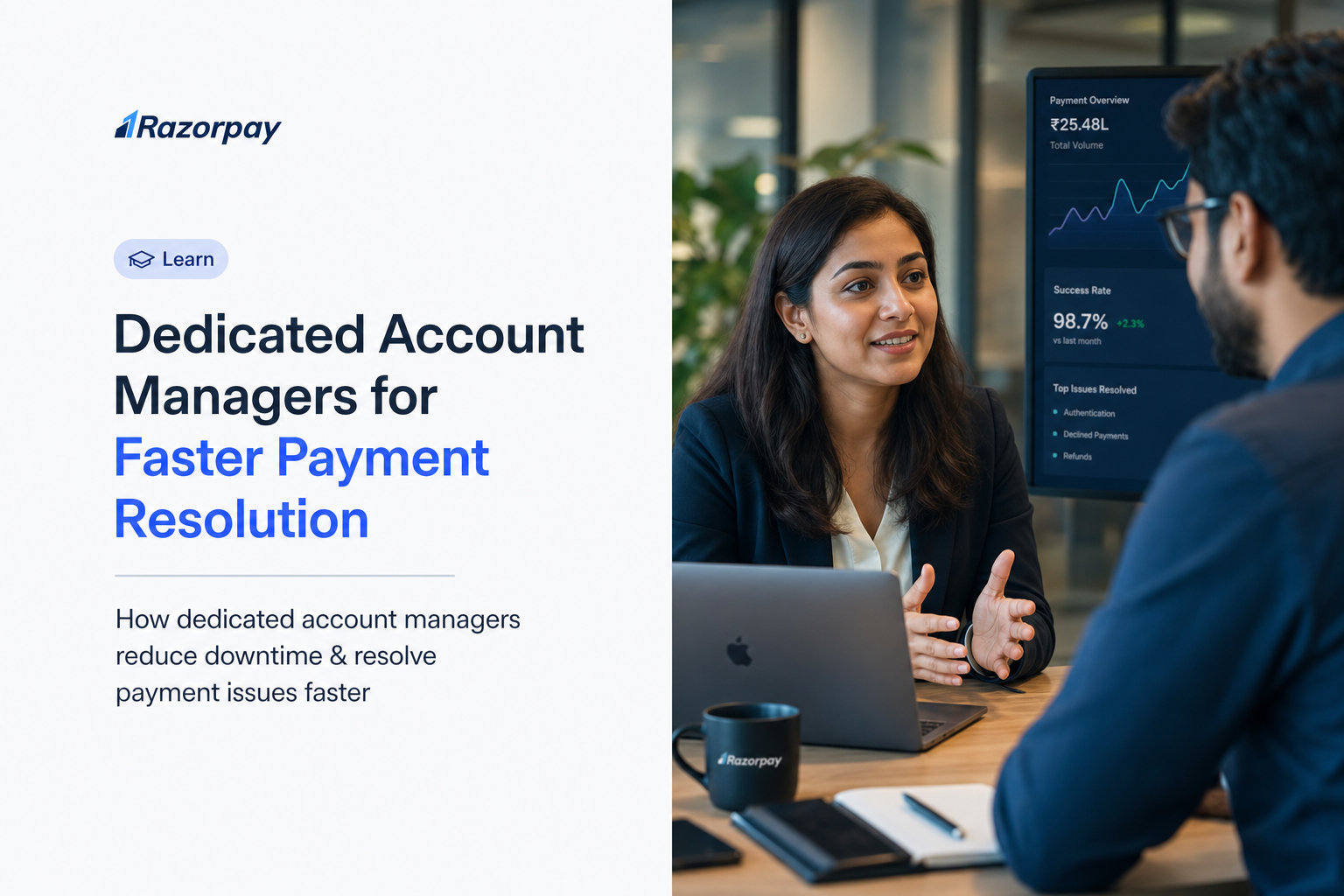
Payment issue resolution has quietly become one of the most consequential operational functions inside Indian businesses. Failed UPI transactions, settlement delays, refund disputes, and reconciliation breaks no longer sit neatly in a support queue – they directly affect cash flow, finance productivity, and customer trust. As digital payment volumes scale through 2026, the merchants pulling ahead are those who have stopped treating payment support as reactive ticketing and started treating it as an owner-led function. At the centre of that shift sits the dedicated account manager: a single point of accountability with the data access, escalation paths, and KPIs to turn payment issues into measurable outcomes.
Key Takeaways
- India’s digital payments market is projected to hit $10 trillion by FY2026, more than tripling from FY2023, which means even a fraction-of-a-percent dispute rate now touches millions of transactions.
- A dedicated account manager differs from generic support in three measurable ways: institutional memory of the merchant’s transaction patterns, internal escalation access inside the payment provider, and direct ownership of dispute KPIs.
- Organisations with structured, owner-led dispute processes have cut average resolution times by 20-30% and reduced bad-debt risk.
- Finance teams globally spend up to 30% of their time on dispute resolution and exception handling.
- 60% of customers have switched brands due to poor service, and payment failures are among the highest-stakes moments of truth.
- Measure your account manager on resolution rate, average resolution time, dispute aging, and DSO impact – not relationship sentiment alone.
Table of Contents
Why Payment Issue Resolution Has Become a Business-Critical Function in 2026
The Scale of India’s Digital Payment Ecosystem and What It Means for Disputes
Did You Know?
India’s digital payments market is on track to reach $10 trillion by FY2026, more than tripling from roughly $3 trillion in FY2023.
When transaction volumes triple in three years, even an unchanged dispute rate produces a much larger absolute volume of failed payments, refund queries, and reconciliation breaks. For merchants accepting UPI payments, cards, netbanking, and wallets in parallel, this scaling effect compounds across rails – a level of operational pressure that generic support queues were never designed to absorb.
Why Generic Support Queues Fail at Scale
Ticket-based support breaks down predictably under volume. Every new interaction resets context, the merchant re-briefs the agent on integration history, and escalation routing depends on whoever picks up the queue. Resolution stretches across days, ownership stays diffuse, and the finance team spends more time chasing status updates than closing exceptions.
The Unique Challenge of Fast-Payment Dispute Resolution in India
Did You Know?
A World Bank study on fast payment systems warns that once disputed funds settle and move downstream, recovery becomes “problematic” – making dispute routing speed as critical as payment speed itself.
In instant-payment environments, the resolution clock starts the moment a transaction fails or reverses incorrectly. Delayed routing is not just poor service; it is a working-capital risk.
The Real Cost of Slow Payment Issue Resolution
Cash Flow Impact – How Unresolved Disputes Lock Working Capital
Unresolved payment issues directly inflate Days Sales Outstanding. According to BillingPlatform analysis, nearly a quarter of companies have significant revenue tied up in outstanding invoices. Settlement disputes, refund holds, and reconciliation breaks all extend the gap between transaction acceptance and cash availability.
Customer Retention – The Hidden Revenue Cost of Poor Payment Support
Did You Know?
60% of customers have switched brands due to poor service, and payment failures rank among the top moment-of-truth interactions.
A delayed refund or unresolved UPI failure is not a back-office problem; it is the most visible point in the customer relationship.
Operational Drag – What Finance Teams Lose to Manual Exception Handling
Finance teams globally spend up to 30% of their time on dispute resolution and exception handling – time pulled away from forecasting, planning, and strategic work. For businesses managing high volumes, Razorpay’s Smart Collect automatically reconciles incoming bank transfers against order IDs, reducing the manual exception-handling burden on finance teams.
What a Dedicated Account Manager for Payment Issues Actually Does
Single Point of Ownership vs. Rotating Support Agents
A dedicated account manager carries institutional memory of the merchant’s integration setup, transaction patterns, seasonal spikes, and historical failure reasons. No re-briefing, no lost context – the conversation always picks up where it left off, which is often the single largest source of compression in resolution time.
Internal Escalation Access – How Dedicated Managers Navigate Payment Provider Systems
The account manager has pre-established working relationships with technical, settlement, risk, and compliance teams inside the payment provider. For merchants evaluating enterprise payment gateway support in India, this internal access is the primary mechanism that compresses routing time from days to hours.
Proactive Issue Detection vs. Reactive Complaint Handling
Rather than waiting for a ticket, a dedicated account manager monitors transaction dashboards for decline-code spikes, refund volume anomalies, and reconciliation mismatches.
Pro-Tip: Ask your payment provider whether your dedicated account manager has access to your transaction-level dashboard and failure-code data – not just your account profile. Proactive detection requires data access, not just a relationship.
Cross-Functional Coordination – Connecting Technical, Finance, and Compliance Teams
Payment issues rarely sit inside one function. A UPI reversal might need engineering diagnosis, settlement reconciliation, and compliance documentation simultaneously. The account manager coordinates all three in parallel rather than sequentially.
How Razorpay’s Payment Gateway and Support Infrastructure Help Dedicated Account Managers Resolve Issues Faster
A dedicated account manager is only as effective as the tooling underneath them. Razorpay’s Payment Gateway is built so that the account manager can diagnose, route, and resolve issues with the same data visibility the merchant has.
- Transaction-level dashboard with smart routing: The account manager can trace failed transactions across payment modes, identify failure points by response code, and surface patterns without escalating to engineering.
- Instant Settlements: When a settlement dispute or unexpected hold affects working capital, this feature gives the account manager a lever to help merchants access funds outside the standard settlement window.
- Smart Collect and reconciliation tools: Incoming bank transfers are automatically matched to virtual account IDs and order references, eliminating the manual exception-hunting that slows dispute closure.
Together, these capabilities turn the account manager from a contact point into a diagnostic owner with the data and levers needed to close issues at source.
How to Structure the Dedicated Account Manager Role for Payment Issue Resolution
Defining the Scope – What Payment Issues Should the Account Manager Own?
A practical scope framework prevents ambiguity:
- Tier 1 (Owns directly): Failed transaction investigation, settlement delays, reconciliation exceptions, refund status tracking.
- Tier 2 (Coordinates): Integration failures, UPI-specific routing, RBI compliance queries, risk reviews.
- Tier 3 (Escalates): Systemic outages, regulatory disputes, banking-partner escalations.
Building the Escalation Framework – From Merchant to Resolution
Define severity levels, internal routing paths, and update expectations upfront. The RBI Payment Systems Vision emphasises time-bound dispute-redress frameworks with clear accountability, which is the regulatory backdrop your internal escalation map should align to.
Setting Up Communication Protocols That Actually Work
Pro-Tip: Agree on a tiered communication protocol upfront – define which issue types warrant immediate contact, which warrant same-day updates, and which fit weekly reviews. Protocol ambiguity is the single most common reason dedicated account management underdelivers.
The 5 Ways Dedicated Account Managers Accelerate Payment Issue Resolution
1. Institutional Memory – No Re-Briefing, No Lost Context
The account manager already knows your integration stack, historical failure modes, and seasonal patterns, eliminating the discovery phase that consumes most ticket-based resolutions.
2. Pre-Mapped Escalation Paths – Routing Issues to the Right Team Immediately
Direct lines into settlement, technical, and compliance teams mean issues bypass intake queues entirely, compressing the routing phase that typically consumes the largest share of resolution time.
3. Proactive Monitoring – Catching Issues Before They Become Disputes
By tracking decline-code spikes, refund volumes, and reconciliation mismatches in real time, the account manager often raises and closes issues before the merchant notices. When working capital is affected, Razorpay’s Instant Settlements gives businesses a way to access funds outside the standard settlement window – a lever a dedicated account manager can activate on the merchant’s behalf.
4. Root Cause Analysis – Preventing the Same Issue from Recurring
Closing the ticket is not the same as closing the issue. The account manager tracks dispute volume by reason code, identifies recurring patterns, and pushes structural fixes upstream.
5. Structured Handoffs – Ensuring Nothing Falls Through During Team Changes
Documented case histories and shared context ensure that internal team changes on either side do not reset resolution progress or break continuity on open disputes.
How to Measure Your Dedicated Account Manager’s Impact on Payment Operations
Treat the role as a measurable function with these core KPIs:
- Dispute Resolution Rate: Share of issues closed within agreed SLA.
- Average Dispute Resolution Time: Cycle time from issue raised to closure.
- Dispute Aging: Open issues bucketed by age bracket.
- Dispute Volume by Reason: Recurring failure patterns by code.
- First-Contact Resolution Rate: Quality of initial diagnosis.
- DSO Impact: Cash-flow improvement attributable to faster resolution.
Pro-Tip: Treat resolution time as a core KPI. Owner-led dispute processes have cut resolution times by 20-30% and reduced bad-debt risk.
Razorpay’s merchant dashboard surfaces transaction-level data, including failure reasons and payment-mode breakdowns, that a dedicated account manager can use to track aging and recurring patterns.
How Razorpay Supports Businesses with Dedicated Account Management and Payment Infrastructure
Razorpay combines dedicated account management with full-stack payment infrastructure so issue resolution is backed by data, levers, and licensed rails.
| Feature / Capability | What It Does for Payment Issue Resolution |
|---|---|
| Dedicated Account Manager Program | Named single point of contact with internal escalation access |
| Transaction-Level Dashboard | Surfaces failure reasons and payment-mode breakdowns |
| Smart Collect | Matches incoming bank transfers to virtual account IDs and order references |
| Instant Settlements | Lever to access funds outside the standard settlement window |
| Smart Routing | Routes transactions across aggregators to reduce failures |
| 100+ Payment Methods | Broad coverage reducing mode-specific failures |
| PCI DSS Level 1 Compliance | Transaction data handled to a recognised security standard |
| RBI-Authorised Payment Aggregator | Licensed PA status with direct settlement relationships |
Explore Razorpay’s Payment Gateway
Conclusion
Payment issue resolution in 2026 is no longer a support conversation – it is a finance, operations, and customer-trust conversation rolled into one. A dedicated account manager accelerates this function only when the role is structured with clear scope, escalation access, dashboard-level data visibility, and measurable KPIs tied to resolution rate, aging, and DSO impact. Treated as a relationship contact, the role underdelivers. Treated as an owner of payment operations, it becomes one of the highest-leverage investments a scaling merchant can make.
Frequently Asked Questions
What does a dedicated account manager do for payment issues that generic support doesn’t?
A dedicated account manager holds institutional memory of your transaction patterns, integration setup, and historical failures – no re-briefing required. They also have internal escalation access to technical, settlement, and compliance teams, plus the ability to monitor dashboards proactively. Generic ticket support resets context with every interaction.
How do I know if my business needs a dedicated account manager for payment support?
Consider it if you process high transaction volumes, accept multiple payment rails like UPI, cards, and netbanking, have high-value B2B customers, or experience frequent reconciliation exceptions. If your finance team spends more than a few hours weekly on payment disputes, the role pays for itself in recovered productivity.
What KPIs should I use to measure my dedicated account manager’s performance?
Track dispute resolution rate within SLA, average resolution time, dispute aging by bracket, first-contact resolution rate, and impact on Days Sales Outstanding. Indian AR best-practice frameworks track these because shortening resolution cycles has a direct, measurable impact on working capital.
How does a dedicated account manager handle UPI-specific payment disputes in India?
UPI disputes such as failed reversals, pending transactions, and Autopay mandate failures have unique resolution rails distinct from card disputes. A dedicated account manager familiar with your UPI integration routes these correctly from the first contact, avoiding the generic queue that treats all payment failures identically.
What is a reasonable SLA for payment dispute resolution in 2026?
SLAs vary by issue type. Failed-transaction investigations typically warrant same-day acknowledgement and 24-72 hour resolution. Settlement disputes involving banking partners may require 3-5 business days. Chargebacks follow card network timelines. Negotiate tiered SLAs based on transaction value and customer impact during onboarding.