

Available in🇮🇳 India
Given below are the steps to integrate with the Import Flow APIs.
1.1 Create a Customer
Creating a customer generates a uniquecustomer_id by collecting basic details such as name, email, and contact details. This customer_id must be included when creating a payment request to link the payment to the customer. Use the following API to create a customer.
You can try out our APIs on the Razorpay Postman Public Workspace. Fork the workspace and test the APIs with your Test API Keys.
POST /customers
Request Parameters
Request Parameters
name mandatory
: string Customer’s name.- Character length: Between 5 and 50 characters.
- Allowed characters: Uppercase letters (A-Z), lowercase letters (a-z), and spaces (not at the beginning).
- Not allowed characters: Numbers, special characters (e.g., @, ”, ,, ., etc.), Unicode characters, emojis, and non-Latin scripts or regional languages.
- Prohibited names: Names must be meaningful and contextually appropriate.
- Avoid using repetitive patterns (e.g., aaa, xyz, kkk kk).
- Names like litri litri, Hfg Gh, or husi husi are not permitted.
- Curse words or offensive names are prohibited.
- Example:
Gaurav Kumar.
contact mandatory
: string The customer’s phone number. A maximum length of 15 characters including country code. For example, +919123456780.email mandatory
: string The customer’s email address. A maximum length of 64 characters for the username. For example, in “gaurav.kumar@example.com”, “gaurav.kumar” must not exceed 64 characters.fail_existing optional
: string The request throws an exception by default if a customer with the exact details already exists. You can pass an additional parameter fail_existing to get the existing customer’s details in the response. Possible values:1(default): If a customer with the same details already exists, throws an error.0: If a customer with the same details already exists, fetches details of the existing customer.
gstin optional
: string Customer’s GST number, if available. For example,
29XAbbA4369J1PA.notes optional
: object Key-value pair used to store additional information about the entity. Holds 15 key-value pairs, 256 characters (maximum) each. For example, "note_key": "Beam me up Scotty”.Response Parameters
Response Parameters
id
: string Unique identifier of the customer. For example, cust_1Aa00000000004.entity optional
: string Indicates the type of entity.name
: string Customer’s name.- Character length: Between 5 and 50 characters.
- Allowed characters: Uppercase letters (A-Z), lowercase letters (a-z), and spaces (not at the beginning).
- Not allowed characters: Numbers, special characters (e.g., @, ”, ,, ., etc.), Unicode characters, emojis, and non-Latin scripts or regional languages.
- Prohibited names: Names must be meaningful and contextually appropriate.
- Avoid using repetitive patterns (e.g., aaa, xyz, kkk kk).
- Names like litri litri, Hfg Gh, or husi husi are not permitted.
- Curse words or offensive names are prohibited.
- Example:
Gaurav Kumar.
contact
: string The customer’s phone number. A maximum length of 15 characters including country code. For example, +919123456780.email
: string The customer’s email address. A maximum length of 64 characters for the username. For example, in “gaurav.kumar@example.com”, “gaurav.kumar” must not exceed 64 characters.gstin
: string GST number linked to the customer. For example,
29XAbbA4369J1PA.notes
: object Key-value pair used to store additional information about the entity. Holds 15 key-value pairs, 256 characters (maximum) each. For example, "note_key": "Beam me up Scotty”.created_at
: integer UNIX timestamp, when the customer was created. For example, 1234567890.Error Response Parameters
Error Response Parameters
1.2 Create an Order
After a customer is created, an order needs to be generated using the Orders API. This order contains details such as the payment amount, currency, customer details, tax-related information and other custom notes. After the order is created, anorder_id is generated, for example, order_NGrgEcmYJsfUyl. You must pass this order_id in the checkout code to associate this order with the payment. Learn more about Order and Payment states.
POST /orders
Curl
Request Parameters
Request Parameters
amount mandatory
: integer The amount for which the order was created, in currency subunits. For example, for an amount of ₹295, enter 29500. Payment can only be made for this amount against the Order.currency mandatory
: string ISO code for the currency in which you want to accept the payment. The default length is 3 characters. For example, INR.receipt optional
: string Receipt number that corresponds to this order, set for your internal reference. Can have a maximum length of 40 characters and has to be unique.customer_id mandatory
: string Unique identifier of the customer. For example, cust_1Aa00000000004.customer_details mandatory
: object This contains details about the customer details of the order.name mandatory
: string Customer’s name.- Character length: Between 5 and 50 characters.
- Allowed characters: Uppercase letters (A-Z), lowercase letters (a-z), and spaces (not at the beginning).
- Not allowed characters: Numbers, special characters (e.g., @, ”, ,, ., etc.), Unicode characters, emojis, and non-Latin scripts or regional languages.
- Prohibited names: Names must be meaningful and contextually appropriate.
- Avoid using repetitive patterns (e.g., aaa, xyz, kkk kk).
- Names like litri litri, Hfg Gh, or husi husi are not permitted.
- Curse words or offensive names are prohibited.
- Example:
Gaurav Kumar.
email optional
: string The customer’s email address. A maximum length of 64 characters for the username. For example, in “gaurav.kumar@example.com”, “gaurav.kumar” must not exceed 64 characters.contact optional
: string The customer’s phone number. A maximum length of 15 characters including country code. For example, +919123456780.shipping_address mandatory
: object This contains the shipping address of the order.line1 mandatory
: string Address Line 1 of the address.- Character length: Must be between 3 and 100 characters.
- Allowed characters: Uppercase letters (A-Z), lowercase letters (a-z), numbers (0-9), spaces, and special characters (*&/-()#_+{}[]:’”.,.).
- Not allowed characters: Regional languages.
line2 mandatory
: string Address Line 2 of the address.- Character length: Must be between 3 and 100 characters.
- Allowed characters: Uppercase letters (A-Z), lowercase letters (a-z), numbers (0-9), spaces, and special characters (*&/-()#_+{}[]:’”.,.).
- Not allowed characters: Regional languages.
city mandatory
: string Name of the city. Must be between 3 and 50 characters in length and can only include uppercase (A-Z) and lowercase (a-z) English letters, and spaces.country mandatory
: string ISO3 country code of the billing address. Only IND is allowed.state mandatory
: string Name of the state. It must be between 3 and 50 characters extended and can only include uppercase (A-Z) and lowercase (a-z) English letters and spaces. Please send the full name of the state, for example, Madhya Pradesh.zipcode mandatory
: string The ZIP code must consist of 6-digit numeric characters. Only valid Indian ZIP codes will be accepted. Refer to the list of supported ZIP codes.latitude optional
: float Latitude of the position expressed in decimal degrees (WSG 84), for example, 6.244203. A positive value denotes the northern hemisphere or the equator, and a negative value denotes the southern hemisphere. The number of digits to represent the precision of the coordinate.longitude optional
: float Longitude of the position expressed in decimal degrees (WSG 84), for example, -75.581211. A positive value denotes east longitude or the prime meridian, and a negative value denotes west longitude. The number of digits to represent the precision of the coordinate.identity optional
: array A list of identity objects containing customer identification details.type optional
: string The type of identification document. For example, tax_id.id optional
: string The identification number or value corresponding to the type provided. For example, ABCDE1234F.notes optional
: json object Key-value pair used to store additional information about the entity. Holds 15 key-value pairs, 256 characters (maximum) each. For example, "note_key": "Beam me up Scotty”.Response Parameters
Response Parameters
amount
: integer The amount for which the order was created, in currency subunits. For example, for an amount of ₹295, enter 29500.amount_due
: integer The amount pending against the order.amount_paid
: integer The amount paid against the order.attempts
: integer The number of payment attempts, successful and failed, that have been made against this order.created_at
: integer Indicates the Unix timestamp when this order was created.currency
: string ISO code for the currency in which you want to accept the payment. The default length is 3 characters.entity
: string Name of the entity. Here, it is order.id
: string The unique identifier of the order.notes
: object Key-value pair used to store additional information about the entity. Holds 15 key-value pairs, 256 characters (maximum) each. For example, "note_key": "Beam me up Scotty”.offer_id
: string The unique identifier of the offer. For example, offer_JHD834hjbxzhd38d.receipt
: string Receipt number that corresponds to this order. Can have a maximum length of 40 characters and has to be unique.status
: string The status of the order. Possible values:created: When you create an order, it is in thecreatedstate. It stays in this state till a payment is attempted on it.attempted: An order changes to theattemptedstate following the first payment attempt and remains in this state until at least one payment is successfully processed and captured.paid: After the successful capture of the payment, the order moves to thepaidstate. No further payment requests are permitted once the order moves to thepaidstate.
The order stays in thepaidstate even if the payment associated with the order is refunded.
Error Response Parameters
Error Response Parameters
1.3 Create a Payment
3.1 Create a Payment Using Netbanking or Cards
3.1 Create a Payment Using Netbanking or Cards
Create a payment using the S2S JSON Payments API.
POST /payments/create/json- Netbanking
- Cards
3.2 Create a Payment Using UPI
3.2 Create a Payment Using UPI
There are 2 UPI flows available for S2S.
- Intent Flow: When a customer selects the UPI payment app on checkout, the app is launched automatically on the mobile device. Customers need not enter VPA or phone numbers as these details are prefilled and submitted along with the other payment details.
- Collect Flow: Customers enter their VPAs, open the respective UPI apps and complete the payment on their mobile devices.
POST /payments/create/upi- UPI Intent Flow
- UPI Collect Flow
UPI Intent Deep Link - Integration Best PracticesWhen rendering the UPI intent flow, use the deep link exactly as returned by the Razorpay API. Do not modify or prefix it with any app-specific scheme (for example,
phonepe://, paytm:// or similar). Using the deep link as is ensures the device automatically surfaces all UPI compatible PSP apps installed on the user’s device, allowing the user to choose their preferred app to complete the payment.Note: This automatic PSP app discovery via the intent deep link is supported on Android only.Request Parameters
Request Parameters
amount mandatory
: integer Payment amount in the smallest currency sub-unit. For example, if the amount to be charged is ₹299, then pass 29900 in this field.currency mandatory
: string Currency code for the currency in which you want to accept the payment. For example, INR.email mandatory
: string Email address of the customer. Maximum length supported is 40 characters.contact mandatory
: string Phone number of the customer. For example, 9123456780.customer_id mandatory
: string Unique identifier of the customer.order_id mandatory
: string Unique identifier of the Order.Know more about Orders API.
ip optional
: string Customer’s IP address.method mandatory
: string Name of the payment method. Possible values are:cardnetbankingupi
notes mandatory
: object Key-value pair that can be used to store additional information about the entity. Maximum 15 key-value pairs, 256 characters (maximum) each. For example, "note_key": "Beam me up Scotty”.invoice_number mandatory
: string Invoice number of the generated invoice. Ensure that each payment has a unique invoice number, with a length of fewer than 40 characters.goods_description optional
: string Description of the goods. For example, Digital Lamp.Response Parameters
Response Parameters
If the payment request is valid, the response contains the following fields.
link
: string The UPI intent link to redirect the customer to their UPI app for mandate approval. Use this as a deeplink on mobile or convert it to a QR code for desktop.razorpay_payment_id
: string Unique identifier of the payment. Present for all responses.next
: array A list of action objects available to you to continue the payment process. Present when the payment requires further processing.action
: string An indication of the next step available to you to continue the payment process. The value here is redirect. Use this URL to redirect customer to the bank page.url
: string URL to be used for the action indicated.- Netbanking
- UPI
- Cards (Debit and Credit)
- Recurring
For recurring payments, additional integration is needed. Cards, UPI, and UPI with TPV are supported as a payment methods.
1.4 Handle Payment Success and Error Events
Once the payment is completed by the customer, aPOST request is made to the callback_url provided in the payment request. The data contained in this request will depend on whether the payment was a success or a failure.
Success Callback
Success Callback
If the payment made by the customer is successful, the following fields are sent:
razorpay_payment_idrazorpay_order_idrazorpay_signature
Callback Example
Failure Callback
Failure Callback
If the payment has failed, the callback will contain details of the error. Refer to Errors for details.
1.5 Verify Payment Signature
Signature verification is a mandatory step to ensure that the callback is sent by Razorpay. Therazorpay_signature contained in the callback can be regenerated by your system and verified as follows.
Create a string for hashing by combining the “razorpay_payment_id” from the callback and the Order ID generated in the initial step, separated by a |. Proceed to hash this string using SHA256 alongside your API Secret.
Generate Signature on your Server
Sample code
Sample code
1.6 Verify Payment Status
Handy TipsOn the Razorpay Dashboard, ensure that the payment status is
captured. Refer to the payment capture settings page to know how to capture payments automatically.You can track the payment status in three ways:
You can track the payment status in three ways:
- Verify Status from Dashboard
- Subscribe to Webhook Events
- Poll APIs
To verify the payment status from the Razorpay Dashboard: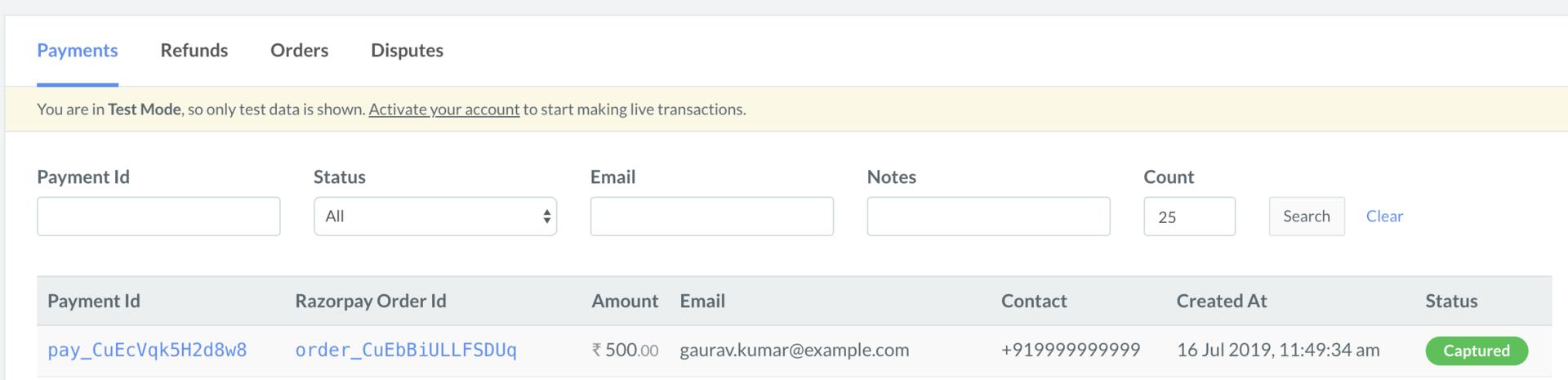
- Log in to the Razorpay Dashboard and navigate to Transactions → Payments.
- Check if a Payment Id has been generated and note the status. In case of a successful payment, the status is marked as Captured.