India’s digital payments have reached a scale where settlement opacity is a direct threat to cash flow and compliance. Digital payment transactions in India grew from 7,404 crore in FY17 to 21,769 crore in FY23, and the money flowing through payment aggregator escrows has multiplied. Yet most founders still sign merchant agreements without interrogating how, when, and where they get paid. This is not another payment settlement basics explainer. It is an interrogation playbook, built on the RBI Payment Aggregator Directions 2025, designed to turn settlement from fine print into a contract you negotiate.
Key Takeaways
- RBI mandates T+1 settlement: Under the RBI Payment Aggregator Directions 2025, aggregators must credit merchant funds no later than T+1 banking day – a contractual right merchants can demand.
- Your money sits in escrow: Funds must be held in a designated escrow account whose core portion cannot fund the aggregator’s own operations. Ask which bank holds it.
- A good settlement report is non-negotiable: Every payout should trace to individual transactions, with MDR, GST, refund offsets, and UTR itemised.
- UPI and cards settle at different speeds: UPI typically settles on T+1 while cards commonly follow T+2 in practice.
- International settlements carry hidden costs: Forex spreads, correspondent bank fees, and multi-day clearing windows are rarely disclosed upfront.
- Non-compliance is expensive: Penalties under the Payment and Settlement Systems Act, 2007 can reach Rs 1 crore for certain contraventions.
Table of Contents
Why Settlement Transparency Has Become a Business-Critical Issue in 2026
As volumes climb, the cost of settlement opacity rises. Delayed payouts, unexplained holds, and net-only reports now directly affect payroll, inventory, and audit readiness.
India’s digital payment scale has raised the stakes
With UPI accounting for roughly 73% of India’s digital payment transaction volume in FY23, near-real-time settlement expectations have become the benchmark merchants measure every other method against. Smooth payment operations now depend on settlement clarity.
RBI regulation has turned settlement into a governance issue
The 2025 PA Directions give merchants enforceable rights: a T+1 ceiling, escrow segregation, and mandatory fee disclosure. Under the Payment and Settlement Systems Act, 2007, penalties can reach Rs 1 crore for certain contraventions.
Did You Know?
RBI’s 2025 PA Directions require aggregators to credit merchant funds no later than T+1 banking day.
What Actually Happens to Your Money Between Payment and Payout
Understanding the settlement lifecycle is the first step to questioning it. Here is how funds move:
- The customer pays at checkout.
- The issuing bank validates the transaction.
- The card network or UPI rail clears it.
- The payment aggregator receives funds into a designated escrow account.
- The merchant receives a net payout after deductions.
Stages four and five are the opacity zone. Most merchants know the customer paid and money eventually arrives, but understanding how payment gateways work reveals where visibility breaks down.
The escrow black box merchants rarely question
RBI requires payment aggregators to maintain a designated escrow account whose core portion is earmarked for merchant settlements and cannot be used for the PA’s own operations. Yet few merchants ask which bank holds it. Razorpay, as an RBI-authorised Payment Aggregator, maintains merchant funds in a designated escrow account, keeping collections separate from its own operational capital.
Did You Know?
RBI mandates that the core portion of the PA escrow account is reserved exclusively for merchant settlements.
The 7 Settlement Questions Every Indian Merchant Must Ask in 2026
This is your interrogation framework. For each question, note the good answer and the red flag before you choose a payment gateway.
1. What is your settlement cycle, and is it contractually guaranteed?
A good answer specifies a T+1 SLA with a defined banking day and method-wise data. A red flag is “best effort” language with no historical performance data.
Pro-Tip: Use RBI’s T+1 mandate as your contractual baseline. Ask: “What percentage of my transactions settle by T+1, and can you show me historical data?”
2. Which bank holds my escrow, and what happens if something goes wrong?
A good answer names the scheduled commercial bank, explains the escrow structure, and outlines contingency plans. A red flag is any refusal to disclose escrow details.
3. How are fees deducted, and will I see a line-item breakdown?
A good answer itemises MDR, GST on MDR, refund offsets, chargeback debits, and reserves. MDR and other charges must be clearly disclosed and contractually agreed. A red flag is net-only settlement.
4. What is your settlement cut-off time, and can it be adjusted?
A good answer states a clear cut-off by method and explains holiday handling. A red flag is no cut-off disclosure, leaving late sales stranded for days.
5. How do you handle settlement holds, and what triggers them?
A good answer documents triggers, review timelines, and an escalation path. A red flag is unilateral, indefinite holds with no reporting.
Did You Know?
Worldwide, merchants lost an estimated $100 billion to chargebacks in 2023 including lost revenue, fees, and operational costs.
6. What does my settlement report contain, and can I export it?
A good answer offers transaction-level export with UTRs and deductions. A red flag is PDF-only or net-only reporting with missing references.
7. What is your dispute and reversal process, and how does it affect settlement?
A good answer clarifies chargeback debit timing, evidence windows, and negative balance rules. A red flag is unclear reversal adjustments.
How Razorpay’s Instant Settlements Give Merchants Greater Control Over Their Cash Flow
Once you have asked the seven questions, the next step is evaluating whether a gateway’s capabilities answer them. Razorpay offers features built around settlement visibility and cash flow control:
- Instant Settlements: Enables merchants to access funds outside the standard settlement window for working capital flexibility.
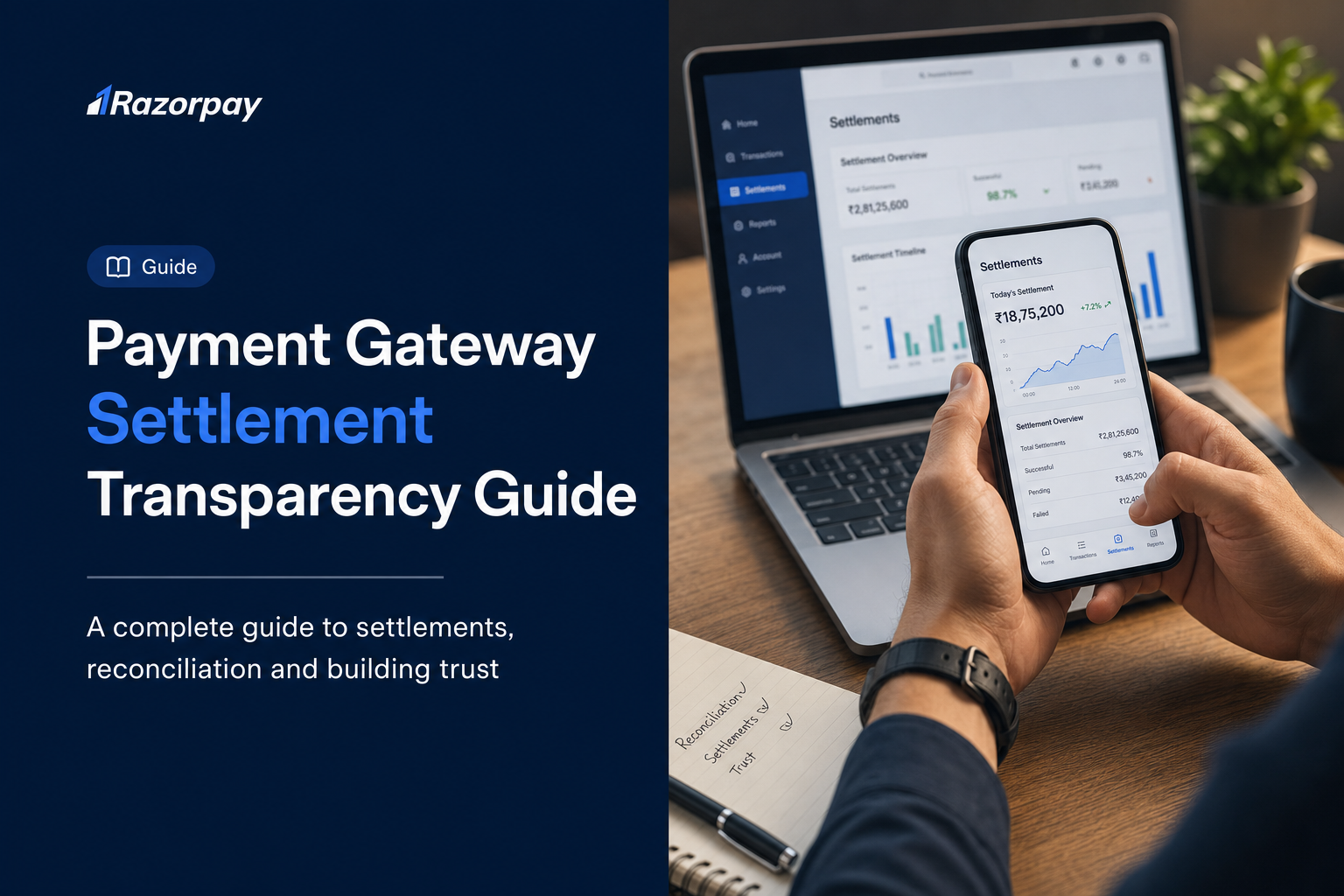
- Settlement Dashboard: Provides transaction-level visibility into what is settled, pending, and deducted to support reconciliation.
- Flexible Settlement Destinations: Allows funds to be routed to bank accounts or virtual accounts depending on how a finance team manages liquidity.
These capabilities map directly to the transparency questions a merchant should be asking. For deeper context, see Razorpay’s view on settlement transparency and working capital. Razorpay operates as an RBI-authorised Payment Aggregator within the regulatory framework discussed throughout this guide.
Settlement Timelines by Payment Method: What Is Normal vs. What Is a Red Flag
Different payment methods settle at different speeds, and knowing the norm helps you spot a problem.
| Payment method | Typical practice | What to ask | Red flag |
|---|---|---|---|
| UPI | Often T+1 | Is T+1 contractually committed? | Frequent delays beyond T+1 |
| Cards | Often T+2 in practice | What is the cut-off and batch logic? | No method-wise reporting |
| Net banking | Varies by bank | How are bank holidays handled? | No bank-wise delay visibility |
| Wallets | Varies by PA | Are wallet settlements reported separately? | Lumped into “other” payouts |
| International | Several days possible | What FX rate and fees apply? | No FX spread or FIRC clarity |
The banking day versus calendar day trap
Card transactions are typically settled on T+2 working days, while UPI transactions are generally settled on T+1. The word “working” matters: weekends and holidays can stretch a T+2 payout into four or five calendar days. Razorpay’s Instant Settlements feature offers an option to access funds outside the standard settlement cycle.
Pro-Tip: Use UPI’s T+1 as your benchmark to push for later card cut-offs. Ask: “What is your card settlement cut-off time, and what would it take to extend it?”
How to Read and Audit Your Settlement Report
Report quality is the most practical test of transparency. MDR and other charges must be clearly disclosed so net payout is fully traceable.
Anatomy of a good settlement report
A reconciliation-ready report should include every one of these fields:
- Transaction ID
- Order ID
- Payment method and channel
- Gross transaction amount
- MDR
- GST on MDR
- Refund offset
- Chargeback deduction
- Rolling reserve or hold amount
- Net settled amount
- Settlement date
- Bank UTR or reference number
Razorpay’s merchant dashboard provides transaction-level settlement reports that break down each payout by payment method, fees applied, and refund offsets. For a deeper look at fees, review the merchant discount rate breakdown.
Three reconciliation red flags
- Net-only reporting with no transaction linkage.
- Missing UTRs, so payouts cannot be matched to bank credits.
- Unexplained deductions finance teams cannot trace.
Did You Know?
GST at 18% is levied on MDR and is eligible for input tax credit – but only if your report shows GST as a separate line item.
International Settlements: The Questions Exporters and Global Merchants Must Add to the List
For exporters, agencies, and SaaS firms, domestic settlement clarity is not enough. Cross-border friction adds hidden costs.
Ask how FX is calculated
Ask which FX rate is used, when it is locked, whether the spread is shown separately, and whether conversion runs directly to INR or routes through another currency first. The gap between the interbank rate and the rate you receive is where margin quietly leaks. Understanding how to receive international payments in India starts here.
Ask about FIRC and intermediary fees
Cross-border settlement can take several days as funds move through international clearing systems, forex conversion, and regulatory checks. Ask whether correspondent bank and SWIFT fees are deducted mid-route, and whether FIRCs are generated automatically. Razorpay’s MoneySaver Export Account is one option for exporters receiving international transfers via local rails.
Pro-Tip: Ask three questions before accepting cross-border payments: (1) What FX rate, locked when? (2) Are correspondent bank fees deducted? (3) Do you provide automated FIRCs?
The Settlement Transparency Checklist: Your Pre-Signing Audit Framework
Consolidate every question into this pre-signing audit table before you choose the right payments solution.
| Clause | What to look for | Red flag |
|---|---|---|
| Settlement SLA | T+1 baseline, method-wise terms | “Best effort” only |
| Escrow bank | Named bank and escrow terms | No disclosure |
| Fee disclosure | MDR, GST, platform fees itemised | Bundled deductions |
| Cut-off time | Written cut-off by method | No batch logic |
| Holds | Defined triggers and review timeline | Indefinite holds |
| Disputes | Chargeback debit and evidence process | Unclear reversals |
| Report format | CSV or dashboard export | PDF-only or net-only |
| Holiday handling | Banking day definition | Calendar day ambiguity |
| International FX | Rate, spread, fees, FIRC | Hidden FX deductions |
| Termination | Final settlement timeline | Open-ended release |
How Razorpay Approaches Settlement Transparency for Indian Merchants
Razorpay is an RBI-authorised Payment Aggregator and India’s first full-stack financial solutions company, helping merchants manage collections, settlements, and reconciliation through one ecosystem.
| Razorpay capability | Functional description |
|---|---|
| RBI-Authorised Payment Aggregator | Operates within India’s regulated PA framework |
| Instant Settlements | Helps merchants access funds outside the standard window |
| Transaction-Level Settlement Dashboard | Supports payout visibility and reconciliation |
| Flexible Settlement Destinations | Routes funds to bank or virtual accounts |
| Smart Collect | Uses virtual accounts to simplify reconciliation |
| MoneySaver Export Account | Helps exporters receive payments via local rails |
| Route | Enables split payments for marketplaces |
| 100+ Payment Methods | Supports broad payment acceptance |
Explore Razorpay’s Payment Gateway
Conclusion
Settlement transparency is no longer a back-office concern. It is a contractual right, a cash flow lever, and a compliance obligation rolled into one. The RBI Payment Aggregator Directions 2025 give merchants a foundation to negotiate against. Use the seven questions and the pre-signing checklist to interrogate every gateway before you sign. A gateway that welcomes these questions and itemises every deduction is a partner you can build on. One that resists them is a risk you should price into your decision.
Frequently Asked Questions
What is the RBI rule on payment gateway settlement timelines in India?
Under the RBI Payment Aggregator Directions 2025, aggregators must credit merchant funds no later than T+1 banking day after the transaction date. Merchants can treat this as a contractual SLA baseline rather than accepting vague “standard cycle” language.
What is an escrow account in payment processing, and why does it matter for merchants?
An escrow account is a segregated account held with a scheduled commercial bank where a payment aggregator parks merchant collections. RBI requires the core portion to be reserved exclusively for merchant settlements, so it cannot fund the aggregator’s own operations. It protects your money before payout.
What should a payment gateway settlement report include?
A good report includes Transaction ID, Order ID, payment method, gross amount, MDR, GST on MDR, refund offsets, chargeback deductions, net settled amount, settlement date, and bank UTR. Every payout should trace back to individual transactions.
What is the difference between T+1 and T+2 settlement in India?
T+1 means funds are credited one banking day after the transaction, while T+2 means two. UPI typically settles on T+1 and cards commonly follow T+2 in practice. For high-volume merchants, this difference can trap an extra day of revenue.
Can a payment gateway hold my settlement funds, and what can I do about it?
Yes, gateways may place holds for volume spikes, high chargeback ratios, or suspected fraud. Negotiate clear hold triggers, defined review timelines, and an escalation path into your contract so holds are never indefinite.
What questions should I ask a payment gateway about international settlements?
Ask which FX rate is used and when it is locked, whether the spread is disclosed separately, whether correspondent bank and SWIFT fees are deducted mid-route, and whether FIRCs are generated automatically for export compliance.