An Indian IT services founder invoices a US client for $5,000. At the market rate of roughly Rs 85 per dollar, that should be about Rs 4.25 lakh in the bank. The credit arrives at Rs 3.9 lakh. A Rs 35,000 gap that nobody explained upfront.
Where did the money go? Three culprits, none of which appeared on the gateway’s pricing page: the forex markup buried inside the conversion rate, the 18% GST charged on the service fee, and intermediary deductions along the payment chain.
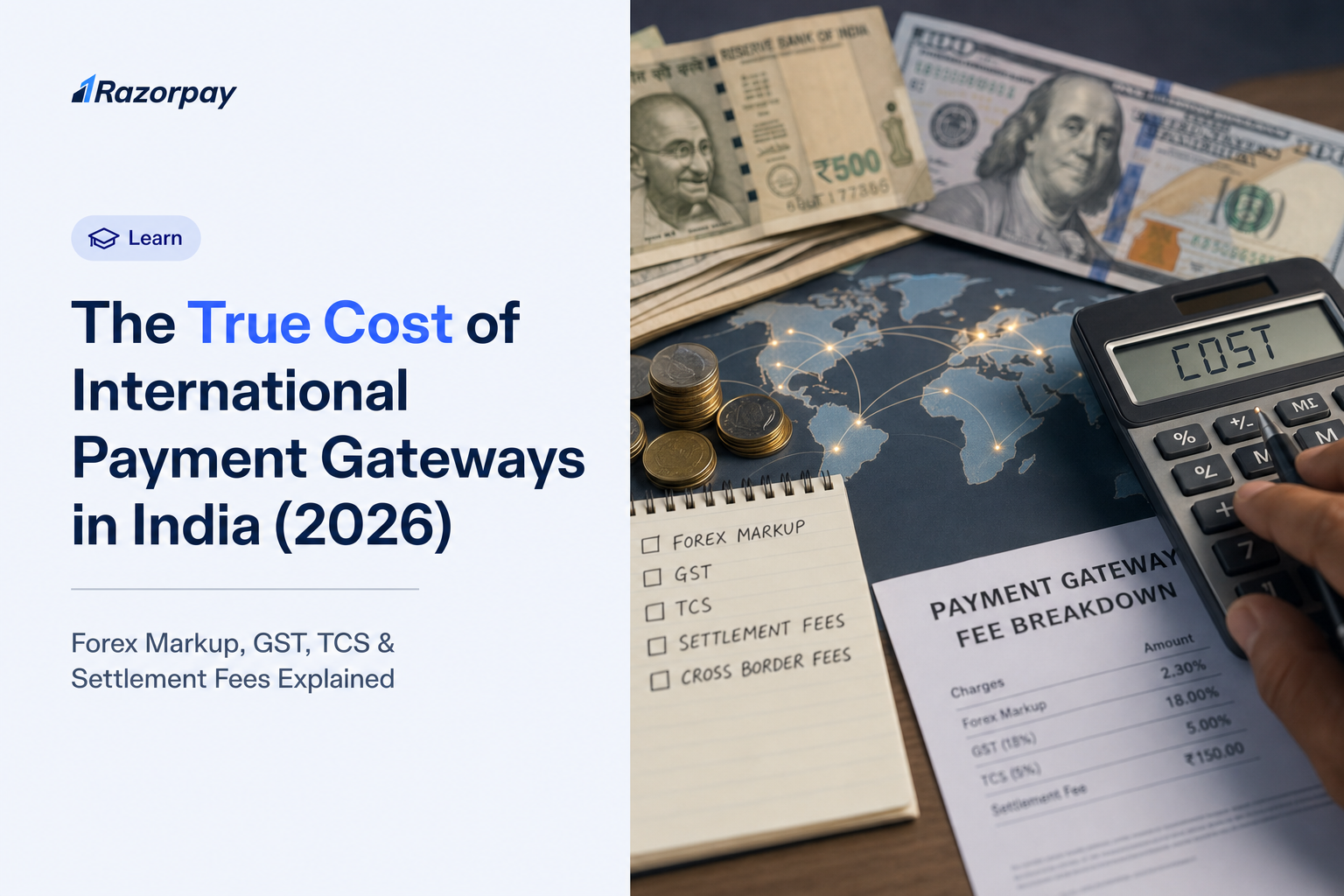
Depending on the payment rail and provider, the effective cost of an international payment can contain four potential layers: processing fees, foreign-exchange costs, GST on applicable taxable fees, and fixed or intermediary settlement charges. Not every transaction incurs all four separately. It is the starting point of your cost, not the ending point. Treating it as the total is how founders end up shocked at settlement.
Whether you are about to launch international payments or are already staring at a reconciliation shortfall, this article gives you the complete cost formula, the current regulatory context, and a business-type decision matrix. India accounted for 49% of global real-time payment transaction volume in 2023 (ACI Worldwide), yet most founders still have no clear view of what cross-border payment acceptance actually costs them.
Key Takeaways
- International payment gateway charges in India consist of four stacked layers: MDR or platform fee, forex markup, 18% GST on the service fee, and any settlement or intermediary deductions. The advertised rate covers only the first layer.
- Depending on the payment rail, the true all-in cost ranges from approximately 0.5% to 1.2% (virtual multi-currency bank transfer accounts) to 3.5% to 6% (international card gateways) to 6% to 8.5% (legacy global wallet aggregators).
- The forex markup is frequently the largest single cost component and is almost never listed on a gateway’s public pricing page. Request it separately, in paisa per dollar.
- TCS under Section 206C(1G) applies to outward remittances made by Indian residents, NOT to inward export receipts. Indian exporters receiving foreign payments do not pay TCS on those receipts.
- FEMA now requires Indian exporters to realise and repatriate export proceeds within 15 months of the date of export, extended from the earlier 9-month rule.
- The eFIRC is issued by your Authorised Dealer bank, not the gateway itself, and is mandatory for GST refund claims on zero-rated export services.
- Choosing the wrong payment rail for your business type costs more than choosing a slightly more expensive gateway on the right rail.
What Exactly Are International Payment Gateway Charges? (And Why the Quoted Rate Is Just the Starting Point)
International payment gateway charges in India are the fees a business pays to accept cross-border payments. The advertised MDR (typically 2.5% to 3% for international cards) is only one of four cost layers. Add the forex markup, 18% GST on the gateway’s service fee, and any intermediary deductions, and the true all-in rate is materially higher.
The website percentage answers a narrow question: what does the gateway charge to process the swipe? It does not answer how much INR reaches your account after conversion and taxes. The gap between those two numbers is where founders lose money.
The Four Potential Cost Layers Behind an International Payment
- MDR / Platform fee – The percentage the gateway advertises. This is the merchant discount rate, commonly 2.5% to 4% for international cards, with higher rates for premium cards or high-risk categories.
- Forex markup – The spread between the live mid-market rate and the rate at which your foreign currency converts to INR. These are the foreign transaction fees almost never displayed on pricing pages. Range: 0% to 3.5% or higher. Frequently the largest cost layer.
- GST on the service fee – 18% GST applies to the gateway’s service fee (the MDR), NOT to the full transaction value. On a 3% MDR, this adds 0.54%. Exporters of services may separately qualify for GST zero-rating under Section 16 of the IGST Act.
- Intermediary / settlement deductions – For SWIFT wire rails, correspondent banks may deduct $10 to $30 per transfer. For card gateways, this is usually nil.
The All-In Cost Formula Every Founder Should Know
Formula: Real cost % = MDR + Forex markup + (MDR x 0.18) + any fixed deductions expressed as a percentage of transaction value.
Worked example (card gateway scenario):
– Transaction: $1,000 from a US client
– MDR: 3%; Forex markup: 2%; GST on MDR: 0.54%
– All-in cost: 5.54%
– Amount received: approximately Rs 79,600 at Rs 85 per USD, versus Rs 85,000 with zero fees
Worked example (virtual bank transfer account scenario):
– MDR / platform fee: 1%; Forex markup: 0%; GST on platform fee: 0.18%
– All-in cost: 1.18%
– Amount received: approximately Rs 83,990 at the same rate
The difference on a single $1,000 transaction is roughly Rs 4,420. Annualised across Rs 50 lakh in foreign receipts, this compounds significantly.
[PRO-TIP: Ask any gateway to state the forex markup in paisa per dollar, separately from the MDR. A 2% MDR with a 3% forex markup costs more than a 3% MDR at mid-market rate. Compare the INR you actually receive, not the percentage on the pricing page.]
How Do International Payment Gateway Charges in India Compare Across Payment Rails? (2026 Benchmark Table)
The payment rail you choose – card checkout gateway, virtual multi-currency bank transfer account, or SWIFT wire – determines your cost range more than any individual provider’s pricing. In India, virtual bank transfer accounts settle closest to mid-market rates (0.5% to 1.2% all-in), while card gateways average 3.5% to 6% and legacy global wallets can exceed 8%.
Two businesses can pay wildly different effective rates not because one negotiated better, but because one is on the wrong rail entirely. Before you compare providers, compare rails.
Indicative 2026 Cost Comparison by Payment Rail in India
| Payment Rail | Typical MDR / Platform Fee | Forex Markup Range | GST on Fee | Settlement Timeline | All-In Cost Range | Best Suited For |
|---|---|---|---|---|---|---|
| Virtual multi-currency export account (bank transfer) | 0.5% to 1.5% | 0% to 1% | 18% of fee | T+1 to T+2 | 0.5% to 1.2% | B2B invoices, IT/SaaS exports, agency fees |
| International card gateway (India-registered) | 2.5% to 3% | 1% to 2% | 18% of fee | T+3 to T+7 | 3.5% to 6% | D2C e-commerce checkout, subscription payments |
| SWIFT wire transfer (bank-to-bank) | 0.5% to 1% | 1% to 3.5% | 18% of fee (if via a gateway) | T+2 to T+5 | 1.5% to 5% plus flat correspondent fees ($10-$30) | Large B2B transactions above $10,000 |
| Legacy global wallet aggregator | ~4.4% plus flat fee | 3% to 4% | 18% of fee | T+2 to T+4 | 6% to 8.5% | Ad-hoc low-volume freelance payments |
[DID YOU KNOW: India accounted for 49% of global real-time payment transaction volume in 2023, processing 129.3 billion real-time transactions (ACI Worldwide, Prime Time for Real-Time 2024 report). Yet many Indian businesses pay some of the highest effective cross-border rates globally because they default to card gateways instead of bank-transfer rails designed for exporters.]
Which Rail Should You Choose Based on How You Get Paid?
- IT agency or SaaS exporter billing US/EU clients monthly: Use a virtual multi-currency bank transfer account. Clients pay via ACH or SEPA into a local account. You receive INR at or close to mid-market rate. Total cost: under 1.5% all-in. This is where a multi-currency payment gateway earns its keep.
- D2C brand selling physical goods internationally with card checkout: Use an India-registered international card gateway such as Razorpay’s International Payment Gateway. Expect 3% to 5% all-in.
- Freelancer receiving marketplace payouts: The marketplace controls the rail. Bank transfer withdrawals are cheaper than card-based withdrawals.
- Indian startup receiving a one-time payment from a global investor: SWIFT wire is typically right for amounts above Rs 10 lakh. Our cross-border payments guide walks through the mechanics.
What Is the Forex Markup and Why Is It the Biggest Hidden Cost?
The forex markup is the difference between the mid-market exchange rate (the rate you see on Google or the RBI reference rate) and the rate at which your gateway or bank actually converts your foreign payment into INR. On most card gateways in India, this spread adds 1% to 2% to your cost. On some legacy global wallets, it exceeds 3%.
Because the markup lives inside the exchange rate rather than appearing as a line item, most founders never see it. The verified 2026 range runs 1% to 3.5%.
How to Measure Your Forex Markup in 30 Seconds
- Note the RBI reference rate for USD/INR on the day your payment settled (available on the RBI website).
- Check the exchange rate your gateway or bank applied.
- Subtract the two. The difference in paise per dollar is your forex markup.
- Express it as a percentage: divide by the RBI reference rate and multiply by 100.
- Example: if your gateway settled at Rs 81.50 while the reference rate was Rs 83.00, your markup was Rs 1.50 per dollar, or approximately 1.8%.
Why Gateways Almost Never Show the Forex Markup on Their Pricing Pages
- The forex markup is not a “fee” in the traditional sense. It is embedded in the conversion rate. RBI guidelines require banks to disclose exchange rates but do not mandate that aggregators display their FX spread upfront.
- This is structurally different from how the MDR is regulated, including zero MDR on UPI and RuPay debit cards for domestic transactions. The forex markup sits in a grey zone of disclosure.
- Practical remedy: ask directly, “Do you convert at the mid-market rate, the RBI reference rate, or a proprietary rate? What is the spread?” Our guide to cross-border fees explained breaks down what to look for.
[PRO-TIP: Route a test transaction of $100 or $500 and compare the INR credited with the RBI reference rate on that date before committing to high-volume collections.]
Does TCS Apply to International Payments Received by Indian Businesses? (The Most Misunderstood Tax in Cross-Border Payments)
No. TCS under Section 206C(1G) of the Income Tax Act applies to outward remittances made under the Liberalised Remittance Scheme (LRS) by Indian residents sending money abroad. It does NOT apply to inward remittances received by Indian businesses as payment for exported goods or services. Indian exporters are on the receiving end and are not subject to TCS on those receipts.
Founders read about “20% TCS on foreign transactions” and assume it eats into their export receipts. It does not. TCS sits on money leaving India, not money entering it.
What TCS Actually Covers – and What It Does Not
What TCS does cover:
– Outward remittances by Indian resident individuals under LRS: education, travel, investments, and gifts sent abroad
– Collected by the Authorised Dealer bank at the point of remittance by the sender. The threshold was raised to Rs 10 lakh from Rs 7 lakh effective April 1, 2025, but this concerns outward flows only.
What TCS does NOT cover:
– Inward payment received by an Indian business from a foreign client for IT services, SaaS, consulting, or goods exports
– Payment received by a freelancer from an overseas client via a gateway or bank transfer
– Any cross-border receipt that is inward into India
What does apply to Indian exporters on the taxation side:
– GST zero-rating on export of services under Section 16 of the IGST Act, provided payment is received in convertible foreign exchange, and the place of supply is outside India
– The eFIRC is the documentary proof required to claim this zero-rating
GST on the Gateway Fee vs GST on Your Export Invoice – Two Separate Things
- GST on your export invoice: Your export invoice is zero-rated under IGST. You do not charge GST to your foreign client and can claim a refund of input tax credit on costs incurred.
- GST charged by the payment gateway: The gateway charges 18% GST on the MDR or platform fee it collects. This is a cost of using the gateway’s service in India, separate from your export GST position.
What Are FEMA Rules for Receiving International Payments in India, and What Is the Deadline?
As of August 2026, India’s export-realisation rules are in a transition period.
The existing FEMA export regulations currently provide a general 9-month period for realisation and repatriation of export proceeds. Note: A technical amendment (FEMA 23(R)/(8)/2026-RB) applies a 9-month period specifically for exports made between 5 June and 30 September 2026. The 15-month period under the new regulations resumes from 1 October 2026. RBI’s new Foreign Exchange Management (Export and Import of Goods and Services) Regulations, 2026 were notified on January 13, 2026, but take effect only from October 1, 2026.
From October 1, 2026, the new regulations provide:
- 15 months from shipment for most goods exports
- 15 months from invoice date for services exports
- 18 months where goods/services are invoiced and/or settled in Indian Rupees
- An Authorised Dealer may allow an extension where the exporter provides reasons for the delay and the bank is satisfied with them.
Important: The applicable deadline depends on the date and regulatory regime governing the export. Businesses should confirm the applicable period with their Authorised Dealer bank.
The FEMA Realisation Period – What the 15-Month Rule Means in Practice
Key obligations:
– For services and goods exports alike, proceeds must arrive in India within 15 months of the date of export
– Under the FEMA 2026 regulations that take effect from October 1, 2026, the realisation/repatriation period is 18 months where the export is invoiced and/or settled in Indian Rupees, compared with 15 months for the general case
– Proceeds must be received in a freely convertible foreign currency through an Authorised Dealer bank
– If your gateway settles in INR directly into your current account, you are compliant as long as settlement happens within the period
What happens if the deadline is not met:
– Apply to your Authorised Dealer bank for an extension, with documentary explanation, before the period lapses
– Failure to realise proceeds is a FEMA contravention, which can attract penalties up to three times the sum involved in material cases
Practical note for gateway users:
– Through a PA-CB-authorised gateway that settles in INR, the realisation obligation is typically satisfied at the point of INR credit
– The eFIRC your Authorised Dealer bank issues is your proof of realisation
What Is an eFIRC and How Do You Get One?
- What is: eFIRC stands for electronic Foreign Inward Remittance Certificate, documentary proof that a foreign inward payment has been received.
- Who issues it: The Authorised Dealer (AD) bank holding the account into which the payment settles. The gateway itself does not issue the eFIRC.
- When you need it: For GST refund claims on zero-rated export services, for EPCG scheme benefits, and for DGFT export incentives. A Karnataka High Court ruling confirmed that GST refunds for export services cannot be denied if eBRC, FIRC, or equivalent proof is on record.
- How to get it via a gateway: If your gateway settles into your Indian current account, your AD bank should issue an eFIRC for each eligible remittance. Ask whether issuance is automatic or requires a request.
- FIRA vs eFIRC: The FIRA is the remittance advice; the FIRC is the certificate. For GST refund purposes, the applicable evidence of export-service realisation may include a BRC or FIRC, depending on the process and documentation available. Do not treat “eFIRC” as the only acceptable document in every case.
[DID YOU KNOW: UPI’s annual volume grew from 1.78 crore transactions in FY 2016-17 to over 24,162 crore in FY 2025-26, a nearly 12,000-fold increase, accelerating RBI’s rollout of the PA-CB licensing framework.]
Our guides on how to receive international payments in India and streamlining purpose codes go deeper on documentation.
How Does the RBI PA-CB Licence Affect Which Gateway You Should Use?
The RBI’s Payment Aggregator – Cross Border (PA-CB) licence authorises a payment aggregator to handle funds directly in cross-border transactions rather than merely routing data. For cross-border payment activities covered by the RBI framework, using an appropriately authorised PA-CB or Authorised Dealer structure helps keep the payment flow within the applicable regulatory framework. However, authorisation does not by itself guarantee GST refund eligibility or eliminate the merchant’s documentation and reconciliation responsibilities.
What PA-CB Authorisation Means for an Indian Exporter
- A PA-CB-licensed provider has RBI authorisation to collect foreign payments, convert them, and settle to your Indian bank account, with FEMA reporting fulfilled at the aggregator level.
- A provider without PA-CB authorisation operates in a grey area. This shifts the compliance burden to you, and the FEMA reporting trail may be incomplete.
- Practical implication: if audited by the RBI, Income Tax, or DGFT, transactions through a non-authorised aggregator may face higher scrutiny.
- Under the current framework, non-bank PA-CB entities already providing cross-border services as on the date of the RBI circular must meet a minimum net worth of Rs 15 crore at application, rising to Rs 25 crore by March 31, 2026. New entrants must reach Rs 25 crore by the end of the third financial year after authorisation. Verify your provider’s authorisation before onboarding. Our B2B cross-border payments guide for India explains what to check.
How Razorpay Handles International Payment Gateway Charges – Import vs Export Flows
Razorpay operates two distinct international payment products with different charge structures. The export flow (Indian businesses receiving from foreign clients via card) runs at 3% on card payments through the International Payment Gateway. The import flow (foreign businesses accepting payments from Indian customers) is priced at 3.5% including forex. Each serves a different use case and compliance path.
Confusing these two flows is one of the most common mistakes founders make. They are separate products with separate economics.
The Export Flow – Indian Businesses Accepting International Card Payments
Product: Razorpay International Payment Gateway
| Attribute | Detail |
|---|---|
| Fee | Up to 3% for card payments via the International Payment Gateway |
| Currencies | 130+ currencies supported |
| Settlement | INR into your Indian bank account |
| Compliance | RBI PA-CB authorised |
| Supported methods | Visa, Mastercard, Amex, other international cards, plus Apple Pay |
| Key feature | Intelligent routing and smart retry for higher success rates |
| Plugins | Shopify, WooCommerce, Magento, plus REST APIs |
| Best suited for | D2C brands selling internationally, SaaS recurring subscriptions, travel platforms |
Success rates matter because cross-border card failure rates are significantly higher than domestic. Industry estimates suggest international card declines can exceed 15% in some corridors, compared with single-digit failure rates for domestic payments when routing is not optimised. Read more on Razorpay international card payments.
The Import Flow – Foreign Businesses Accepting Payments from Indian Customers
Product: Razorpay International Payments – Import
- Fee: 3.5% including forex
- Use case: a foreign business that wants to accept payments from Indian customers, including via UPI, RuPay, netbanking, and Indian wallets, without a local Indian entity
- Why Indian-specific: foreign gateways typically fail on Indian transactions because of 2FA and OTP requirements under RBI guidelines
- Settlement: funds settle to the foreign business’s overseas bank account
- Best suited for: global brands entering India, international edtech serving Indian students, SaaS tools with a significant India user base
The Bank Transfer Alternative – Razorpay’s Lower-Cost Export Receiving Option
- For Indian exporters receiving B2B invoice payments, the bank transfer route via multi-currency virtual accounts is materially cheaper than the card gateway at up to 3%.
- Razorpay merchant Pankaj Nagpal (Co-Founder) reports savings of Rs 10 to 15 lakh per year after switching to Razorpay’s international bank transfer route for export collections.
[DID YOU KNOW: Digital payments made up 99.8% of India’s transaction volume by count in H1 2025, according to the RBI, making Indian payment infrastructure among the most technically advanced in the world.]
For implementation, see accept international payments with Razorpay, how Zibell simplified export compliance with Razorpay, and introducing the Razorpay exporters dashboard.
What Are the International Payment Gateway Charges for Different Business Types? (A Decision Matrix for 2026)
The right gateway and charge structure depends on three variables: how the payment arrives (card vs bank transfer), the average transaction size, and whether the business is receiving from consumers or from other businesses. Matching these to the right rail can cut effective charges by 50% to 80%.
Decision Matrix by Business Type
| Business Type | Payment Arrival Method | Recommended Rail | Expected All-In Cost | Key Compliance Requirement |
|---|---|---|---|---|
| IT/SaaS exporter, agency | B2B bank transfer (ACH, SEPA, SWIFT) | Virtual multi-currency account | 0.5% to 1.5% | eFIRC from AD bank; FEMA export-realisation deadline applicable to the transaction |
| D2C brand selling globally | International card at checkout | India-registered card gateway | 3% to 5% | PA-CB gateway; purpose code reporting |
| Freelancer, consultant | Marketplace payout or bank transfer | Bank transfer withdrawal | 1% to 2% | eFIRC per receipt; GST zero-rating claim |
| Event/education platform | International card or UPI from NRIs | Card gateway plus UPI | 3% to 4% (card); lower for UPI | PA-CB licence; FEMA compliance |
| Foreign brand accepting from India | Card plus UPI plus netbanking | India-specific import gateway | 3.5% including forex | RBI 2FA compliance; overseas settlement |
| Large goods exporter | SWIFT wire transfer | AD bank direct wire or PA-CB gateway | 1% to 2.5% plus flat bank fees | FEMA 15-month rule; realisation certificate |
[PRO-TIP: If your average international invoice is above $5,000 and you receive fewer than 20 payments per month, a bank-transfer-based virtual account is almost certainly cheaper than a card gateway. Run the calculation for your actual volume before renewing any contract.]
For a broader view, see methods of payment in international trade.
How to Reduce Your International Payment Gateway Charges: Five Actionable Steps
Indian businesses can reduce effective charges by choosing the right payment rail, requesting the forex markup separately before committing, routing recurring B2B collections through bank-transfer accounts, maximising GST input tax credit on gateway fees, and using a PA-CB-authorised provider to protect compliance.
Step 1 – Match the Rail to the Transaction Type
Use bank-transfer virtual accounts for invoiced B2B receivables, and card gateways only where a genuine card checkout is needed. Using a card gateway for an invoiced payment is the most common and expensive category error.
Step 2 – Request the Forex Markup in Paisa Per Dollar, in Writing
Never accept a headline MDR without the FX spread stated separately. Benchmark it against the RBI reference rate with a test transaction before committing volume.
Step 3 – Route Recurring B2B Collections Through a Bank-Transfer Account
For predictable monthly invoices, a multi-currency virtual account settling near mid-market rate is materially cheaper than repeated card acceptance.
Step 4 – Claim GST Input Tax Credit on Your Gateway Fees
The 18% GST the gateway charges may be recoverable as ITC against your overall GST liability. Confirm eligibility with your CA and ensure gateway invoices are GST-compliant.
Step 5 – Use a PA-CB-Authorised Provider to Protect Compliance
A licensed provider maintains the FEMA reporting trail and eFIRC issuance chain automatically, protecting your GST refunds and reducing audit exposure.
[DID YOU KNOW: Cross-border card failure rates are typically several times higher than domestic transaction failure rates. Optimising routing and retries can recover significant revenue leakage. Routing recurring flows through bank rails reduces both cost and failed-payment revenue leakage.]
Frequently Asked Questions
Does TCS apply when I receive international payments as an Indian exporter?
No. TCS under Section 206C(1G) applies to outward remittances made under the Liberalised Remittance Scheme by Indian residents sending money abroad. As an Indian exporter receiving inward payment, you are not subject to TCS on those receipts. Your relevant tax position is GST zero-rating on export services.
How long do I have to bring an international payment into India?
As of August 2026, the applicable FEMA export-realisation period depends on the regulatory regime and date of export. The existing framework currently provides a general 9-month period. The FEMA (Export and Import of Goods and Services) Regulations, 2026 take effect on October 1, 2026 and provide 15 months for goods and services, or 18 months where exports are invoiced and/or settled in Indian Rupees. An AD bank may allow an extension where justified.
Do I need a separate bank account to accept international payments?
Not necessarily. If your gateway settles in INR into your existing current account, that account can work, provided your AD bank issues an eFIRC for each remittance. For high-volume receipts, a dedicated export arrangement simplifies reconciliation.
Is GST charged on the full amount my foreign client pays?
No. The 18% GST charged by the gateway applies only to its service fee (the MDR), not the full transaction value. Separately, your own export invoice is zero-rated under Section 16 of the IGST Act if conditions are met.
What is an eFIRC and who issues it?
An FIRC is evidence that a foreign inward remittance was received. For GST refund claims involving export of services, the applicable process requires evidence of realisation such as a BRC/FIRC. The exact document and issuer can depend on the banking and transaction structure, so exporters should confirm the requirement with their AD bank and GST adviser
Can I accept international UPI payments from the Indian diaspora?
Yes. UPI-based collection typically carries lower charges than international card acceptance. The import-flow product handles UPI, RuPay, and netbanking from Indian customers even for foreign businesses without a local entity.
What is the real all-in cost of accepting foreign payments in India?
It depends on the rail. Virtual bank-transfer export accounts run approximately 0.5% to 1.2% all-in. India-registered card gateways run 3.5% to 6%. Legacy global wallets can exceed 8%. Always calculate MDR plus forex markup plus 18% GST on the fee, not the headline rate alone.