India processed 21.70 billion UPI transactions in January 2026 alone, and much of that volume clusters around predictable peak windows: Diwali sales, IPL drops, salary credit days, and GST deadlines. When those windows hit, your payment gateway’s SLA is the only contractual layer standing between transaction volume and your revenue.
This guide is a benchmark-and-best-practice framework for Indian merchants. It defines what a payment gateway SLA must guarantee during peak traffic and the exact clauses CFOs and CTOs should demand before signing.
Key Takeaways
- India processed 21.70 billion UPI transactions in January 2026 alone, and your gateway’s SLA is the only contractual layer standing between that volume and your revenue.
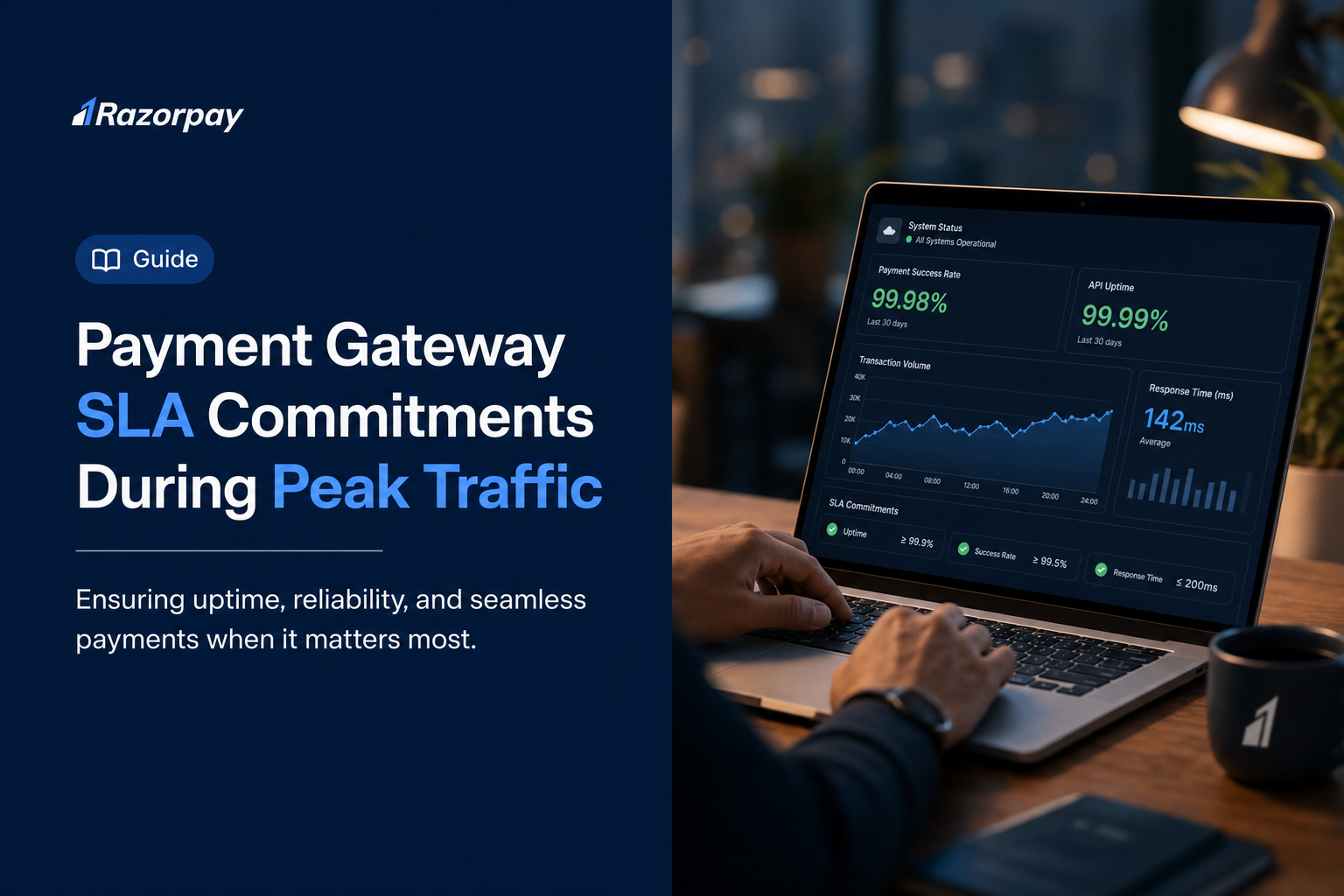
- Moving from 99.9% to 99.99% uptime cuts allowed annual downtime from 8 hours 46 minutes to just 52 minutes, a critical difference during a 48-hour Diwali sale.
- Average latency is misleading. A gateway with 50 ms average latency can still deliver p99 latency of 5 seconds, hitting 1 in 100 customers at checkout.
- Best-practice SLAs for critical payment incidents target 1-2 hours for initial acknowledgement and 4-6 hours for resolution.
- Demand SLAs covering uptime, p95/p99 latency, transaction success rate, throughput capacity, and tiered incident response.
- A single hour of peak-period downtime can cost large e-commerce businesses USD 100,000 to 300,000 in lost sales.
Table of Contents
Why Peak Traffic Is the Ultimate SLA Stress Test
An SLA’s real test is not the quiet Tuesday afternoon. It is the 48-hour window when traffic spikes 10x and every minute of degradation maps directly to lost GMV. With India accounting for 46% of global real-time payment transactions in 2022, the infrastructure load during peak events is unlike anything most global SLAs were designed for. For more context, see how UPI upgrades affect Indian businesses.
India’s Peak Traffic Calendar – When SLAs Get Tested
- Diwali and festive commerce windows
- Big Billion Days style flash sales
- IPL ticket drops and merchandise launches
- Salary credit days (1st to 7th of each month)
- GST filing and tax payment deadlines
The key question: does your SLA cover named peak events, or only monthly averages? Razorpay’s Optimiser routes transactions across multiple payment aggregators, helping businesses reduce single-gateway dependency during high-traffic events.
The Cost When a Gateway Fails During Peak Traffic
A single hour of peak-period downtime can cost large e-commerce businesses USD 100,000 to 300,000 in lost sales. The invisible costs compound the damage:
- Cart abandonment and lost lifetime value
- Customer trust erosion and refund requests
- Reconciliation chaos across failed transactions
- Customer support load spikes
Decoding the SLA Metrics That Actually Matter for Payment Gateways
Most merchants sign SLAs that promise “99.9% uptime” and “24/7 support” without unpacking what those words contractually mean. The SRE community has formalised this language, and payment teams should borrow it directly. Learn more about how to manage failed transactions regardless of headline uptime.
The SLI to SLO to SLA Hierarchy
- SLI (Service Level Indicator): the actual measured signal. For payments, that means UPI success rate, p99 latency on /pay, or TPS sustained at checkout.
- SLO (Service Level Objective): the internal target a provider commits to. Per Google SRE guidance, SLOs should be tighter than the SLA by 20-40%.
- SLA (Service Level Agreement): the contractual floor with remedies attached.
The question to ask vendors: “What are your internal SLOs during Diwali or Big Billion Days?”
Uptime SLAs – What Each “Nine” Really Costs You
| Uptime | Annual Downtime | Monthly Downtime | Peak-Event Risk |
|---|---|---|---|
| 99% | 3 days 15 hours | 7 hours 12 min | Unacceptable |
| 99.9% | 8 hours 46 min | 43 min | Risky for flash sales |
| 99.99% | 52 min | 4 min 19 sec | Baseline for peak |
| 99.999% | 5 min | 26 sec | Premium resilience |
Did You Know?
Moving from 99.9% to 99.99% shrinks annual downtime from around 8 hours 46 minutes to about 52 minutes.
Pro-Tip: Aim for 99.99%+ uptime during peak seasons and negotiate explicit maintenance-window rules.
Latency SLAs – Why Averages Lie and Percentiles Protect You
Average latency hides catastrophe in the tail. A system with 50 ms average can still deliver p99 latency of 5 seconds, meaning 1 in 100 checkout attempts crawls.
- p50: the typical user experience
- p95: the slowest 1 in 20 users
- p99: the slowest 1 in 100 users
Pro-Tip: Demand percentile-based latency SLAs in writing, for example “p99 < 500 ms for /pay and /confirm under agreed peak TPS.” Never accept averages alone.
Transaction Success Rate and Throughput SLAs
Uptime is not the same as success rate. A gateway can be “up” while processing at 70% success because of routing failures or timeouts. Industry benchmarks suggest digital payment rails can sustain 98%+ success rates when routing and retries are configured well.
For throughput, demand documented maximum TPS, the level at which p95/p99 latency and success rate SLAs still hold, and evidence of load testing at 3-5x expected peak TPS.
How Razorpay’s Payment Gateway Is Built for Peak-Traffic Reliability
Infrastructure choices made months before a sale determine whether a gateway holds up when transaction volume surges. Architectural redundancy, intelligent routing, and reconciliation automation matter more than any single uptime figure on a contract page.
- Optimiser: Routes transactions intelligently across multiple payment aggregators. When one network experiences congestion, Optimiser redirects through alternative paths to reduce single-point-of-failure risk during high-volume surges.
- Turbo UPI: Built for UPI payment flows during scenarios where many transactions initiate simultaneously, such as flash sale windows where the UPI rail carries the bulk of checkout traffic.
- Smart Collect: Automates matching of incoming NEFT, RTGS, and IMPS payments to orders using virtual bank accounts, reducing manual reconciliation burden when transaction volumes spike across multiple rails.
Together, these capabilities give merchants architectural protection that complements contractual SLA language during India’s compressed festive commerce windows.
Incident Response SLAs – The Clauses Most Merchants Miss
Uptime and latency clauses describe the steady state. Incident response clauses describe what happens when things break, and they are where most merchant SLAs fall apart. Best-practice contracts define severity tiers, response time, and resolution time separately, with critical incidents typically targeting 1-2 hours response and 4-6 hours resolution. Reliable payment webhooks are also essential for keeping merchant systems aligned during incidents.
Did You Know?
A 99.9% SLA still permits roughly 43 minutes 12 seconds of downtime every 30-day month, enough to wipe out an entire flash-sale window.
Severity Tiers – How Incidents Should Be Classified
| Severity | Definition | Target Response | Target Resolution |
|---|---|---|---|
| P1 | Complete payment outage | 1-2 hours | 4-6 hours |
| P2 | Major method failure | 1-4 hours | Same day or workaround |
| P3 | Partial degradation | Business hours | 1-3 business days |
| P4 | Low-impact query | Next business day | Agreed timeline |
What “24/7 Support” Actually Means
- Does 24/7 cover all severity levels or only P1?
- Is phone and chat available for P1, or is it email-only?
- Is there dedicated staffing on Indian public holidays?
- Are status pages and proactive notifications part of the contract?
For businesses managing cash flow during high-volume periods, Razorpay’s Instant Settlements feature gives access to funds outside the standard settlement window.
The SLA Red Flags Every Merchant Should Spot Before Signing
Before signing any contract, scan for these red flags. Each one shifts risk back to the merchant. If you are still evaluating providers, this guide on accepting online payments in India is a useful starting point.
Vague Uptime Definitions
- Planned maintenance windows excluded from uptime calculation
- “Force majeure” defined broadly enough to cover third-party bank or UPI outages
Average Latency Instead of Percentile-Based
- “Average response time under 300 ms” is not meaningful when tail latency can spike to several seconds
No Transaction Success Rate Commitment
- A gateway can be technically up while processing at 75% success. Demand a minimum success rate measured over rolling windows during peak
Service Credits That Don’t Reflect Real Business Loss
- A 10% credit on a small monthly fee is meaningless if a 2-hour outage cost lakhs in lost GMV
Building Your Peak-Traffic SLA Checklist – A Practical Framework for Indian Merchants
Use this five-dimension framework to evaluate any payment gateway SLA against Indian peak-traffic reality. For UPI-heavy merchants, pair it with this UPI excellence assessment.
| Dimension | Minimum | Recommended | Must Ask |
|---|---|---|---|
| Uptime | 99.9% | 99.99%+ during peak | Maintenance window rules? |
| Latency | p95 < 1s | p99 < 500 ms | Under what TPS does this hold? |
| Success Rate | 95% | 98%+ digital rails | Measured by method? |
| Throughput | Documented TPS | 3-5x peak load tested | Evidence in writing? |
| Incident Response | 24/7 P1 | Tiered P1-P4 with phone | Holiday coverage? |
Ten questions to ask before signing:
- Does this SLA explicitly cover named peak events?
- What is your p99 latency under our agreed peak TPS?
- How do you separate gateway failures from issuer or PSP failures?
- What is excluded from availability calculations?
- Can we independently monitor and dispute SLA reports?
- What service credits apply to success-rate failures, not just downtime?
- What is your incident escalation matrix during Indian public holidays?
- Have you load-tested at 3-5x our expected peak?
- Is smart routing a contractual feature?
- What is your post-incident root-cause-analysis commitment?
Pro-Tip: Use digital rails plus smart routing to push success rates above 98% during traffic spikes. Ask whether smart routing is a contractual feature, not just a marketing one.
Razorpay’s Smart Collect automates reconciliation of incoming bank transfers using virtual accounts, reducing manual triage burden when transaction volumes spike.
How Razorpay Supports Merchants Through Peak-Traffic Demands
Peak-traffic infrastructure is the product, not an accessory. The features below map directly to the SLA dimensions Indian merchants should be negotiating.
| SLA Dimension | Razorpay Feature | What It Does |
|---|---|---|
| Throughput and Routing | Optimiser | Routes transactions across multiple payment aggregators to reduce single-point-of-failure risk |
| UPI at Scale | Turbo UPI | Built for high-velocity UPI flows during simultaneous transaction spikes |
| Reconciliation at Volume | Smart Collect | Automates matching of incoming bank transfers to orders via virtual accounts |
| Checkout Speed | Magic Checkout | Pre-fills returning customer data to reduce checkout time |
| Recurring Payments | Subscriptions / UPI Autopay | Handles recurring mandates with retry logic for failed payments |
| Settlement Flexibility | Instant Settlements | Provides access to funds outside the standard settlement window |
| Compliance | PCI DSS Level 1 / RBI Payment Aggregator | Operates under India’s payment compliance standards |
Ready to evaluate a gateway built for India’s peak traffic demands? Explore Razorpay’s Payment Gateway.
Conclusion
India’s payment infrastructure now carries more real-time volume than any other market, and that volume arrives in compressed, predictable peaks. A peak-traffic SLA is no longer a luxury clause buried in legal review. It is baseline business protection. Evaluate every gateway across five dimensions: uptime with explicit peak-event coverage, percentile-based latency commitments, transaction success rate by method, throughput backed by load-test evidence, and tiered incident response with real escalation paths. Get every commitment in writing.
FAQs
What uptime percentage should I demand from a payment gateway in India?
For peak commerce events, target 99.99% or higher. 99.9% allows roughly 43 minutes of downtime per month, which can cluster entirely inside a flash-sale window. 99.99% caps that exposure to about 4 minutes per month.
What is the difference between p95 and p99 latency in a payment gateway SLA?
p95 latency is the response time experienced by the slowest 1 in 20 users, while p99 covers the slowest 1 in 100. Average latency hides tail behaviour. Demanding p99 ensures even your worst-served customers get a fast checkout.
What should I do if my payment gateway fails during a peak sale event?
Route traffic to a backup gateway, enable fallback methods like UPI intent or COD, display a checkout banner, capture error logs and timestamps, file an SLA claim within the contractual window, and demand a root-cause analysis.
How do I calculate how much downtime my SLA actually allows?
Multiply (100% minus uptime percentage) by total time. A 99.9% SLO on a 30-day month equals 0.1% of 43,200 minutes, or about 43.2 minutes of allowed downtime.
What is the difference between an SLA, SLO, and SLI for payment gateways?
SLI is the measured signal. SLO is the internal target the provider commits to. SLA is the contractual floor with remedies attached. SLOs should be set tighter than SLAs to protect the contractual commitment.
Can I negotiate SLA terms with a payment gateway provider?
Yes. Negotiate peak-event riders, percentile-based latency, separate transaction success rate clauses, load-test evidence, holiday support coverage, and service credits that reflect real revenue loss.