Your customer finds what they want on your website. They add it to their cart. They are ready to buy.
Then comes the card form. Card number. Expiry. CVV. Authentication.
Intent was never the problem. The problem is that the card they have already saved on an app they trust does not follow them to your checkout. Every new website asks them to start over.
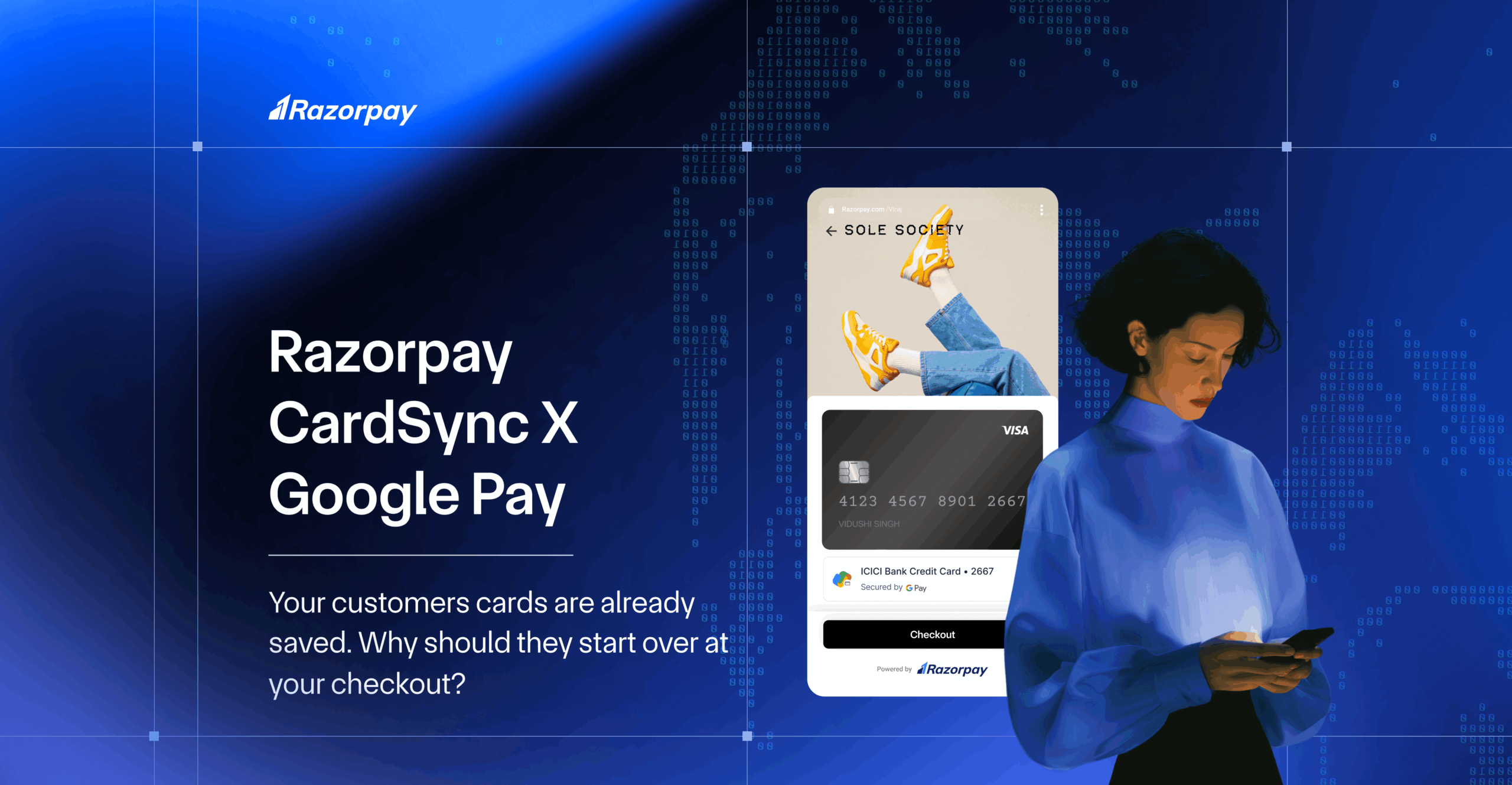
At GFF 2026, Razorpay CardSync takes another step towards fixing that. Through our partnership with Google Pay, eligible cards saved on Google Pay can now be surfaced at participating Razorpay-powered checkouts, with the customer’s explicit consent. The customer picks a card they already use, approves it, and pays. No re-typing.
And soon, Google Pay’s biometric authentication will let customers approve eligible payments with a fingerprint or face instead of an OTP. Saved on Google Pay. Ready at Razorpay Checkout. Authenticated with a touch.
Why checkout still feels like a memory test
Customers save cards inside the apps they use every day. But those cards have traditionally stayed locked to the platform where they were saved. Shop with a new business, and that trusted payment identity vanishes: find the physical card, type the number, enter the CVV, clear an authentication step, all to finish a purchase already decided on.
The friction hits hardest with first-time shoppers, mobile users, high-value purchases and anyone without their card nearby. For your business, each extra step is one more place to hesitate or drop off.
The real gap is not card entry. It is the distance between where a customer’s credentials are securely stored and where they actually shop.
From saved cards to interoperable payment identities
Razorpay launched CardSync with Visa and CRED in 2025 to prove a new model: a tokenised card saved in one trusted consumer ecosystem could, with consent, become available at a participating merchant checkout.
Google Pay is the next big chapter. Customers no longer need to save the same card separately with every business they buy from.
How it works
- An eligible Google Pay-saved card appears at a participating Razorpay-powered checkout.
- The customer explicitly consents to use it.
- The customer authenticates the payment. With biometric authentication rolling out soon, this becomes a touch instead of an OTP.
- The payment completes.
The principles behind it
- Customer choice. A card is surfaced and used only with explicit consent.
- Tokenised security. Underlying card credentials stay tokenised and are never exposed to the merchant.
- Interoperability. A trusted payment identity works beyond the ecosystem where it was first saved.
What this means for your business
CardSync removes friction at one of the most decisive moments in the customer journey. It is especially valuable if you are:
- An ecommerce or D2C brand with high-value purchases
- A travel or ticketing business, where customers pay under time pressure
- An insurance or financial-services business with larger transaction values
- A digital business with a high share of first-time customers
Instead of asking a new customer to build a payment relationship from scratch, you can offer a checkout that already recognises a card they use and trust. Razorpay manages the interoperability layer behind the scenes, so the benefit reaches you through Razorpay Checkout with no extra integration burden.
Building the checkout of tomorrow, together
The future of card payments will not be won by faster forms alone. It will be defined by trusted, tokenised payment identities that move across participating experiences with customer consent, and authenticate in ways that feel natural and immediate.
For customers: less repetition, a more familiar way to pay. For businesses: fewer steps between intent and purchase. For the ecosystem: a shift from cards trapped inside individual platforms to credentials that work securely across them.
Razorpay CardSync with Google Pay is now live for all participating Razorpay-powered checkouts.