As a business owner, you understand the importance of maintaining accurate financial records. One crucial aspect of this is providing your customers with a payment receipt confirmation after each transaction. A well-designed payment confirmation receipt not only serves as proof of purchase but also helps build trust and professionalism in your business dealings. In this article, we’ll explore the key elements of a payment receipt and provide you with templates for creating acknowledgment letters.
Table of Contents
Key Takeaways
- Sending a payment receipt confirmation after every successful transaction acts as proof of purchase and builds trust + professionalism with customers.
- A solid payment receipt should capture the essentials: business + customer details, transaction date, what was sold, item-wise quantity/price, total paid, payment method, and a unique receipt/transaction ID.
- Using a standard receipt template improves consistency, saves time, looks more professional, and makes accounting + dispute handling easier.
- Invoice vs receipt: an invoice requests payment (amount due, terms, due date), while a receipt confirms payment received (amount, date, method). A confirmation note also reassures customers and supports better record-keeping and relationships.
Template of Payment Receipt Confirmation Email
Here’s a sample template for a payment receipt confirmation email:
Subject: Payment Receipt Confirmation – Order #[Order Number]
Dear [Customer Name],
Thank you for your recent purchase from [Company Name]. We are pleased to confirm payment received for your order.
Order Details:
– Order Number: [Order Number]
– Order Date: [Date]
– Payment Method: [Payment Method]
– Total Amount: [Amount]
Please find attached a copy of your Payment Receipt for your records. If you have any questions or concerns regarding this transaction, please don’t hesitate to contact us.
Thank you once again for your business. We appreciate your trust in our products/services.
Best regards,
[Your Name]
[Company Name]
[Contact Information]
What is a Payment Receipt?
A payment receipt is a written or digital proof that a business has received money from a customer for goods or services. It acts as an official record of the transaction for both parties.
A typical payment receipt includes:
• Business name and contact details
• Customer name (and contact details, if needed)
• Date of transaction
• Receipt number or transaction ID
• Description of goods or services provided
• Quantity and price of each item (if itemised)
• Subtotal, taxes/fees (if applicable), and total amount paid
• Payment method (cash, card, UPI, bank transfer, cheque, etc.)
• Payment status (paid in full or partial payment with balance due, if applicable)
A payment receipt helps keep things clear and transparent, reduces payment disputes by acting as proof, and supports bookkeeping, returns, and audits.
Benefits of Using a Payment Receipt Template
Using a standardised payment receipt format offers several advantages:
1. Consistency: Ensures all necessary information is captured for each transaction
2. Efficiency: Saves time by eliminating the need to create receipts from scratch
3. Professionalism: Presents a polished and organised image to customers
4. Record-keeping: Simplifies accounting and financial reporting processes
5. Dispute resolution: Provides clear evidence in case of customer disputes or refund requests
What is the Difference between Payment Receipt vs. Invoice
While payment receipts and invoices both document financial transactions, they serve different purposes.
The key differences between an invoice and a receipt lie in their purpose and details included. An invoice is a formal payment request, typically outlining items sold, the total amount due, payment terms, and the due date. In contrast, a receipt serves as proof that payment has been received, documenting the payment amount, date, and method used. While an invoice includes details such as a due date, invoice number, and the goods or services yet to be paid for, a receipt confirms payment with details like the amount paid and the payment method (e.g., cash, card, or bank transfer).
Example:
Invoice: “Payment of ₹10,000 for graphic design services is due by 31st December 2024.”
Receipt: “Payment of ₹10,000 for graphic design services received on 23rd December 2024 via UPI.”
Why Confirming Receipt is Important?
Sending a confirmation of received payment is essential for several reasons:
1. Acknowledges the customer’s payment and expresses gratitude for their business
2. Provides reassurance that the payment was received and processed correctly
3. Serves as a reference for the customer’s records and financial tracking
4. Demonstrates professionalism and attention to detail in your business operations
5. Helps maintain positive customer relationships and encourages repeat business
Acknowledgment Letter for Payment Received
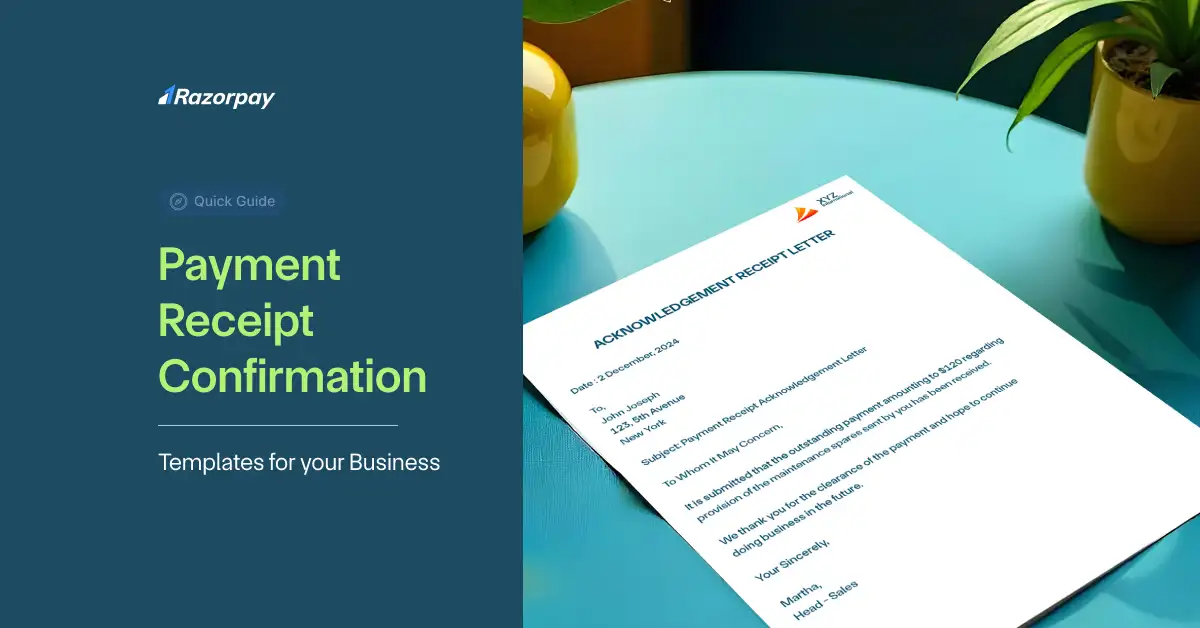
In addition to sending a payment receipt, it’s good practice to acknowledge the receipt of payment with a formal letter or email. This is particularly important for significant purchases, subscription payments, or B2B transactions.
1. Acknowledgement Letters for Receipt of Payment
Here’s a sample format for an acknowledgment letter:
Dear [Customer Name],
We are writing to acknowledge the receipt of payment for your recent purchase from [Company Name]. We have received your payment of [Amount] on [Date] via [Payment Method].
Please find attached a copy of your Payment Receipt for your records. If you have any questions or require further assistance, please feel free to contact us.
Thank you for your business. We value our relationship with you and look forward to serving you again in the future.
Sincerely,
[Your Name]
[Company Name]
[Contact Information]
2. Acknowledgement Letter for Cheque Received
If you receive payment via cheque, your acknowledgment letter should include the following details:
Dear [Customer Name],
We are pleased to confirm payment received in the form of a cheque for your recent purchase from [Company Name].
The details of the cheque are as follows:
– Cheque Number: [Cheque Number]
– Cheque Date: [Date]
– Amount: [Amount]
Please note that the payment will be processed subject to the clearing of the cheque by our bank. Once cleared, we will update our records to reflect the payment.
Thank you for your prompt payment. We appreciate your business and look forward to a continued partnership.
Best regards,
[Your Name]
[Company Name]
[Contact Information]
3. Acknowledgement Letter for Payment Received
When acknowledging receipt of payment, it’s essential to state the full amount received and reference the related invoice or order:
Dear [Customer Name],
We are writing to acknowledge the receipt of payment for Invoice #[Invoice Number] dated [Date]. We have received the full amount of [Amount] on [Date] via [Payment Method].
Please consider this letter as a formal confirmation of the received payment and find attached a copy of your Payment Receipt for your records.
Thank you for your timely payment. We value your business and appreciate your trust in our products/services.
Sincerely,
[Your Name]
[Company Name]
[Contact Information]
Frequently Asked Questions (FAQs):
1. How do I confirm a payment received?
To confirm payment received, issue a payment receipt to the customer detailing the transaction information, including the amount paid, date, payment method, and any relevant order or invoice numbers. You can also send a formal acknowledgment letter or email to express gratitude and provide a record of the payment.
2. How to write a payment receipt confirmation letter?
A payment receipt confirmation letter should include the following elements:
1. A clear statement acknowledging receipt of payment
2. The amount received and the date of payment
3. The payment method used (cash, cheque, credit/debit card, etc.)
4. Reference to the related invoice or order number
5. A thank-you message expressing appreciation for the customer’s business
6. Your contact information for any further inquiries
Keep the letter concise, professional, and error-free.
3. How do I write a proof of payment receipt confirmation?
To provide proof of payment, issue a payment receipt that includes the following information:
1. Your business name, logo, and contact details
2. Customer name and contact information
3. Date of transaction
4. Description of goods or services provided
5. Quantity and price of each item
6. Total amount paid
7. Payment method
8. Unique receipt number or transaction ID
For added confirmation, you can also send a formal acknowledgment letter or email referencing the payment receipt and thanking the customer for their business.