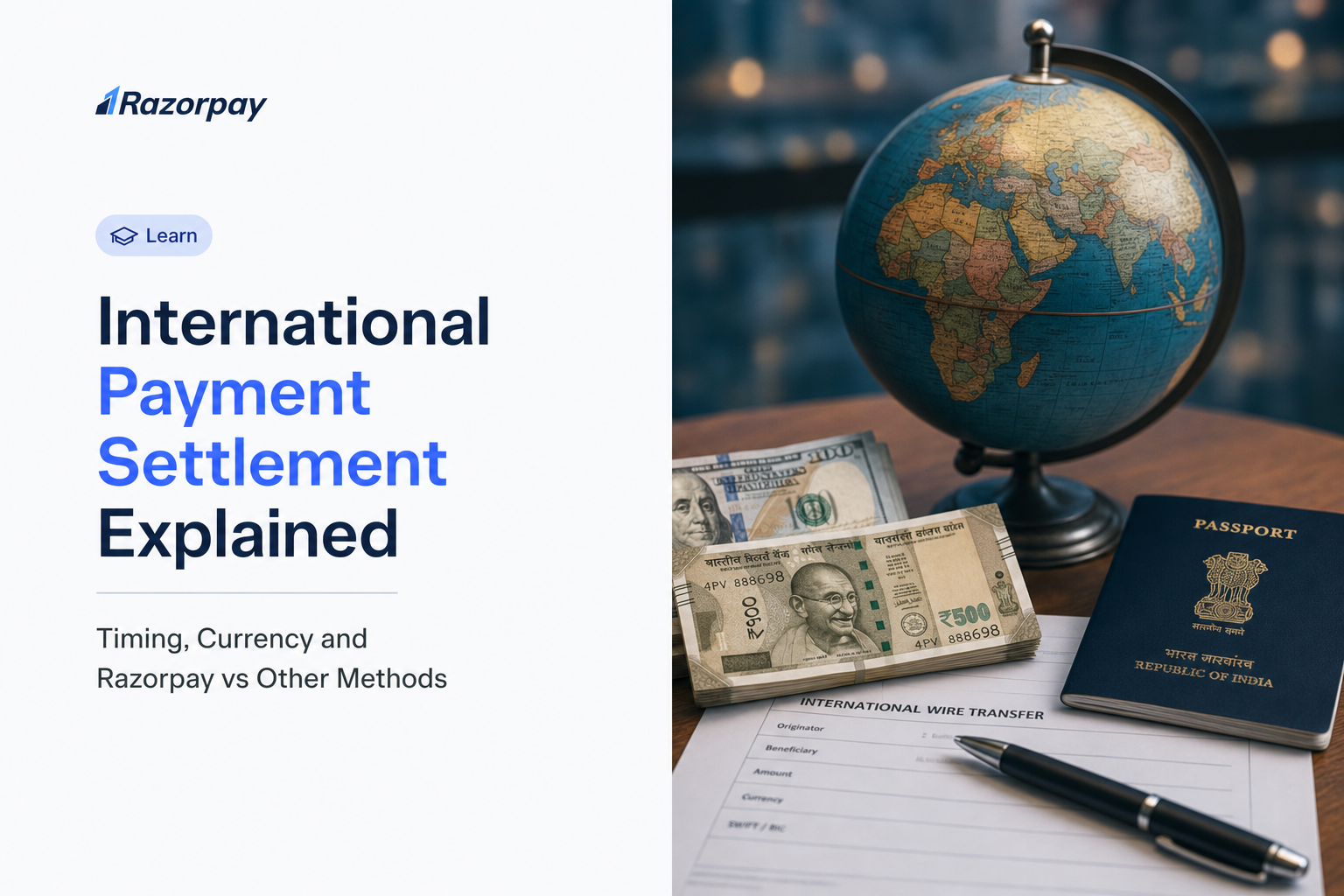
International payment settlement is the transfer of collected overseas customer payments into your business bank account. The expected credit date, currency and supporting documents depend on the collection method, your approved account settings and any outstanding verification. Razorpay’s standard gateway settlement is in INR; eligible EEFC arrangements provide a separate foreign-currency settlement option.
If a customer says they have paid but the money has not reached your bank, start with the payment’s actual status. A card authorisation, a captured payment, a bank transfer received in a collection account and a completed bank settlement are different events. This guide explains how to check each one and compare Razorpay with other collection methods on the same basis.
Key Takeaways
- Razorpay’s international card settlement follows your approved account schedule. T+7 business days is described as typical in the pricing explainer; confirm the Dashboard schedule and use the capture date when interpreting T.
- MoneySaver bank-transfer timing starts after invoice capture or details submission. The documented T+1 runs from that event against the payment, rather than automatically from the customer initiating a transfer.
- Standard INR settlement and eligible EEFC settlement are separate arrangements. Confirm the supported currency, bank account and activation requirements before collecting.
- Measure FX from gross conversion before fees and GST. Use net credited INR separately to reconcile the total amount received.
- Check remittance documents and export deadlines separately. Confirm the exact FIRA, FIRC, eFIRC or FIRS document required. The provider’s settlement timing does not replace your FEMA realisation obligations.
Why Has My International Payment Not Reached My Bank?
A payment can be awaiting capture, scheduled for a later settlement, waiting for invoice or buyer details, or already settled by the provider but still requiring a bank-credit check. Identify the stage before assuming the payment has failed or the settlement is overdue.
Check the payment and settlement separately
| What you see | What it means | What to check next |
|---|---|---|
| Card payment authorised | The issuer approved the authorisation; settlement still requires capture. | Capture status and the applicable capture settings. |
| Payment captured | The payment is eligible for settlement under the account’s conditions. | Scheduled settlement date, balance and any hold. |
| Bank transfer received, details outstanding | The collection needs the required invoice or buyer documentation. | Invoice, purpose code, buyer details and applicable goods-export evidence. |
| Settlement processed | The provider has processed the settlement. | Settlement reference, beneficiary account and the bank statement. |
| Settlement failed or on hold | A bank, account or verification issue needs attention. | The stated reason and the specific action requested in the Dashboard. |
Razorpay’s settlement documentation explains capture prerequisites, account activation and settlement states. An authorised payment alone does not establish that a bank credit is due immediately.
Did You Know? Capture and settlement are separate steps. An approval message confirms the issuer’s decision; it does not confirm that the merchant’s bank account has received the money.
How Long Does International Payment Settlement Take?
There is no single timeline that applies to every international payment. Compare the collection method and the event that starts its settlement clock, then check the approved schedule for the specific account.
| Collection method | Timing to verify | Important condition |
|---|---|---|
| Razorpay international card payment | Schedule shown in the Dashboard; the pricing explainer describes T+7 business days as typical. | Payment must be captured. Schedule is subject to bank approval and account conditions. |
| Razorpay MoneySaver bank transfer | Documented T+1 from invoice capture or invoice-details submission against the payment. | Valid invoice, buyer details and applicable goods-export documents are required. |
| FlashLinks ACH debit | The bank-transfer product page advertises settlement in five days. | Separate collection flow; confirm its timing and conditions in your quote. |
| Direct bank wire | The AD bank’s quoted receipt and credit timeline. | Correspondent banks, cut-offs, currency conversion and checks can affect the journey. |
| Early settlement option | The revised schedule approved for the merchant and method. | Do not assume an option available for domestic payments also applies to an international flow. |
The one-day and five-day product descriptions should not be combined into a single bank-transfer promise. Ask whether the stated period covers receipt into a collection account, verification, initiation of settlement or final credit to your Indian account.
What do weekends and bank holidays change?
For a schedule expressed in working days, bank holidays are excluded. Check the relevant banking calendar, capture or invoice-submission date, and cut-off. Avoid a blanket assumption that every payment made on Friday starts counting on Monday; the trigger and cut-off depend on the method.
Pro Tip: Record the payment date, capture date, invoice-details submission date and scheduled settlement date in separate columns. That makes it much easier to identify whether a delay occurred before or after the settlement clock started.
What Currency Will You Be Settled In?
Razorpay’s standard payment-gateway settlement converts supported foreign-currency payments into INR for credit to the registered Indian bank account. Presentment currency is what the customer pays; settlement currency is what the merchant receives. They need not be the same.
For example, a customer may pay a USD-denominated invoice while the business receives an INR bank credit. That does not, by itself, identify the FX spread or the total charge. Reconcile the converted amount and fee deductions separately.
Can an Indian business receive USD or EUR instead?
Eligible EEFC arrangements can support foreign-currency settlement. Razorpay’s EEFC account guide describes international-card settlement in USD, EUR, GBP, AED and SGD, with other currencies continuing to settle in INR. The bank-transfer documentation also describes non-INR settlement to an EEFC account. Confirm the supported flow, currency, account and activation requirements for your business.
An EEFC account is distinct from a virtual foreign-currency receiving account. The documented MoneySaver collection flow does not allow a merchant simply to leave funds in its local receiving account for later foreign-currency payouts. EEFC balances are subject to applicable utilisation and conversion rules; confirm these with the AD bank.
Did You Know? A USD receiving account does not automatically mean unrestricted USD holding. Receiving-account details, settlement currency and the ability to retain foreign currency are three separate product questions.
Where Is the Exchange Rate Applied?
Razorpay’s standard card-conversion documentation describes conversion using the processing bank’s exchange rate at payment time. Its settlement documentation refers to payment creation. Confirm the applicable rule for the product you use; do not assume every collection method uses the eventual settlement-day rate.
To assess the conversion, obtain the foreign amount, gross converted INR, conversion timestamp and any stated FX charge. Compare with a reference rate for the same currency pair and time. A later market rate can differ because the market moved, even if the provider’s pricing did not change.
See Razorpay’s currency-conversion documentation for the distinction between original currency, base amount, fees and settlement.
Razorpay vs Other International Settlement Methods
Compare methods according to the customer experience and the finance workflow they support. A card checkout, an invoiced bank transfer and a direct wire solve different collection needs; one method’s advertised timing does not establish that it is the best choice for every invoice.
| Method | Useful for | Questions before choosing |
|---|---|---|
| International card checkout | Customers who expect to pay during an online purchase. | Approved card acceptance, capture settings, fees, FX, settlement currency and refund/dispute workflow. |
| MoneySaver bank-transfer collection | Suitable invoiced B2B collections from overseas customers. | Local receiving details, invoice requirements, minimum charges, settlement trigger and document availability. |
| Direct AD bank wire | Receipts requiring the bank’s specific trade or remittance arrangement. | Routing, charges, beneficiary details, purpose and the bank’s credit process. |
| Eligible EEFC arrangement | Businesses that need an approved foreign-currency settlement and retention structure. | Currency, supported collection method, bank approval, permitted use and conversion rules. |
Razorpay’s international payments, MoneySaver bank-transfer and payment gateway pages describe the relevant collection products. This guide concerns inbound customer collections. It does not establish availability or pricing for paying an overseas supplier.
Which Remittance Documents Should You Expect?
Ask for the exact document name and reporting period. FIRC is a certificate, eFIRC its electronic form, FIRA an advice and FIRS a statement. Their purpose overlaps, but their issuer, content and suitability for a particular bank, tax or export-benefit process can differ.
Razorpay’s FIRS process describes bank-provided certificates and Razorpay-generated statements available through the Dashboard, based on monthly transactions. The correct purpose code must be updated and checked. For the documented bank-transfer flow, FIRS is sent to the contact email within 24 hours after settlement.
Match the document to your invoice and settlement record. If a process requires a bank-issued certificate rather than a provider statement, resolve that requirement before depending on the statement for a filing.
Which RBI and FEMA Rules Affect the Collection?
Check the provider’s legal entity and the regulatory category of the actual flow. RBI’s 2025 payment-aggregator directions set a maximum value of ₹25 lakh per transaction for inward or outward transactions processed by a PA-CB. This is not a universal ceiling on every cross-border bank payment.
The framework also excludes a card transaction from PA-CB activity where a card network facilitates FX settlement and the aggregator receives local currency. Banks do not require separate authorisation to conduct PA business. Avoid treating every international card collection as the same regulatory flow. Razorpay’s PA-CB licence guide explains the entity and inward/outward scope to check.
How is the export realisation deadline different?
The amended FEMA Export and Import of Goods and Services Regulations, 2026, in force since 1 October 2026, provide nine months from shipment for ordinary goods exports and from invoice date for services. A twelve-month period applies where the export is invoiced and/or settled in INR. Warehouse and project exports have specific provisions, and AD banks may allow extensions in the circumstances described by the rules.
Do not assume a foreign-currency invoice qualifies for the twelve-month provision simply because the provider converts the proceeds and credits INR. Confirm the applicable treatment with your AD bank. A provider’s payment hold does not automatically extend the exporter’s deadline.
What is the services EDF deadline?
The regulations generally require a services Export Declaration Form within 30 days after the end of the invoice month. A single EDF may cover the month’s exports; consolidation is an option rather than an obligation. There is an alternative provision for non-software services and provision for AD-bank extensions. Confirm the applicable filing process with your bank or specified authority.
How Do You Reconcile What Reaches the Bank?
Separate the invoice value, gross conversion, processing charge, GST on taxable charges and any other deductions. The net receipt is the amount to match against the bank credit. It is not the exchange rate before fees.
Illustration only: USD 1,000 converted at an assumed ₹95 per USD gives ₹95,000 gross. If the assumed processing charge is 2% and GST on that charge is 18%, the fee is ₹1,900, GST is ₹342 and net receipts are ₹92,758. This is arithmetic, not a Razorpay tariff or exchange-rate quote.
Pro Tip: Keep one reconciliation row per invoice or traceable settlement allocation. Include the foreign amount, gross INR, fee, tax, adjustments, document reference and bank-credit reference. Investigate differences before treating them as FX costs.
What Should You Do When a Settlement Is Overdue?
- Find the payment identifier and confirm capture or transfer-receipt status.
- Check the approved settlement schedule in the Dashboard.
- Check invoice, buyer-address and purpose-code requirements for the method.
- Review holds, settlement failures, balance adjustments and the stated reason.
- Confirm the beneficiary bank details and relevant bank holidays.
- Match the processed settlement reference against the bank statement.
- If the expected date has passed, raise a request through Razorpay Support with the relevant identifiers and dates.
Use the secure support workflow for payment details. Keep customer information out of public posts, and retain the response for your finance records.
Frequently Asked Questions
How long does Razorpay take to settle international payments?
Use the approved schedule in your Dashboard. The pricing explainer describes T+7 business days as typical for international payments, while operational documentation makes the cycle account-specific. The documented MoneySaver bank-transfer T+1 starts from invoice capture or invoice-details submission against the payment.
Can Razorpay settle international payments in a foreign currency?
Standard gateway settlement is in INR. Eligible EEFC arrangements can support foreign-currency settlement, depending on the payment method, supported currency, bank account and activation. Confirm those conditions before collecting.
Does every international payment generate the same FIRC document?
No single document promise should be assumed across all flows. Confirm whether the document is bank-issued FIRS, a provider statement, FIRA or eFIRC, whether it is per transaction or consolidated, and whether your accountant or AD bank accepts it for the intended process.
Can I request early international settlement?
Ask whether it is available for your specific account and collection method, and obtain the approved schedule and charges. Availability of domestic Instant Settlements does not establish eligibility for an international flow.
Does a provider hold extend my FEMA realisation period?
Do not assume it does. Track the export deadline separately and consult your AD bank about the applicable period or an extension. Resolve outstanding collection documents promptly.