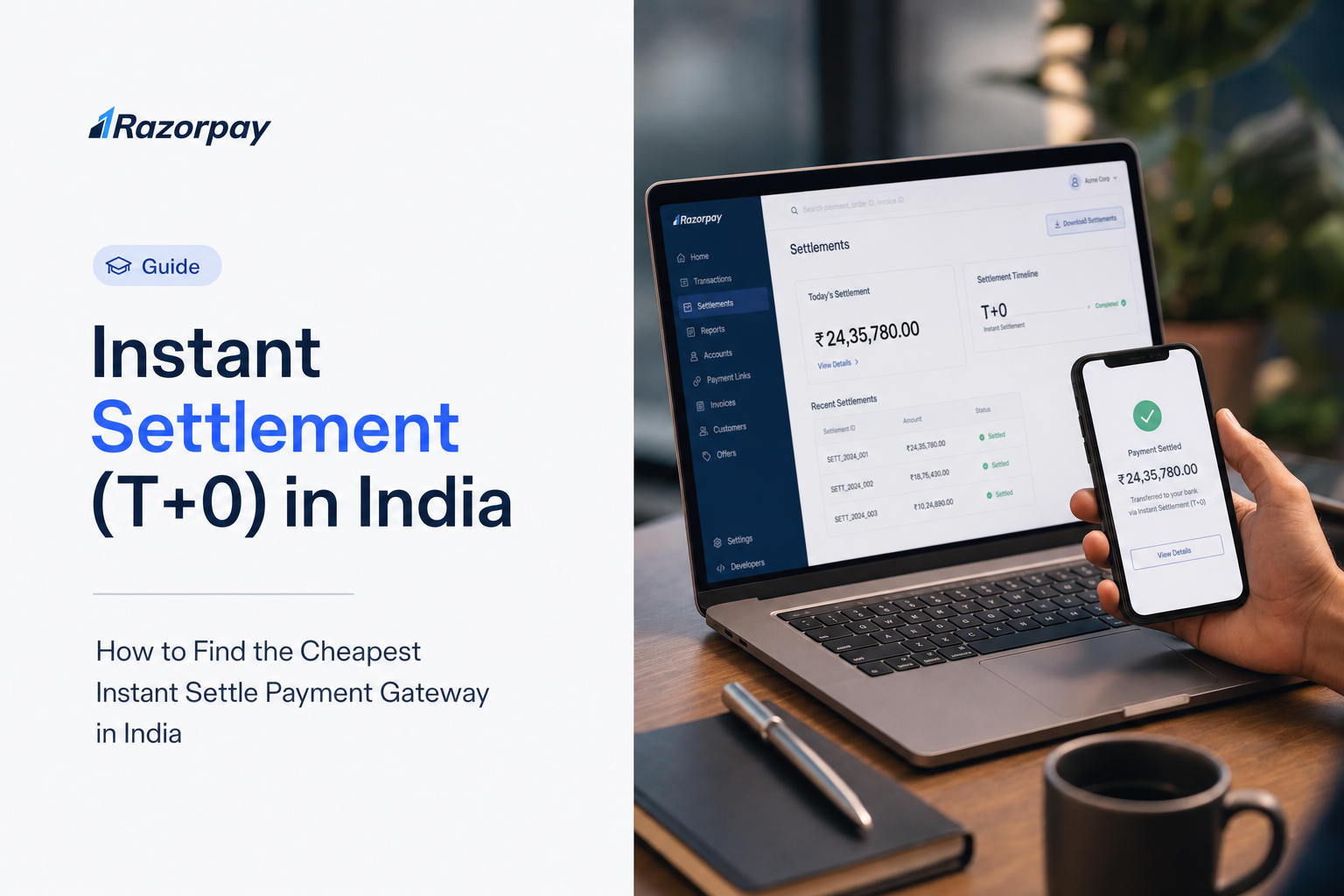
Instant settlement (T+0) lets merchants access transaction funds the same day instead of waiting two working days. The question most merchants get wrong is not whether T+0 is available, but what it actually costs after GST, payout fees, and refund treatment. A 0.25% T+0 fee becomes 0.295% post-GST, which annualizes to 107.675% on a one-day acceleration. The decision frame should be Total Cost of Ownership (TCO), not headline TDR. A payment gateway with a lower transaction rate but Rs. 4,999/year in annual maintenance charges (AMC) often costs more in absolute rupees than one with zero AMC at typical Indian MSME volumes. This guide breaks down which Indian payment gateways offer T+0 and what merchants actually pay per Rs. 1,00,000 settled.
Key Takeaways
- T+0 settlement transfers customer payment funds to the merchant the same day, often within minutes, instead of the standard T+1 or T+2 cycle.
- Instant settlement fees in India typically range from 0.10% to 1.00% per transaction, with 18% GST applied on top. Razorpay’s On-Demand Settlement is priced at 0.30% per settlement.
- A 0.25% T+0 fee becomes Rs. 295 per Rs. 1,00,000 settled after GST, with an annualized cost of 107.675% on one-day acceleration.
- Razorpay offers two IS products: On-Demand Settlement (merchant-triggered, any time) and Scheduled T+0 (automatic batches at 9 AM and 5 PM on working days).
- Access is tiered: Restricted IS → OD Full → T+0 Scheduled, with eligibility expanding as merchant transaction history builds.
- Total Cost of Ownership matters more than headline TDR. A Rs. 4,999 AMC adds Rs. 416 to monthly operating costs.
- At Rs. 2.08L/month GMV, zero AMC outweighs a 0.25 percentage point lower TDR in absolute rupees.
- Eligibility typically requires around 50 days of clean transaction history, low dispute rates, and complete KYC.
- T+0 fees may not be refunded on partial refunds, and chargeback liability shifts to the merchant immediately after instant settlement.
- Custom pricing is generally available above Rs. 5L/month GMV through direct negotiation.
Quick answer: What is T+0 instant settlement?
T+0 settlement means funds from a captured customer payment are made available to the merchant’s bank account on the same calendar day as the transaction. The standard Indian settlement cycle is T+1 or T+2, where funds are credited one or two working days after the transaction, as defined in the Razorpay instant settlement guide. T+0 compresses this window, sometimes to minutes.
T+0 is not a single product. Payment gateways offer it under several models. On-demand settlement requires the merchant to trigger a settlement request manually. Automatic same-day settlement releases funds in fixed batches throughout the day. Scheduled instant settlement runs at merchant-defined intervals. The commercial structure differs across these models, as does the fee.
The funding mechanism matters for cost. Because banks and card networks do not settle funds to the acquirer in real time, the payment gateway is effectively advancing liquidity to the merchant from its own balance sheet. The T+0 fee is the price of that advance, plus risk coverage for chargebacks or reversals that may occur before the underlying transaction settles through the standard banking rails. This is why T+0 fees behave more like short-term financing than a standard processing charge.
T+0 vs instant settlement vs same-day settlement vs instant payout
These terms get used interchangeably in marketing copy, but they describe different products with different cost structures.
| Term | What it means | Who initiates | Typical speed |
|---|---|---|---|
| T+0 settlement | Customer payment credited same calendar day | Gateway or merchant | Same day |
| Instant settlement (On-Demand) | Settlement in seconds or minutes after merchant request | Merchant | Seconds to minutes |
| Same-day settlement (Scheduled) | Automatic fixed same-day batches at defined times | Gateway | Multiple batches per day |
| On-demand settlement | Merchant triggers when needed via dashboard | Merchant | Variable |
| Instant payout | Merchant sends money out to a vendor or seller | Merchant | Seconds |
| Standard settlement | T+1 or T+2 cycle | Gateway, automatic | 1 to 2 working days |
A payment gateway settles money in. A payout product sends money out. Conflating the two leads to incorrect cost comparisons.
How Razorpay structures instant settlement access
Razorpay offers two distinct IS products, and access to each is gated by a merchant’s transaction maturity. Understanding the tier structure matters because the product a merchant gets at onboarding is not always the product they will use at scale.
On-Demand Settlement (OD)
On-Demand Settlement is merchant-triggered. The merchant navigates to Dashboard → Settlement Page → Settle Now, and funds reach the linked bank account within minutes. There is no automatic schedule. The merchant decides when to pull funds based on operational need.
OD is priced at 0.30% per settlement. GST at 18% applies, making the effective cost 0.354% per settlement or Rs. 354 per Rs. 1,00,000 settled.
OD suits merchants with irregular cash flow needs: high-sales days, supplier payment deadlines, payroll runs, and emergency operational expenses. Because the merchant controls when to trigger settlement, OD is a precision working capital tool rather than a background automation.
Scheduled T+0 (Same-Day Automatic Settlement)
Scheduled T+0 settles accumulated transaction balance to the merchant’s bank account automatically, twice per working day, typically around 9 AM and 5 PM. The merchant does not need to trigger anything. Funds from the previous night and morning batch arrive without manual intervention.
The 9 AM run is used by merchants who need inventory or vendor payment capital before opening. The 5 PM run clears the day’s transactions for end-of-day payouts, payroll, and supplier clearing. On bank holidays and public holidays, T+0 scheduled settlement does not run. Merchants dependent on both runs should maintain a buffer to bridge holiday gaps.
The access tier structure: Restricted → OD Full → T+0
Instant settlement access progresses through three tiers as merchants build transaction history and demonstrate low dispute rates.
| Tier | Settlement limit | Eligibility basis | What unlocks next tier |
|---|---|---|---|
| Restricted IS | Rs. 50,000 per settlement | KYC complete, initial transaction history | Consistent usage, clean dispute record |
| OD Full | Higher cap, merchant-specific | Clean transaction history, dispute rate below threshold | Volume growth, usage frequency |
| T+0 Scheduled | Merchant-specific, negotiated | Sustained clean history, risk review | Custom pricing available above Rs. 5L/month GMV |
Merchants entering at the Restricted IS tier have a Rs. 50,000 per-settlement cap. This cap is sufficient for SMEs but will bind for merchants with Rs. 5L+ daily transaction volume. Regular OD usage builds the behavioral history that accelerates progression to OD Full and T+0 Scheduled tiers.
Did You Know?
Razorpay charges zero annual maintenance fee and zero setup fee for its payment gateway. A gateway charging Rs. 4,999/year in AMC adds Rs. 416 to monthly operating costs, which at Rs. 2L GMV erases any TDR advantage from a 0.25 percentage point lower transaction rate.
Which payment gateways offer instant settlement in India?
Most major Indian payment gateways now offer some form of T+0 or instant settlement. The differences lie in fee structure, eligibility, caps, and disclosure practices. Some publish their T+0 fees on public pricing pages. Others quote pricing only after underwriting. A merchant evaluating instant settlement (T+0) in India should treat published rates as ceiling rates, since negotiated pricing for high-volume merchants is often materially lower.
India T+0 payment gateway comparison table
The table below summarizes the typical T+0 offering structure across Indian payment gateway categories. Merchants should request written quotes before signing.
| Gateway type | T+0 offered | Speed | 24/7 availability | Public fee disclosure | Typical eligibility |
|---|---|---|---|---|---|
| Full-stack aggregator | Yes, on-demand and automatic | Seconds to minutes (OD); twice-daily batch (Scheduled) | OD: Yes. Scheduled: Working days only | Published or quote-based | 50 days clean history; tier-based access |
| Bank-led gateway | Yes, same-day batch | Hours | Working days only | Quote-based | Existing current account |
| Enterprise-focused | Yes, negotiated | Variable | Variable | Not publicly disclosed | High volume, formal underwriting |
| Subscription-bundled | Yes, bundled with plan | Same day | Yes | Published as plan tier | Active subscription |
| UPI-only gateway | Yes, for UPI rails | Minutes | Yes | Quote-based | UPI onboarding complete |
Some gateways charge a flat fee per settlement request, such as Rs. 5 to Rs. 10 per payout, in addition to the percentage T+0 fee.
What “not publicly disclosed” means for merchants
A significant share of Indian payment gateways do not publish T+0 pricing. The fee is quoted after onboarding, underwriting, or a sales conversation. This puts merchants at an informational disadvantage.
When pricing is not publicly disclosed, request the following in writing before activating T+0: the percentage fee, any fixed fee, GST treatment, refund and chargeback fee policy, caps, and the conditions under which the fee can change. A verbal quote is not enforceable.
Public pricing vs negotiated pricing
Public T+0 fees function as ceiling rates. Merchants processing above Rs. 5 lakh per month in GMV can typically negotiate lower rates by submitting volume projections, chargeback history, and category risk profile. Razorpay offers custom pricing above Rs. 5L/month GMV through direct negotiation, and similar tiering exists across most established payment aggregators.
Volume-based discounting is real but not automatic. Merchants must explicitly request a custom quote citing their projected monthly volume, payment mode mix, and refund rate. Without this request, the merchant defaults to the published ceiling rate.
What does instant settlement actually cost?
The headline T+0 fee is one of several costs. Merchants who evaluate only the percentage fee consistently underestimate the actual debit per Rs. 1,00,000 settled. The Total Cost of Ownership for instant settlement includes the T+0 fee, GST, standard MDR or TDR, fixed payout fees, failed transaction charges, refund handling fees, chargeback recovery, and any allocated AMC or setup fee. Reviewing the full breakdown of payment gateway charges clarifies which line items apply.
Fee components merchants should calculate
A complete T+0 cost model includes the following per Rs. 1,00,000 settled:
- Standard MDR or TDR on the underlying payment instrument
- Instant settlement fee, as a percentage of the settled amount
- 18% GST on all taxable gateway fees
- Fixed per-settlement or per-payout fee, where applicable
- Setup fee, amortized across expected transaction volume
- Annual maintenance charge, amortized monthly
- Failed transaction charges
- Refund processing fee
- Chargeback fee, typically Rs. 500 to Rs. 2,000 per dispute
The sum, divided by the gross amount settled, is the merchant’s effective cost rate. This is the only number that supports a valid comparison between two payment gateways.
GST-inclusive cost per Rs. 1,00,000 settled
The 18% GST on payment gateway fees is often quoted separately or buried in the agreement. The actual debit is the fee plus GST.
| Stated T+0 fee | Fee on Rs. 1,00,000 | GST at 18% | Total cost | Effective rate |
|---|---|---|---|---|
| 0.10% | Rs. 100 | Rs. 18 | Rs. 118 | 0.118% |
| 0.25% | Rs. 250 | Rs. 45 | Rs. 295 | 0.295% |
| 0.30% (Razorpay OD) | Rs. 300 | Rs. 54 | Rs. 354 | 0.354% |
| 0.50% | Rs. 500 | Rs. 90 | Rs. 590 | 0.590% |
| 1.00% | Rs. 1,000 | Rs. 180 | Rs. 1,180 | 1.180% |
| 0.25% + Rs. 5 fixed | Rs. 255 | Rs. 45.90 | Rs. 300.90 | 0.3009% |
These are T+0 fees only. Standard MDR continues to apply. A merchant on a 2% card MDR with a 0.30% T+0 add-on (Razorpay OD) pays a combined effective rate of approximately 2.712% after GST.
Why 0.30% is not the same as the true cost
A 0.30% T+0 fee looks small. In the context of short-term financing, it is not. Annualized, the cost of capital is high.
Annualization formula:
Annualized cost = GST-inclusive fee % × 365 / days accelerated
Applied for a one-day acceleration:
| Effective post-GST rate | Days accelerated | Annualized cost |
|---|---|---|
| 0.118% | 1 | 43.07% |
| 0.295% | 1 | 107.68% |
| 0.354% (Razorpay OD) | 1 | 129.21% |
| 0.590% | 1 | 215.35% |
| 1.180% | 1 | 430.70% |
A 0.30% T+0 fee charged for one-day acceleration is equivalent in annualized terms to a 129.21% working capital line. This does not mean T+0 is unjustified. It means the comparison benchmark is the merchant’s next-cheapest source of capital. If the alternative is an overdraft at 14%, T+0 is materially more expensive. If the alternative is a missed inventory restock that costs 20% margin, T+0 is materially cheaper.
T+0 settlement calculator: How to compare payment gateways
A valid comparison between two gateways requires three calculations: net credit per Rs. 1,00,000, effective T+0 rate, and annualized financing cost.
Net credit = Gross amount - MDR - T+0 fee - GST on fees - adjustments

Effective T+0 rate = Total T+0 cost / Gross settled amount

Annualized cost = GST-inclusive fee % × 365 / days accelerated
Worked example for Rs. 1,00,000 of UPI settled via Razorpay OD:
- Standard UPI MDR: 0%
- OD fee: 0.30% = Rs. 300
- GST on OD fee: Rs. 54
- Total deduction: Rs. 354
- Net credit: Rs. 99,646
- Annualized cost on one-day acceleration: 129.21%
The same calculation for a card transaction at 2% MDR with a 0.30% OD fee:
- MDR on Rs. 1,00,000: Rs. 2,000
- GST on MDR: Rs. 360
- OD fee: Rs. 300
- GST on OD fee: Rs. 54
- Total deduction: Rs. 2,714
- Net credit: Rs. 97,286
The difference between the two is not the T+0 fee. It is the underlying MDR. T+0 amplifies the importance of the MDR comparison because the fee stacks on top.
Does T+0 cost differ for UPI, cards, netbanking, wallets, EMI, and BNPL?
Yes. Payment gateways often charge differentiated T+0 rates by payment instrument, reflecting differences in interchange economics, chargeback risk, and settlement timing on the underlying rail.
UPI typically carries the lowest T+0 fee structure because the underlying MDR is zero for transactions below the threshold and chargeback risk is minimal. Some gateways offer T+0 on UPI at 0.10% to 0.20%. Cards, both credit and debit, attract higher T+0 fees, typically 0.25% to 0.50%, because the chargeback liability window for cards extends to 120 days or more under network rules.
Netbanking T+0 pricing tends to sit between UPI and cards. Wallet T+0 pricing varies by operator. Some wallets settle to merchants within hours on a standard cycle, making T+0 effectively a no-op with a fee attached.
EMI and BNPL transactions almost always carry the highest T+0 fees, often 0.50% to 1.00%, because the merchant is receiving an advance on a transaction the underlying lender has yet to disburse fully.
When requesting T+0 pricing, ask for a payment-mode-wise breakdown. A blended quote of “0.25% for instant settlement” can obscure the fact that cards and EMI are quoted higher with UPI subsidizing the headline.
Did You Know?
A 0.30% OD fee paid daily across a full month on Rs. 10 lakh in monthly GMV adds up to Rs. 3,540 after GST, roughly 0.354% of GMV as a pure settlement acceleration cost, before factoring in standard MDR.
Eligibility, caps, and risk holds
T+0 is not available to every merchant on day one. Payment gateways apply eligibility filters before activating instant settlement, primarily to manage credit risk on the advance.
Typical eligibility requirements include:
- Minimum transaction history, often around 50 days of clean activity, as noted in the Razorpay instant settlement guide
- Completed KYC and business verification
- Validated settlement bank account
- Dispute and chargeback rate below a published or undisclosed threshold
- Refund rate within acceptable bounds
- Merchant category not on the restricted or high-risk list
- Minimum monthly transaction volume in some cases
Caps apply at multiple levels: a daily settlement cap, a per-settlement cap, and a per-transaction cap. For Restricted IS merchants on Razorpay, the initial per-settlement cap is Rs. 50,000. This cap expands as merchants migrate to OD Full and T+0 tiers.
Risk holds and settlement disablement
Risk holds can be triggered by sudden volume spikes, refund surges, dispute clusters, or category reclassification. When triggered, the gateway may suspend T+0 eligibility for a cooldown period, often three to ten working days, and revert the merchant to T+1 or T+2 settlement. Merchants planning cash flow around T+0 must build a contingency.
Disablement is a real operational risk. Merchant data shows that a portion of IS users are disabled due to risk triggers each month, often concentrated in ecommerce and financial services categories with higher transaction volatility. Merchants who have built operational workflows around T+0, daily inventory purchases, pre-scheduled vendor payments, face acute cash flow disruption when settlement access is suspended without notice. Maintaining a minimum operational reserve in a separate account is a practical hedge.
T+0 availability on weekends and public holidays is a meaningful differentiator. Razorpay’s On-Demand Settlement is available 24/7, including weekends and public holidays. Scheduled T+0 runs on working days only (9 AM and 5 PM batches). Verify availability in writing.
The payment aggregator framework under RBI regulation requires existing payment aggregators to reach Rs. 25 crore net worth by March 31, 2023, as documented in RBI payment aggregator regulation. Working with an RBI-authorized payment aggregator is a baseline trust filter.
Refunds, chargebacks, failed payments, and partial refunds
This is the section that exposes the largest gaps between payment gateways. Headline T+0 fees are often comparable. Refund and chargeback treatment is not. Reviewing how refunds and MDR interact under the merchant agreement is essential before activating T+0.
Do you get the instant settlement fee back on refunds?
The T+0 fee treatment on full refunds varies. Some gateways reverse the T+0 fee when a full refund is processed within a defined window, often 24 to 72 hours. Others retain the T+0 fee regardless of refund status, on the basis that the liquidity was already advanced. The merchant agreement is the only authoritative source.
In refund scenarios, the standard MDR is also typically not reversed. T+0 fee retention on refunds is an additional layer of cost leakage that compounds when refund rates are high.
What happens after a partial refund?
Partial refunds are the most poorly documented area of T+0 economics. If a merchant settles Rs. 1,000 instantly with a Rs. 3.54 T+0 fee after GST (at 0.30% OD rate) and later refunds Rs. 300, the typical treatment is that the base transaction is reduced but the T+0 fee remains fully charged. The merchant pays Rs. 3.54 in T+0 fee on a transaction that nets to Rs. 700.
A small number of gateways pro-rate the T+0 fee on partial refunds. This is rare and must be confirmed in writing. For merchants in categories with high partial refund frequency such as travel, marketplace, and food delivery, the cumulative impact can be meaningful.
Are instant settlement fees charged on failed transactions?
Most gateways do not charge T+0 fees on failed transactions, since no settlement occurs. However, some apply a failed transaction processing fee separately, typically Rs. 1 to Rs. 5 per failed attempt. At high payment volumes, failed transaction fees can accumulate.
What happens if a chargeback arrives after instant settlement?
Chargeback liability remains with the merchant. When a chargeback is raised on a transaction already settled via T+0, the gateway typically debits the disputed amount from the merchant’s available balance, future settlements, or directly from the linked bank account. A standard chargeback fee, often Rs. 500 to Rs. 2,000, is also charged.
If the merchant balance is insufficient, the gateway may invoke a rolling reserve or hold future settlements until the chargeback is resolved. Merchants in chargeback-prone categories should model the worst-case cash flow impact before activating T+0.
Can instant settlement create a negative balance?
Yes. If chargebacks, refunds, or failed transaction reversals exceed current settlement inflow, the merchant balance can go negative. The gateway recovers the negative balance from incoming settlements or by direct debit. T+0 amplifies this risk because funds are released before the underlying settlement cycle confirms.
Did You Know?
On a Rs. 1,000 transaction settled via Razorpay OD with a Rs. 3.54 post-GST fee that is later partially refunded by Rs. 300, the merchant still pays the full Rs. 3.54 on net revenue of Rs. 700. The effective T+0 rate rises from 0.354% to 0.506%.
T+0 settlement and payment success rate: Why the cheapest fee may not be cheapest overall
The lowest T+0 fee does not produce the lowest absolute cost. Payment success rate has a larger impact on net realized revenue than a 0.05 to 0.10 percentage point difference in T+0 fees at most merchant volumes.
Worked comparison on Rs. 10,00,000 in checkout attempts:
| Metric | Payment Gateway A | Payment Gateway B |
|---|---|---|
| Checkout attempts | Rs. 10,00,000 | Rs. 10,00,000 |
| Payment success rate | 82% | 80% |
| Captured revenue | Rs. 8,20,000 | Rs. 8,00,000 |
| T+0 fee at 0.25% | Rs. 2,050 | Rs. 2,000 |
| GST at 18% | Rs. 369 | Rs. 360 (18% of Rs. 2,000 at 0.25%) |
| Total T+0 cost | Rs. 2,419 | Rs. 1,888 |
| Net cash to merchant | Rs. 8,17,581 | Rs. 7,98,112 |
The gateway with the higher T+0 fee delivers Rs. 19,469 more in net cash because of the higher success rate. The T+0 fee differential is dwarfed by the revenue gap. Optimizing for T+0 fee in isolation can produce worse outcomes.
A reduction in checkout drop-off from improvements like tokenization and saved card flows can produce success rate improvements that outweigh fee differences entirely.
How to choose the right instant settlement payment gateway
The choice should follow a TCO framework, not a TDR comparison. The following sequence captures the decision logic.
First, list every cost line item: standard MDR by payment mode, T+0 fee by payment mode, GST, fixed payout fees, setup fee, AMC, failed transaction fees, refund handling, chargeback fees, and reserve requirements.
Second, normalize to a per-Rs. 1,00,000 basis. Use actual payment mode mix and projected refund and chargeback rates. The output is the effective net cost per Rs. 1,00,000 settled.
Third, factor in payment success rate. A 1 percentage point success rate difference at Rs. 10 lakh monthly GMV is Rs. 10,000. A 0.05 percentage point T+0 fee difference at the same volume is Rs. 500.
Fourth, evaluate AMC and setup fees in absolute rupee terms. A gateway charging Rs. 4,999/year in AMC adds Rs. 416/month. At Rs. 2.08 lakh monthly GMV, this is equivalent to 0.20% of GMV, enough to offset most TDR differentials. Comparing options across the low cost payment gateway in India decision guide can clarify where AMC structures break even.
Fifth, verify policy clauses in writing: refund treatment, partial refund treatment, chargeback recovery, risk hold triggers, rate change notice period, and weekend availability.
Sixth, request custom pricing if monthly GMV exceeds Rs. 5 lakh. Published rates are ceiling rates. Negotiated rates can be materially lower with documented volume projections.
Did You Know?
At Rs. 2.08 lakh monthly GMV, a gateway charging Rs. 4,999/year in AMC adds the equivalent of 0.20% to effective cost. A competing gateway with zero AMC and a TDR that is 0.20 percentage points higher arrives at the same total cost.
Questions to ask before enabling instant settlement
A merchant agreement that activates T+0 should answer every question on this checklist in writing.
- What is the exact T+0 fee by payment mode for UPI, credit cards, debit cards, netbanking, wallets, EMI, and BNPL?
- Is GST charged on top of the T+0 fee or included?
- Is there a fixed per-settlement fee in addition to the percentage?
- What is the daily cap on instant settlement amount?
- What is the per-settlement cap?
- Does T+0 work 24/7 including weekends and public holidays, or only on working days?
- What eligibility criteria apply, and what triggers suspension or disablement?
- Is the T+0 fee refunded on full refunds within a defined window?
- How is the T+0 fee treated on partial refunds?
- How are chargebacks recovered when funds have already been settled via T+0?
- Is there a rolling reserve requirement?
- What is the notice period for fee changes?
- What setup fee and AMC apply to the underlying payment gateway account?
- Can custom pricing be negotiated based on projected volume?
- Is the gateway an RBI-authorized payment aggregator?
- For tiered products: how does the merchant migrate from Restricted to Full to T+0 scheduled access?
Final recommendation: When T+0 is worth paying for
The T+0 decision is a financing decision, not a payment processing decision. The headline 0.30% OD fee is small. The annualized cost is 129.21%. The question is whether the operational benefit of same-day liquidity exceeds the financing cost.
Merchant survey data from Razorpay’s IS user base shows the four primary use cases that justify the cost:
| Use case | Share of merchants citing this reason | Why T+0 pays off |
|---|---|---|
| Short-term cash flow gaps | 35% | Avoids overdraft or credit line at higher annualized cost |
| Vendor or inventory payments | 33% | Early payment discounts from suppliers often exceed 0.354% effective cost |
| High sales days or spikes | 30% | Faster capital recycling during peak periods extends effective GMV capacity |
| Emergency expenses | 25% | Same-day access avoids last-minute borrowing at higher rates |
The 27% of merchants who cite satisfaction with their current settlement cycle as the reason not to use T+0 are making a rational decision. T+0 at 0.30% post-GST is not universally justified. It is justified when the operational benefit exceeds the financing cost in absolute rupees.
Three scenarios consistently clear that bar:
- Supplier discounts for early payment that exceed the T+0 fee. A 1% supplier discount captured by paying invoices same-day is more valuable than a 0.354% post-GST OD cost.
- Inventory restocking during high-demand periods, where stockout cost in lost margin exceeds the T+0 fee.
- Bridging payroll or statutory payments where the alternative is an overdraft priced higher than the annualized T+0 rate.
Merchants who use T+0 occasionally for specific operational needs, rather than as a default settlement mode across all transactions, keep the cost proportional to the benefit. Applying T+0 selectively to the 20% of GMV where same-day access generates operational value, while leaving the remaining 80% on standard T+1 settlement, is a practical cost-control approach.
Frequently Asked Questions
What is the Razorpay instant settlement fee?
Razorpay’s On-Demand Settlement (OD) is priced at 0.30% per settlement. With 18% GST applied, the effective cost is 0.354% per settlement, or Rs. 354 per Rs. 1,00,000 settled. This is a per-settlement charge, merchants only pay when they trigger a settlement. Standard settlement cycles (T+1) carry no additional fee. Custom pricing is available for merchants processing above Rs. 5 lakh per month in GMV. See Razorpay Instant Settlements for the current rate card.
What is the difference between Razorpay On-Demand Settlement and Scheduled T+0?
On-Demand Settlement is merchant-triggered. The merchant navigates to the Razorpay Dashboard, clicks Settle Now, and funds arrive in the linked bank account within minutes. It is available 24/7 including weekends and public holidays, at 0.30% per settlement. Scheduled T+0 settles the accumulated balance automatically, twice per working day at approximately 9 AM and 5 PM, without requiring the merchant to trigger anything. Scheduled T+0 runs on working days only. Both products serve different operational patterns: OD for reactive cash flow needs, Scheduled for predictable daily operations.
How does Razorpay instant settlement access work for new merchants?
New merchants start on a Restricted IS tier with a Rs. 50,000 per-settlement cap. Consistent usage, clean dispute records, and transaction volume growth unlock progression to OD Full (higher caps) and eventually T+0 Scheduled (automatic twice-daily settlement). The migration is based on behavioral and risk signals, not just time elapsed since onboarding.
What triggers a risk hold or suspension of instant settlement?
Common triggers include sudden spikes in transaction volume, elevated refund or chargeback rates, category reclassification, KYC anomalies, and fraud signals. When a risk hold is triggered, T+0 access is suspended and the merchant reverts to standard T+1 or T+2 settlement, typically for three to ten working days. Merchants who have built operational workflows around T+0, daily inventory purchases, pre-scheduled vendor payments, should maintain a cash buffer to bridge unexpected suspension periods.
Is instant settlement available on weekends and public holidays?
Razorpay’s On-Demand Settlement is available 24/7, including weekends and public holidays. Scheduled T+0 (the automatic twice-daily batches at 9 AM and 5 PM) runs on working days only. On bank holidays, the scheduled batches do not run. For merchants who rely on both runs for same-day operations, OD provides a manual fallback on non-working days.
Does Razorpay charge setup fee or AMC alongside the T+0 fee?
No. Razorpay’s payment gateway carries zero setup fee and zero AMC. The T+0 cost is the OD fee (0.30% + GST) and the underlying MDR on the payment instrument. Some gateways add Rs. 3,600 to Rs. 4,999/year in AMC on top of T+0 fees. At Rs. 2 lakh monthly GMV, that AMC adds 0.21% to effective cost and erases most TDR advantages. Razorpay’s zero-AMC structure removes this compounding cost layer.
What happens to my T+0 fee if a customer is refunded?
The T+0 fee (OD fee) is retained by the gateway when a refund is processed after settlement. The principal amount is returned to the customer, but the OD fee charged at the time of instant settlement is not reversed. For partial refunds, the T+0 fee typically applies to the full original settled amount, not the net post-refund value. Merchants with high refund rates in their subscription or e-commerce business should factor this into their T+0 cost model. See our MDR refund policy guide for the full treatment.