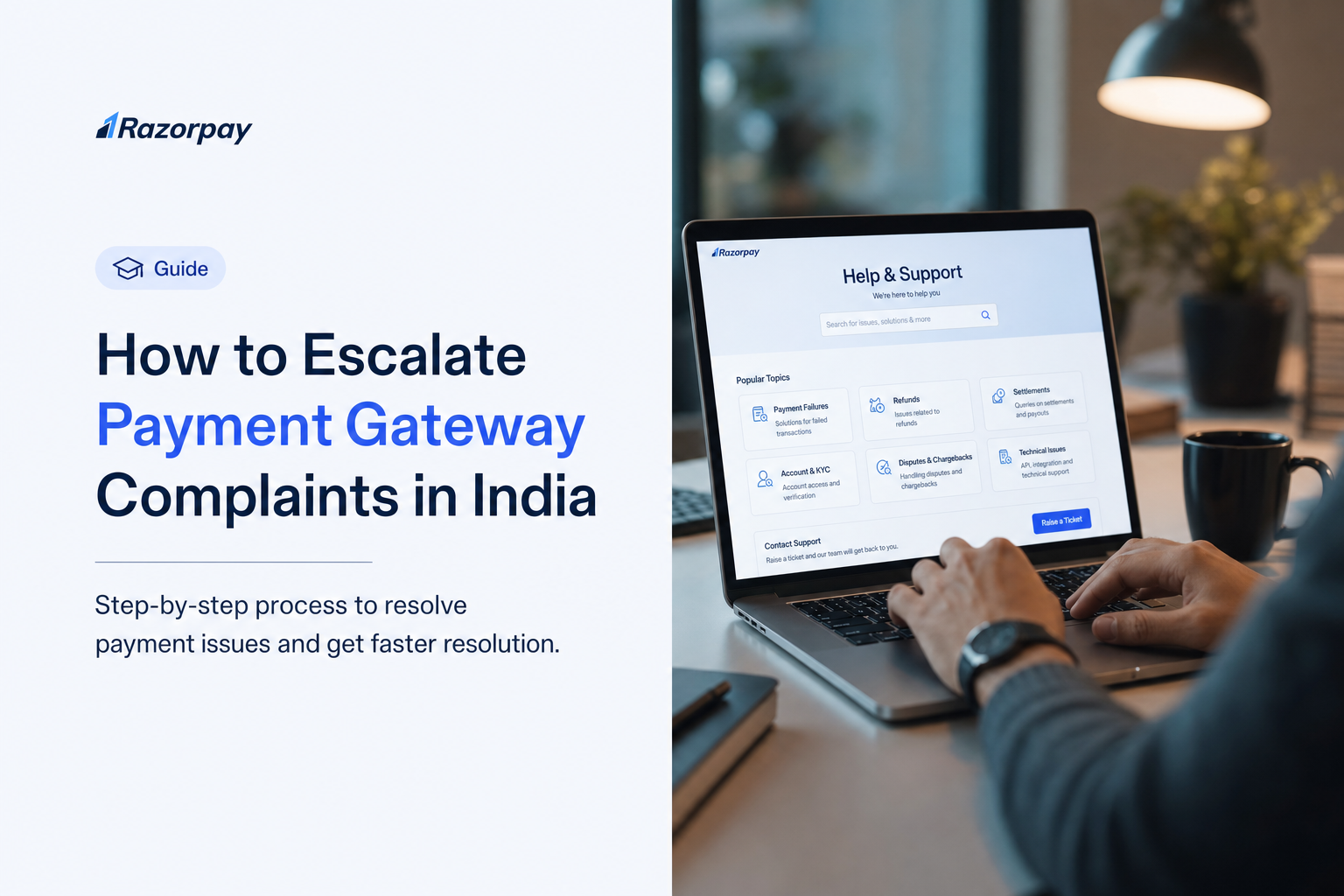
For Indian merchants, an unresolved payment gateway complaint is a working capital risk, not just a service problem. When a customer’s money is debited but not credited, when settlements are withheld, or when a refund disappears into limbo, every hour of delay erodes cash flow and brand trust. The good news: India has a clear, four-tier escalation ladder backed by RBI regulations, and merchants who know how to use it resolve disputes faster and claim compensation they did not know existed. This guide breaks down how to escalate payment gateway complaints, step by step.
Key Takeaways
- Four-tier escalation ladder: Payment gateway, then bank nodal officer/NPCI, then RBI Integrated Ombudsman, then Appellate Authority/Consumer Court.
- 30-day rule: You must complain to the regulated entity and wait 30 days before approaching RBI, per the RBI Integrated Ombudsman FAQ.
- ₹100 per day compensation applies when your provider misses the failed-transaction TAT, under RBI Notification 11693.
- 3-day fraud window: Report unauthorised transactions within 3 working days for zero liability, per RBI Notification 11040.
- Compensation ceiling: The RBI Ombudsman can award up to ₹20 lakh for direct loss plus ₹1 lakh for mental agony.
- Filing is free at the RBI Ombudsman; no lawyer required.
- The RBI Ombudsman received 9,34,355 complaints in 2023-24, a 32.81% rise over the prior year, with digital payment-related complaints accounting for a significant share.
Table of Contents
Why Payment Gateway Complaints Are Rising – and Why You Need a Playbook
India processed 188.4 billion digital payment transactions in FY 2023-24 across UPI, cards, NEFT, IMPS, and wallets. At this scale, even a tiny failure rate translates into thousands of stuck transactions every day. For merchants, that means more disputes, more reconciliation gaps, and more pressure on operations. Knowing how to escalate is now a core finance skill, not a niche legal one. For context on transaction flows, see how Razorpay covers managing failed transactions.
The Most Common Payment Gateway Complaints in India
- Failed transactions – customer debited but merchant not credited.
- Settlement delays – funds sit beyond the promised settlement window.
- Unauthorised charges – fraudulent debits or chargebacks.
- Refund delays – refund initiated but not received by the customer.
- KYC or account freezes – risk-based holds during sales spikes.
Know Your Rights Before You Escalate: RBI Timelines and Compensation Rules
Most merchants escalate without quoting the specific RBI rules that protect them. That is a mistake. Three rights matter most:
- Failed transaction TAT and compensation: Under RBI Notification 11693, reversal must happen within T+1 to T+5 working days. Beyond that, ₹100 per day compensation is payable by the entity responsible.
- Zero liability for unauthorised transactions: Under RBI Notification 11040, if you report an unauthorised electronic transaction within 3 working days, your liability is zero.
- RB-IOS compensation ceiling: The RBI Integrated Ombudsman can award up to ₹20 lakh for actual financial loss, plus up to ₹1 lakh for mental agony.
Pro-Tip: Set a T+5 reminder for every disputed transaction. If not reversed by that date, send a written complaint quoting RBI Notification 11693 and the ₹100/day clause.
Did You Know? RB-IOS covers all Payment System Participants, including non-bank payment gateways. Merchants can escalate directly to RBI.
Step 1 – Identify the Type of Complaint You Have
Not every complaint follows the same route. Mapping the issue to the right first contact saves weeks. Understanding how online card payments work also helps you identify where a transaction broke.
| Complaint Type | First Contact |
|---|---|
| Failed transaction (debit, no credit) | Payment gateway + bank simultaneously |
| Settlement delay (merchant-side) | Payment gateway |
| Unauthorised charge or fraud | Bank immediately (within 3 working days) |
| Refund delay | Payment gateway |
| KYC or account freeze | Gateway compliance team |
How Razorpay’s Merchant Dashboard Helps You Build an Airtight Complaint Case
Documentation is the foundation of every successful escalation. Without clean, time-stamped evidence, even valid complaints get rejected as non-maintainable. The Razorpay Payment Gateway gives merchants the tools to build that evidence trail from Day 1.
- Transaction Audit Trail: The dashboard surfaces every transaction ID, payment method, amount, timestamp, and status flag. This serves as a primary evidence document when filing complaints with the gateway, bank, or RBI.
- Smart Collect Reconciliation: Smart Collect automatically matches incoming bank transfers to order IDs, generating reconciliation records that support the documentation requirements RBI and banks expect during dispute review.
- Instant Refunds Tool: Merchants can initiate and track refunds with a logged reference ID, creating a documented paper trail that proves refund initiation timing – critical when a customer claims a refund was never processed.
Together, these tools turn ad hoc complaint-building into a structured, evidence-led workflow.
Step 2 – Gather Your Evidence: The Complaint Documentation Checklist
Before you write a single email, assemble the following in a chronological timeline document:
- Order ID and gateway transaction ID
- Date, time, and exact amount
- Payment method (UPI, card, netbanking, wallet)
- Dashboard screenshot showing transaction status
- Bank statement entry or UTR/UPI reference
- Customer confirmation email or SMS
- Prior complaint reference numbers
- Full communication log with the gateway and bank
Razorpay’s merchant dashboard provides a downloadable transaction history with order IDs, payment method, and status flags that serve as ready-made documentation for any complaint filing.
Did You Know?
Zero liability for unauthorised transactions applies only if you report within 3 working days, as defined in RBI Notification 11040.
Step 3 – Escalation Tier 1: Raise a Formal Complaint with Your Payment Gateway
This step is non-negotiable. RBI rejects complaints as non-maintainable if you have not first approached the regulated entity. Your written complaint should include:
- A clear subject line with the transaction ID and complaint category
- A factual description of the issue and timeline
- A citation of the relevant RBI circular (Notification 11693 for failed transactions)
- The resolution you expect
- A stated intent to approach the RBI Ombudsman after 30 days if unresolved
If the first response is inadequate, escalate to the Grievance Redressal Officer (GRO) whose contact details every regulated entity must publish. The 30-day RBI clock starts from your first written complaint, per RBI FAQ Q14-Q15.
For settlement-related disputes, Razorpay’s Instant Settlements feature gives merchants access to funds outside the standard settlement window, which can reduce settlement delay complaints.
Step 4 – Escalation Tier 2: Your Bank’s Nodal Officer and NPCI
Escalate to your bank when the issue involves debit-without-credit, an unauthorised debit, or a refund processed but not received. Every bank publishes its nodal officer details on its website.
- Bank nodal officer: File a written complaint citing the same transaction references used with the gateway.
- NPCI dispute route: For UPI failures, raise a dispute via the app and through your acquiring bank. UPI alone processed 131 billion transactions in FY 2023-24, making this a high-frequency escalation path.
- Simultaneous filing: Do not wait for the gateway to point fingers at the bank. File both on Day 1.
Pro-Tip: File with the gateway and bank simultaneously on Day 1, quoting the same internal complaint reference. This prevents the classic “pass-the-buck” delay.
Step 5 – Escalation Tier 3: The RBI Integrated Ombudsman Scheme (RB-IOS)
Once 30 days have passed without satisfactory resolution, or the entity has rejected your complaint, you can file with the RBI Integrated Ombudsman. Any customer of a regulated entity, including business merchants using a licensed payment gateway, can file.
- Visit cms.rbi.org.in – RBI’s free 24×7 complaint portal.
- Complete the form per FAQ Q17, providing complainant details, the regulated entity, complaint category, and a clear description.
- Upload your evidence – dashboard exports, prior complaint references, bank statements, and email logs.
- Track the complaint via the auto-generated complaint number and SMS updates.
The process flows through scrutiny, conciliation, and finally an Award if not settled. Encouragingly, 57.4% of maintainable complaints in 2023-24 were resolved via mutual settlement. The Ombudsman can award up to ₹20 lakh for direct loss and ₹1 lakh for mental agony.
Did You Know?
The RBI Ombudsman process is completely free. No lawyer or paid intermediary is needed.
Step 6 – Escalation Tier 4: The RBI Appellate Authority and Consumer Courts
If you are dissatisfied with the Ombudsman’s decision, you have further options:
- RBI Appellate Authority: Appeal within 30 days via the CMS portal or by writing to aaos@rbi.org.in. Filing remains free.
- Consumer Court: Under the Consumer Protection Act, 2019, digital payment services qualify as a “service.” Jurisdiction by value: District up to ₹50 lakh, State ₹50 lakh to ₹2 crore, National above ₹2 crore.
- Cybercrime portal: For fraud-related disputes, file at cybercrime.gov.in in parallel.
The Parallel Escalation Strategy: How to Accelerate Resolution
Linear escalation wastes weeks. A parallel approach keeps the 30-day RBI clock running while you work other channels.
| Day | Action |
|---|---|
| Day 1 | File written complaint with gateway + bank nodal officer |
| Day 7 | Raise NPCI/UPI dispute if relevant; escalate to GRO |
| Day 30 | File with RBI Integrated Ombudsman via CMS portal |
| Day 60+ | Appeal to Appellate Authority or move Consumer Court |
Pro-Tip: In your Tier 1 email, include a paragraph citing RBI’s TAT circular, the ₹100/day compensation clause, and your 30-day intent to approach RBI. This signals seriousness and often accelerates Tier 1 resolution.
How to Prevent Payment Gateway Complaints Before They Happen
- Reconciliation hygiene: Match every order ID to gateway and bank references daily.
- Transaction monitoring: Use payment webhooks to catch failures in real time.
- KYC readiness: Keep documentation current to avoid sudden compliance freezes.
Merchants using Razorpay’s Smart Collect tool can generate automated reconciliation records that support documentation requirements when filing complaints.
How Razorpay Supports Merchants Through Payment Disputes
Razorpay is an RBI-authorised Payment Aggregator, giving merchants a clear regulatory escalation chain when disputes arise.
| Feature | How it helps in a complaint scenario |
|---|---|
| Merchant Dashboard | Provides exportable transaction history and status records |
| Smart Collect | Generates reconciliation records tying bank credits to orders |
| Instant Refunds | Creates trackable refund reference IDs |
| Grievance Redressal Officer | Formal escalation point inside the regulated entity |
| Merchant Support | Helps initiate and track complaint tickets |
| RBI-authorised PA Licence | Clarifies the regulated entity for RBI escalation |
Conclusion
Escalating payment gateway complaints in India is not about persistence alone; it is about knowing the rules. The four-tier ladder – gateway, bank/NPCI, RBI Ombudsman, Appellate Authority/Consumer Court – gives every merchant a structured path to resolution. Combine that with rights most merchants overlook (₹100/day compensation, ₹20 lakh + ₹1 lakh award ceiling, zero liability for fraud reported in 3 days), and you have a playbook that delivers outcomes. Document everything, escalate in parallel, and quote RBI circulars confidently. Explore the Razorpay Payment Gateway for the documentation trail and regulatory clarity to win disputes.
Frequently Asked Questions
What should I do immediately if a payment gateway deducts money but doesn’t credit the merchant?
Check your dashboard transaction status, raise a written complaint with your gateway the same day, and note the date – this starts your 30-day clock to escalate to RBI. Quote RBI Notification 11693 in your complaint to invoke the failed-transaction TAT.
How long does a payment gateway refund take in India?
RBI’s TAT circular mandates reversal within T+1 to T+5 working days for most digital payment instruments. Beyond this window, ₹100 per day delay compensation applies, payable by the entity responsible.
Can a merchant file a complaint with the RBI Ombudsman?
Yes. The RB-IOS covers all customers of regulated entities, including merchants using licensed payment gateways and Payment System Participants, as clarified in the RBI Ombudsman FAQ.
What is the RBI CMS portal and how do I use it to file a payment complaint?
cms.rbi.org.in is RBI’s free 24×7 online complaint portal. File only after 30 days of unresolved complaint with the regulated entity, or after a rejection. The toll-free helpline is 14448.
What compensation can I claim if my payment gateway doesn’t resolve my complaint?
₹100 per day for TAT violations under RBI’s 2019 circular, plus up to ₹20 lakh for direct financial loss and ₹1 lakh for mental agony under RB-IOS, if the Ombudsman rules in your favour.
What if I’m not satisfied with the RBI Ombudsman’s decision?
Appeal to the RBI Appellate Authority within 30 days via the CMS portal or aaos@rbi.org.in. You can also pursue Consumer Court remedies under the Consumer Protection Act, 2019.