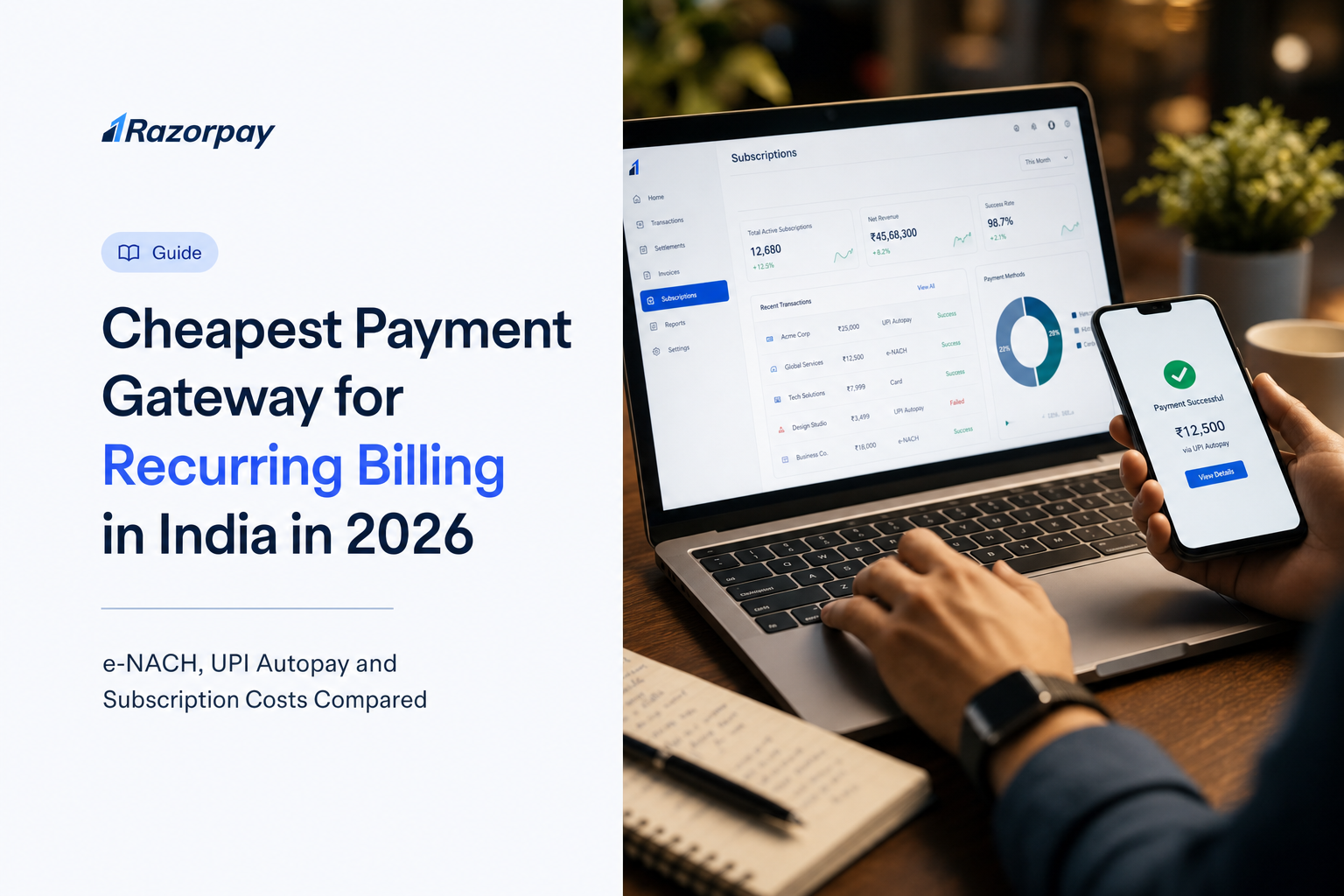
For most Indian subscription businesses in 2026, UPI AutoPay is the lowest-cost recurring billing rail for payments under Rs. 15,000, while e-mandate (e-NACH) is more economical for high-value collections, EMIs, insurance, education fees, and B2B retainers. But here is the point most merchants miss: the cheapest payment gateway for recurring billing in India is not the one quoting the lowest Transaction Discount Rate (TDR). It is the payment gateway with the lowest Total Cost of Ownership (TCO) per successful debit after AMC, setup fees, mandate registration, retries, GST, settlement surcharges, refunds, and failed-payment recovery.
Key Takeaways
- UPI AutoPay is generally cheapest for ticket sizes up to Rs. 15,000, with category-specific limits up to Rs. 1 lakh for SIPs, insurance, and IPOs.
- e-NACH remains the rational choice for high-value mandates up to Rs. 10 lakh and EMIs.
- A payment gateway charging Rs. 4,999/year in annual maintenance charges (AMC) adds Rs. 416 to monthly operating costs.
- The break-even point where zero AMC overtakes a 0.25% lower TDR is approximately Rs. 1.67 lakh monthly GMV (₹4,999/year ÷ 12 months ÷ 0.25% TDR gap = ₹1,66,633).
- Payment success rate variance of 5-7 percentage points has larger rupee impact than a 0.2% TDR difference.
What Is the Cheapest Recurring Payment Option by Use Case in India?
The cheapest recurring payment rail depends on ticket size, billing frequency, and customer payment behaviour, not on the headline payment gateway rate. The table below maps the lowest-TCO option to common Indian subscription scenarios in 2026.
| Use case | Typical ticket size | Lowest-TCO rail | Primary reason |
|---|---|---|---|
| OTT and content subscriptions | Rs. 149 to Rs. 499 | UPI AutoPay | Mobile-first approval, low friction, low per-debit cost |
| SaaS plans (SMB) | Rs. 999 to Rs. 9,999 | UPI AutoPay | Within Rs. 15,000 frictionless limit |
| SaaS plans (mid-market) | Rs. 10,000 to Rs. 15,000 | UPI AutoPay | Still within mandate execution cap |
| Insurance premiums | Rs. 1,000 to Rs. 1,00,000 | UPI AutoPay (eligible categories) or e-NACH | UPI AutoPay allows up to Rs. 1 lakh for insurance |
| Mutual fund SIPs | Rs. 500 to Rs. 1,00,000 | UPI AutoPay (category limit) | Higher per-debit limit for SIPs |
| EMI collections | Rs. 15,000 to Rs. 10,00,000 | e-NACH | Higher mandate cap, bank-level authentication |
| NBFC loan repayments | Rs. 25,000+ | e-NACH | Reliable for high-value scheduled debits |
| B2B retainers | Rs. 1,00,000+ | e-NACH or paper NACH | UPI AutoPay unsuitable for high ticket |
| Cross-border SaaS | USD/INR equivalent | Card recurring with tokenisation | UPI AutoPay and e-NACH are domestic |
Why ticket size determines the cheapest rail
For ticket sizes under Rs. 500, every rupee of mandate setup fee inflates cost-per-debit, so UPI AutoPay’s low-friction mandate creation wins. Between Rs. 500 and Rs. 15,000, UPI AutoPay’s lower per-transaction rate dominates. Above Rs. 15,000, e-NACH becomes the only practical recurring rail for most merchant categories. For international subscriptions, recurring card tokenisation through an international payment gateway remains the only viable rail because UPI AutoPay and e-NACH are India-domestic.
Did You Know? UPI AutoPay mandates crossed 1.27 billion in November 2025, establishing it as the dominant recurring payment rail for sub-Rs. 15,000 ticket sizes in India.
What Does Recurring Billing Actually Cost in India in 2026?
Most merchants compare payment gateways by TDR alone. That approach is incomplete because the recurring billing cost stack contains at least nine separate fee layers, each of which can erode margin independently of the headline rate.
The full recurring billing TCO formula:
TCO = Transaction fees + GST on fees + Mandate setup fees + Subscription product fees + Retry charges + Settlement surcharges + Refund handling costs + Chargeback fees + Revenue lost to failed debits
The nine fee layers explained
- TDR or platform fee: The percentage charged on each successful debit, typically 0.4% to 2% plus GST depending on rail.
- Mandate setup fee: A per-mandate registration charge that some payment gateways pass through, especially for e-NACH.
- Subscription product fee: A separate monthly or per-event fee for using the payment gateway’s subscription engine.
- Retry fees: Some payment gateways charge per retry attempt after the first failure, which compounds quickly on low-ticket subscriptions.
- GST: 18% GST is applied on every fee line item, not just the headline TDR.
- Settlement surcharges: Standard T+1 is usually free, while T+0 instant settlement typically attracts a surcharge of roughly 0.5%.
- Refund handling: Some payment gateways retain TDR on refunds, while others charge a fixed refund processing fee.
- Chargeback fees: Per-dispute charges that hit harder on recurring billing because of mandate-related dispute patterns.
- Annual maintenance charges: Fixed yearly costs that erase TDR advantages at low GMV.
Why AMC quietly inflates cost more than TDR
A payment gateway quoting a 0.25 percentage point lower TDR but levying Rs. 4,999 in annual AMC costs more in absolute rupees until a merchant crosses Rs. 2.08 lakh in monthly GMV. Below that volume, the fixed AMC erases the rate advantage. Razorpay Payment Gateway charges zero AMC and zero setup fee, shifting the comparison to variable cost per successful debit.
How Do UPI AutoPay, e-NACH, and Card Subscriptions Compare on Cost?
The three recurring rails available to Indian merchants in 2026 differ on mandate creation, per-debit cost, ticket size limits, customer friction, and failure-recovery economics. The choice is not binary because most subscription businesses benefit from running two or three rails in parallel and routing dynamically by ticket size.
Rail-level comparison
| Parameter | UPI AutoPay | e-NACH | Card subscriptions |
|---|---|---|---|
| Standard mandate limit | Rs. 15,000 per debit | Rs. 10 lakh per debit | Tokenised card limit |
| Category-specific limit | Up to Rs. 1 lakh for SIPs, insurance, IPOs | Up to Rs. 10 lakh | Card network-defined |
| Mandate setup time | Instant via UPI app | 1 to 5 working days | Instant with tokenisation |
| Customer friction | Low (single tap in UPI app) | Medium (bank authentication) | Low (one-time card entry) |
| Typical per-debit cost | Low | Medium | Medium to high |
| Bounce/dishonour charge to customer | None | Possible | Card decline (no bank fee) |
| Best for ticket size | Up to Rs. 15,000 | Rs. 15,000 to Rs. 10 lakh | Cross-border, premium domestic |
| Cross-border support | No | No | Yes |
When each rail is cheapest
UPI AutoPay wins on per-debit economics for low and mid-ticket domestic subscriptions because the rail runs on NPCI infrastructure with structurally low processing cost. e-NACH wins on high-value debits because amortising the mandate setup over a Rs. 25,000 EMI dilutes the fixed cost dramatically. Card subscriptions are essential for global SaaS billing and premium domestic customers without UPI preference, but they carry higher per-transaction MDR and meaningful chargeback exposure.
Did You Know? e-NACH e-mandates support recurring debits up to Rs. 10 lakh, while UPI AutoPay typically caps frictionless execution at Rs. 15,000 except for specific categories where the limit extends to Rs. 1 lakh.
The hybrid routing argument
Merchants that combine UPI AutoPay and e-NACH through a single payment gateway capture the lowest TCO across their subscription book. A SaaS company with plans from Rs. 999 to Rs. 25,000 should route lower plans through UPI AutoPay and higher-value enterprise plans through e-NACH, using the same dashboard for unified reconciliation. See the UPI AutoPay vs e-NACH comparison for deeper rail mechanics.
How Does Payment Gateway Pricing for Recurring Billing Compare in India?
Public pricing pages across Indian payment gateways are notoriously inconsistent for recurring billing because most rates are negotiated, volume-tiered, or quoted on enquiry. The matrix below abstracts the cost categories that genuinely vary between payment gateways in 2026 and the typical range for each.
Pricing transparency matrix
| Cost component | Typical range across Indian payment gateways | Razorpay position |
|---|---|---|
| UPI AutoPay per-debit fee | Contract-dependent | Standard pricing; custom above Rs. 5 lakh/month GMV |
| e-NACH per-debit fee | Contract-dependent | Standard pricing; custom above Rs. 5 lakh/month GMV |
| Mandate setup fee | Some payment gateways pass through | Bundled into platform pricing |
| Subscription product fee | Some payment gateways charge separately | No separate Subscriptions product fee |
| Setup fee | Rs. 0 to Rs. 5,000+ | Rs. 0 |
| Annual maintenance charge | Rs. 0 to Rs. 4,999/year | Rs. 0 |
| Standard settlement cycle | T+1 to T+2 | T+1 standard |
| Instant settlement surcharge | Approximately 0.5% when enabled | Available on opt-in |
| Refund fee policy | Varies (TDR retention or fixed fee) | Disclosed at onboarding |
| Chargeback fee | Per-dispute fixed fee | Disclosed at onboarding |
Where the absolute-rupee differences appear
Payment gateways charging Rs. 4,999 annually in AMC add Rs. 416 to monthly operating costs. At Rs. 2 lakh monthly GMV, that Rs. 416 erases the rupee advantage of a 0.25 percentage point lower TDR. At Rs. 5 lakh monthly GMV, a Rs. 1,200 yearly AMC adds Rs. 100/month, but a 0.10% higher TDR adds Rs. 500/month. The arithmetic flips at different GMV bands, which is why merchants should run their own break-even before signing.
The transparency premium
Recurring billing pricing visibility matters as much as the rate because hidden line items distort budget planning. Some payment gateways quote a blended rate during sales and then layer in subscription module fees, mandate registration fees, retry fees, and conditional AMC activations after the first 12 months. The defensible approach is to obtain itemised per-rail pricing in writing before integration, covering UPI AutoPay, e-NACH, cards, mandate setup, retries, refunds, chargebacks, and settlement cycle.
Custom pricing for scaled merchants
Payment gateways extend custom pricing to merchants crossing meaningful GMV thresholds. Razorpay offers custom pricing for merchants processing above Rs. 5 lakh per month, which compresses the per-debit cost on UPI AutoPay and e-NACH recurring volume. The lower the standard ticket size, the more important volume-tier pricing becomes because fixed-cost components dilute slower at low ticket sizes.
Did You Know? At Rs. 2.08 lakh monthly GMV, a payment gateway charging Rs. 4,999/year in AMC costs the same in absolute rupees as a competitor charging 0.25 percentage points more in TDR with zero AMC.
Which Payment Gateway Is Cheapest After Factoring In Failures and Fees?
Headline TDR comparison falls apart once payment success rates and retry economics enter the calculation. A payment gateway quoting a lower TDR with an 82% success rate is more expensive per successful debit than a payment gateway quoting a higher TDR with an 89% success rate. The four scenarios below illustrate the cost-per-successful-debit logic across common Indian subscription archetypes. All rate figures are illustrative and based on industry-typical ranges for 2026; actual rates depend on payment gateway contract terms.
Scenario 1: OTT subscriptions at Rs. 199 per month, 10,000 attempts
At an 85% success rate, 8,500 debits succeed and collect Rs. 16,91,500. At a representative UPI AutoPay platform fee of 0.5% plus 18% GST, payment gateway fees are approximately Rs. 9,980. Cost per successful debit: roughly Rs. 1.17. The same volume on a net banking-based recurring flow at 1.5% and 75% success would collect Rs. 14,92,500 at a fee of approximately Rs. 26,572, with cost per successful debit of roughly Rs. 3.54. The combination of a lower rail cost and higher success rate produces a 3x difference in cost-per-debit.
Scenario 2: SaaS subscriptions at Rs. 999 per month, 2,000 attempts
UPI AutoPay at 90% success collects Rs. 17,98,200 from 1,800 successful debits. At 0.5% plus GST, payment gateway cost is approximately Rs. 10,609, equating to Rs. 5.89 per successful debit. The same book on card recurring at 2% plus GST and 86% success would collect Rs. 17,17,080 at a cost of approximately Rs. 40,564, equating to Rs. 23.58 per successful debit. Rail selection here is worth four times more per debit than TDR negotiation.
Scenario 3: B2B retainers at Rs. 15,000 per month, 500 attempts
e-NACH at 88% success collects Rs. 66,00,000 from 440 successful debits. At a representative e-NACH processing rate of 1.2% plus GST, payment gateway cost is approximately Rs. 93,456. Cost per successful debit: roughly Rs. 212. UPI AutoPay would be ineligible above the Rs. 15,000 frictionless cap for non-eligible categories, making e-NACH the only viable rail at this ticket size.
Scenario 4: EMI collections at Rs. 25,000 per month, 1,000 attempts
e-NACH at 87% success collects Rs. 2,17,50,000 from 870 successful debits. At a representative rate of 1.0% plus GST, payment gateway cost is approximately Rs. 2,56,650. Cost per successful debit: roughly Rs. 295. Card recurring at this ticket size would expose the merchant to higher chargeback risk and meaningfully higher MDR.
What the scenarios prove
The cheapest payment gateway is the one where (total fees + GST + retries + AMC/12) divided by successful debits is lowest. A payment gateway with zero AMC and a slightly higher TDR can still produce the lowest cost per successful debit at low monthly GMV. The cost-per-successful-debit metric also penalises payment gateways with poor success rates regardless of their headline rate.
What Recurring Billing Policy Costs Do Most Merchants Miss?
Beyond the headline rate, six policy-level cost categories quietly inflate the actual rupee outflow on recurring billing. These are the line items that produce bill-shock complaints across merchant forums.
Failed retry fees
Retry policies vary widely. Some payment gateways include three free retries before charging per attempt, while others charge from the first failure. On a subscription book with a 12% initial failure rate, retry fees can add 0.25 to 0.40 percentage points to the effective processing cost, often larger than the TDR difference merchants negotiated.
e-NACH bounce and dishonour charges
When an e-NACH debit fails on the customer’s bank account, the customer’s bank typically applies a dishonour charge to the customer. The downstream cost to the merchant is churn risk, support load, and revenue recovery effort. Merchants reporting 20-30% e-NACH mandate rejection rates incur Rs. 15 to Rs. 25 per follow-up in support resources.
Refund fee treatment
Some payment gateways refund TDR on refunds processed before settlement and retain TDR on refunds after settlement. Others apply a fixed refund handling fee. Subscription businesses with mid-cycle plan changes and frequent partial refunds can see effective processing cost rise by 0.15 to 0.20 percentage points if the payment gateway charges on the refunded amount.
Chargeback fees
Recurring billing is more chargeback-prone than one-time payments because customers forget mandates, dispute auto-debits, or revoke authorisation after consumption. Per-dispute fees, plus working capital impact during the investigation window, materially affect TCO.
Settlement cycle costs
Standard T+1 settlement is typically free. Instant settlement (T+0) usually attracts approximately a 0.5% surcharge. For a SaaS business with Rs. 50 lakh monthly recurring revenue, opting into instant settlement adds Rs. 25,000/month, which can dwarf the savings from a lower TDR.
Mandate modification fees
Subscription modification fees of Rs. 0.75 to Rs. 1.50 per event have appeared at several payment gateways. For a SaaS business processing 5,000 monthly plan changes, this layer adds Rs. 3,750 to Rs. 7,500 in unbudgeted monthly cost (5,000 × Rs. 0.75 = Rs. 3,750; 5,000 × Rs. 1.50 = Rs. 7,500). Merchants should negotiate caps or volume waivers before signing.
Did You Know? A subscription business opting into instant T+0 settlement on Rs. 50 lakh monthly recurring revenue pays approximately Rs. 25,000/month in settlement surcharge alone.
How Should Merchants Choose the Cheapest Payment Gateway for e-NACH, UPI Autopay and Subscription Without Losing Revenue?
The selection logic for recurring billing should be sequenced from TCO inputs to rail strategy to vendor commercials, in that order. Choosing on TDR alone is the most common cause of unexpected cost inflation.
Compare cost per successful debit, not TDR
Build a model with five inputs: monthly attempts, ticket size, success rate, TDR plus GST, and fixed costs (AMC plus subscription fees) annualised and divided by 12. Calculate cost per successful debit. This is the only comparable metric across payment gateways with different fee structures.
Ask for rail-wise pricing instead of a blended rate
A blended rate hides the most important detail: which rail your customers actually use. If 70% of debits flow through UPI AutoPay, a payment gateway with the lowest UPI AutoPay rate matters more than the lowest card rate. Insist on itemised pricing for UPI AutoPay, e-NACH, debit cards, credit cards, and net banking.
Verify success rate methodology
Some payment gateways report success rates that exclude declined transactions, inflating the headline number. Ask whether reported success rates include mandate registration failures, customer-side declines, and bank downtime events. The difference between published and field success rates is typically 5-7 percentage points.
Negotiate the fixed-cost components
Setup fee, AMC, subscription module fee, and minimum monthly commitment are negotiable, especially at scale. Confirm zero AMC remains zero after 12 months and that there is no minimum transaction volume clause that triggers retroactive activation.
Run UPI AutoPay and e-NACH together
The lowest blended TCO usually comes from running both rails through a single payment gateway with unified reconciliation, dynamic routing by ticket size, and consolidated reporting.
What Should Merchants Ask a Payment Gateway Before Signing a Recurring Billing Contract?
Use the checklist below before committing to any payment gateway for recurring billing. Each question maps to a TCO line item that has caused merchant bill-shock in 2025-2026.
| Question to ask | Why it matters |
|---|---|
| Is UPI AutoPay priced separately from standard UPI? | Zero UPI MDR does not always equal zero UPI AutoPay cost |
| Is the e-NACH mandate registration fee bundled or pass-through? | Pass-through fees inflate low-ticket cost |
| Is there a separate subscription product fee? | Some payment gateways charge for the subscription engine |
| Are failed retries free, and how many are included? | Retry charges compound on low-ticket failures |
| Is GST applied on every fee line item? | 18% GST applies to all payment gateway fees |
| Is MDR refunded when a recurring debit is refunded? | Affects churn-heavy subscription economics |
| What is the chargeback fee per dispute? | Recurring billing carries higher dispute frequency |
| What is the T+0 settlement surcharge? | Instant settlement can erase TDR savings |
| Does zero AMC remain zero after 12 months? | Conditional AMCs activate on volume drops |
| Is there a minimum monthly transaction commitment? | Triggers retroactive fees during low seasons |
| What is the mandate modification fee policy? | Per-event fees add up on dynamic pricing |
| Do reported success rates include mandate failures? | Methodology determines comparability |
| At what GMV does custom pricing become available? | Volume tiers materially change TCO |
Final Recommendation: The Cheapest Payment Gateway Is the One With the Lowest TCO
For Indian subscription businesses in 2026, the conclusion is consistent across ticket size, vertical, and volume band: the cheapest payment gateway for recurring billing is the one delivering the lowest cost per successful debit after fees, GST, retries, settlement charges, refunds, chargebacks, AMC, and setup. UPI AutoPay is the cheapest rail for sub-Rs. 15,000 ticket sizes. e-NACH is the rational choice for high-value debits up to Rs. 10 lakh. A hybrid setup using both rails through a single payment gateway with zero AMC and zero setup fee removes the fixed-cost floor that distorts low-GMV economics.
Why Razorpay UPI AutoPay Delivers Higher Debit Success Rates
The cost-per-successful-debit model established earlier makes payment success rate the single highest-leverage variable in recurring billing economics. A higher success rate reduces the volume of retry events, cuts revenue lost to failed debits, and lowers support cost per subscriber. This section details the specific mechanisms behind Razorpay UPI AutoPay’s debit success rate performance — because understanding what drives the number is more useful than citing the number alone.
Mandate registration: 60+ UPI app coverage and ₹1 authorisation
Mandate registration failure is the earliest and most overlooked cost point in a recurring billing stack. If a customer cannot complete mandate setup, no debit ever succeeds. Razorpay UPI AutoPay supports 60+ UPI apps, covering the full customer UPI surface in India. Smart Intent technology contextually surfaces the customer’s preferred UPI app at checkout, reducing the friction that causes drop-offs when customers are redirected to an unfamiliar app.
Registration mandates can be initiated at Rs. 1 — auto-refunded after authorisation — which builds customer trust without the psychological friction of an immediately visible debit. This approach converts first-time mandate registrations into long-term subscription relationships at a higher rate than full-amount authorisation.
Intelligent retries: 8% more debit collections recovered
Razorpay’s Intelligent Retry Mechanism uses real-time payment intelligence to recover failed debits automatically. According to Razorpay’s published data, this mechanism recovers 8% more debit collections on top of the baseline success rate. On a subscription book of 10,000 monthly debits at Rs. 999 each, that 8% recovery represents Rs. 7,99,200 in monthly revenue that would otherwise remain uncaptured.
Pre-debit notifications sent 24 to 48 hours before each scheduled debit further reduce the failure rate by giving customers time to ensure sufficient balance — a mechanism that is particularly effective in India where UPI bank accounts frequently carry minimal float.
Field success rate data: FatakPay NBFC case study
The published performance data from lending use cases provides a concrete field benchmark. FatakPay, an NBFC, moved 75% of its collections to Razorpay UPI AutoPay and consistently recorded approximately 97% success rates at scale, across a tripling of collection volume. Lending collections represent a high-stakes stress test for recurring billing infrastructure — higher ticket sizes, stricter debit schedules, and zero tolerance for mandate failure — which makes the 97% figure a meaningful data point for subscription businesses with lower ticket complexity.
Advanced UPI AutoPay capabilities by vertical
Beyond standard mandate execution, Razorpay offers three advanced UPI AutoPay modes relevant to specific subscription use cases:
Turbo UPI — removes the redirect to the customer’s UPI app entirely, keeping the debit flow within the merchant’s own app. Eliminates the drop-off that occurs during inter-app transitions, which is measurable on high-volume subscription books.
Reserve Pay — customers authorise once and Reserve Pay handles every subsequent debit until the reserve is exhausted, removing repeated PIN prompts. Relevant for high-frequency low-ticket subscriptions where authentication friction compounds across the customer base.
Irrevocable Mandates — prevents customers from unilaterally cancelling mandates from their UPI app, relevant for lending and EMI use cases where mandate stability is a credit risk control.
TPV-Enabled Mandates — links mandate execution to a specific customer bank account, relevant for investment platforms (mutual fund SIPs, brokerages) that require source-of-funds control.
Did You Know? Razorpay UPI AutoPay supports 60+ UPI apps and uses Smart Intent technology to surface each customer’s preferred UPI app at checkout — directly reducing mandate registration drop-offs that would otherwise never appear in a payment gateway’s reported success rate.
Razorpay for Recurring Billing in India: Cost Position Summary
| Cost component | Razorpay |
|---|---|
| Setup fee | Rs. 0 |
| Annual maintenance charge | Rs. 0 |
| UPI AutoPay | Supported; standard pricing with custom rates above Rs. 5 lakh/month GMV |
| e-NACH via Subscriptions | Supported; standard pricing with custom rates above Rs. 5 lakh/month GMV |
| Card recurring via Payment Gateway | Supported with RBI-compliant tokenisation |
| Cross-border subscriptions via International Payment Gateway | Supported |
| Mandate setup fee | Bundled; no pass-through charge |
| Subscription product fee | Rs. 0; no separate engine fee |
| UPI app coverage | 60+ UPI apps via Smart Intent routing |
| Mandate registration method | Rs. 1 authorisation (auto-refunded); ₹1 registration builds trust and maximises conversion |
| Pre-debit notifications | 24-48 hours before each scheduled debit; reduces failure rate |
| Intelligent retry recovery | 8% additional debit collections recovered over baseline |
| Failed retry policy | Included; no per-retry charge up to standard limit |
| Refund fee policy | TDR not refunded on post-settlement refunds; disclosed at onboarding |
| Standard settlement cycle | T+1 |
| Instant settlement (T+0) | Available on opt-in; surcharge applies |
| Advanced UPI modes | Turbo UPI, Reserve Pay, Irrevocable Mandates, TPV-Enabled Mandates (on request) |
| Custom pricing eligibility | Above Rs. 5 lakh monthly GMV |
| Hybrid rail routing | UPI AutoPay and e-NACH on one dashboard with unified reconciliation |
Frequently Asked Questions
Which is cheaper for recurring billing in India in 2026, UPI AutoPay or e-NACH?
UPI AutoPay is cheaper for ticket sizes up to Rs. 15,000 because the per-debit cost is lower and mandate setup is instant with no registration lag. e-NACH is the more economical choice for ticket sizes above Rs. 15,000 and up to Rs. 10 lakh, because the higher mandate limit makes it the only viable rail for EMIs, insurance premiums, loan repayments, and B2B retainers at that range. For most subscription businesses, the lowest blended cost comes from running both rails simultaneously and routing by ticket size — UPI AutoPay for lower plans and e-NACH for high-value plans. See the UPI AutoPay vs e-NACH comparison for a full rail-level breakdown.
What is the full cost of recurring billing beyond TDR?
The full recurring billing cost stack has nine layers: TDR plus GST, mandate setup fees, subscription product fees, retry charges, settlement surcharges, refund handling costs, chargeback fees, AMC (annualised to a monthly figure), and revenue lost to failed debits. TDR is the most visible but rarely the largest variable. At low GMV, AMC and fixed fees dominate. At high GMV and high failure rates, retry fees and revenue lost to uncaptured debits dwarf the TDR component. The defensible way to compare payment gateways is to calculate cost per successful debit across all nine layers, not to compare headline TDR.
Does Razorpay charge a setup fee or annual maintenance charge for recurring billing?
No. Razorpay’s Subscriptions product carries zero setup fee and zero AMC. There is no separate charge for the subscription engine, and mandate setup fees are bundled into platform pricing rather than passed through per mandate. This removes the fixed-cost floor that makes recurring billing more expensive at low subscription volumes on payment gateways that charge Rs. 2,400 to Rs. 9,999 per year in annual maintenance.
What is the break-even GMV between a zero-AMC and a lower-TDR payment gateway for subscriptions?
If Payment Gateway A charges zero AMC with a marginally higher TDR and Payment Gateway B charges Rs. 4,999/year (Rs. 416/month) with a TDR 0.25 percentage points lower, the break-even monthly GMV at which B becomes cheaper on transaction cost alone is approximately Rs. 2.08 lakh. Below that GMV, the zero-AMC gateway is cheaper in absolute rupees regardless of the TDR gap. Above Rs. 2.08 lakh, the lower-TDR gateway’s cost advantage grows with volume, but only if its payment success rate matches. A 5 percentage point success rate deficit at Rs. 2 lakh GMV erases roughly Rs. 10,000 in captured revenue, which shifts the true break-even significantly higher.
How many free retries does Razorpay include on failed subscription payments?
Razorpay’s subscription engine includes retry logic for failed recurring debits at no additional per-retry charge up to the standard retry limit. The Intelligent Retry Mechanism recovers 8% more debit collections over the baseline success rate by using real-time payment intelligence to time retry attempts optimally. This matters at scale because a subscription book with a 12% initial failure rate generates a large volume of retry events. Payment gateways that charge per retry attempt from the first failure can add 0.25 to 0.40 percentage points to effective processing cost on recurring billing, a figure that often exceeds the TDR difference merchants negotiated. For current retry configuration options, see the Razorpay Subscriptions documentation.
Is MDR refunded when a subscription payment is reversed?
No. MDR is charged on the original successful debit and is not reversed when a refund is issued to the subscriber. The principal amount returns to the customer in full, but the gateway retains the transaction fee. This is standard practice across Indian payment gateways and affects subscription businesses with frequent mid-cycle cancellations and partial refunds. A business with a 10% refund rate at Rs. 10 lakh recurring GMV and 2% MDR absorbs approximately Rs. 2,000 in non-refundable transaction fees on reversed revenue each month. Our MDR refund policy explainer covers how to model this cost.
How do I calculate the cheapest payment gateway for my subscription business?
Build a cost-per-successful-debit model with five inputs: monthly debit attempts, average ticket size, expected payment success rate, TDR plus GST, and fixed monthly costs (AMC plus subscription engine fees). Multiply attempts by success rate to get successful debits. Multiply successful debits by ticket size to get captured GMV. Multiply captured GMV by TDR and by 1.18 (for GST) to get transaction fees. Add fixed monthly costs. Divide total cost by successful debits. Repeat for each payment gateway you are evaluating and compare the resulting per-debit cost. Run this at your actual GMV, not at a hypothetical volume, because the fixed-cost component flips the ranking at different scales.
What UPI AutoPay limits apply to subscription businesses in India?
The standard UPI AutoPay mandate execution limit is Rs. 15,000 per debit without additional customer action. Category-specific higher limits apply for eligible use cases: up to Rs. 1 lakh per debit for mutual fund SIPs, insurance premiums, credit card bill payments, and IPO applications. For subscription businesses outside these categories processing amounts above Rs. 15,000, UPI AutoPay requires additional customer authentication at execution, which increases friction and typically reduces success rates. In those cases, e-NACH — with a mandate cap of Rs. 10 lakh — is the lower-friction and lower-cost rail.