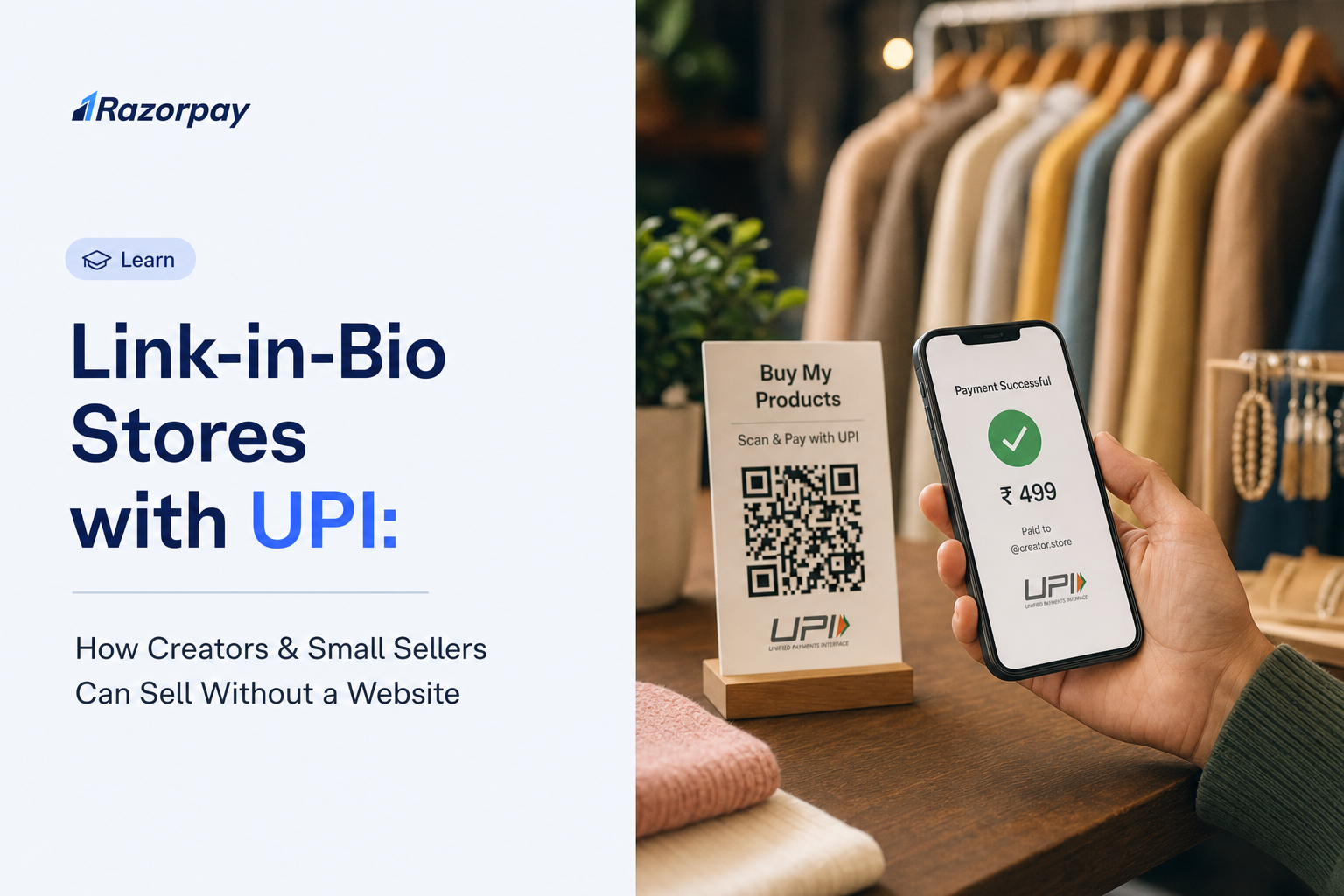
You have built an audience on Instagram, YouTube, or WhatsApp. Now you want to sell – a course, a batch of cupcakes, a coaching slot, a thrifted jacket. But you keep hitting the same wall: your bio allows just one clickable link, and your only payment tool is a personal UPI ID. That means DMs full of “send it to this handle,” screenshots as proof, and no clean record of who paid for what. It is a workflow that breaks the moment orders start scaling. A bio link store UPI setup fixes this. It turns your single link into a proper checkout where buyers pay by UPI in seconds, and every payment maps to an order automatically. This guide shows you how to build one, price it, design it for mobile, and stay compliant, all without a website or a single line of code.
Key Takeaways
- UPI dominates India’s digital payments, processing 22.64 billion transactions in March 2026 and over 80% of retail digital payments. A bio link store without native UPI blocks your majority audience from the start.
- A personal UPI handle is not a store: it offers no order tracking, no refund workflow, no GST invoicing, and no reconciliation dashboard.
- A UPI-enabled bio link store lets you sell digital products, courses, bookings, and physical goods straight from your bio, with no website needed.
- Many eligible small merchants pay zero MDR on low-value UPI, per the Government’s incentive scheme for BHIM-UPI.
- You can add UPI Autopay for recurring memberships and course instalments. UPI Autopay mandates crossed 1.27 billion in November 2025.
- Most single UPI transactions are capped at ₹1 lakh, with higher limits up to ₹5 lakh for select categories. Pricing within these rails avoids checkout friction.
What Is a Bio Link Store – and Why UPI Changes Everything in 2026
A bio link store is a single hosted page that does real commerce: it lists your products, shows prices, collects payment, and confirms the order. A plain link-in-bio page just redirects visitors elsewhere, leaving the actual selling to happen somewhere else. The difference is the checkout that lives on the page itself.
Because Instagram and YouTube allow only one clickable link, that link is prime real estate. In India, where behaviour is mobile-first and UPI-first, the store built behind that link must accept UPI natively. UPI processed 22.64 billion transactions in March 2026, and India now accounts for 49% of global real-time payments. A store that makes buyers pay via a copied handle is fighting the way the country already pays, and every extra step costs you conversions.
A true bio link store handles:
- Product listings with prices in rupees
- Native UPI checkout
- Order confirmation
- Digital or physical delivery
Explore how modern payment solutions power this shift.
Why Your Personal UPI Handle Is Not a Bio Link Store
A personal UPI ID can receive money, but it cannot run a store. Asking buyers to “send payment to my UPI ID” adds friction at the exact moment they are ready to buy, and payment friction is costly – cart abandonment averages above 70%. Every screenshot request is a chance for the sale to slip away. Here are the five structural gaps:
- No order-level tracking. You see a ₹500 credit but not which product or which buyer. Razorpay’s Payment Links assign a unique payment ID to every transaction, giving you a clean order trail a personal UPI handle cannot produce.
- No automated buyer confirmation. Buyers wait, then send a screenshot as proof.
- No refund workflow. Returns become manual reverse transfers with no audit trail.
- No GST invoice generation. Come tax season, you have a bank feed, not invoices.
- No reconciliation dashboard. Matching payments to orders is guesswork that eats hours.
A store closes every one of these gaps automatically, so you spend time selling instead of bookkeeping.
How Razorpay’s Payment Links and Payment Pages Power Your Bio Link Store
Picture a coach selling a 6-week programme from Instagram, or a boutique sharing a custom-order link on WhatsApp. Neither needs to build a website. They need a link and a checkout, and that is exactly what these no-code tools provide, ready to share in minutes.
- Payment Links: Generate a shareable URL carrying a specific amount, description, and expiry. Buyers pay via UPI, cards, or net banking, and each payment returns an order-linked confirmation. Share the link via WhatsApp, Instagram DM, email, or drop it straight into your bio.
- Payment Pages: Build a branded, hosted checkout page with your logo, product images, and multiple items, all without code. It accepts UPI (including UPI Intent for app switching on mobile), cards, net banking, and wallets. This page URL is what goes in your bio.
- UPI QR Codes: Create dynamic QR codes tied to individual transactions, so each payment maps to a specific order for clean reconciliation.
Together, these turn one bio link into a working storefront that runs itself.
Step-by-Step – Setting Up a UPI-Enabled Bio Link Store (No Website Required)
You can sell without a website using UPI in an afternoon. Here is the sequence, start to finish.
- Create a payment gateway account. Sign up with an RBI-authorised payment aggregator, then complete KYC. You will typically need a PAN and a bank account; operating as a sole proprietor is fine. Authorised aggregators hold customer funds in escrow, adding a layer of trust that a personal handle lacks.
- Create a payment page or link. Set the price, upload a product image and description, and enable UPI as the default payment method. For a multi-item store, use a hosted payment page; for a single offer, a payment link is enough.
- Paste one URL into your bio. Add it to your Instagram bio, YouTube description, WhatsApp Business profile, and X bio. This single URL becomes your storefront entrance across every channel.
- Test the full buyer flow from a mobile device. Open the link on your phone, tap through to UPI, and confirm the app switch and payment complete cleanly. Most buyers arrive on mobile, so test where they shop.
- Set up order confirmation and digital delivery. Configure an automatic confirmation and, for digital products, an auto-delivery of the download or access link.
Pro-Tip: Place UPI as the first payment option in your checkout layout. With UPI making up over 80% of retail digital payments and 96% of Indians online via mobile, leading with UPI cuts the taps between “I want this” and “paid.”
Designing a High-Converting Bio Link Store Layout for Indian Mobile Users
Because 96% of Indians access the internet via mobile phones, design for a thumb, not a mouse. Use a simple three-block layout:
- Identity: Your name, photo, and one line on what you sell.
- Hero offer: Your main product with a rupee price and a bright UPI checkout button.
- Secondary links: A short list of other offers below the primary CTA.
Keep the store tight. Listing more than five items dilutes attention and hurts conversion, so lead with your best-seller. Always show prices in rupees so buyers do not do mental maths. Add trust signals: the UPI and RuPay logos, a secure badge, your seller photo, and a visible refund policy. These small cues reassure first-time buyers who have never bought from you before. Read more on reducing friction in this cart abandonment guide.
Pro-Tip: Display the UPI logo visibly on your payment page. Indian buyers read it as a mark of legitimacy, the same trust they place in the QR code at their local kirana store.
Did You Know? India accounts for 49% of global real-time payments, so your buyers are already trained to scan and pay.
UPI Autopay – Recurring Revenue From Your Bio Link
One-time sales are only half the opportunity. UPI Autopay lets a buyer authorise a mandate once, after which renewals are debited automatically. This turns a bio link into a subscription engine that earns while you sleep. Razorpay’s Subscriptions product supports UPI Autopay mandates, letting creators offer membership plans or course instalments directly from a bio link page. Common use cases:
- Monthly membership communities
- Course fees split into instalments
- Gated newsletters
- Coaching retainers
- D2C product replenishment
Demand is real: UPI Autopay mandates crossed 1.27 billion in November 2025. One caveat to plan for – about 20 million mandates are revoked each month over low balances – so price tiers sensibly and build in retries. Learn more in this UPI Autopay guide.
Fees, Settlement, and Keeping More of Every Rupee
For many eligible small merchants, low-value UPI attracts zero MDR under the Government’s BHIM-UPI incentive scheme, so you keep the full ticket on those sales. That matters most when margins are thin. A few practical points:
- A domestic gateway platform fee may still apply depending on your plan, so read the UPI transaction charges explainer.
- International transactions carry separate handling and currency conversion.
- Note the live update: MDR on UPI transactions above ₹2,000 is under consideration for large merchants. This is a proposal, not law, and it targets larger merchants, so most small sellers are unaffected.
For cash flow between launches, Razorpay’s Instant Settlements feature gives businesses the option to access funds outside the standard settlement window.
Did You Know?
The Government continues to support zero MDR for eligible low-value BHIM-UPI merchant transactions, per its incentive scheme.
Compliance Basics Every Bio Link Seller Must Know in 2026
Two rules shape how you price and register. First, GST: registration is generally required once turnover crosses ₹40 lakh for goods and ₹20 lakh for services in most states, with lower limits in special-category states. A gateway can generate GST-ready invoices automatically, saving you a scramble at filing time. Second, the UPI cap: most single transactions are limited to ₹1 lakh, with higher limits up to ₹5 lakh for select categories. Price within safe rails, and offer instalments or bank transfer for high-ticket offers.
UPI-friendly price points:
- Digital downloads: ₹99 to ₹999
- Online courses: ₹999 to ₹9,999
- Coaching packages: ₹5,000 to ₹50,000
- High-ticket offers: up to ₹1 lakh
Selling to buyers abroad? See the e-FIRA guide and open a current account for clean records.
Pro-Tip: If you sell to a buyer outside India, RBI requires a FIRA for GST export compliance. Use a gateway that auto-generates FIRA per transaction instead of chasing your bank branch.
How Razorpay Supports Your Bio Link Store – Feature Summary
Razorpay offers a suite of no-code and developer-friendly tools that cover every layer of a bio link store, from checkout to compliance, so you can start simple and grow.
| Your Bio Link Store Need | Razorpay Product | What It Does |
|---|---|---|
| Share a single paid link | Payment Links | Creates a shareable URL with a set amount and description |
| A full storefront in your bio | Payment Pages | Hosts a branded, multi-item checkout without code |
| Order-mapped payments | UPI QR Codes | Ties each dynamic QR to a specific transaction |
| Recurring revenue | Subscriptions (UPI Autopay) | Runs membership and instalment mandates |
| Faster checkout | Magic Checkout | Streamlines the buyer’s path to pay |
| Selling abroad | International Payments | Accepts cross-border payments |
| Bank-transfer collections | Smart Collect | Assigns virtual accounts for reconciliation |
| Flexible cash flow | Instant Settlements | Accesses funds outside the standard window |
| Simple embedded buy button | Payment Buttons | Adds a checkout button anywhere |
Ready to build? Start with Razorpay Payment Solutions.
Conclusion
The gap between collecting payments and running a store is the gap between a personal UPI handle and real payment infrastructure. A bio link store UPI setup gives you order tracking, automated confirmations, refunds, GST-ready invoices, reconciliation, and the ability to charge recurring subscriptions, all from one link in your bio. You do not need a website, a developer, or a big budget to get started. You need a checkout that works the way India already pays. Set it up once, test it on mobile, price within UPI rails, and you move from chasing screenshots to running an actual business with clean records. Start building your store today with Razorpay.
Frequently Asked Questions
Can I accept UPI payments without a website?
Yes. Using payment links or a hosted payment page, you can collect UPI payments from your Instagram, YouTube, or WhatsApp bio without building a website. You simply place one checkout URL in your bio and buyers pay via UPI directly, with each payment mapped to an order.
What’s the difference between a UPI payment link and a payment page for a bio link store?
A payment link is a single-transaction URL set to one amount, ideal for a custom order or a one-off sale. A payment page is a hosted, branded catalogue with multiple items and a full checkout. For a bio link store, the payment page URL is what goes in your bio.
Is there a fee on UPI transactions for my bio link store?
Under the Government’s incentive scheme, eligible small merchants pay zero MDR on low-value UPI, though a gateway platform fee may still apply depending on your plan. A separate proposal to charge MDR on UPI transactions above ₹2,000 is under discussion but targets large merchants and is not yet law, so most small sellers are unaffected.
What is the maximum I can collect via a single UPI payment?
RBI caps most single UPI transactions at ₹1 lakh. Higher limits of up to ₹5 lakh apply to specific categories, subject to KYC and your bank’s policy. For high-ticket offers, split payments into instalments or use bank transfer to avoid hitting the ceiling.
How do I sell a membership or course subscription from my Instagram bio using UPI?
Set up a subscription plan with a UPI Autopay mandate. The buyer authorises the mandate once from a link shared in your bio, and renewals are debited automatically. This works well for communities, gated newsletters, and course instalments where you want predictable recurring income.