Many small businesses struggle to secure a line of credit crucial to running their operations. This is a bottleneck that impacts their overall financial infrastructure. While many founders resort to using their personal credit cards, this can put their personal finances at risk. What is the solution? A corporate credit card!
Like personal credit cards, corporate cards are also issued by a financial institution. Compared to traditional loans, business credit card interest rates are slightly higher, as they offer a type of unsecured loan and hence, are riskier. However, some lenders do offer secured business credit cards that can come in handy, especially for businesses with little or no credit history. There are various types of corporate cards available for small businesses. Want to know more about them? Scroll down!
Signup for corporate credit for your startup
RazorpayX Corporate Card was launched in 2020 exclusively for consistent users of Razorpay and RazorpayX, where we tried to address the needs for growing businesses. It was developed in association with SBM India, one of the biggest banks in the APAC region. But, there are a lot of questions about what a Corporate Card really is. This blog aims to answer those questions by describing different kinds of Corporate Cards.
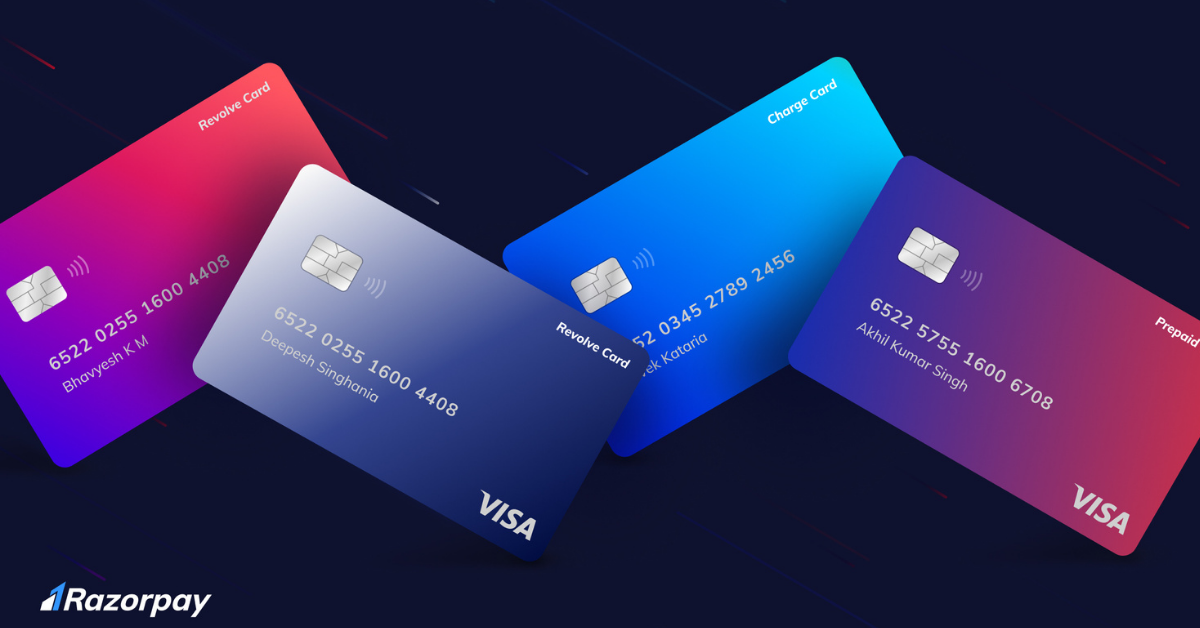
Types of Corporate cards
1. Purchase Cards
Purchase Cards, also known as P-Cards, are generally used for operational expenses. They act as procurement tools that are used for B2B transactions and can be used to bypass the Purchase Order (PO) process for low-value items. Such cards are best used for purposes like buying office supplies, paying utility bills, or managing software subscriptions.
Purchase cards offer control over spending and allow finance teams to set spending limits and restrict usage to specific merchant categories. They reduce administrative burden and make procurement of products or services easier for a business.
2. Virtual Corporate Cards
With digital-native businesses on the rise, Virtual Cards have become the fastest-growing category in B2B payments. A virtual card is a randomly generated 16-digit card number, CVV, and expiry date, and does not exist physically. You can generate these cards instantly via an institution and can be linked to your main corporate credit line or wallet.
These cards are often considered safer as they cannot be physically stolen. They are also easy to disable in case they get compromised. Virtual Corporate Cards are also easier to control as you can update your transaction limits as per your needs. The only drawback is that you cannot do any offline POS transactions with it.
3. Travel & Entertainment Cards
Travel & Entertainment (T&E) cards are corporate credit instruments designed to manage expenses related to business travel, dining, and entertainment. These cards are typically issued to employees who frequently travel for work, ensuring they do not have to use personal funds for flights, accommodation, or meals.
These cards often come with travel-centric perks such as complimentary airport lounge access and travel insurance. T&E cards are beneficial for both employees and employers as they streamline the reimbursement process by consolidating all travel-related spending into a single statement.
4. Business Cards
Business Cards are credit solutions primarily aimed at business owners and top-level management to handle general operational costs. These cards are designed to cover a wide range of day-to-day business needs, ensuring that the company’s operational cash flow remains fluid without impacting the working capital.
They are best utilized for recurring expenses such as utility payments, digital marketing ad spends, and monthly SaaS subscriptions. By using Business Cards, owners can separate their personal finances from business liabilities. These cards also offer exclusive discounts and interest-free credit periods.
5. Prepaid cards
This is not exactly a credit card as one needs to load cash before using it. After loading cash, one can use this card until the balance becomes zero again. The great advantage of prepaid corporate cards is that they can be used at all places that accept credit cards.
It is a great way to easily pay for all the recurring and international expenses for a business and keep a track of team expenditure. However, keep in mind that not all prepaid cards are the same. Gift cards, also called prepaid cards, once redeemed, can not be reused.
6. Charge cards
These cards have stark differences when compared to revolving credit cards. One needs to settle all the outstanding balances at the end of each month. Again, there is no surcharge in case of timely payment. However, one might need to pay substantial fees if the payment is not cleared after the set period.
There is also an annual fee attached with the charge card. To get approval for a charge card, businesses must have a good to excellent credit score. Since there is a huge spending limit that comes with charge cards, businesses can leverage it for large purchases. Charge cards also typically have a very generous rewarding mechanism for the cardholders.
Comparing Different Types of Corporate Cards
Here is a brief difference between different types of corporate credit cards based on their features.
|
Feature |
Business Card |
T&E Card |
Purchase Card |
Prepaid Card |
Charge Card |
Virtual Card |
|
Credit Facility |
Yes (Revolving) |
Yes (Revolving) |
Yes (Revolving/Controlled) |
No (Pre-load) |
Yes (Pay in full) |
Linked to the parent limit |
|
Interest-Free Period |
30–45 Days |
30–45 Days |
30–45 Days |
N/A |
~30 Days (Until due) |
Same as the parent card |
|
Primary Use Case |
Operations, Utilities & Ads |
Travel, Dining & Hotels |
Procurement & Supplies |
Team Allowance / One-time |
Large Purchases |
SaaS & Online Payments |
|
Best For |
Business Owners & Ops |
Frequent Travelers |
Bypassing the PO process |
Controlling team spends |
Maximizing Rewards |
Security & Subscriptions |
|
Eligibility |
Revenue & Biz Vintage |
Employees/Sales Teams |
Established Business |
Any (No credit check) |
Excellent Credit Score |
Existing Account Holder |
Difference Between Business Cards and Purchase Cards
It is common to confuse purchase cards with business cards. Here are the major differences between the two, tabulated below.
|
Feature |
Purchase Cards |
Business Cards |
|
Liability |
Company Liability; debt belongs to the business entity |
Owner Liability; a personal guarantee is required from the owner |
|
Primary Target |
Finance & Admin Teams |
Business Owners & Founders |
|
Primary Goal |
Bypassing PO Process |
Separating Expenses |
|
Spend Category |
Procurement & Supplies, such as Office supplies, vendor payments |
General Operations, such as Digital Ads, Utilities, SaaS subscriptions |
|
Credit Assessment |
Based on Company Financials |
Based on Owner’s Credit Profile |
|
Control Level |
High |
Standard |
There are various types of credit cards that are suitable for different kinds of business needs. To pick the most suitable one for your business, you should assess each of them on various parameters like benefits, flexibility, rate of interest, credit portfolio, and more. Carefully consider these criteria in advance while picking a business credit card so that it supports the growth of your business instead of hurting your creditworthiness.
How to Choose the Right Corporate Card for Your Small Business?
There are various types of credit cards that are suitable for different kinds of business needs. To pick the most suitable one for your business, you should assess each of them on various parameters like liability structure, collateral requirements (secured vs. unsecured), expense control features, forex markup fees, reward benefits, and more. Carefully consider these criteria in advance while picking a business credit card so that it supports the growth of your business instead of hurting your creditworthiness. Here are some factors to consider before finally settling down on a choice –
- No Collateral – Look for an issuer that holistically assesses you based on cash flow, growth potential, funding, GST returns, potential business revenue, not just Fixed Deposits (FD).
- Personal Liability – It is important that the card should be a liability of the company, not the founder’s.
- Rewards – Choose a card that is not just a payment tool but also helps your business save money and grow faster. For example, the Corporate Card offered by RazorpayX offers discounts on popular corporate tools, such as AWS, Google Workspace, etc., so you can optimize your finances.
- Forex Markup – Most cards charge you for international transactions that can eat up your profits. Look for cards with lower forex rates to save money and retain revenue.
The Right Corporate Card for Your Business
The Corporate Card, powered by RazorpayX in partnership with RBL Bank and Yes Bank, acts as an asset that offers credit lines to small businesses while constantly evolving and trying to address the needs of a wide range of features. This card combines the best features of different types of corporate cards to help your business grow. Here are some of its features that make it the perfect choice for your small business!
- Real Savings – We don’t offer generic points, we offer real savings. We offer low forex markups at just 2.5% on international transactions. What’s more, you can earn up to 1% cashback on Marketing, SaaS, and Cloud spends and get up to 30% off on 500+ top business tools like AWS, Google Cloud, and Microsoft via our concierge service – “Savings Negotiator”!
- Accessible Line of Credit – Whether you are a day-one startup, small business enterprise (SME), or a scaling enterprise, we have a corporate card for you.
- For early-stage or bootstrapped startups without a credit history, we offer cards on a minimum FD of INR 5 to 7 Lakhs, offering you a credit limit of up to 90%. And these FDs come with up to 8% interest too! Not only is it a profitable deal, but it also helps you create a solid CMR Score that makes securing credit at lower interest rates easier for your business’s future needs.
- For established businesses, you can get up to INR 2 Crore unsecured credit and choose billing cycles that match your cash flow (up to 45-50 days interest-free).
- Better Control & Tracking –– When you use a Corporate Card powered by RazorpayX, you also unlock features from two of India’s leading banks – RBL Bank and Yes Bank. Track every rupee spent by employees in real-time via the respective bank’s website, set limits by category, and customize your limits across add-on cards for easy operations.
It is now time to switch up your small business’s finances with a Corporate Card that can shift the way you spend and save!