India’s digital payments market is on a steep climb, projected to grow from USD 3 trillion in 2023 to approximately USD 10 trillion by 2026. For every merchant in this market, payment infrastructure reliability has shifted from a back-office concern to a board-level revenue continuity issue.
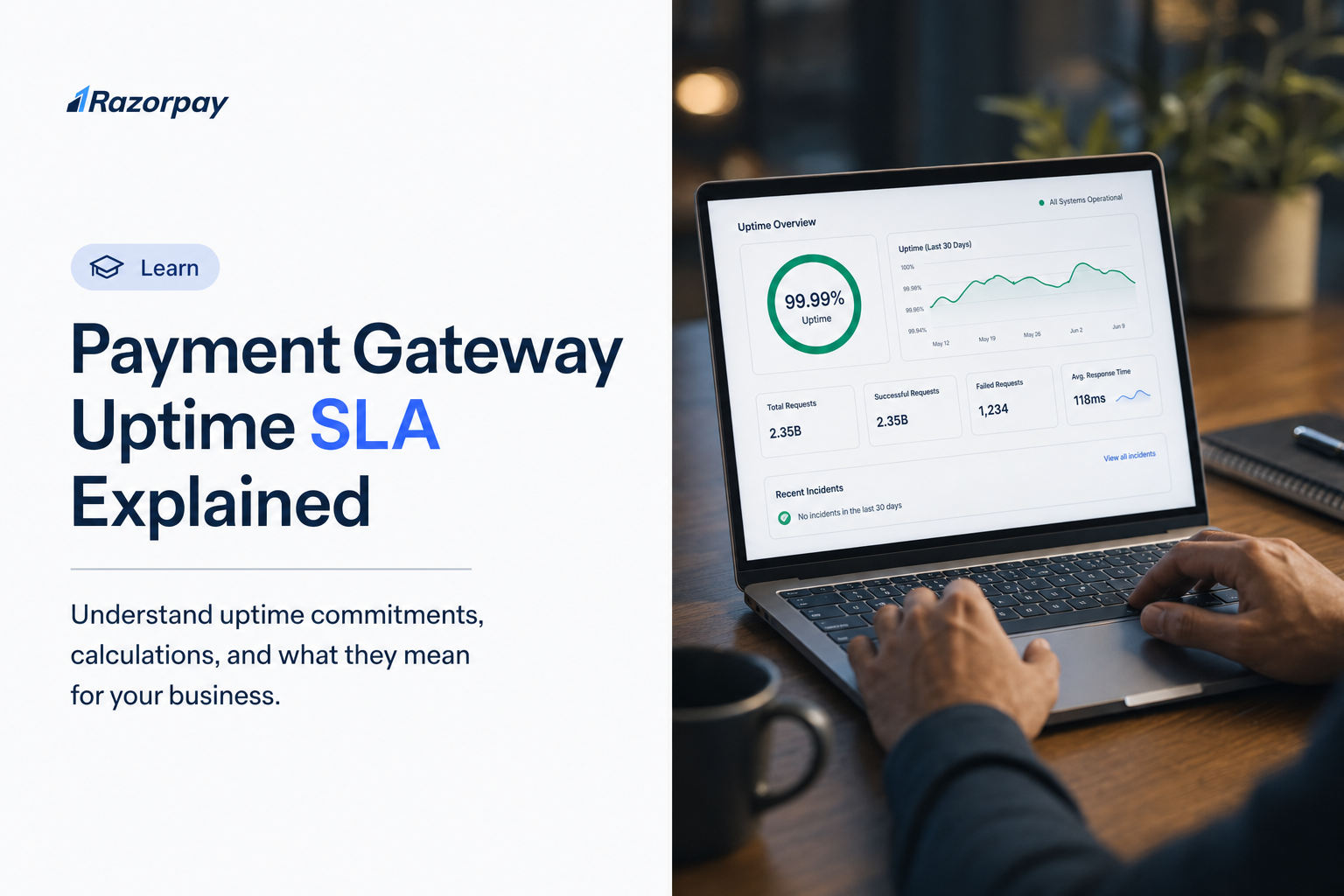
Yet almost every gateway advertises “99.9% uptime” as if it guarantees near-perfection. The reality: that one decimal hides up to 8 hours 45 minutes of permitted downtime every year, often concentrated in the worst possible moments.
This guide decodes what payment gateway uptime SLAs actually mean, the fine print that hides real risk, the rupee cost of downtime, and architectural alternatives to expensive SLA tiers.
Key Takeaways
- 99.9% uptime equals about 43 minutes of permitted downtime per month, or roughly 8 hours 45 minutes per year, per InMotion Hosting and UptimeRobot.
- Each additional “nine” cuts allowable downtime by 10x. 99.99% allows about 4 minutes per month; 99.999% allows roughly 26 seconds per month.
- SLA fine print matters more than the headline number. Most contracts exclude scheduled maintenance, third-party rail outages, and force majeure, per FiberFed.
- India’s UPI concentration amplifies downtime risk. UPI accounted for over 75% of non-cash retail payments by volume in Q4 2023.
- You do not need to pay 3-5x more for four-nines reliability. Multi-gateway orchestration delivers effective higher availability at lower cost, per Andrew Matveychuk’s analysis.
- The right SLA question is what downtime costs your business per minute. Global benchmarks place small-business outage cost between USD 137 and USD 427 per minute.
Table of Contents
The “Nines” Decoded: What Uptime Percentages Actually Mean in Time
The Uptime Ladder: From Two Nines to Five Nines
In SLA contracts, “nines” is shorthand for availability tiers. The leap from one tier to the next is dramatic: each extra nine reduces permitted downtime by a factor of ten. At 99.9% uptime, a service can be unavailable for nearly 8 hours 45 minutes per year; at 99.99%, that shrinks to roughly 52 minutes per year.
Did You Know?
A service operating at 99.9% uptime is contractually permitted to be unavailable for roughly 9 hours every year – about one full working day of potential lost payment revenue.
| Uptime SLA | Downtime/year | Downtime/month | Downtime/week | Typical use case |
|---|---|---|---|---|
| 99% | ~3 days 15 hours | ~7.3 hours | ~1.7 hours | Internal tools |
| 99.9% | ~8 hours 45 min | ~43 minutes | ~10 minutes | Standard SaaS |
| 99.95% | ~4 hours 23 min | ~22 minutes | ~5 minutes | Mid-tier production |
| 99.99% | ~52 minutes | ~4.4 minutes | ~1 minute | Revenue-critical |
| 99.999% | ~5 minutes | ~26 seconds | ~6 seconds | Mission-critical |
Why “Three Nines” Is the Industry Default
99.9% became default because it is achievable without exotic redundancy. Pushing to 99.99% can require 3 to 5 times higher infrastructure spend. For a blog, 43 minutes of monthly downtime is an SEO inconvenience. For a payment gateway during a Diwali sale or salary-day rush, the same 43 minutes can mean thousands of failed orders and lasting trust damage.
How Uptime Is Measured
Not all uptime numbers measure the same thing. Three common methods produce very different pictures:
- Provider-reported infrastructure uptime – API availability from the provider’s own monitors.
- Third-party endpoint monitoring – independent checks from multiple regions.
- Transaction-level success rate – the merchant-facing metric that actually drives revenue.
A gateway can legitimately report 99.9% infrastructure uptime while merchants see lower transaction success because downstream rails are failing. Razorpay’s dashboard gives merchants visibility into transaction success rates and failure reasons, helping identify whether downtime or routing issues are causing revenue leakage.
The True Cost of Payment Gateway Downtime for Indian Businesses
Calculating Your Personal Downtime Cost
To translate SLA percentages into rupee exposure:
- Take your monthly GMV – for example, ₹50 lakh.
- Divide by 43,200 (minutes in a month) – roughly ₹116 per minute.
- Apply a peak multiplier – festive traffic can spike 3-5x, so revenue per minute can reach ₹350-580.
- Multiply by your SLA’s permitted downtime – 43 minutes at peak could mean ₹15,000-25,000 in direct GMV loss per month, before refund handling and lost repeat purchases.
For merchants who need funds outside standard settlement windows, Razorpay’s Instant Settlements provides access to funds without waiting for the standard settlement cycle.
Did You Know?
Small businesses globally can lose between USD 137 and USD 427 for every single minute their payment systems are down.
India’s UPI Concentration Risk
Indian merchants face a structural amplifier most global content ignores: UPI dominance. UPI’s share of non-cash retail payments by volume rose from around 23% in FY 2018-19 to over 75% by Q4 2023. When the UPI rail or a key PSP bank has issues, the gateway can be technically “up” while most of your checkout fails.
- Your gateway’s headline uptime can be misleading if 70-80% of checkout depends on a single rail.
- Multi-rail redundancy is no longer optional for merchants with meaningful GMV.
The Reputational Cost
A failed payment is worse than a slow page because the customer has already committed intent and money. With 53% of mobile site visitors abandoning pages that take more than 3 seconds to load (Google research), tolerance for checkout friction is minimal. Failed-payment customers rarely return.
Pro-Tip: Before your next peak sale, calculate your downtime cost per minute using last month’s GMV. If that exceeds the cost of upgrading your gateway plan or adding a backup rail, the business case writes itself.
How to Read a Payment Gateway SLA Without Getting Fooled by the Fine Print
The 5 Questions Every Merchant Should Ask
The headline uptime number is the easy part. Before signing, ask:
- What counts as downtime? Is partial degradation (high latency, elevated error rates) included, or only complete outages?
- When does the clock start? From the moment of failure, or after provider confirmation?
- What is excluded? Scheduled maintenance, third-party rails, force majeure, and customer-side issues are common carve-outs.
- How are credits structured? Automatic or manual claim within a fixed window? Capped at a small percentage of monthly fees?
- Is there an MTTR commitment? Enterprise providers often commit to 4-hour MTTR for critical incidents.
Did You Know?
Many payment gateway SLAs exclude scheduled maintenance, third-party rail failures, and force majeure events from uptime calculations.
The Scheduled Maintenance Trap
Many providers schedule maintenance at “off-peak” 2-4 AM IST and exclude it from downtime calculations. But Indian e-commerce now serves NRI customers across time zones. Insist on 48-72 hour advance notice and confirmation-required scheduling around peak windows.
Third-Party Rail Failures
Indian gateways depend on NPCI, bank switches, and telecom networks for OTP delivery. Most SLAs exclude downtime caused by these third parties. Real protection comes from gateway architecture (multi-rail routing, fallback methods) rather than contract language.
Pro-Tip: Ask your gateway: “Does your SLA cover downtime caused by NPCI outages or bank switch failures?” If no, your protection comes from architecture, not the contract.
How Razorpay’s Payment Gateway and Optimiser Are Built for High-Availability Payments
Razorpay’s payment infrastructure is designed with a reliability-first approach that addresses the layered risks Indian merchants face. Three capabilities are central:
- Payment Gateway – PCI DSS Level 1 compliant infrastructure supporting 100+ payment methods including UPI, cards, netbanking, and wallets. Smart routing redirects transactions to alternate paths when a specific route encounters issues.
- Optimiser – A payment orchestration layer that routes transactions across multiple payment aggregators, helping eliminate single points of failure. It supports dynamic routing based on success rates and method-level health.
- Turbo UPI – A UPI processing capability designed to reduce latency and transaction drop-offs during high-traffic periods such as festive sales and flash events.
Together, these give merchants the building blocks for a multi-rail, multi-aggregator checkout architecture rather than relying on a single SLA tier as the only line of defence.
Multi-Gateway Failover: The Practical Path to Four-Nines Reliability
Why Upgrading Your SLA Tier Isn’t Always the Answer
Moving from 99.9% to 99.99% with a single provider can require 3 to 5 times more infrastructure spend. For most Indian SMEs and growing D2C brands, that math rarely works, especially when the higher tier still excludes NPCI and bank switch failures.
Payment Orchestration
Payment orchestration adds a routing layer between your checkout and multiple gateways or aggregators:
- Primary plus fallback configuration – if the preferred route degrades, traffic shifts automatically.
- Method-level redundancy – UPI, cards, netbanking, and wallets each have independent routing.
- Real-time success-rate monitoring – routing decisions adapt to live performance.
The result: a 99.9% primary gateway plus orchestration can deliver an effective experience closer to 99.99%. Razorpay’s Optimiser is designed for this use case, routing transactions across multiple aggregators to reduce the impact of any single provider’s downtime. Platforms can extend this with embedded payments architecture.
When to Invest
Consider orchestration when:
- Monthly GMV exceeds ₹50 lakh – downtime cost justifies the investment.
- Festive or flash-sale peaks drive 3-5x traffic spikes.
- UPI dependency is over 60% of checkout volume.
- You operate in a regulated sector where RBI oversight reviews availability and resiliency.
Did You Know?
RBI’s oversight framework explicitly reviews availability, resiliency, and continuity as key risk dimensions.
How to Audit Your Current Gateway’s SLA Before It Costs You
With 99.3% of non-cash payments in India now digital, run this 10-point audit:
- Locate the actual SLA document, not the marketing page.
- Identify the headline uptime percentage and measurement period.
- Map every exclusion clause.
- Understand how credits are calculated and claimed.
- Check for MTTR and escalation commitments.
- Review the scheduled maintenance policy.
- Set up independent transaction monitoring.
- Calculate your downtime cost per minute.
- Identify single points of failure across rails, banks, methods.
- Benchmark against your worst-case business scenario.
Pro-Tip: Run a tabletop exercise – pick a worst-case scenario like “UPI down for 2 hours on Diwali,” calculate the revenue impact, then check whether that scenario is covered by your current SLA.
Why Razorpay Is Built for the Reliability Demands of India’s Digital Economy
India’s payment context – UPI dominance, festive spikes, and RBI compliance expectations – demands a reliability-first platform rather than a single-rail dependency.
| Capability | What It Does | Why It Matters for Uptime |
|---|---|---|
| Payment Gateway | Supports 100+ payment methods across UPI, cards, netbanking, wallets. | Reduces dependence on any single method. |
| Optimiser | Routes transactions across multiple payment aggregators. | Helps reduce the impact of single provider disruption. |
| Turbo UPI | Processes UPI transactions with a focus on lower latency. | Supports UPI-heavy traffic during peaks. |
| Smart Collect | Collects and reconciles payments via virtual accounts and UPI IDs. | Improves payment tracking and operational continuity. |
| Instant Settlements | Provides access to funds outside standard settlement cycles. | Supports cash flow continuity during spikes. |
| Transaction Dashboard | Surfaces transaction status, success rates, failure reasons. | Helps teams detect and diagnose issues faster. |
Explore Razorpay’s Payment Gateway
Conclusion
The right question is not “what is the highest SLA percentage I can buy?” It is “what downtime can my business absorb, and what is the most cost-effective way to achieve it?” For most Indian merchants, the answer combines a solid base SLA with architectural redundancy – multi-rail routing, fallback methods, and orchestration.
With RBI’s Payments Vision 2028 (released March 2026) targeting continued growth in digital payment volumes through December 2028, an SLA that feels acceptable today may be inadequate within 18 months. Audit your contract, calculate downtime cost per minute, and treat orchestration as a smarter lever than premium SLA tiers.
Frequently Asked Questions
What does 99.9% uptime mean for a payment gateway?
99.9% uptime means your gateway is permitted to be unavailable for approximately 43 minutes per month, or about 8 hours 45 minutes per year. For a business processing meaningful GMV, this represents a real window of potential revenue loss, particularly during peak periods like festive sales.
What is the difference between 99.9% and 99.99% uptime?
The difference is 10x in allowable downtime. At 99.9%, your gateway can be down up to 43 minutes per month. At 99.99%, that budget shrinks to roughly 4 minutes per month. Each additional “nine” reduces permitted downtime by a factor of ten.
What should I look for in a payment gateway SLA beyond uptime percentage?
Look for a clear definition of “downtime,” explicit exclusions (especially scheduled maintenance and third-party rails), whether credits are automatic or require manual claims, an MTTR commitment, and whether the SLA is measured monthly or annually.
Does a payment gateway SLA cover NPCI or UPI outages?
Typically, no. Most SLAs exclude downtime caused by third-party infrastructure including NPCI, bank switches, and telecom networks. This is why architectural redundancy – multi-rail routing and fallback methods – is often more protective than SLA terms alone.
How do I calculate the cost of payment gateway downtime?
Divide your monthly GMV by 43,200 (minutes in a month) to get revenue per minute. Multiply by the downtime minutes your SLA permits to estimate maximum permitted revenue exposure. During festive peaks, multiply by your traffic multiplier (often 3-5x).
Is 99.9% uptime good enough for an Indian e-commerce business?
It depends on GMV and seasonality. Early-stage businesses can often accept 99.9% with active monitoring. For ₹50 lakh-plus monthly GMV or peak-event-heavy businesses, 99.9% combined with multi-gateway orchestration typically provides stronger protection than upgrading to a higher SLA tier.