A customer in Paris searches online for Indian sarees.
She discovers your website through Google, browses through the collection, and quickly finds something she likes. The designs look beautiful, the pricing feels reasonable, and within minutes she adds a product to her cart.
Then she reaches the payment page.
She is asked to enter her card number, followed by the expiry date and CVV. An unfamiliar authentication step appears next. She scans the page looking for a payment method she recognises or uses regularly.
There is no Apple Pay.
No PayPal.
No Klarna.
The checkout flow looks unfamiliar, and she does not yet know your brand well enough to trust it instinctively. What should have been the easiest step in the purchase journey suddenly becomes the most uncertain one.
So she hesitates.
In many cases, that hesitation turns into an abandoned cart.
Now imagine the same moment playing out differently.
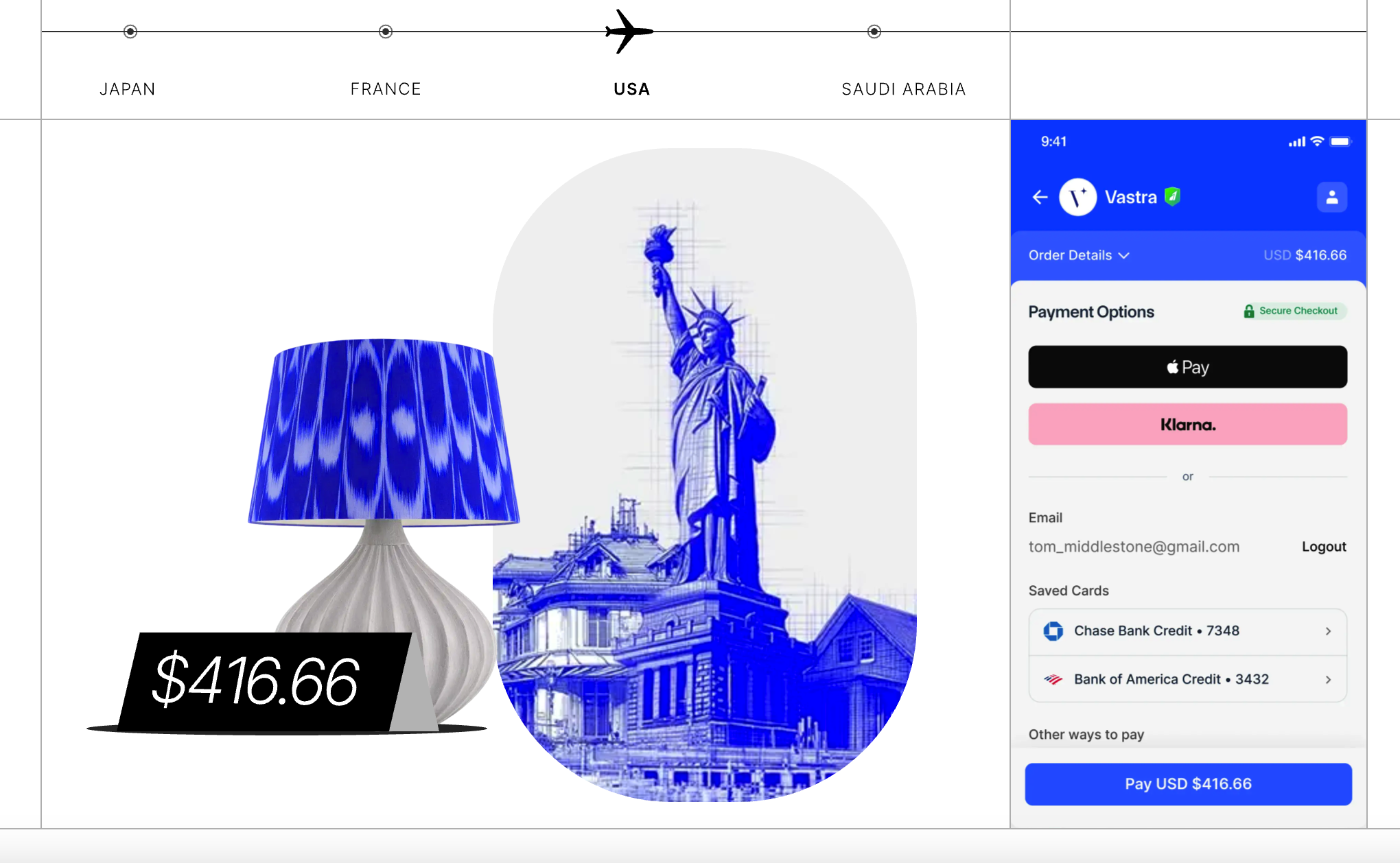
She reaches checkout and immediately sees a payment method she already trusts. Apple Pay appears at the top of the page. With a single tap and biometric authentication, the payment is completed in seconds.
No card entry.
No friction.
No second thoughts.
That moment of familiarity is often the difference between a lost customer and a successful international sale.
It is exactly this moment that inspired us to build the all-new Razorpay International Checkout.
The challenge with international checkout experiences
Indian businesses are increasingly selling to customers around the world. Fashion brands ship to the United States and Europe, D2C brands reach international consumers through their websites, and digital businesses—from SaaS platforms to creators—serve audiences across continents.
Across Razorpay, merchants now transact with customers in over 180 countries.
However, most checkout experiences were originally designed for domestic buyers. While this works perfectly for Indian customers, the same experience can feel unfamiliar to buyers in other markets.
International customers frequently encounter payment methods they do not recognise, authentication flows that are uncommon in their geography, and form fields designed for Indian address formats. These small points of friction accumulate quickly during checkout.
Our analysis of millions of international transactions revealed three recurring patterns behind abandoned payments:
the absence of familiar payment methods, a lack of trust signals for first-time buyers, and unnecessary checkout friction.
Individually, these issues may appear minor. Together, they quietly reduce conversion rates.
The hidden cost of checkout friction
When global customers abandon checkout, the loss is rarely obvious in analytics.
The marketing campaign worked.
The product page performed well.
The customer added items to the cart.
But the purchase never happened.
This friction has been quietly causing hundreds of crores in potential revenue to slip away every month for Indian exporters. The demand exists, but the checkout experience does not always meet global expectations.
Solving this required rethinking the checkout experience from the ground up.
Meet the All-New Razorpay International Payments Checkout
The new Razorpay international payments checkout has been designed specifically for international buyers.
Instead of forcing global customers into a domestic checkout flow, it dynamically adapts to how customers expect to pay in their own markets. Payment methods, authentication flows, and form structures align with regional behaviour, allowing international shoppers to complete their purchase without hesitation.
The result is a checkout experience that feels familiar, fast, and trustworthy, regardless of where the customer is located.
The new checkout surfaces globally recognised digital wallets directly at the top of the payment page, including Apple Pay, Google Pay, and PayPal. Customers can complete transactions using biometric authentication, without entering card numbers, expiry dates, or CVVs.
This dramatically reduces the time it takes to complete a payment. What previously required close to a minute of form-filling can now be completed in seconds.
For mobile-first international shoppers, this change alone can significantly improve checkout completion rates.
Payment methods customers already trust
Payment preferences vary widely across regions. While cards remain common in many markets, consumers often prefer familiar wallets or buy-now-pay-later options that are widely used in their geography.
The new checkout supports a growing ecosystem of global payment methods, including Apple Pay, Google Pay, PayPal, Tabby, and Klarna (coming soon). Over time, Razorpay plans to expand this to 50+ global payment methods.
By presenting payment options that customers already recognise and trust, the checkout experience becomes instantly more intuitive.
Login designed for global customers
Authentication patterns also differ significantly across markets. In many countries, customers prefer logging in using email rather than mobile numbers, while OTP-based verification can sometimes introduce friction.
The new checkout supports both email and mobile authentication, giving customers the flexibility to log in using the method they expect. This also enables faster repeat purchases through saved payment methods and more reliable authentication across geographies.
Address formats that work worldwide
Address formats vary dramatically between countries. Rigid address forms often force international customers to adjust how they enter their details, which can lead to confusion and errors.
The new checkout supports international address structures, ensuring that customers can enter their information naturally without needing to reinterpret form fields.
This seemingly small improvement can make a meaningful difference in form completion rates.
Trust signals for first-time global buyers
For international shoppers, your brand may be unfamiliar. When purchasing from a company located thousands of miles away, visible trust indicators become important.
The new checkout introduces trust signals designed for global customers, helping reassure buyers that the transaction is secure and reliable.
These signals reduce hesitation and encourage customers to complete their purchase with confidence.
The impact businesses can expect
Even small improvements at checkout can have a large impact at scale.
Early results from the new checkout show up to a 10% improvement in international conversion rates. For businesses selling globally, this translates directly into more successful payments and higher revenue from existing traffic.
In other words, businesses can unlock meaningful growth simply by improving the final step of the purchase journey.
A checkout built for global commerce
Indian businesses are building brands that reach customers across the world.
Their payment infrastructure should reflect that ambition.
With the All-New Razorpay International Payments Checkout, businesses can offer global customers a payment experience that feels familiar, trustworthy, and effortless.
One checkout.
Multiple global payment methods.
A buying experience designed for international conversion.
Because when the world discovers your product, checkout should never be the reason they leave.