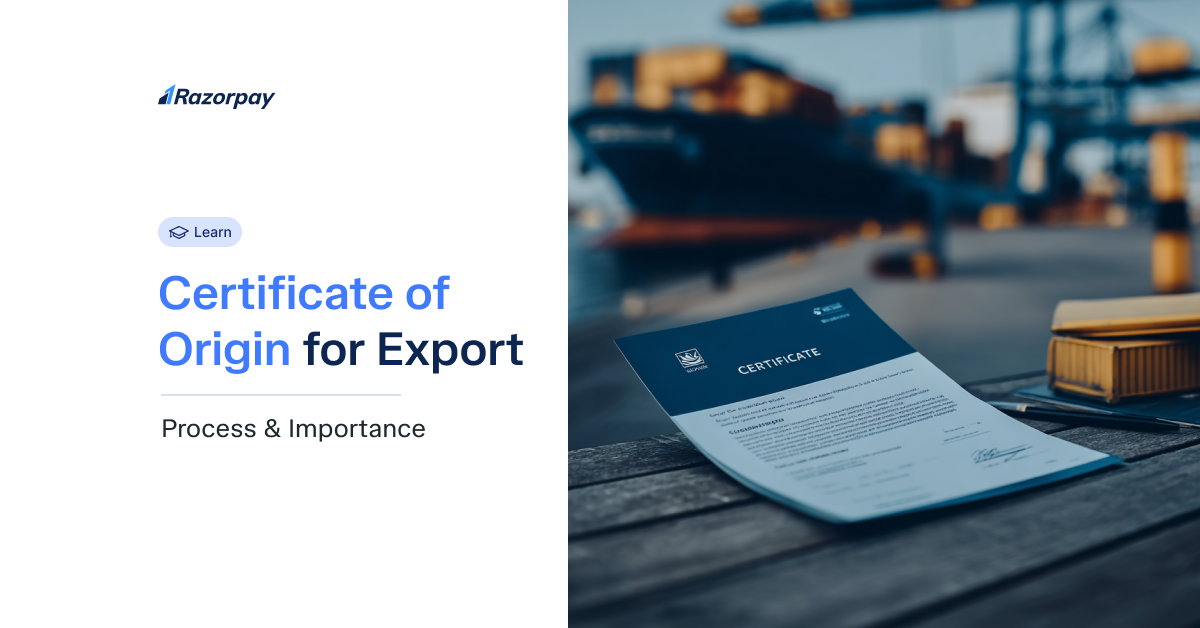
Picture an Indian textile exporter’s container stuck at Dubai customs for three weeks because one document was missing. The culprit? A certificate of origin for export, the passport that proves where goods were actually made. This crucial document determines whether your products face standard duties or enjoy preferential rates under Free Trade Agreements, directly impacting your competitiveness in global markets. Without proper origin certification, exporters risk customs delays, hefty penalties, or outright rejection of shipments.
This guide cuts through the confusion surrounding certificate of origin meaning and the application process. You’ll learn exactly which type of certificate your exports need, how India’s new mandatory digital filing system works, and the step-by-step process to obtain certificates online through the DGFT portal.
Key Takeaways
- What it is: A Certificate of Origin (CoO) is an official declaration that goods were produced or obtained in a specific country — the “passport” for products used by customs to verify origin and apply rules of trade.
- Is it mandatory? No — it is required only when the importing country’s regulations demand it or when you need to claim preferential tariff treatment under an FTA; otherwise, it is optional.
- Key requirement: A CoO is typically valid for 12 months from issuance — you can apply online via the DGFT or Common Digital Platform using your IEC, HS codes, commercial invoice, packing list, and by paying the applicable fee to receive a digitally signed certificate.
- Why it matters: The right CoO (preferential vs non-preferential) can unlock lower or zero duties under FTAs and make your exports more competitive; missing or incorrect CoOs can cause customs delays, higher duties, or denied clearance.
What Is a Certificate of Origin for Export?
A certificate of origin for export is an official document that certifies the country in which exported goods were produced or manufactured. Think of it as a passport for your products — just as your passport proves your nationality at international borders, a CoO proves where your goods originated. Customs authorities use this document to determine eligibility for preferential tariff treatment under Free Trade Agreements or to apply import rules.
The certificate serves several critical functions in international trade:
- Customs clearance: Importing authorities verify the legality of goods and apply relevant regulations based on origin
• Duty determination: Officials calculate correct import duties and taxes based on the source country
• Trade statistics: Governments track trade balances and enforce quotas using origin data
• Anti-dumping measures: Prevents goods from sanctioned countries being re-routed through third parties
It’s important to understand that a CoO differs from other shipping documents. While a commercial invoice details the transaction value and a bill of lading proves shipment, the certificate of origin online specifically establishes manufacturing location.
Why Is the Certificate of Origin Important?
Beyond basic customs requirements, origin certification directly impacts your bottom line through several mechanisms:
- Customs Clearance: Authorities use it to verify the legality of imports and apply relevant regulations. Without proper certification, goods face delays or rejection at borders.
- Duty Determination: It helps officials calculate the correct import duties and taxes based on the source country. Under India’s various FTAs, correct certification can reduce duties from 20% to zero.
- Trade Statistics: Governments use this data to track trade balances and enforce quotas. Accurate origin reporting ensures continued access to preferential markets.
- Anti-Dumping Measures: It prevents goods from sanctioned countries from being re-routed through a third country, protecting legitimate exporters from unfair competition.
Who Needs a Certificate of Origin?
The CoO requirement touches multiple stakeholders in the export chain:
- Exporters: Required to prove the origin of their goods to buyers and customs. Indian exporters must now use the mandatory e-CoO 2.0 platform for non-preferential certificates as of January 2025
- Importers: Needed to claim lower duty rates if a trade agreement exists. Your international buyers rely on accurate CoOs to reduce landed costs
- Banks: Often required as part of the Letter of Credit documentation to release payment. Financial institutions verify CoOs before processing trade finance
Types of Certificates of Origin
The previous section established why origin certification matters for customs clearance and duty calculations. Now let’s examine the two distinct certificate types that determine whether your exports qualify for special tariff treatment or face standard rates.
Indian exporters must choose between Preferential and Non-Preferential Certificates of Origin. This choice directly affects your buyer’s import costs and your product’s price competitiveness in foreign markets.
| Feature | Non-Preferential CoO | Preferential CoO |
| Purpose | General customs clearance, compliance | Claim reduced/zero duties under FTAs |
| Tariff Benefits | Standard MFN rates apply | Reduced or zero tariffs |
| Issuing Authority | Chambers of Commerce | Government agencies (EIC, DGFT) |
| Applicability | All countries | Only FTA partner countries |
Non-Preferential Certificate of Origin
Non-Preferential Certificates simply certify origin without claiming special tariff concessions. Key features include:
- Definition: Certifies origin without claiming any special tariff concessions
• Purpose: Used for general customs clearance, complying with embargoes, or statistical purposes
• Issuance: Typically issued by local Chambers of Commerce like ICC or FIEO
• Implication: Goods are subject to standard ‘Most Favored Nation’ (MFN) duty rates
Since January 2025, all Non-Preferential CoO applications must be filed electronically through the DGFT common platform, eliminating manual paperwork.
Explore Razorpay’s Global Payment Solutions
Preferential Certificate of Origin
Preferential Certificates unlock duty savings under Free Trade Agreements. Their distinguishing characteristics:
- Definition: Certifies that goods qualify for reduced or zero tariffs under a Free Trade Agreement (FTA)
• Examples: GSP (Generalized System of Preferences), SAPTA, or bilateral treaties like India-UAE CEPA
• Requirement: Goods must meet specific ‘Rules of Origin’ criteria (e.g., minimum value addition)
• Benefit: Makes exports more competitive by lowering the cost for the importer
Pro Tip: Check if your destination country has an FTA with India before applying. Using a preferential certificate when eligible can reduce your buyer’s duties from 10-20% to zero, making your quote significantly more competitive.
Who Issues the Certificate of Origin?
Having understood the types of certificates available, exporters need to know which authorised bodies can issue them. Unlike commercial invoices that businesses generate internally, CoOs require third-party validation from designated agencies.
Chambers of Commerce
Chambers of Commerce serve as the primary issuers for Non-Preferential Certificates:
- Role: Primary issuers of Non-Preferential Certificates across India
• Examples: Indian Chamber of Commerce (ICC), Federation of Indian Export Organisations (FIEO)
• Process: They verify the exporter’s declaration and stamp the document after checking supporting paperwork
These chambers connect to DGFT’s digital platform, enabling paperless issuance with QR codes and security features.
Government Agencies
Government bodies handle Preferential Certificates requiring stricter origin verification:
- Role: Primary issuers of Preferential Certificates under specific trade agreements
• Agencies: Export Inspection Council (EIC), Marine Products Export Development Authority (MPEDA), and Textile Committee
• Verification: They perform stricter checks to ensure goods meet the specific treaty’s origin rules
The choice of issuing agency depends on your product category and destination country’s requirements.
Understanding the Rules of Origin Criteria
Securing the right issuing authority is only half the battle. Exporters must prove their goods actually ‘originate’ from India according to specific criteria. This becomes complex when products contain imported raw materials or components.
Wholly Obtained Goods
The simplest origin qualification applies to products entirely sourced within India:
- Definition: Goods naturally grown, harvested, or mined entirely within the country
• Examples: Agricultural produce, minerals extracted from local soil, live animals born and raised locally
• Application: Simplest criterion to prove as there are no foreign inputs
Substantial Transformation
Manufacturing exporters face more complex requirements when using imported materials:
- Definition: Goods produced using imported materials that have undergone significant processing
• Criteria A (Change in Tariff Classification): The final product has a different HS code than the imported inputs
• Criteria B (Value Addition): A minimum percentage of value (e.g., 40%) was added domestically
• Importance: Critical for manufacturing exports where supply chains are global
Did You Know?
The customs term ‘Certificate of Origin’ was officially changed to ‘Proof of Origin’ in CBIC regulations effective 18 March 2025 (CBIC Notification No. 14/2025-Customs (N.T.), which amended CAROTAR, 2020). An explanatory circular (No. 14/2025-Customs) was issued on 21 April 2025 to operationalise the change, but the binding amendment preceded it, though both terms remain widely used in practice.
How to Get a Certificate of Origin: The Procedure
With origin criteria understood, let’s examine the actual application process. India’s shift to mandatory digital filing has streamlined what was once a paper-heavy procedure. The new eCoO 2.0 platform launched in January 2025 brings features like multi-user access, Aadhaar e-signatures, and integrated dashboards.
Documents Required for Application
Before starting your online application, compile these essential documents:
- Commercial Invoice: Details the value and description of goods with buyer information
- Packing List: Specifies the contents of each package with weights and dimensions
- Bill of Lading/Airway Bill: Proof of shipment showing carrier and route details
- Purchase Order: Confirmation of the sale terms between exporter and importer
- Indemnity Bond: Required for some manual applications as security
Additionally, manufacturing exporters need supplier invoices showing origin content and manufacturer’s declarations.
Online Application via DGFT CoO Portal
The certificate of origin online process through DGFT follows these steps:
- Registration: Log in to the Common Digital Platform using your IEC code. First-time users must create an exporter profile.
- Data Entry: Fill export details including HS codes, FOB value, consignee information, and shipment specifics.
- Uploads: Attach digital copies of commercial invoice, packing list, and supporting origin evidence.
- Selection: Choose the specific issuing agency and certificate type (Preferential/Non-Preferential) based on destination.
- Payment & Issuance: Pay the fee online (typically ₹500-₹2,000 depending on chamber). Download the digitally signed certificate with QR code upon approval.
The platform now supports Aadhaar-based e-signatures alongside traditional digital signature certificates, making it accessible to smaller exporters.
Offline/Manual Application Process
Though digital filing is now mandatory for Non-Preferential certificates, some situations still require physical applications:
- Context: Still used by some chambers or for specific countries not yet integrated digitally
• Steps: Submit physical copies of the application form and supporting documents to the local chamber
• Verification: The authority reviews the paperwork and physically stamps the certificate
• Drawback: Slower processing and requires physical presence at chamber offices
Manual applications typically take 3-5 working days versus same-day digital processing.
Streamlining Export Finance with Razorpay International Payments
While a Certificate of Origin ensures your goods clear customs smoothly, managing the financial side of exports presents its own challenges. Indian exporters often wait weeks for payments to arrive and spend additional time chasing banks for Foreign Inward Remittance Certificates.
Razorpay International Payments addresses these pain points with automated compliance features designed specifically for Indian exporters. The platform handles essential requirements like FIRC generation, purpose codes, and export documentation in line with RBI and FEMA rules. This eliminates manual bank follow-ups and keeps tax records audit-ready.
Streamlining Export Finance with Razorpay
Collect export payments faster and simplify compliance with automated FIRC, purpose codes, and RBI/FEMA-aligned documentation-so your records stay audit-ready without manual follow-ups.
Conclusion
Navigating origin certification requires understanding the distinction between preferential and non-preferential types, meeting specific origin criteria, and adapting to India’s new mandatory digital filing system. The shift to eCoO 2.0 has reduced processing times from weeks to hours while the terminology update from “Certificate of Origin” to “Proof of Origin” reflects evolving compliance standards.
Start by determining whether your destination country has an FTA with India, then gather required documentation before logging into the DGFT portal. For seamless export operations, combine efficient origin certification with modern payment infrastructure that automates compliance and accelerates settlements.
FAQs:
Q1. Is a Certificate of Origin mandatory for all exports?
Not every shipment requires a Certificate of Origin, but it is mandatory if the importing country’s customs regulations demand it or if the exporter wishes to claim tariff concessions under a Free Trade Agreement.
Q2. Can I issue my own Certificate of Origin?
Generally, no; a valid Certificate of Origin must be issued and signed by an authorised body, such as a Chamber of Commerce or a designated government agency like the DGFT in India, though some agreements allow for self-certification by approved exporters.
Q3. What is the difference between a commercial invoice and a Certificate of Origin?
A commercial invoice is a bill of sale declaring the value and description of goods for payment and duties, whereas a Certificate of Origin specifically certifies the country where the goods were manufactured or produced.
Q4. How long is a Certificate of Origin valid?
The validity of a Certificate of Origin typically lasts for 12 months from the date of issuance, although this can vary depending on the specific issuing authority and the rules of the trade agreement involved.
Q5. What is the fee for obtaining a Certificate of Origin?
The fee varies depending on the issuing agency and whether you are a member of that chamber, but it generally ranges from ₹500 to ₹2,000 for most chambers, plus any applicable GST on services.