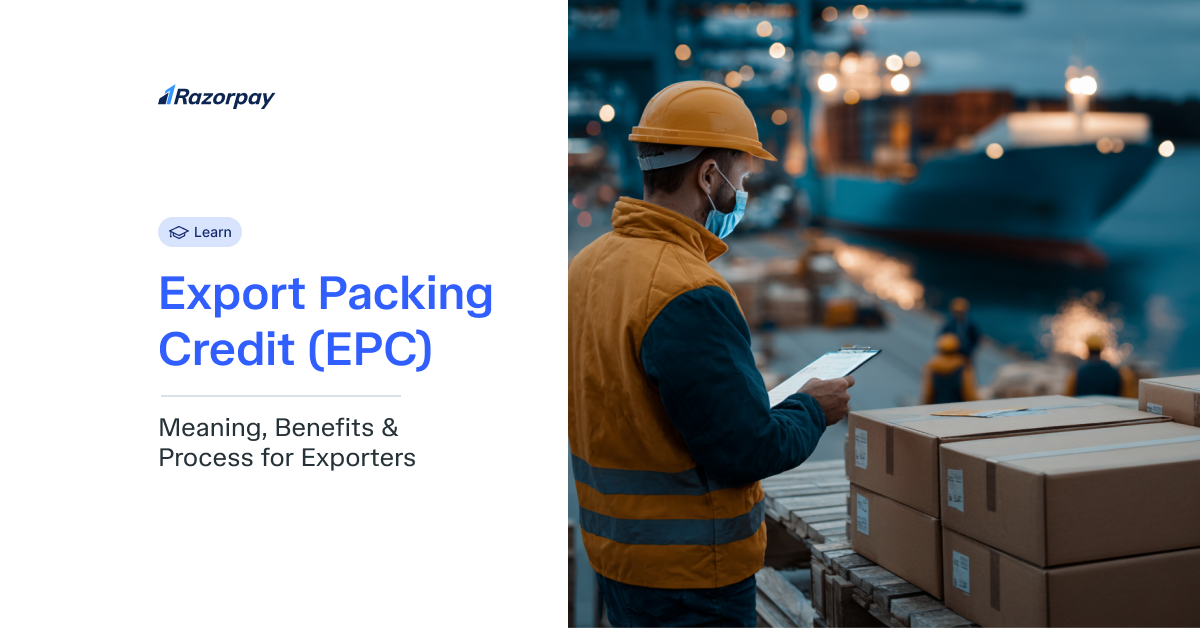
Export packing credit is a pre-shipment finance facility that banks extend to Indian exporters to fund costs before goods leave the country. You can use it for raw materials, processing, packing, warehousing, and other expenses linked directly to an export order.
International trade rarely pays upfront. Buyers take time, while your costs begin immediately. Export packing credit bridges this working capital gap and helps you keep production moving without straining your cash flows. For SaaS exporters, agencies, and goods exporters alike, it brings predictability to export execution.
Used well, this facility helps you meet delivery timelines, price competitively, and scale exports with confidence. In this guide, you will learn what export packing credit is, how it works, who can access it and how to use it strategically.
Key Takeaways
- Export packing credit helps you manage pre-shipment working capital without straining internal cash flows.
- Timely compliance and proper liquidation are critical to retain concessional interest benefits.
- Choosing the right credit structure and usage timing can significantly reduce financing costs.
What Is Export Packing Credit and Why Does It Matter?
Export packing credit is a short-term working capital facility that banks provide to exporters to finance activities before shipment. It supports you from the moment you receive an export order until the goods are ready to leave India.
What it Typically Covers?
- Purchase of raw materials or inputs.
- Manufacturing or processing costs.
- Packing and labelling expenses.
- Inland transportation and warehousing linked to the export order.
Why it Matters?
International trade involves long payment cycles, creating a gap between spending and receipt of funds. Export packing credit bridges this gap, ensuring steady cash flow during production. It enables Indian exporters to meet delivery timelines, price competitively, and execute global orders with confidence, even as scale and demand increase.
Key Features of Export Packing Credit
- Pre-Shipment Focused: Available specifically to fund costs incurred before goods or services are exported.
- Order-Linked Financing: Sanctioned against confirmed export orders or letters of credit (LC).
- Concessional Pricing: Offered at lower rates than standard domestic working capital loans.
- Flexible Currency Options: Available in Indian Rupees or foreign currency, depending on your exposure.
- Aligned to Export Timelines: Tenor matches production and shipment cycles.
- Widely Accessible: Available to manufacturers, traders, service exporters, and MSMEs.
Is Export Packing Credit Short-Term or Long-Term?
Export packing credit is inherently a short-term facility. Banks usually grant it for up to 180 days, in line with standard export execution timelines.
In specific cases—such as production delays or extended shipment cycles—banks may allow extensions up to 360 days, and in limited situations, even 450 days, subject to Reserve Bank of India guidelines and bank approval.
What Are the Interest Rates for Export Packing Credit?
- Rupee Packing Credit: Typically linked to the bank’s Marginal Cost of Funds based Lending Rate(MCLR) or base rate, with a concessional spread.
- PCFC (foreign currency): Benchmarked to international rates such as Secured Overnight Financing Rate (SOFR), making it attractive for exporters with forex exposure.
- Interest Equalisation Scheme: Under the government’s scheme for pre- and post-shipment Rupee export credit, eligible exporters—especially MSMEs— may receive additional interest support, subject to notified caps and government extension.
Does Export Packing Credit Require Collateral?
Collateral requirements depend on your risk profile and export track record. Banks may offer unsecured limits to established exporters with strong credit history. In other cases, they may seek primary security such as raw materials, work-in-progress, or finished goods, along with collateral or guarantees.
Coverage from Export Credit Guarantee Corporation of India can reduce the bank’s risk, often lowering collateral demands and improving access to export finance.
Explore Razorpay’s Global Payment Solutions
Types of Export Packing Credit Available to Indian Exporters
Banks offer different types of export packing credit to match how your export order is structured. Choosing the right option helps you control costs and manage currency exposure more effectively. Broadly, exporters can access funding either in Indian Rupees or in foreign currency.
What Is Rupee Packing Credit (Export Packing Credit / Packing Credit Loan)?
Rupee packing credit is pre-shipment finance extended in INR to cover export-related costs before dispatch. You can use it for domestic expenses such as raw materials, processing, packing, and inland transport.
It suits exporters whose costs are largely local and who prefer predictable repayment aligned with Indian interest rate benchmarks.
How Does Pre-shipment Credit in Foreign Currency (PCFC) Work?
PCFC is pre-shipment finance denominated in foreign currency such as USD, EUR, GBP, or JPY. It helps you match borrowing with your export receivables.
Why Exporters Use PCFC?
- Interest rates are usually lower than rupee loans, as they link to global benchmarks like SOFR and Euro Interbank Offered Rate (EURIBOR).
- It reduces exchange rate risk since repayment comes from your foreign currency export earnings.
- It works well for exporters with confirmed foreign currency invoices or contracts.
Did You Know?
PCFC is time-bound. If you do not repay it within the allowed period—typically 360 days overall or 30 days after the due date—the loan gets crystallised. This means the foreign currency liability converts into INR, often at a higher commercial exchange rate, increasing your cost.
What Are Other Specialised Packing Credit Options?
- Advances Against Letters of Credit: When you hold a confirmed export order or a LC, banks may extend packing credit based on that assurance. This reduces lender risk and often leads to faster sanction and better terms.
- Advances Against Duty Drawback and Export Incentives: Banks can finance you against expected duty drawback, RoDTEP, or other notified export incentives. This helps you unlock liquidity before the incentive is actually credited.
- Packing Credit Against Advance Licence Entitlements: Exporters operating under an Advance Licence can access packing credit linked to duty-free import entitlements, easing cash flow while meeting export obligations.
Eligibility Criteria for Export Packing Credit
- Valid Importer-Exporter Code (IEC) issued by DGFT
- Active PAN and GST registration (where applicable)
- Confirmed export order or LC
- Export activity permitted under current foreign trade policy
- Satisfactory credit profile and banking track record
- Compliance with FEMA and export reporting norms
Do I Need a Confirmed Export Order or Letter of Credit?
Yes, in most cases. Banks usually require a confirmed export order or an irrevocable LC to sanction packing credit. This assures them that the funds are tied to a real export transaction.
There is an exception. Established exporters with a strong repayment history may get a Running Account Facility. Under this, the bank releases credit before a specific order is submitted, with the condition that export orders are furnished within a defined period, commonly 30 days.
What Documentation Is Required for Application?
- IEC: Confirms your legal status as an exporter.
- PAN: Used for credit and tax verification.
- GST Registration: Validates indirect tax compliance.
- Confirmed Export Order / LC: Establishes transaction certainty.
- Purchase Order or Proforma Invoice: Shows pricing and commercial terms.
- Past Export Performance: Helps banks assess execution capability and risk.
How to Apply for Export Packing Credit: A Step-by-Step Guide
Step 1: Securing Your Export Order and Initial Bank Approach
- Start with a confirmed export order or a valid LC. This document anchors your entire application.
- Next, approach your existing bank or a lender that specialises in export finance.
- During this stage, you share basic company details, the export contract, and an outline of funding needs to initiate the process.
Step 2: Document Submission and Bank Verification
- Submit the required documents, including IEC, PAN, GST registration, export order or LC, and recent financial statements.
- The bank then carries out bank verification, checks document authenticity, reviews your export track record, and assesses repayment capacity through due diligence.
Step 3: Credit Limit Sanction and Account Setup
- Based on its assessment, the bank sanctions a packing credit limit. This usually depends on the export order value or your past export turnover.
- Banks may open a separate packing credit account for each order to track usage and repayment. Interest starts from the date of disbursement.
Step 4: Fund Disbursement and Utilisation
- Funds may be released in one tranche or in stages, depending on your production cycle.
- You must use them strictly for approved pre-shipment expenses.
- Banks often monitor end use, so clear documentation and disciplined utilisation are essential.
Strategic Considerations for Optimising Export Packing Credit
Export packing credit works best when you treat it as a planning tool, not just a funding source. With the right approach, you can reduce financing costs, avoid compliance issues, and keep your export cycle predictable even as volumes grow.
- Align credit drawdowns closely with production schedules to avoid unnecessary interest costs.
- Choose between rupee and foreign currency packing credit based on your forex exposure and margins.
- Maintain clean documentation and regular communication with your bank to prevent delays or rate reversals.
- Review eligibility under government interest support schemes at the start of each financial year.
How to Effectively Manage Repayment and Liquidation?
Packing credit is designed to be self-liquidating. In most cases, banks adjust it automatically from the proceeds of your export bill when post-shipment finance is availed.
Other accepted liquidation routes include:
- Using balances from your EEFC account, where export proceeds are already parked.
- Repayment from rupee resources, provided the export has been completed.
Recent relaxations by the Reserve Bank of India allow greater flexibility. For packing credit availed before 31 August 2025, if dispatch fails, banks may permit liquidation through non-export income or substitution of export orders, subject to conditions.
Navigating RBI Guidelines and Compliance
Strict compliance with RBI’s Master Directions on export of goods and services is non-negotiable. Gaps here can lead to penalties or restricted access to future export credit.
Key areas to watch:
- Timely submission of shipping bills and export documents.
- Ensuring funds are used strictly for export-related purposes.
- Accurate reporting and closure of entries on platforms like EDPMS.
If advances are not adjusted within 360 days—or 450 days under recent relief measures—banks withdraw concessional interest benefits and reprice the facility.
What Is the Role of ECGC in Securing Export Packing Credit?
The Export Credit Guarantee Corporation of India plays a quiet but critical role. It provides insurance cover to banks against default risk on packing credit.
This protection encourages banks to lend more confidently, especially to MSMEs and first-time exporters. For you, it often translates into easier approvals, higher limits, and, in some cases, more flexible collateral terms.
Export Packing Credit vs. Other Trade Finance Options
How Does Packing Credit Differ from a Letter of Credit?
Packing credit is a financing facility. It gives you working capital to produce, process, and pack goods before shipment. The bank lends money based on your export order.
A Letter of Credit, in contrast, is not a loan. It is a payment assurance issued by the buyer’s bank. It guarantees that you will receive payment once you ship goods and present compliant documents.
Packing Credit vs. Post-Shipment Finance: Understanding the Timing
Packing credit applies before shipment, when expenses are high and cash inflows have not started.
Post-shipment finance begins after goods leave India. Banks provide it to cover the waiting period until the overseas buyer pays, usually through bill discounting or negotiation.
Export Packing Credit vs Letter of Credit vs Post-Shipment Finance
| Feature | Export Packing Credit | Letter of Credit | Post-Shipment Finance |
| Primary purpose | Funds pre-shipment costs | Assures payment | Bridges payment delay |
| Stage of use | Before shipment | Before shipment | After shipment |
| Nature | Working capital loan | Payment guarantee | Short-term credit |
| Who provides it | Exporter’s bank | Buyer’s bank | Exporter’s bank |
| Repayment source | Export proceeds | Buyer’s payment | Buyer’s payment |
Simplify Global Payments with Razorpay MoneySaver Export Account
Once you have secured export finance like packing credit, the next challenge is ensuring your international payments are received smoothly and converted without avoidable costs. This is where the MoneySaver Export Account helps. With this you can:
- Receive international payments from customers across 180+ countries through bank transfers and global cards.
- Get a virtual account created in your name to accept payments in currencies like USD, EUR, GBP, SGD, AUD, AED, and more—without opening a foreign bank account.
- Offer overseas clients local bank transfer options, reducing friction and payment delays.
- Benefit from zero forex mark-up, helping you retain more of your export earnings.
- Access automatic eFIRC certificates for eligible export transactions, supporting export and FEMA compliance.
Collect global payments without the usual banking friction
Virtual accounts in your name let clients pay locally while you settle in India. Track collections easily, avoid forex mark-ups, and get automatic eFIRC for eligible export receipts.
Conclusion
Export packing credit remains an essential tool for Indian exporters navigating long and complex global trade cycles. By funding pre-shipment expenses, it helps you manage working capital efficiently, meet delivery commitments, and stay competitive in international markets.
To get the most value, it is important to stay updated with the latest RBI guidelines, use applicable government support schemes, and combine packing credit with reliable digital payment and reconciliation solutions for end-to-end export finance management.
FAQs
1. What is export packing credit?
Export packing credit is a short-term pre-shipment finance facility that banks offer to exporters to fund activities such as procuring raw materials, manufacturing, and packaging goods before shipment.
2. Who is eligible for export packing credit in India?
You are generally eligible if you hold a valid IEC, have a confirmed export order or LC, and maintain a satisfactory banking and export track record.
3. How are export packing credit interest rates determined in India?
Interest on rupee packing credit usually links to a bank’s MCLR or base rate. PCFC rates link to global benchmarks such as SOFR.
4. What is the maximum repayment period for export packing credit?
Typically, packing credit runs for up to 180 days and can extend to 360 days with bank approval. As per recent relief measures by the RBI, banks may allow export credit tenures of up to 450 days for eligible disbursements.
5. How does PCFC benefit exporters?
PCFC allows you to borrow in foreign currency, reducing exchange rate risk and often lowering interest costs. This makes it easier to price exports competitively and manage currency exposure.
6. What is the role of ECGC in export finance?
The ECGC provides insurance cover against commercial and political risks of non-payment by overseas buyers. This protection encourages banks to extend credit more confidently to exporters.