
Singapore is globally renowned as a premier trade hub, often cited as the gold standard for its free port status. For many Singaporean merchants selling online, this reputation suggests a frictionless entry into the global market. While it is true that over 99% of all imported goods enter the country duty-free, the remaining 1%, coupled with the mandatory 9% Goods and Services Tax (GST), can significantly impact your bottom line if not properly accounted for. In 2026, navigating this landscape requires a strategic grasp of the current tax environment to ensure your business remains competitive and compliant.
Key Takeaways
- Free Port, Not Tax-Free: Singapore is a free port, but a 9% GST applies to almost all imported goods.
- Dutiable Exceptions: Only four categories (Liquors, Tobacco, Motor Vehicles, and Petroleum) incur specific Customs or Excise duties.
- Export Advantage: Exports are GST zero-rated, providing a significant pricing advantage for cross-border sellers.
- Compliance is King: Using correct HS Codes and obtaining the right permits is mandatory to avoid costly Customs delays or legal penalties.
What are Import and Export Taxes in Singapore?
To master your shipping costs, you must first distinguish between the three pillars of Singapore’s trade tax system:
- Customs Duty: These are taxes levied specifically on goods imported into Singapore.
- Excise Duty: These are internal taxes imposed on specific sin or luxury goods, whether they are manufactured locally or imported.
- GST: The broad-based consumption tax. As of 2026, this stands at 9% and is applied to nearly all goods and services consumed in Singapore.
- Export Duty: It is important to note that Singapore currently imposes no duties on goods exported from the country, reinforcing its position as a global export launchpad.
Decoding Import Taxes: GST, Customs, and Excise Duties
The 9% GST on Imported Goods
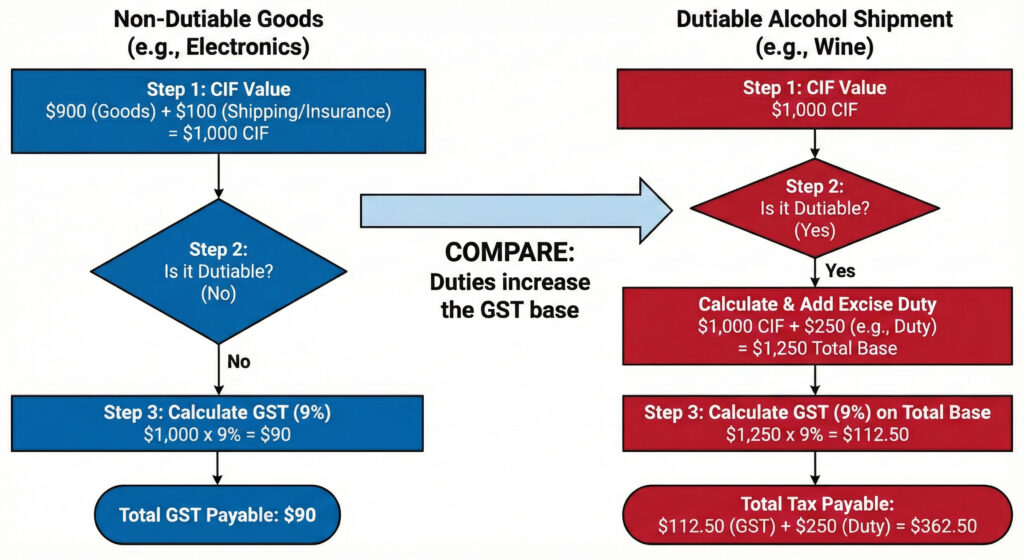
GST is a significant factor for any online merchant. It is calculated based on the CIF value (Cost of the goods + Insurance + Freight) plus any applicable duties.
For e-commerce sellers, the Overseas Vendor Registration (OVR) regime remains a critical 2026 compliance point. If you are an overseas seller or a platform facilitating the sale of low-value goods (items valued at S$400 or less) to Singapore, you may be required to register for and collect GST at the point of sale.
The Four Dutiable Categories
Most e-commerce goods (like electronics, fashion, or home decor) are non-dutiable. However, if your business deals in the following, specific rates apply:
- Intoxicating Liquors: Taxed based on alcohol strength and volume.
- Tobacco Products: Following the 2026 Tobacco Tax hike, these products have seen a 20% increase in excise duty to discourage consumption.
- Motor Vehicles: Taxed based on value (Ad Valorem).
- Petroleum Products: Taxed based on volume.
Quick Reference: Dutiable Goods Categories & Rates (2026)
| Category | Tax Basis | 2026 Rate Example |
| Intoxicating Liquors (e.g., Sparkling Wine) | Specific Rate | $88.00 per litre of alcohol |
| Tobacco Products (e.g., Cigarettes) | Specific Rate | 58.9 cents per stick (increased by 20% in Budget 2026) |
| Motor Vehicles (e.g., Passenger Cars) | Ad Valorem | 20% of the Customs Value |
| Petroleum Products (e.g., Unleaded Petrol) | Specific Rate | $7.90 per decalitre (dal) for RON 97 and above |
How to Calculate Your Import Taxes: A Practical Example
Calculating your landed cost is vital for setting your retail price. Use this formula: Total Tax Payable = [(CIF Value + Duties) x 9% GST] + Applicable Duties
Navigating the Export Landscape: Zero-Rating for Merchants
For Singaporean SMEs selling cross-border, the news is overwhelmingly positive. Exports are zero-rated. This means you do not charge GST to your international customers. However, the responsibility lies with you to prove the goods have actually left Singapore. You must maintain meticulous records, including:
- Invoices with the customer’s overseas address.
- Bills of Lading or Airway Bills.
- Export permits.
Failure to produce these documents during an IRAS audit could result in you being liable for the 9% GST out of your own pocket.
Compliance Essentials: Permits, HS Codes, and UEN
To ship like a pro, you need the right “keys” to the border:
- UEN & Customs Account: Your Unique Entity Number (UEN) must be activated with Singapore Customs before you can trade.
- HS Code Classification: Every product has a Harmonized System (HS) code. An incorrect code can lead to your shipment being flagged for “undervaluation” or “wrongful declaration,” resulting in heavy fines.
- Declaring Agents: Most SMEs use freight forwarders as declaring agents. While they handle the paperwork, the legal responsibility for the accuracy of the data remains with the merchant.
Cash-Flow Optimization: Schemes for Smart SMEs
Tax compliance doesn’t have to drain your cash flow. Consider these schemes:
- Major Exporter Scheme (MES): Designed for businesses that export a large portion of their goods, allowing you to import goods without paying GST upfront.
- Import GST Deferment Scheme (IGDS): This allows GST-registered businesses to defer the payment of import GST until their monthly return is filed, keeping capital in your bank account longer.
- Free Trade Zones (FTZs): You can store dutiable goods in FTZs without paying taxes until the goods are moved into the local market.
The Cross-Border Merchant’s Challenge: Managing Global Payments and Compliance
Tax compliance is only half the battle. For Singaporean merchants selling online, the real complexity arises in the money trail. Managing payments in different currencies often leads to a 3–5% loss in hidden conversion fees. Furthermore, reconciling fragmented payment reports from various countries with your Singapore GST tax invoices can become an administrative nightmare, leading to errors in your tax filings.
Empowering Businesses with Razorpay Singapore
This is where Razorpay Singapore becomes your competitive advantage. By acting as the financial engine for your e-commerce store, Razorpay streamlines both the payment and the reporting process.
- Seamless Integration: Use Razorpay Payment Links and Payment Pages to collect global payments in multiple currencies, ensuring your international customers have a localized experience.
- Transparent Reporting: The Razorpay dashboard provides unified data that simplifies tax reconciliation. You can see exactly what was paid, in which currency, and when. This makes GST filing a breeze.
- Scalability: Trusted by SMEs, Razorpay’s technical services offered in conjunction with our licensed payment service partners handle the heavy lifting of global payment security and processing, so you can focus on expanding your product line across borders.
Ready to scale your cross-border business? Visit razorpay.com/sg today to get started.
Conclusion
Singapore’s tax regime in 2026 remains highly favorable for merchants, but it is no longer a set and forget system. From the 9% GST rate to the specific nuances of excise duties on tobacco and liquor, success requires meticulous attention to detail. By leveraging the right regulatory knowledge and integrating advanced fintech tools like Razorpay, your SME can navigate the complexities of import/export taxes with confidence and scale globally.
Frequently Asked Questions (FAQ)
Do I have to pay GST on every import in 2026? Generally, yes. Most imports are subject to the 9% GST. However, if you are a GST-registered business, you can often claim this back as input tax. Low-value goods are also covered under the Overseas Vendor Registration (OVR) regime.
What is the difference between Customs Duty and Excise Duty? Customs Duty is specifically a tax on imported goods. Excise Duty is a tax on specific goods (like alcohol or tobacco) that applies regardless of whether they are imported or manufactured locally, often to meet social or health objectives.
Are there taxes on exporting goods from Singapore? No. Singapore does not currently levy export duties. Furthermore, exported goods are zero-rated for GST, meaning you don’t charge GST to your overseas customers.
How do I find the HS Code for my product? You can use the Singapore Trade Classification, Customs, and Statistical Nomenclature (STCCSN) search tool on the Singapore Customs website to find the correct 8-digit HS code for your items.
What happens if I declare the wrong value on an import? Incorrect declarations are a serious offense. You could face heavy fines, the seizure of your shipment, and in severe cases, criminal prosecution for tax evasion.
Can I claim back the GST I paid on imports? Yes, if your business is GST-registered with IRAS, the GST you pay at the point of import is considered input tax and can usually be claimed against the “output tax” you collect from customers.
