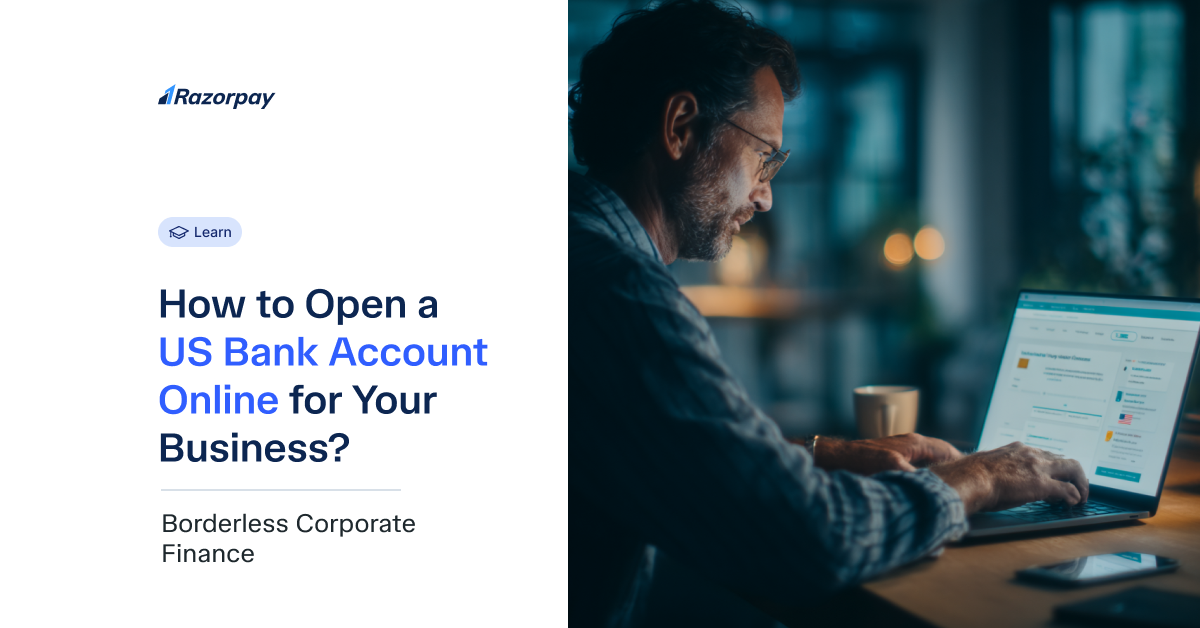
Accessing a US bank account is becoming essential for Indians who work with US clients or run export-focused businesses. It helps you hold funds in USD, reduce conversion losses, and manage cross-border finances more smoothly.
But opening a US bank account from India isn’t always simple. Traditional US banks often expect you to apply in person, which creates major hurdles for Indian residents. To bridge this gap, several digital platforms and neo-banks now offer easier alternatives, allowing you to open a US bank account remotely with fewer requirements.
Continue reading this guide to know the different ways you can open a US bank account from India and the specific requirements you must meet for each option.
Key Takeaways
- Opening a US bank account from India has become more accessible, helping professionals receive USD payments smoothly and manage cross-border finances with greater control.
- Traditional US banks remain difficult for Indian residents due to in-person verification, SSN/ITIN requirements, and strict documentation rules.
- Neo-banks and digital platforms offer a practical alternative, enabling remote account opening with simpler KYC and lower fees.
- Preparing essential documents—passport, PAN, proof of address, and W-8 forms—helps streamline the application process for both personal and business accounts.
- For those handling frequent USD payments, the Razorpay MoneySaver Export Account provides a streamlined and cost-effective alternative to traditional banking routes.
Why an Indian Resident Needs a US Bank Account?
A US bank account helps you handle money more smoothly when you study, work, or run a business with American clients. It also gives you easier access to the US financial ecosystem, which can be extremely useful when you are earning or spending in USD.
Here’s why it matters:
- It allows you to receive payments in USD directly from US clients, employers, or platforms without delays or additional intermediaries.
- It helps you avoid high forex mark-ups and repeated international transfer charges, making cross-border payments more cost-efficient.
- It gives you access to US-specific financial services and payment platforms that may not fully support Indian bank accounts.
- It simplifies routine financial tasks such as paying tuition fees, software subscriptions, or everyday expenses when you are studying, working, or travelling in the US.
- It helps you build a financial record in the US, which becomes useful later if you plan to apply for credit cards, loans, or investment products.
Traditional US Banks: Requirements and Challenges for Indians
Opening an account with a traditional US bank can be difficult if you live in India. These banks follow strict identity and address verification rules, and most expect you to visit a branch in person before approving your application.
Here’s what you should be prepared for:
- Traditional US banks generally require you to be physically present in the US to complete the onboarding process.
- Most banks ask for a Social Security Number (SSN) or an Individual Taxpayer Identification Number (ITIN), which many Indian residents do not have unless they have worked or filed taxes in the US.
- You must show valid proof of a US residential address, such as a lease agreement or a recent utility bill.
- Banks usually ask for two forms of government-issued identification, and your Indian passport will be one of them.
- Large institutions like Chase, Bank of America, and Wells Fargo strictly follow these in-person verification and documentation requirements.
Traditional US Banks vs Neo-banks for Indian Applicants
| Parameter | Traditional US Banks | Neo-banks / Digital Platforms |
| Account opening from India | Physical visit to a US branch is required | You can open an account remotely from India |
| Demand | Preferred by long-term US residents due to physical branch access. | Increasingly popular among Indian freelancers and businesses for quick onboarding. |
| Services Offered | Full-service banking: accounts, cards, loans, investments, and branch support. | Essential services: USD accounts, virtual bank details, and online payment tools. |
| Fees and Charges | Higher fees and balance requirements; costly international transfers. | Lower fees, no minimum balance, and simpler pricing. |
| Requirements | Need SSN/ITIN, US address, and physical presence. | Need only passport and basic KYC |
Neo-banks and Digital Platforms: Simplifying US Banking from India
Neo-banks are online financial platforms that partner with licensed banks to offer banking services without physical branches, allowing Indian residents to open a US bank account remotely without needing to travel or visit a branch.
Here’s how they help:
- They let you open a US bank account remotely from India, removing the need to travel or visit a branch.
- They usually do not require an SSN or ITIN, which makes onboarding simpler for freelancers and small businesses.
- They accept basic documentation such as a valid passport, Indian address proof, and your PAN card.
- They provide virtual US bank details, including an account number and routing number, which you can use to receive USD payments.
- They offer lower fees, faster setup, and a more user-friendly experience compared to traditional banks.
Note: When comparing neo-banks, always check which licensed bank they partner with and whether that bank is Federal Deposit Insurance Corporation (FDIC) insured. This helps you confirm the safety of your funds and ensures you’re choosing a platform that follows proper US banking regulations.
Explore Razorpay’s Global Payment Solutions
Essential Documents for Opening a US Bank Account from India
Before you start the application, it helps to keep all necessary documents ready. Most providers—traditional banks and digital platforms—ask for a standard set of personal and business documents.
Here’s what you’ll typically need:
- Valid Indian Passport: Serves as your primary identity document for all US banking applications.
- Proof of Indian Address: Recent utility bills, bank statements, Aadhaar, or any government-issued proof confirming your residential address.
- PAN Card: Used to verify your identity and tax residency in India during the onboarding process.
- Business Registration Documents: If you’re applying as a business, you may need your Certificate of Incorporation, GST Certificate, partnership deed, or relevant registration paperwork.
- Employer Identification Number (EIN): Mandatory only for US-registered entities operating from India or remotely.
- Form W-8BEN / W-8BEN-E: Used by non-US individuals and businesses to certify foreign status and claim treaty benefits where applicable.
- Visa or Immigration Documents: Only needed if you are opening a US bank account while moving to the US or applying for an account type that specifically asks for your visa status.
CHECKLIST
For Individuals (Personal Account)
- Valid Indian Passport
- Proof of Indian Address (utility bill, bank statement, Aadhaar, etc.)
- PAN Card
- Form W-8BEN
For Freelancers / Sole Proprietors
- Valid Indian Passport
- Proof of Indian Address
- PAN Card
- Form W-8BEN
- GST Registration, if you have one
For Businesses (Partnership, LLP, Pvt Ltd, or US LLC)
- Valid Passport of the Authorised Signatory
- Indian Address Proof
- PAN of Business and Authorised Signatory
- Certificate of Incorporation / Partnership Deed / GST Certificate
- EIN (only for US-registered Entities)
- Form W-8BEN-E
Understanding Costs and Fees for US Bank Accounts
Before choosing any US bank account, it’s important to understand the different fees involved. Each provider follows its own pricing model, and these costs can directly affect your earnings and international transfers.
- Account Setup Fees: Some platforms or service providers may charge a one-time fee to create your US bank account.
- Monthly Maintenance Fees: Many neo-banks have zero monthly charges, while traditional banks often waive fees if you maintain a minimum balance.
- Inbound and Outbound Transfer Fees: Charges for receiving or sending money through ACH, domestic wires, or international SWIFT transfers can vary widely across providers.
- Currency Conversion Rates: The exchange rate and markup applied when converting USD to INR significantly impact the final amount you receive.
- ATM Withdrawal Fees: Using your US debit card at international ATMs may attract additional charges, depending on the network and provider.
- Hidden Charges: Watch out for less obvious fees such as inactive account charges, chargeback fees, and cross-border processing costs.
| Fee Type | Traditional US Banks | Neo-banks |
| Account Opening Fee | Usually zero | Depends on provider (often zero) |
| Monthly Maintenance Fee | $5–$25 per month | Usually zero |
| International Transfer Fee (SWIFT) | Around $20 for domestic wires and $35+ for international transfers | Generally lower than traditional banks |
| ATM Withdrawal Fee | A few dollars per withdrawal | Varies by provider |
How Razorpay MoneySaver Export Account Benefits Indian Professionals
Managing international payments can be challenging when you rely solely on traditional banking routes. The Razorpay MoneySaver Export Account offers a simpler, more cost-efficient way for Indian professionals to receive global payments. Here’s how it supports smoother cross-border operations:
Easy International Payments via Local Virtual Accounts
With the Razorpay MoneySaver Export Account, you get a virtual account that accepts payments from abroad via methods like SWIFT, ACH, SEPA, BACS or Fedwire. This allows your clients to pay you through familiar local bank-transfer options in their own countries, while you receive the funds directly in India without needing a foreign bank account or any physical presence abroad.
Zero Forex Markup and Transparent Fees
Razorpay does not apply any forex (FX) markup on international transfers made through the MoneySaver Export Account. You receive funds at the live exchange rate, without hidden conversion charges. This transparency helps you understand exactly how much you will receive in INR, making it easier to manage margins, plan cash flow, and price your services or products accurately.
Lower Transfer Costs and Faster Settlements
Compared to other cross-border payment methods, Razorpay MoneySaver typically offers lower costs for international bank transfers. You avoid the high SWIFT or intermediary bank fees often associated with traditional transfers, and in many cases, you can save up to 75% compared to traditional banks. Settlements also happen faster, allowing you to access your international earnings without long delays. This is especially valuable if you work with clients who make regular payments from different countries.
One Unified Dashboard — Easier Money Management
The MoneySaver Export Account integrates with the Razorpay dashboard, giving you a single place to manage your global payments. It keeps your international transfers organised and easier to review, especially when dealing with multiple clients or currencies. This unified setup reduces manual work and helps you stay on top of your cross-border finances more efficiently.
Built-in Compliance and Auto-Generated FIRC for Exports
Razorpay also simplifies compliance by generating essential documents like the digital Foreign Inward Remittance Certificate (FIRC). Since FIRC is required for export documentation and financial reporting in India, having it available automatically reduces administrative work and lowers the risk of missing important regulatory steps.
Start simplifying your international payments today Razorpay MoneySaver Export Account
Conclusion
Opening a US bank account from India is now far more accessible than it used to be. With digital neo-banks simplifying remote onboarding, you no longer have to depend solely on traditional banks or in-person verification to manage your USD payments.
As you review the available options, focus on what fits your profile—whether you’re a freelancer, SaaS business, or export-driven company. Prioritise providers that are transparent about fees, offer reliable international payment processing, and give you a smoother way to handle your US-based finances.
FAQs
1. Can I open a US bank account from India without visiting the US?
Yes. Many neo-banks and fintech platforms allow Indian residents to open a US bank account remotely. Traditional banks, however, generally require an in-person visit for non-residents.
2. Do I need a Social Security Number (SSN) or ITIN to open a US bank account?
Traditional US banks usually ask for an SSN or ITIN. But most neo-banks let you open an account using your passport and basic identification documents, without needing an SSN or ITIN.
3. What documents are required to open a US bank account from India?
To open a US bank account from India, you generally need a valid Indian passport, proof of address, and your PAN card. Business accounts may require additional documents such as company registration papers and an EIN. Some providers may also ask for Form W-8BEN or W-8BEN-E to verify your foreign status.
4. What are the main benefits of having a US bank account for an Indian resident?
A US bank account helps you receive USD payments smoothly, reduce currency conversion losses, process transactions faster, and access US payment platforms.
5. Are neo-bank accounts in the US safe and regulated?
Most neo-banks work with FDIC-insured partner banks, which means your deposits are protected up to the standard insurance limits.
6. How long does it take to open a virtual US bank account from India?
The process is usually quick. Depending on the platform and document verification, it can take anywhere from a few hours to a couple of days.