Checkout vs Payment Gateway? Wait, aren’t they the same thing?
We speak to thousands of businesses every month. Some are just getting started with their online store. Some have been running one for years. And almost every single one of them, at some point, has used the words “checkout” and “payment gateway” to mean the same thing.
We get it. Both show up at the end of a purchase. Both feel like the payment experience. And since we offer both at Razorpay, they often come as part of the same conversation. But here is what we have seen firsthand: brands that do not know the difference between the two end up looking at the wrong data when something goes wrong. And when you are trying to fix a conversion problem, looking at the wrong data is worse than having no data at all.
So let us clear this up properly.
Table of Contents
The Quick Answer: Checkout vs. Payment Gateway
| Feature | The Checkout Page | The Payment Gateway |
| Primary Role | The Experience Layer (Collects customer and shipping data). | The Transaction Layer (Securely transfers money between banks). |
| What It Does | Captures names, addresses, and preferred payment methods. | Authenticates data, routes funds, handles OTPs, and clears the transaction. |
| Regulatory Scope | Managed by the e-commerce store or a checkout solution. | Strictly regulated by the Reserve Bank of India (RBI). |
| Impact on Business | Affects friction and how easily a customer reaches the final step. | Affects success rates and whether the money actually goes through. |
What Actually Happens When a Customer Buys From Your Store
When a customer clicks “Buy Now,” two separate backend systems trigger back-to-back. It happens so seamlessly that it feels like a single action, but it is actually a two-part relay race.
The Checkout Stage (The Hand-off)
First, the customer enters the checkout page. This is the information-gathering step. Here, they confirm their order, type in their shipping address, and choose how they want to pay. No money moves during the checkout stage. The checkout is a form, an interface enabled by a checkout solution sitting on your storefront.
The Payment Gateway Stage (The Sprint)
The moment the customer clicks “Pay Now,” the checkout page has finished its job. It hands the data over to the payment gateway. The gateway is an entirely separate system whose sole purpose is to securely route money from your customer’s bank account to yours. It communicates with networks, verifies the transaction, triggers the OTP page, and settles the funds.
Why Neither Your Store Nor Your Checkout Page Can Process Payments
This is something most first-time founders do not know, and it is important.
In India, moving money online is not something any website or checkout page can do. The Reserve Bank of India governs which entities are allowed to process, route, and settle payments. Your online store and the checkout page sitting on it are not among them, no matter how well set up either one is.
Here is where it gets specific. The checkout page feels like it is close to the transaction because it is collecting card details, UPI IDs, and payment preferences. But collecting that information and actually processing a payment are two completely different things. The checkout page is essentially a form. It gathers what the customer wants to pay with and passes it forward. It has no connection to any bank, no ability to verify funds, and no regulatory standing to move money.
Processing a payment requires direct communication with banking networks, real-time verification, and an authorization that only RBI-approved entities hold. This is exactly why businesses partner with a payment gateway like Razorpay. We hold that authorization. The moment your customer hits Pay Now, the checkout has done its job and the payment gateway takes over entirely.
This is also why the checkout and the payment gateway, despite feeling like one continuous experience to your customer, are fundamentally different in what they are, what they do, and who is responsible for them.
The Checkout Experience: Why It Matters More Than You Think
Here is something we see a lot. A brand enables checkout, payment gateway, and starts getting orders. Drop-offs begin. They immediately look at payment success rates. But the problem was never at the payment stage. Customers were leaving at the checkout page itself.
A standard checkout presents a long form. New customers have to manually type their name, address, phone number, email, and then pick a payment method. On average, this takes between one to one and a half minutes. On mobile, in the middle of a busy day, that is enough friction to lose a sale.
A smarter one-click checkout, the kind Razorpay offers, works differently. It recognises the customer, pre-fills their details, and gets them to payment in seconds. Even a first-time buyer in your store can have a returning-customer kind of experience, because a network of stored preferences works in the background. No long form. No retyping. Just confirm and pay.
The difference in conversion between these two experiences is something we see in our data regularly. And it has nothing to do with the payment gateway.
The Payment Gateway: What Happens After Pay Now
Once the checkout is done, the payment gateway takes over. This is where the actual transaction happens.
The gateway communicates with your customer’s bank, authenticates the payment, processes the OTP, deducts the amount, and credits it to your account. It supports multiple payment methods, cards, UPI, net banking, wallets, and ensures every transaction is secure and compliant with RBI guidelines.
Your customer barely sees this happening. But it is doing the heaviest lifting in the entire purchase flow. A good payment gateway means high transaction success rates, fast processing, and payment methods that match what your customers actually use.
Drop-Offs: Why Knowing the Difference Changes Everything
This is where the distinction between checkout and payment gateway goes from being theoretical to being directly useful for your business.
When a customer drops off, the instinct is often to call it a “payment problem.” But a drop-off at the checkout stage and a drop-off at the payment gateway stage are two completely different problems with two completely different fixes.
- If the drop-off is at checkout, the customer saw the form, felt the friction, and left. The fix is in the checkout experience. Fewer fields, faster load, pre-filled details, better design.
- If the drop-off is at the payment gateway, the customer got through the entire checkout, chose their payment method, and still did not complete the transaction. Maybe the OTP did not arrive. Maybe their preferred payment method was not available. Maybe the transaction failed. The fix here is in payment success rates, method availability, and gateway performance.
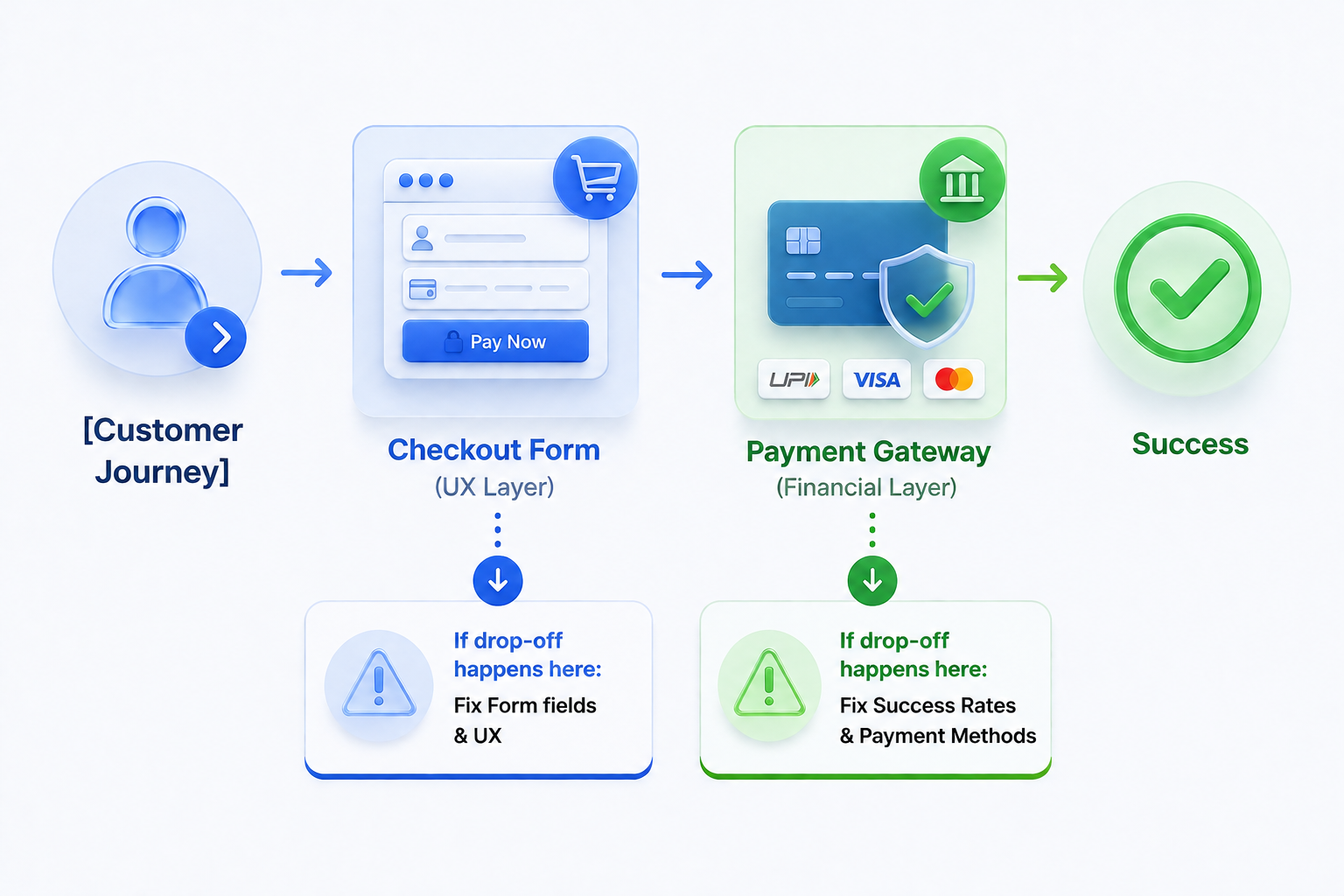
We have seen brands spend weeks redesigning their checkout form when the actual problem was OTP drop-offs at the payment stage. And we have seen the opposite too. When you call both the same thing, you are essentially trying to solve a problem you have not correctly identified yet.
The Clearest Way to Think About It
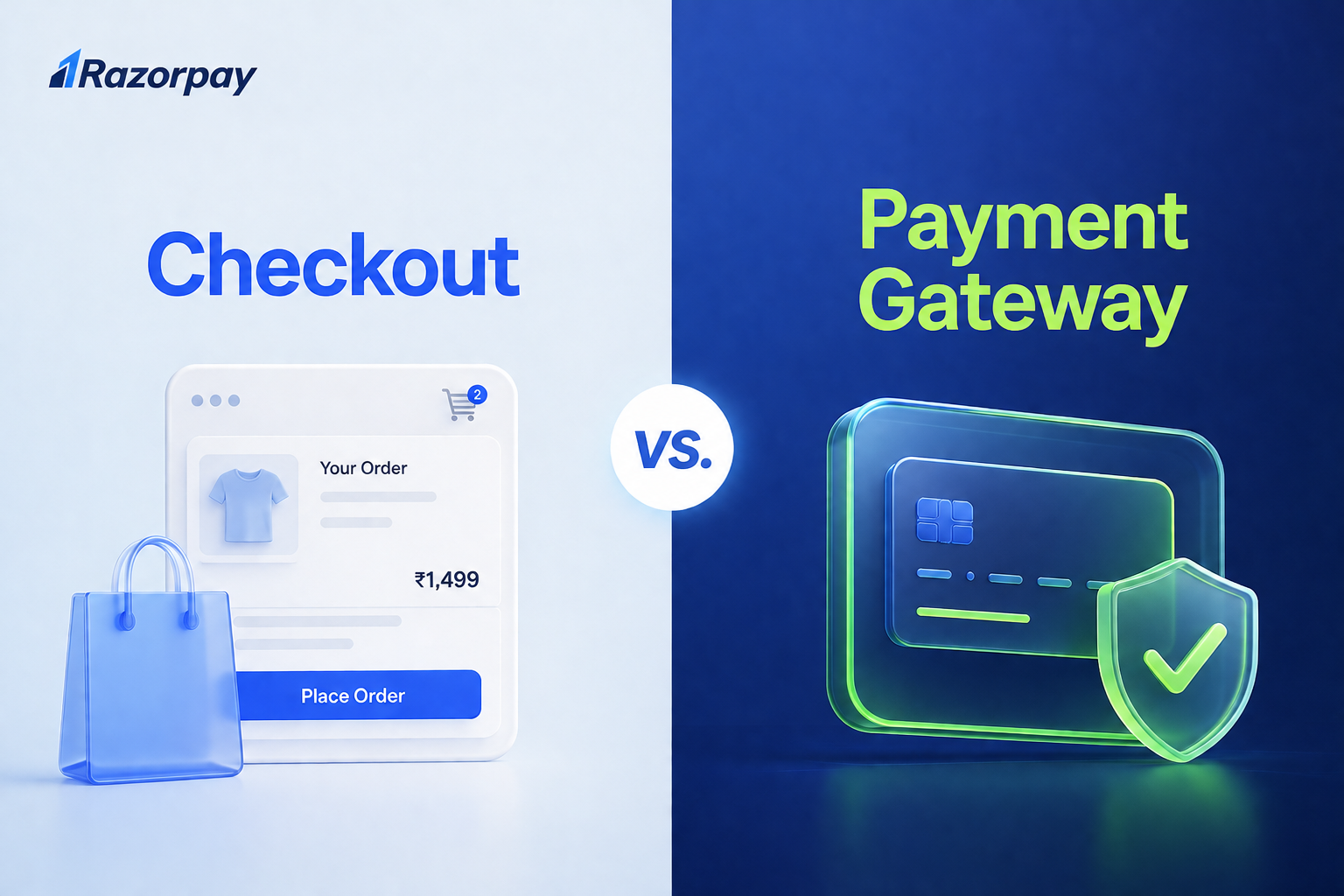
Your checkout is the experience layer. It collects your customer’s information and gets them ready to pay. Your payment gateway is the transaction layer. It actually moves the money.
One affects how smoothly a customer reaches the point of payment. The other affects whether the payment actually goes through.
Both matter. Both are different. And at Razorpay, we work on both, which is exactly why we know how costly it is to mix them up.
Want to understand what checkout really is, how it works, and what makes a great checkout experience? Read our in-depth guide here.