For the last decade, India has perfected the digital checkout. The flow is familiar: open the app, add items to the cart, enter your UPI PIN, and confirm the payment. It works at scale, and it has built one of the most reliable digital payment ecosystems in the world. But the way people interact with digital services is beginning to change.
We are entering a new phase of digital commerce, one where transactions don’t begin at checkout screens, but at moments of intent. A voice command to reorder groceries. An AI assistant booking your daily commute. A telecom app automatically renewing your data pack before you even realise it’s about to expire.
In this world, payments cannot remain a manual interruption. They must move at the speed of intent.
This is the shift underway in India today, from checkout-led commerce to conversational, agent-driven execution. And powering this transition is Razorpay’s launch of UPI Reserve Pay, built on the National Payments Corporation of India’s Single Block Multi Debit (SBMD) framework.
Reserve Pay changes how payments are structured in the background. It transforms UPI from a transaction tool into an execution layer, enabling users to authorise once, set clear financial boundaries, and allow trusted platforms or AI agents to complete multiple debits within those limits.
Enable Payments that Move at the Speed of Intent
Build seamless, pre-authorised UPI payment experiences for high-frequency commerce and AI-driven transactions using Razorpay UPI Reserve Pay.
This creates a future where discovery, decision, and payment can happen within the same continuous experience.
And once payments move at the speed of intent, everything changes.
The Hidden Friction in High-Frequency Commerce
India’s digital economy runs on frequency.
We order groceries multiple times a week, take mobility rides daily, recharge our mobile plans, top up wallets, and place quick-commerce orders late at night. Micro-transactions have become a macro force in the economy.
Yet each of these actions still carries the same ritual: authentication, context switching, PIN entry.
When you look at it transaction by transaction, it seems trivial. But when you zoom out, it becomes clear that having to authenticate every single time is one of the biggest points of friction in high-frequency commerce.
This friction has three real consequences:
- First, it breaks the flow. Even the most optimised app cannot prevent the cognitive interruption of a payment step that requires deliberate action.
- Second, it reduces conversion. Every additional step increases drop-off probability, especially in impulse-driven categories like grocery and food delivery.
- Third, it prevents automation. AI systems can recommend, remind, and optimise, but until now, they could not complete payments without human intervention.
The result? We built an economy that is digitally discoverable but still manual in many ways. Reserve Pay changes that equation.
What UPI Reserve Pay Actually Enables
At its core, UPI Reserve Pay introduces a simple but powerful shift in how consent works.
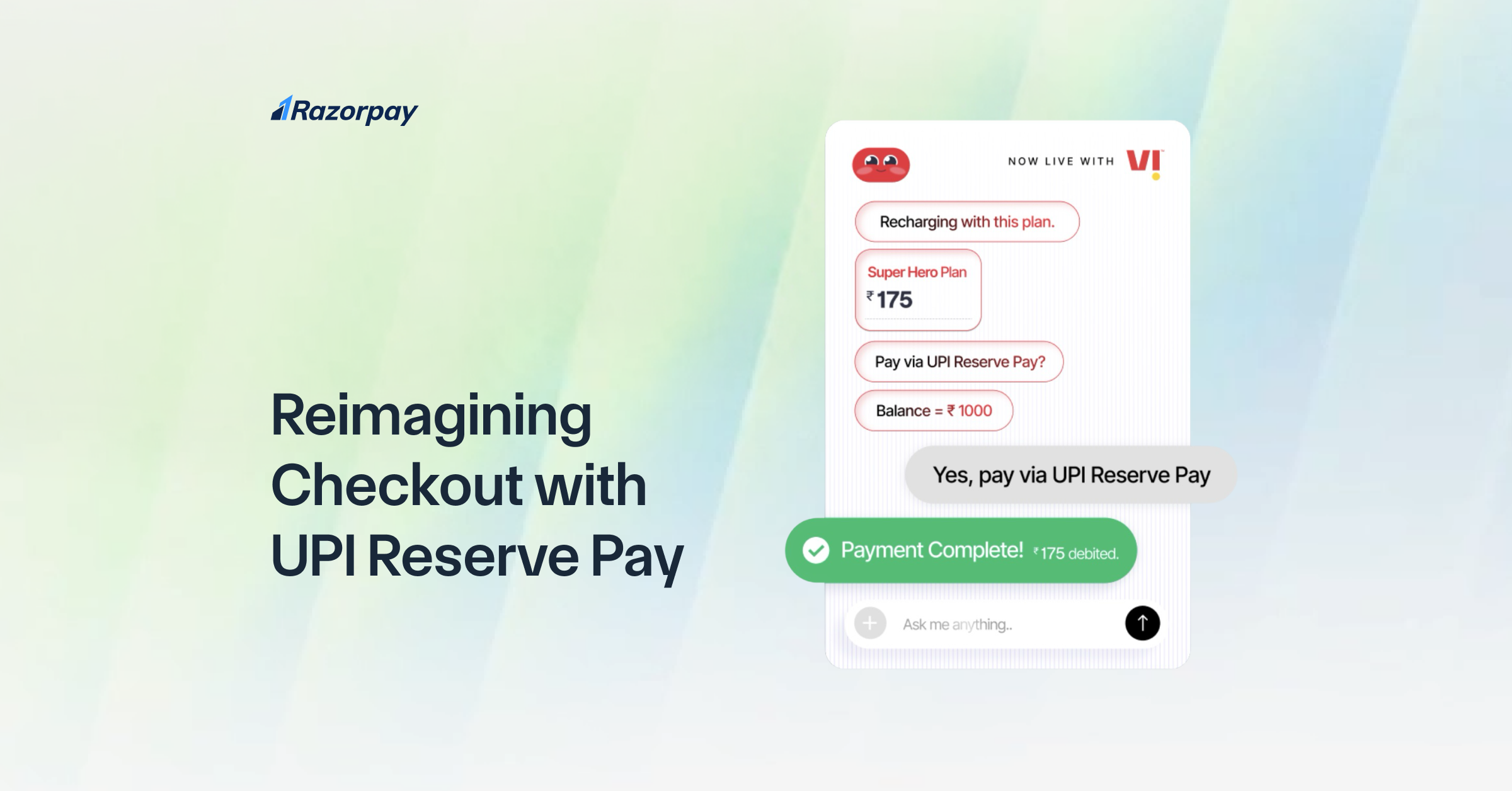
A user authorises a merchant or platform once. They define a spending limit. That amount is blocked, or reserved, in their bank account against the merchant. The funds remain visible and under their control. But within that predefined boundary, the merchant can debit multiple times without requiring fresh authentication for each transaction.
From a product architecture standpoint, this turns payments from an “event” into a “capacity.” That shift may sound subtle, but it has deep implications. It reduces friction without reducing control. It allows software to act without bypassing consent.
And for businesses operating in high-frequency categories, it meaningfully increases completion rates, repeat behaviour, and long-term retention, because the experience feels continuous rather than interrupted.
Remove Checkout Friction from Everyday Transactions
Allow customers to authorise once and transact multiple times within predefined limits using UPI Reserve Pay.
From Infrastructure to Reality: Agentic Payments in the Wild
Reserve Pay is not a theoretical infrastructure. At Razorpay, it is already powering real-world agentic experiences.
At the Global Fintech Fest and later at the India AI Impact Summit, we demonstrated in-app agentic payments across leading AI ecosystems, including ChatGPT, Gemini, and Claude.
For the first time, AI conversations did not end with redirection to an external checkout page. A user could discover, decide, and complete a transaction within the same conversational interface.
Powered by Razorpay’s Agentic Payments stack and backed by UPI Reserve Pay, users authorised once, set clear boundaries, and allowed trusted AI agents to execute purchases within those limits. No app switching. No broken funnels. No repeated payment prompts.
Just one continuous flow, from intent to confirmation.
At FTX this year, we are also piloting in-app agentic experiences across India’s most high-frequency commerce platforms, including Zepto, Zomato, and Swiggy.
Here, intent replaces navigation. A user can simply say, “Order my usual groceries,” or “Get everything I need to make gajar halwa,” and the system understands context, recalls past behaviour, curates the basket, and prepares the transaction. With UPI Reserve Pay powering the backend, the AI seeks lightweight approval within pre-authorised limits and completes the purchase seamlessly.
No searching. No cart-building. No repeated authentication.
The experience feels conversational, not transactional, a continuous flow from craving to checkout, executed within the guardrails the user has already defined.
Voice is another powerful frontier
India already conducts over a billion voice searches every month. With partners like SuperU and others across voice AI ecosystems, we are enabling voice-driven commerce where a simple spoken confirmation can trigger a Reserve Pay-backed transaction. In these flows, AI agents understand context, confirm intent, and execute securely, all within the user’s predefined financial guardrails.
Voice moves beyond search and becomes a way to complete transactions.
These pilots are early signals of something larger: payments embedded inside intelligence, not layered on top of it.
High-Frequency Industries: Where the Impact Is Immediate
The impact of Reserve Pay becomes most visible in industries defined by high-frequency transactions.
In grocery and quick commerce, average users transact multiple times per week. Even a marginal reduction in checkout friction translates into measurable uplift in completion rates and repeat orders.
In mobility, daily riders often authenticate payments several times per day. Reserve Pay enables a pre-approved fare buffer, allowing rides to conclude seamlessly while maintaining user control.
In e-commerce, repeat buyers can pre-authorise spending pools for fast reorders, transforming purchase behaviour from deliberate to instinctive.
In telecom and utilities, prepaid recharges and dynamic billing become autonomous, reducing service interruptions and increasing lifecycle value.
Across these categories, the benefit is not just speed, but how naturally people start transacting more often. When payment feels invisible, yet secure, transaction frequency increases.
Security by Structure, Not Repetition
A common misconception is that fewer authentication prompts mean weaker security. In reality, Reserve Pay strengthens security by consolidating consent.
Instead of dozens of micro-authentications, often rushed through, there is one explicit, high-confidence authorisation event. The user defines the amount, the merchant scope, and the time horizon. Users retain full visibility of this mandate via their UPI Apps, and can revoke access at any time.
Security becomes structural rather than repetitive. This is a new way for payments automation to scale responsibly.
The Next Decade of Indian Commerce
India is uniquely positioned to lead the shift from e-commerce to agentic commerce.
We have the world’s most advanced real-time payment infrastructure alongside high-frequency digital behaviour across categories. And we are one of the fastest-growing AI-native markets globally.
When you combine UPI’s trust layer with Reserve Pay’s consent architecture and AI’s contextual intelligence, you unlock something fundamentally new: commerce that is conversational, autonomous, and still user-controlled.
And once that happens, commerce doesn’t just get faster. It becomes agentic.
Start Building the Future of Agentic Commerce
Join the early access program to enable seamless, pre-authorised UPI payments for your platform with Razorpay UPI Reserve Pay.