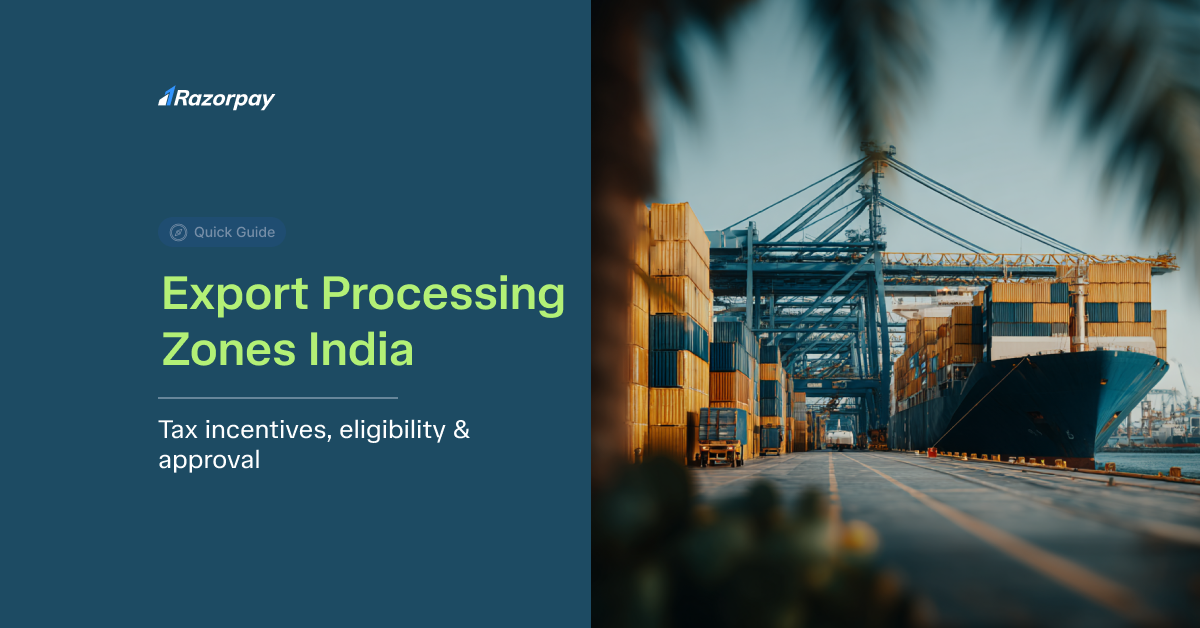
An Export Processing Zone (EPZ) is a designated area where Indian exporters operate under simplified trade rules and targeted tax incentives. The objective is straightforward: reduce the cost and complexity of exporting. By lowering input costs, easing customs procedures, and shortening export timelines, EPZs help Indian businesses compete more effectively in global markets while keeping compliance clear and predictable.
Over time, EPZs became a key tool in India’s effort to increase foreign exchange earnings and generate employment by bringing export-focused businesses together within shared infrastructure. As trade volumes grew and policy priorities shifted, this model evolved into the Special Economic Zone (SEZ) framework—a broader system built on the same core principle of making exports from India faster, cheaper, and more reliable.
Key takeaways
- EPZs, now part of the SEZ framework, help Indian exporters improve competitiveness through policy incentives, infrastructure support, and simplified procedures.
- Eligibility and ongoing benefits depend on meeting net foreign exchange commitments and following export-linked operating conditions.
- Location choice and long-term export planning are critical, as zone rules and compliance obligations apply for the entire approval period.
What Is an Export Processing Zone (EPZ)?
An EPZ is a clearly demarcated industrial area created to make exports from India easier and more competitive. Within an EPZ, businesses operate under a more liberal economic regime than the domestic tariff area, especially for customs and foreign trade rules.
Key characteristics of an EPZ include:
- It functions as a separate customs territory, where imports and exports follow distinct duty and procedural norms.
- The core aim is to attract foreign direct investment (FDI) and encourage export-oriented manufacturing and services.
- For trade operations, an EPZ is treated as a “deemed foreign territory”, even though it is physically located within India.
Did You Know?
India set up its first EPZ in Kandla in 1965, marking a shift towards export-led growth.
How Does an EPZ Differ from a Special Economic Zone (SEZ)?
India gradually moved from the EPZ model to the SEZ framework to support a wider range of export-led businesses. Most operational EPZs were formally converted into SEZs after the SEZ Act, 2005 came into force, which gave exporters a clearer legal base and long-term policy certainty.
While EPZs focused mainly on manufacturing for exports, SEZs expanded the scope to include services and trading activities. The scale also changed—SEZs typically require larger land area and support integrated infrastructure, unlike the more limited industrial setups of EPZs. Most importantly, SEZs operate under a standalone law, replacing the policy-driven structure that governed EPZs.
EPZ vs. SEZ
| Feature | Export Processing Zone | Special Economic Zone |
| Scope | Mainly manufacturing exports | Manufacturing, services, trading |
| Infrastructure | Basic industrial infrastructure | Large land area, integrated townships |
| Legal framework | Governed by foreign trade policy | Governed by the SEZ Act, 2005 |
| Customs status | Deemed foreign territory | Deemed foreign territory with clearer rules |
What Is the Scope of Activities in EPZs vs SEZs?
- EPZs allowed only manufacturing and processing of goods meant strictly for exports.
- SEZs permit a wider range of activities, including IT and IT-enabled services, warehousing, trading, and Free Trade Warehousing Zones (FTWZs).
How Do Tax Incentives Compare?
- EPZs earlier offered tax holidays through policy-driven exemptions, which varied over time.
- SEZ units became eligible for income tax benefits under Section 10AA, including phased profit-linked deductions, even for units converted from EPZs.
- Sunset clauses now limit tax benefits for new SEZ units, making timing and structure critical for exporters planning entry today.
How Many Export Processing Zones Are There in India?
India originally set up seven Central Government–controlled EPZs to promote export-led manufacturing. Additionally, Surat emerged as a pioneering private-sector zone. Over time, all of them transitioned into SEZs under the SEZ Act, 2005. Legally, they now operate as SEZs, but many exporters and online searches still refer to them as EPZs due to their legacy role and identity.
These zones are spread across key coastal and inland trade corridors, making it easier for you to identify the closest hub based on your sector and logistics needs.
Kandla Export Processing Zone (KAEPZ)
- Kandla EPZ was India’s first export processing zone and the earliest of its kind in Asia, established in 1965.
- It is located in Gujarat, close to the Kandla port, which gives exporters direct access to maritime trade routes.
- The zone has traditionally supported industries such as chemicals, engineering goods, and textiles.
Explore Razorpay’s Global Payment Solutions
Santacruz Electronics Export Processing Zone (SEEPZ)
- SEEPZ was established in 1973 and is located in Mumbai, India’s financial and commercial hub.
- It developed a strong specialisation in electronics manufacturing and the gems and jewellery sector.
- Over the years, SEEPZ has emerged as one of the highest export-contributing zones in the country.
Noida Export Processing Zone (NEPZ)
- Noida EPZ benefits from its strategic location near New Delhi, offering proximity to policymakers and major markets.
- The zone supports software exporters, gem and jewellery units, and ready-made garment manufacturers.
- Its connectivity to inland container depots helps exporters move goods efficiently without relying solely on seaports.
Madras Export Processing Zone (MEPZ)
- Madras EPZ is located in Chennai, one of India’s most established industrial centres.
- It caters to sectors such as auto components, garments, and electronics manufacturing.
- Exporters benefit from seamless access to both Chennai Port and the international airport.
Cochin Export Processing Zone (CEPZ)
- Cochin EPZ operates from Cochin in Kerala, close to key shipping routes along the western coast.
- The zone focuses on food processing, electronics, and software-driven exports.
- Its proximity to Cochin Port offers logistical advantages for time-sensitive shipments.
Falta Export Processing Zone (FEPZ)
- Falta EPZ is located in West Bengal and serves exporters across eastern India.
- It supports industries such as tea processing, engineering goods, and petrochemicals.
- The zone plays a regional role by reducing dependence on western and southern export hubs.
Visakhapatnam Export Processing Zone (VEPZ)
- Visakhapatnam EPZ is situated in Visakhapatnam on the eastern coastline.
- It has developed strength in marine products, pharmaceuticals, and bulk drug exports.
- The presence of a deep-water port allows exporters to handle large cargo vessels efficiently.
Surat Export Processing Zone
- Surat EPZ emerged as a specialised centre for diamonds and jewellery exports.
- It later transitioned into the SEZ framework while retaining its export-focused identity.
- The zone continues to draw strength from Surat’s globally recognised diamond cutting and polishing industry.
What are the benefits of setting up in an EPZ?
Customs and GST Benefits
- EPZ units can import raw materials, capital goods, and consumables without paying customs duty.
- Supplies from the Domestic Tariff Area to an EPZ are treated as exports and are zero-rated under GST.
- Earlier exemptions from Central Sales Tax and Service Tax now flow through the GST framework, keeping indirect tax costs neutral.
Foreign Direct Investment Privileges
- Manufacturing units can receive up to 100% foreign direct investment through the automatic route.
- Investors can repatriate profits and dividends with fewer procedural hurdles.
- Compliance requirements remain simpler compared to non-zone manufacturing setups.
Infrastructure and Single-window Clearance
- EPZs offer a single-window system for approvals, licences, and operational clearances.
- Exporters gain access to ready infrastructure such as factory sheds, reliable power, and water supply.
- On-site customs offices help clear consignments faster and reduce logistics delays.
Who Is Eligible to Apply for an EPZ Unit?
- You can apply for an EPZ unit if your business commits to earning net foreign exchange (NFE) over the prescribed period. In simple terms, your exports must exceed your imports and foreign currency outflows.
- Both manufacturing and service exporters are eligible, provided the proposed activity is export-oriented and compliant with foreign trade policy.
- The government allows multiple business structures to apply, including Public Limited companies, Private Limited companies, Partnership firms, and Proprietorships.
- You must demonstrate financial viability, technical capability, and a clear export plan at the time of application.
- Certain sectors face additional scrutiny. Activities related to arms, ammunition, defence equipment, or hazardous items usually require special approvals from relevant ministries.
- Units engaged in prohibited or restricted items under India’s export policy cannot operate from an EPZ without explicit clearance.
How to Manage Payments and Financial Compliance in EPZs?
Operating from an EPZ—or its current equivalent, an SEZ—means you must follow clearly defined rules on how foreign currency is received, recorded, and reported. Banks and regulators monitor export proceeds closely to ensure they are realised on time and reported accurately, as this directly affects your eligibility for tax benefits.
Choosing a compliant payment channel is therefore not optional, because it determines whether you can close export documents smoothly and claim GST refunds without delays. At the center of this process is the Foreign Inward Remittance Certificate (FIRC), which acts as official confirmation that your export earnings have entered India through authorised banking routes.
Exchange Earners’ Foreign Currency (EEFC) Accounts
- An EEFC account allows you to retain a portion of your export earnings in foreign currency without converting them into INR immediately.
- Exporters use EEFC accounts to reduce exchange rate risk, especially when they have regular foreign currency inflows and outflows.
- RBI permits retention up to prescribed limits, subject to periodic review and usage rules.
- These accounts are useful for paying import suppliers, overseas vendors, or software subscriptions without incurring conversion costs each time.
Traditional Bank Transfers (SWIFT)
- SWIFT transfers remain the standard method for receiving export payments through international wire transfers.
- Pros: They are universally accepted and supported by all authorised dealer banks.
- Cons: They often involve high bank charges, intermediary fees, and slower settlement timelines.
- Manual reconciliation and delayed FIRC issuance can add to compliance workload, especially for high-volume exporters.
Razorpay International Payments
- Razorpay International Payments lets you accept export payments in 135+ currencies through a single platform.
- The system offers automated FIRC generation, which simplifies compliance for EPZ and SEZ units.
- Faster settlement cycles and seamless integration with existing ERP or accounting systems reduce operational friction.
- Built-in fraud detection tools are designed specifically for cross-border transactions, helping you manage risk as volumes scale.
What Are the Challenges of Operating in an EPZ?
Location and Connectivity Issues
- Some EPZs are located away from city centres, which can make it harder to attract skilled labour or increase employee commute time.
- Older zones may face connectivity constraints, such as longer transit times to ports or limited access to international airports.
Market Dependency Risks
- EPZ units rely heavily on global demand, making revenues sensitive to international slowdowns and currency volatility.
- Sales into the Domestic Tariff Area are permitted only under specific conditions and attract applicable customs duties (equivalent to import duties under Section 30 of the SEZ Act, 2005) plus GST, reducing price flexibility.
Administrative Bottlenecks
- Despite the single-window clearance framework, procedural delays can still arise at the approval or renewal stage.
- Units must meet strict reporting and monitoring requirements to maintain positive NFE status, increasing compliance effort.
Simplify International Payments with Razorpay
Accept 135+ currencies, get faster settlements, automated FIRCs, and fraud protection—all in one export-ready platform.
Conclusion
Export Processing Zones, now operating under the SEZ framework, continue to offer strong strategic value for Indian exporters across goods and services. They reduce friction in cross-border trade by combining tax incentives, shared infrastructure, and simplified procedures that support faster scale-up. For you, the real advantage lies in aligning these benefits with your export model—choosing the right location, understanding net foreign exchange obligations, and planning compliance upfront. Equally important is how you manage international payments. Using modern, compliant financial tools can simplify currency inflows, documentation, and refunds, helping you focus less on paperwork and more on growing your export business sustainably.
FAQs
Q1. How do EPZ activities differ from SEZ activities?
EPZs were mainly limited to manufacturing and processing activities, while SEZs allow a wider range of operations, including services, trading, and warehousing.
Q2. How many Export Processing Zones are currently active in India?
India originally set up seven central EPZs—Kandla, SEEPZ, Noida, MEPZ, Cochin, Falta, and Visakhapatnam—all of which now operate as SEZs.
Q3. Are EPZ units allowed to sell goods in the Indian domestic market?
Yes. Sales to the Domestic Tariff Area are permitted but are treated as imports and attract applicable customs duties and taxes.
Q4. Do EPZ units still get income tax holidays?
Most new units do not qualify for the Section 10AA income tax holiday after April 1, 2020, but indirect tax benefits such as duty-free imports continue.
Q5. What is the Net Foreign Exchange (NFE) requirement?
You must ensure that your total foreign exchange earnings exceed your total foreign exchange outflows over a cumulative five-year period.
Q6. Is an RCMC mandatory for EPZ units?
Yes. A valid Registration-cum-Membership Certificate from the relevant export promotion council is required to claim policy benefits.
Q7. How can exporters manage FIRC compliance for international payments?
Exporters must receive foreign payments through authorised banking channels and ensure the correct purpose code is applied so an FIRC is issued for each transaction. Using compliant payment gateways that automate FIRC generation reduces manual follow-ups and compliance delays.