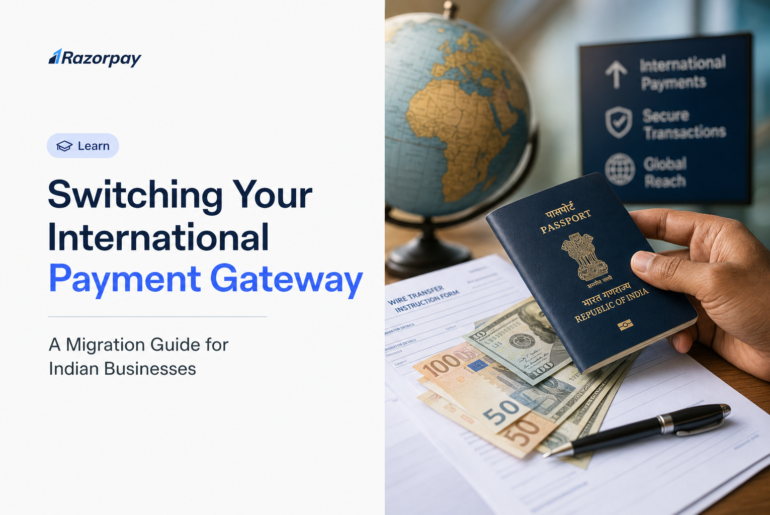
If you’re running a SaaS startup, managing a creative agency, or selling products online, one of your biggest challenges is getting paid smoothly by international clients. Figuring out how to receive international payments in India can feel confusing — with multiple options, hidden fees, and compliance rules that aren’t always clear.
This guide provides a clear explanation of the best ways to receive money from abroad in India and stay fully compliant.
Key Takeaways
You can receive international payments through wire transfers, remittance apps, wallets, payment gateways, and demand drafts.
Always use authorised channels and the correct purpose code for compliance.
Watch out for hidden forex markups that reduce your payout.
Using partners like Razorpay ensures automated compliance, faster settlements, and transparent conversion rates.
5 Popular Methods for Receiving Money from Abroad in India
1. Direct Bank or Wire Transfer
Wire transfers move money directly from a foreign bank account to your Indian bank via SWIFT. Ideal for high-value B2B transfers with strong traceability.
2. Online Money Transfer Services
These allow clients to send money quickly with lower fees and better forex rates. Great for freelancers and small agencies.
3. Digital Wallets
Digital wallets let you receive and hold foreign currency before transferring it to your Indian bank. Useful for creators and freelancers.
4. Demand Drafts (DDs)
A paper-based method where an overseas bank issues a foreign currency draft payable in India. Slow but still valid for formal transactions.
5. International Payment Gateways
Gateways like Razorpay allow SaaS startups and online sellers to accept international payments in India via cards, UPI, and net banking with faster settlements.
Comparison Table: Best Methods to Receive Money from Abroad
| Method | Best For | Typical Speed | Average Cost | Key Limitation |
|---|---|---|---|---|
| Wire Transfer | B2B exporters, SaaS companies | 1–5 business days | ₹500–2,000 + forex fees | High fees for small transfers |
| Online Transfer Services | Freelancers, small agencies | Minutes to several days | Varies; includes forex markup | Transfer limits vary by platform |
| Digital Wallets | Freelancers, creators | Instant to 2 days | 0–5% of the amount | Limited control over forex rates |
| Demand Drafts | Traditional exporters | 7–28 business days | 0.30% + forex margin | Slow and outdated |
| International Payment Gateways | SaaS startups, online sellers | 0–2 business days | Up to 3.5% per transaction (Razorpay) | Requires setup & documentation |
The Legal and Regulatory Framework
RBI Guidelines on Foreign Inward Remittances
The RBI regulates all foreign remittances under FEMA. Payments must route through Authorised Dealer (AD) Category-I banks.
- Purpose codes are mandatory for every inward remittance.
- Use only approved channels like banks and regulated gateways.
- Exporters must realise payments within 9 months of export.
KYC and Documentation Requirements
To accept international payments, you must follow KYC rules set by your bank and RBI.
- PAN and GST certificate (if applicable)
- Import-Export Code (IEC)
- Bank account with an AD Category-I bank
- Invoices and agreements supporting export of goods/services
Tax Implications and Reporting
- Income Tax: All export and service payments are taxable.
- GST: Exports can be done under LUT without charging GST.
- Foreign Tax Credit: Claimable under DTAA rules.
Decoding the Cost and What You Actually Pay
Upfront Transfer Fees
These include charges from banks or platforms. Wire transfers often cost ₹500–2,000. Platforms like Razorpay charge 1%–3.5% depending on currency.
The Hidden Costs – Exchange Rate Markups
Banks often convert using rates 1–3.5% below the mid-market rate. This reduces your final payout significantly.
Getting Paid by Global Clients: Why It’s Not So Simple
- Delays in fund settlement due to multiple intermediaries.
- High transaction fees cutting 3–7% of your invoice value.
- Currency conversion losses from hidden markups.
- Compliance complexities involving purpose codes and documents.
- Fraud and chargebacks that may be irreversible.
How Razorpay Helps You Receive International Payments
Razorpay eliminates delays, compliance hassles, and hidden forex losses with a powerful infrastructure built for Indian exporters.
- Seamless onboarding without visiting a bank branch.
- Automated compliance including purpose codes.
- Higher success rates with intelligent routing.
- Supports all export categories recognised in India.
- Zero forex markup with real-time market-linked rates.
- Accept payments in 100+ currencies with INR settlement.
Tips to Optimise Your International Payments
- Choose RBI-regulated payment partners.
- Clarify transfer fees in advance.
- Monitor exchange rates closely.
- Use clear invoices and purpose codes.
- Automate payment tracking and reconciliation.
Ready to streamline your payments?
FAQs
Is it legal to receive foreign payments directly into Indian bank accounts?
Yes. It is fully legal as long as the money comes through RBI-approved channels.
What documents are required to receive money from abroad?
You need an invoice, purpose code, and FIRC from your bank. Exporters may also need IEC and export documents.
How can I avoid currency conversion losses?
Use regulated platforms offering mid-market rates and transparent fees, or hold foreign currency until rates are favourable.
Can I receive international payments via UPI?
No. International transfers do not directly support UPI currently.
How long does a SWIFT transfer take?
Typically 1–5 business days depending on intermediaries and compliance checks.
How much money can be received without paying tax?
Income for services or exports is taxable. Gifts under ₹50,000 may be exempt if they meet eligibility criteria.